Port Moresby
pp. 23-142 · Read in the full issue
'Chinatown' Comes To Port Moresby
From a Correspondent
Papua, one of the few South Pacific territories without a ring centre that can be loosely, if colourfully, referred to as latown”, is about to have one.
beginnings of a Chinese busi ess section has started in Port by’s Koki area, and the suburb roko, too, is about to be in- Port Moresby town area, business sites are at a pre has not yet seen a Chinese ssman but it is not expected tsition will remain that way for e before the war, Port Moresby id only one Chinese shop—Luk Vai’s tailor shop at Koki. At popular Luk calls it a tailoring and he is a tailor, but he also Jongkong nicknacks, transistor suitcases, and all the huge ' of Eastern ware so familiar uth Pacific travellers every from Dutch New Guinea to has no window displays. What > to sell is hidden behind the /alls of the building which also as his home, and his custo lave to seek him out. ay, Luk can stand at the front and point to a new Chinese ;oing up across the street, and i to you that another one is up just around the corner. right alongside his shop he how you the vacant blocks he explains will be leased soon iree more Chinese stores. A r native cafe has been bought by lese woman, who is running it,
and who is putting her son up in a new store opposite the cafe, Trade stores are being taken over, and more stores selling the usual Hongkong goods are planned.
At the beginning of this year Luk Poy Wai was virtually in Port Moresby on his own. Today he will tell you there are nine Chinese families in business in Port Moresby
(Continued on p. 140)
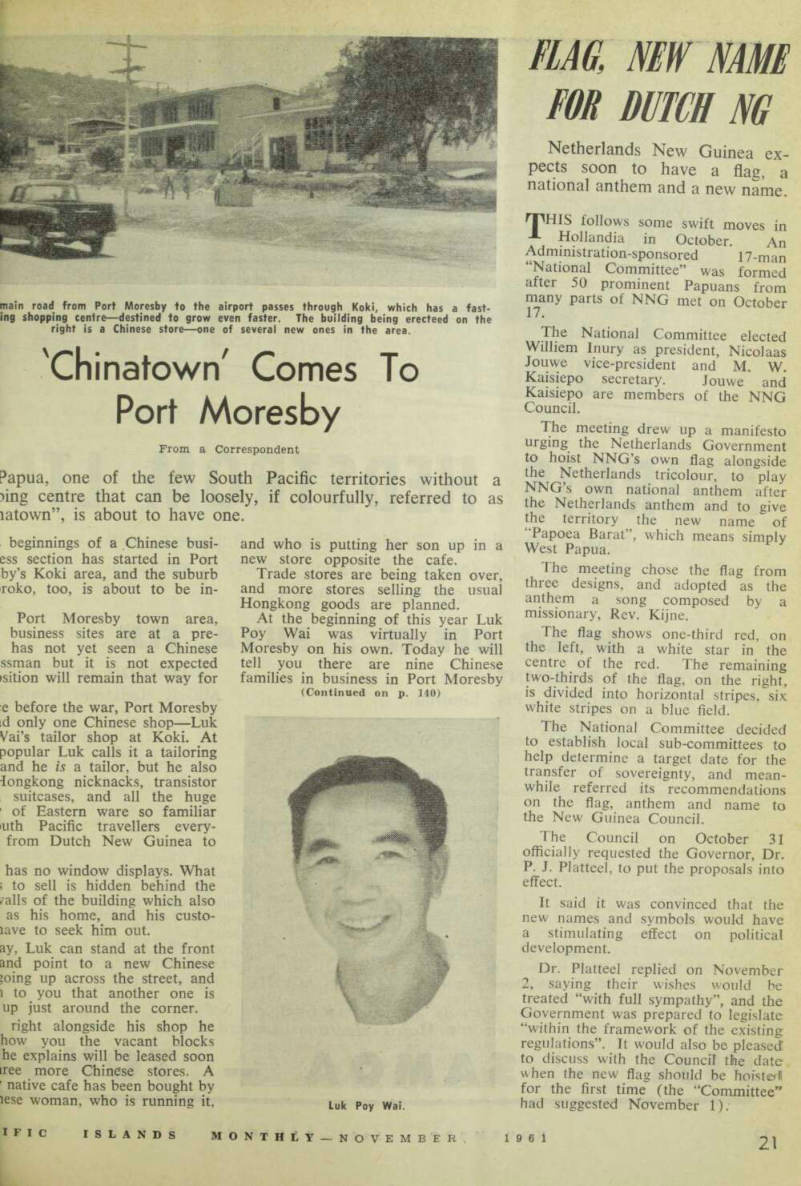
main road from Port Moresby to the airport passes through Koki, which has a fas-ting shopping centre—destined to grow even faster. The building being erecteed on the right is a Chinese store—one of several new ones in the area.
Luk Poy Wai.
and more on the way.
The explanation for the sudden influx has nothing to do with a sud den realisation by the Chinese busi ness world that Port Moresby has possibilities, Papua is distinct from New Guinea in that it is an Austra lian territory, not an Australian-ad ministered trust territory.
Immigration laws have kept Chinese business people on the other side of the border. This has been changed in the last 18 months follow ing the Australian Government’s de cision to allow certain Chinese New Guinea residents to become natura
lised Australian citizens.
Following granting of citizenship they naturally have the right to move anywhere they want within Austra lia or her territories. The Chinese who are now taking an interest in Port Moresby have come mostly from Lae and Rabaul, and include names like Chow, Lee and Seeto.
Luk Poy Wai thinks that Koki will be the main Chinese business area, although it is possible Boroko might take the honours. Rows of Chinese shops will certainly give Koki, which is predominantly a native area, some added colour and make it real tourist bait.
Luk is not concerned about the forthcoming competition. He says he’s had a “fair go” since he first arrived in Port Moresby from Hongkong in
1934 on a tailoring contract will local firm. Two others had ant a month before.
They had five-year permits to main in Papua, but by the time tr were up, China was at war, Australia looked like being in it One way or another nobody sees anxious for them to go so Luk stss in business on his own in 1939.
During the Pacific war he stjj in NG with the 10th Australian vanced Depot.
These days he owns, besides? store, a station-wagon and a model Chev, and has eight childre two of whom are being educate* Australia. The eldest works withe Administration.
And Luk is a happy man.