Offer Nothing New
pp. 21-22 · Read in the full issue
New Guinea Target Dates Offer Nothing New
From our Canberra Correspondent
The UN Trusteeship Council can hardly be expected to tp praise on the five-year plan for social, educational and momic advancement in Papua - New Guinea which the nister for Territories, Mr. Hasluck, introduced on the last 9 of the Twenty-third Parliament.
plan contains no change in >licy. It frankly reiterates that )licy is, “by steady degrees and the limits of our financial and istrative capacity, to promote Ivancement of the people so Itimately they will choose for :lves their own constitution heir future relationship with figures in the five-year targets ine the phrase “by steady de plan is the one Mr. Hasluck idowed in July, e of the objectives is any way Tibitious, so the plan seems to run up against objections those UN critics who claim he Australian policy of uni development is too slow for n needs. 5e are the five-year objectives lich Australia will strive “with ; vigour and resources at our md”. *LIC SERVICE: At least expatriates and 2,500 natives be recruited, making a total Service of 10,000, of whom a '12.5 per cent, at present) will ives.
The question of including native “Administration servants”—teachers, clerical assistants, field workers, health assistants, drivers, postal workers, firemen and tradesmen—in the Public Service is being con sidered.
The 10,000 of these who would be affected would lift the proportion of native public servants to two-thirds, A central administrative training college is to be established by 1963 and by 1967 this and existing train ing institutions should have at least 3,500 enrolled.
EDUCATION: Secondary schools, technical schools and professional training to be developed during the five-year plan, with special attention to teacher training, By the end of the five-year plan, enrolments at post-primary and secondary schools are expected to total 10,000; technical schools, 2,000; and teacher training schools 2,000.
School enrolments are expected to rise from 150,000 to 350,000 and, by the end of 1975, all the estimated 750,000 children of school age will be within reach of schools.
HEALTH: Rebuilding of older hospitals is to continue; construction
of 70 new small hospitals is planned; and the number of medical aid posts is to be increased, by 340 to 2,000.
The number of infant and mater nal welfare centres is to be raised from 150 to 200.
It is planned to raise the number of doctors from 100 to 180; assistant medical practitioners from 11 to 44; European nurses from 220 to 280; native nurses from 30 to 550; and European medical assistants from 170 to 200.
The groundwork in the five years is intended to lead towards a major build-up in the succeeding five years.
This effort will give one doctor, or assistant medical practitioner, for every 10,000 of population, or one trained member of the medical staff for every 1,750 of population.
By 1967 the Government hopes to increase the number of pre-school children attending child-health clinics, and the number of native women re ceiving ante-natal care, from 20 per cent, to 60 per cent, of the popula tion.
NATIVE AFFAIRS: There is yet another set of target dates for bring ing the Territory under control.
Similar ones have been set before.
The whole of the Territory is to be brought “under influence” by the end
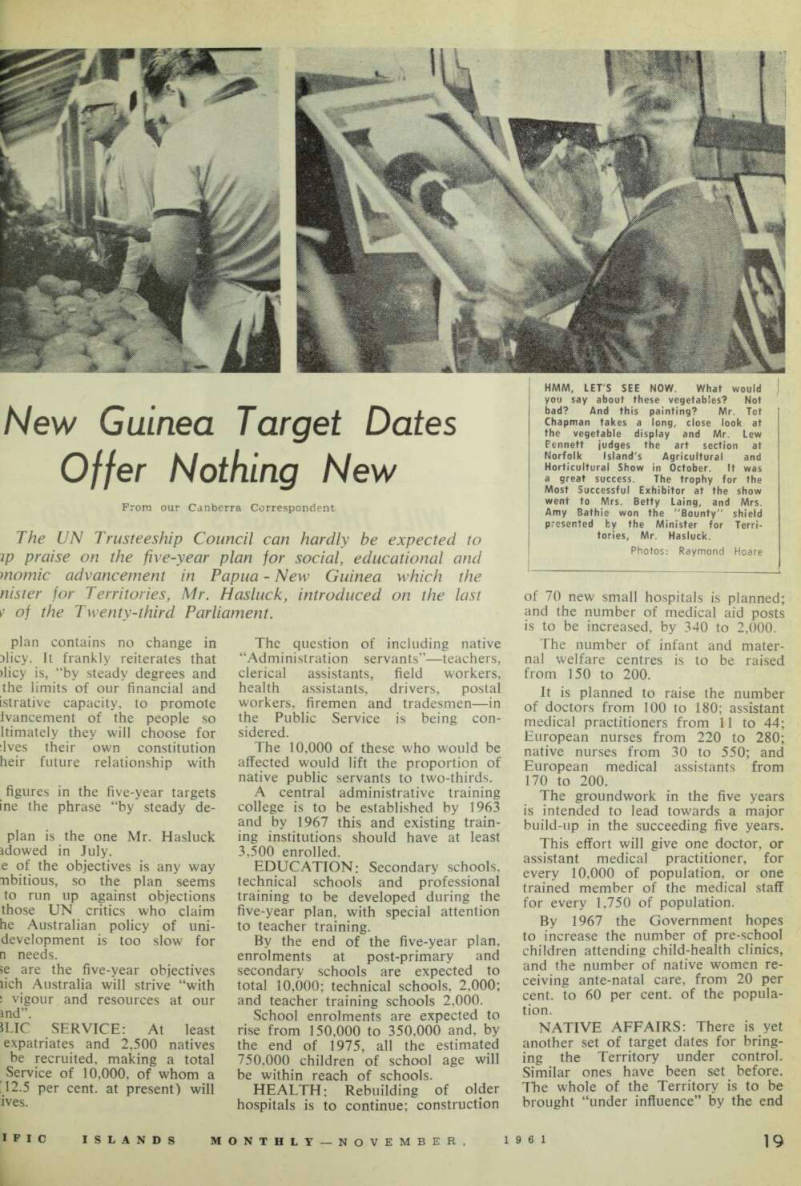
HMM, LET'S SEE NOW. What would you say about these vegetables? Not bad? And this painting? Mr. Tot Chapman takes a long, close look at the vegetable display and Mr. Lew Pennett judges the art section at Norfolk Island's Agricultural and Horticultural Show in October. It was a great success. The trophy for the Most Successful Exhibitor at the show went to Mrs. Betty Laing, and Mrs.
Amy Bathie won the “Bounty" shield presented by the Minister for Terri tories, Mr. Hasluck.
Photos: Raymond Hoare
of 1963 and “under control” by the end of 1966.
Native Local Government Councils are to be extended to serve 800,000 people, instead of 380,000 as at pre sent,
Economic Advancement:
Production of both cocoa and coffee is expected to double by 1963.
Rubber output will rise by 50 per cent, by 1966, sawn timber by 50 per cent, by 1965.
Plywood output is expected to re main stable, and copra is likely to show an increase of only about six per cent.
Over the next five years 7,500 new blocks for native settlement are to be provided.
Cattle numbers will be increased to 50,000, and 2,500 cattle will be dis tributed to native cattle projects.
The number of agricultural col leges will be increased from one to four, agricultural extension stations from 11 to 15, and agricultural ex tension centres from 45 to 110.
A Rabaul correspondent in October said that reaction of business people there to the five-year plan was that it would bring trouble if it forced social and economic development ahead of the Territory’s economic ability to absorb the change.
They want a parallel programme of investment and economic ex pansion to accompany the plan.
Mr. J. L. Chipper, chairman of the Rabaul Chamber of Commerce and an elected member for New Britain in the Legislative Council, said the new development plan was “good in itself, but not by itself’.
Australia, he said, was already providing £l7 million a year as an outright grant to Papua-New Guinea.
This was well spent if properly applied, but it could commit Aus tralia to untold new expenditure if it were used on impractical develop ment schemes. (See comment, next column ) Speaking to a meeting of econo mists in Sydney in October, the Territories Minister, Mr. Hasluck, said it might be necessary in the future to attract substantial amounts of private investment in the Territory and that some sort of assurance of security of capital, and repatriation of it, after independence might be necessary.
He said the Government’s present policy was to keep taxation low enough to encourage development.
He added that Australia would have to continue to underwrite the bills in P-NG long after independence.
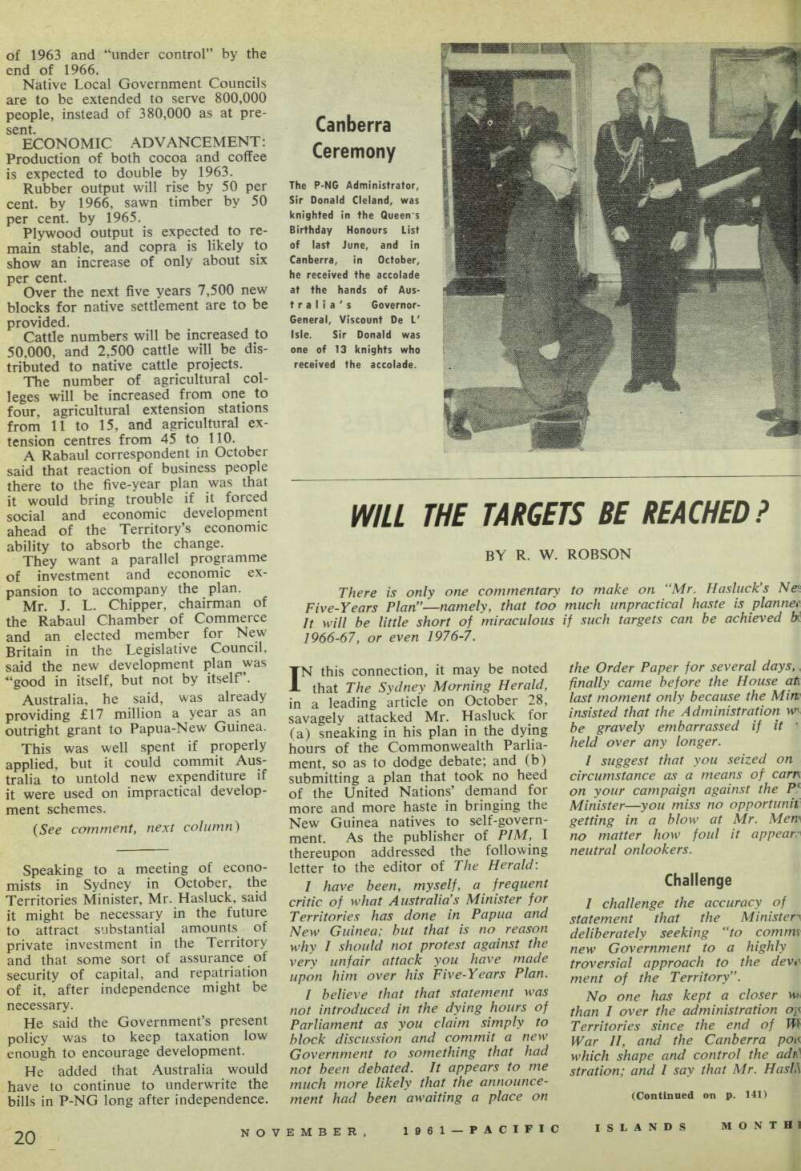
Canberra
Ceremony
The P-NG Administrator, Sir Donald Cleland, was knighted in the Queen s Birthday Honours List of last June, and in Canberra, in October, he received the accolade at the hands of Aus tralia's Governor- General, Viscount De L' Isle. Sir Donald was one of 13 knights who received the accolade.