Plight Of Fiji
pp. 19-143 · Read in the full issue
Big Sugar Loss Worsens Plight Of Fiji
From a Correspondent
The people and Government of Fiji are being faced this month with a number of awkward problems and difficult economic adjustments.
Among them:
• It is vital that early steps be taken to implement the recommendations of the Sugar Commission published early in September.
The Government has not yet announced the appointment of the “independent chairman” of the sugar industry, around whom is built the whole scheme of regenerating and strengthening the industry. A private letter from a person of unquestionable authority, received in Fiji in October, reported that the position had been offered in London to a “retired admiral” who turned it down because he did not wish to live in Fiji. • Because the 1960 Patel-led strike of growers dislocated production of cane, the mills, which had hoped to make 200,000 tons of sugar in this (1961) season, are ceasing operations. Labasa, Lautoka and Penang
are closed and Ba will close on Nov ember 17.
The millers have announced that in consequence of the failure of the cane supply, this year’s crushing will produce only 145,000 tons. This means a direct loss in the Colony s income of £2,000,000, at a time when it can least afford a loss, , Appeals for Action The CSR in a challenging state ment pu bli s hed in The Fiji Times on November 3 announced that it is “ w iHi ng to adopt, without any varia tion, the cane contract as recom mended in the report of the Commis sion, provided the legislation (which the Government is expected to intro duce shortly) adheres to the report in spirit and in fact .
It is generally believed that this
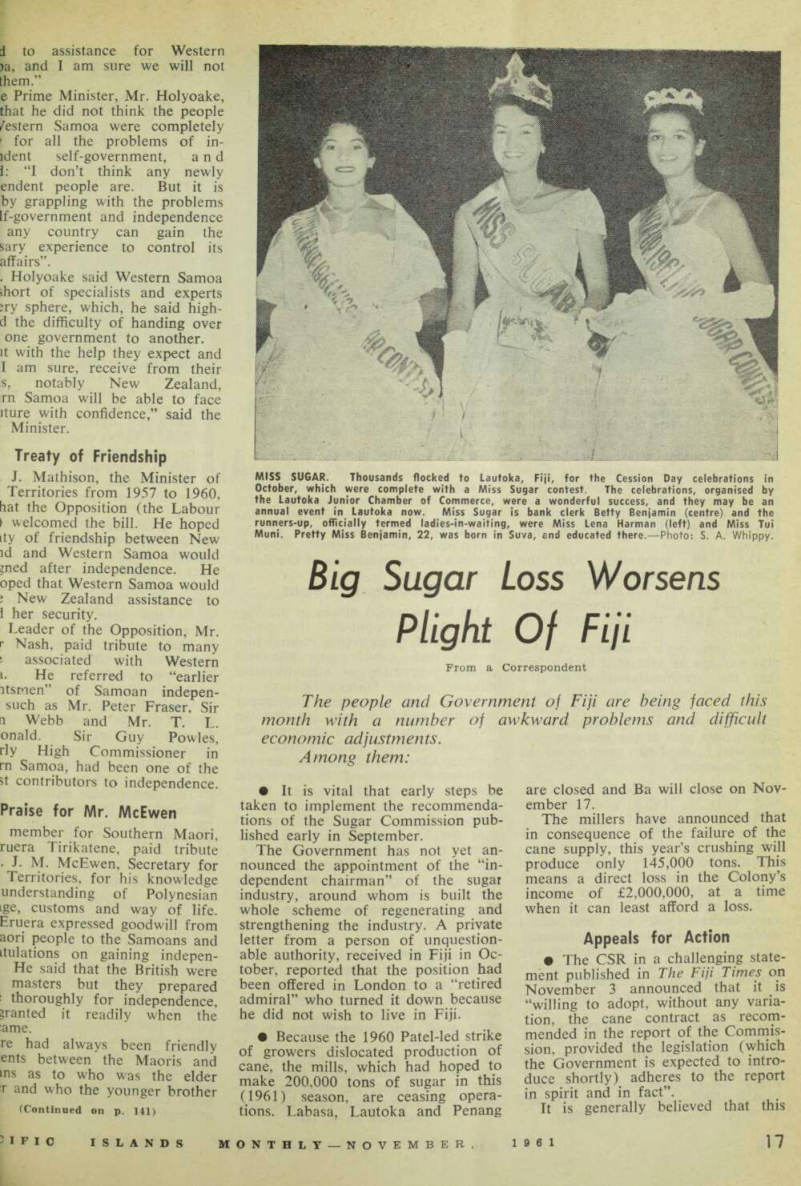
MISS SUGAR. Thousands flocked to Lautoka, Fiji, for the Cession Day celebrations in October, which were complete with a Miss Sugar contest. The celebrations, organised by the Lautoka Junior Chamber of Commerce, were a wonderful success, and they may be an annual event in Lautoka now. Miss Sugar is bank clerk Betty Benjamin (centre) and the runners-up, officially termed ladies-in-waiting, were Miss Lena Harman (left) and Miss Tui Muni. Pretty Miss Benjamin, 22, was born in Suva, and educated there. Photo: S. A. Whippy.
public statement was inspired by a belief that the Government is planning to alter in some important way the structure of the plan as submitted by the Commission. It also is ealeulated to hurry the Government into action.
The CSR emphasises that the Commission’s recommendations are “a completely integrated, interconnected, inter-dependent scheme which must be accepted as
a whole. , . . ...
The company s insistence on this may perhaps be explained by the fact that the recommendations of the Burns Commission m 1960 were similarly submitted as a complete plan, but the Fiji Government accepted only part of the recommendations and ignored two or three of the most important. • If the sugar industry is to function fully in 1962, and give the Colony a chance of economic recovery, it is vital that the new scheme of industry control—and especially the new form of contract to operate between millers and growers —be brought into operation quickly.
The Legislative Council is to meet on November 8, and non-official classes are combining to put pressure on the Government, so that it will make definite pronouncements in this session on what it proposes to do to give effect to the Sugar Commission report It is apparent that unless new contracts are signed between company and growers within the next few weeks, there will be insufficient provision for planting and cane production in 1962, and that the Colony’s economy Will Suffer accordingly.
• Meanwhile the Government is adjusting itself to the unexpected arrangement made in mid-October, under which the Secretary for Finance, Mr. E. R. Bevington, was appointed to the new post of De velopment Commissioner (created under a recommendation of the Burns Report).
"Development" Plans
pj e as OCCU pi e( j offices in the Vic toria Arcade, opposite the police station, and is gathering around him a new sta ff—mostly men who had g a j ne( j experience as administrative offidals in the District offices.
There was immediate newspaper criticism, which pointed out that the Burns Commission had recommended the establishment of a Natural Re sources Council, comprising six de partmental heads and six non-official persons, with the Development Com missioner as chairman and executive officer. Burns apparently intended that the Development Commissioner should be advised and guided by non official as well as official people in his vital work of developing the country’s resources, and co-ordinating the various public and private instru mentalities which are directed to that purpose.
It is understood that the official reply to that criticism is that, in the Government’s opinion, a Natural Re sources Council could serve no use ful purpose at this time, because the first work being undertaken by the Development Commissioner is to bring more land into usage, in ac cordance with the plan of the newly established Land Development Au thority. A Committee, including non
(Continued on p. 141)
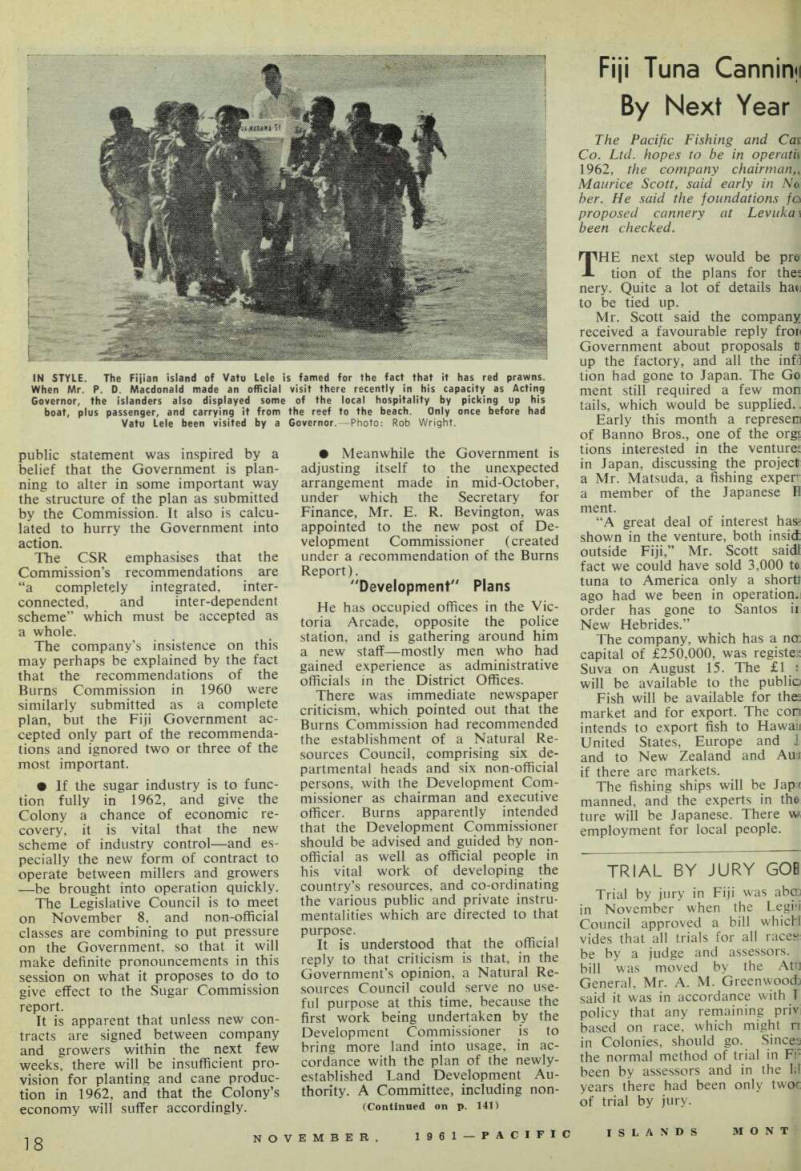
IN STYLE. The Fijian island of Vatu Lele is famed for the fact that it has red prawns.
When Mr. P. D. Macdonald made an official visit there recently in his capacity as Acting Governor, the islanders also displayed some of the local hospitality by picking up his boat, plus passenger, and carrying it from the reef to the beach. Only once before had Vatu Lele been visited by a Governor. Photo: Rob Wright.
official people, has been set up to help the Commissioner in this direc tion.
The issues here seem to be narrowed down to the point that the Fiji Government considers itself capable of deciding for itself what shall be done in relation to develop ment, and does not want any un official interference. • Because of the early closing of the sugar mills and the heavy reduc tion in the Colony’s income through the lesser sugar output, there is grow ing fear of unemployment in the country—especially in the Nadi- Lautoka-Ba area.
The Government is seeking urgently to counter this by commenc ing large public works, like the re building of the Suva docks, on funds being made available from British sources, like the Colonial Develop ment Fund. But the outlook is not good, whether the viewpoint is poli tical, economic, or social.
Most of these matters, in some form or other, will come before the November Legislative Council. But there may be little sting in the de bates, simply because there is no one to whom public criticism can be directed.
The Governor is responsible for most of what is going on, or is pro posed; and, nowadays, with the Colonial Office so preoccupied with Africa, West Indies, etc., it is no use appealing to London for help or advice!