West Samoan Independence
pp. 17-18 · Read in the full issue
Final Obstacles Cleared For West Samoan Independence
“I would not like to say that West Samoa is perfectly ready ndependence, but then, what country is?”
1 speaker was West Samoa’s rime Minister, Fiame Mataafa, the occasion was his formal >s to the UN Trusteeship :il in October, when he asked he termination of the UN :eship Agreement, administered Z, to enable West Samoa to le independent next January 1. ; Council agreed unanimously e determination and a few later the final obstacle was re -1 when the General Assembly I. h measures were formal. The obstacle was surmounted earlier sar, in May, when West Samoa for its independence at a jonsored plebiscite held through- Vest Samoa. Earlier still, a tutive assembly had hammered pproval of a constitution for will be the first Polynesian :ign and independent state to emerged from colonialism. it Samoa will celebrate her mdence during five days of ng from January 1. ne Minister Mataafa was intro to the Trusteeship Council by hairman of the New Zealand tion (Mr. F. H. Corner), who
said that his Government had “done its best to guide the Samoan people towards full self-government.”
“My Government believes that Western Samoa is ready to assume sovereign status,” Mr. Corner said.
Mataafa said Western Samoa did not intend to seek immediate United Nations membership after it became independent, but “may well join certain of the specialised agencies whose work has particular relevance to Samoan problems”.
The Prime Minister, who delivered his prepared text in Samoan, said he had to “confess frankly that certain aspects of our journey into the future cause me concern”, but his people needed “the spur of freedom” to fully accept their responsibilities.
Lacked Officers He said that Samoa lacked trained people to run its services, and was, therefore, “all the more appreciative of the five-year New Zealand educa tional aid programme, which is at present running at more than £BO,OOO a year”.
He said that Samoa’s economic situation, in common with that of other primary producing nations, was “rather sombre”.
It was thus not surprising that his Government was “most concerned at the low prices being received for copra and cocoa in the world markets, and by the prospect of the loss of markets to specially favoured com petitors.
“Our first intention,” he said, “is to help ourselves. We are reviewing our expenditure and increasing taxes.
“We shall not hesitate to look at our overseas exchange position if imports get out of hand.”
The Prime Minister emphasised that “Western Samoa would prefer to rely first on its ability to trade, rather than on aid, and would support all measures to provide fair and stable prices and equal access to markets for the world’s primary pro ducers.
“Since we cannot expect sufficient provision from trade alone, I should state equally frankly that we shall certainly need capital and technical assistance from abroad. ... I hope
we can rely on the United Nations, its agencies and its members to supplement the efforts of our friends in New Zealand”.
He said his Government did not intend to make any “sudden decision” and would evolve a foreign policy “according to our needs”.
Naturally, he said. Western Samoa would “look to relations with our
close neighbours”.
Mr. Corner said New Zealand had confidence in the ability of the Samoan people, through their Parlia mentary form of government, “to control the full range of their internal and external affairs.”
“Over the years, New Zealand has done its best to guide the Samoan people towards full self-government,”
Mr. Corner said. “It has made mis takes. But it has, I believe, learned from those mistakes.
“The very close relationship which
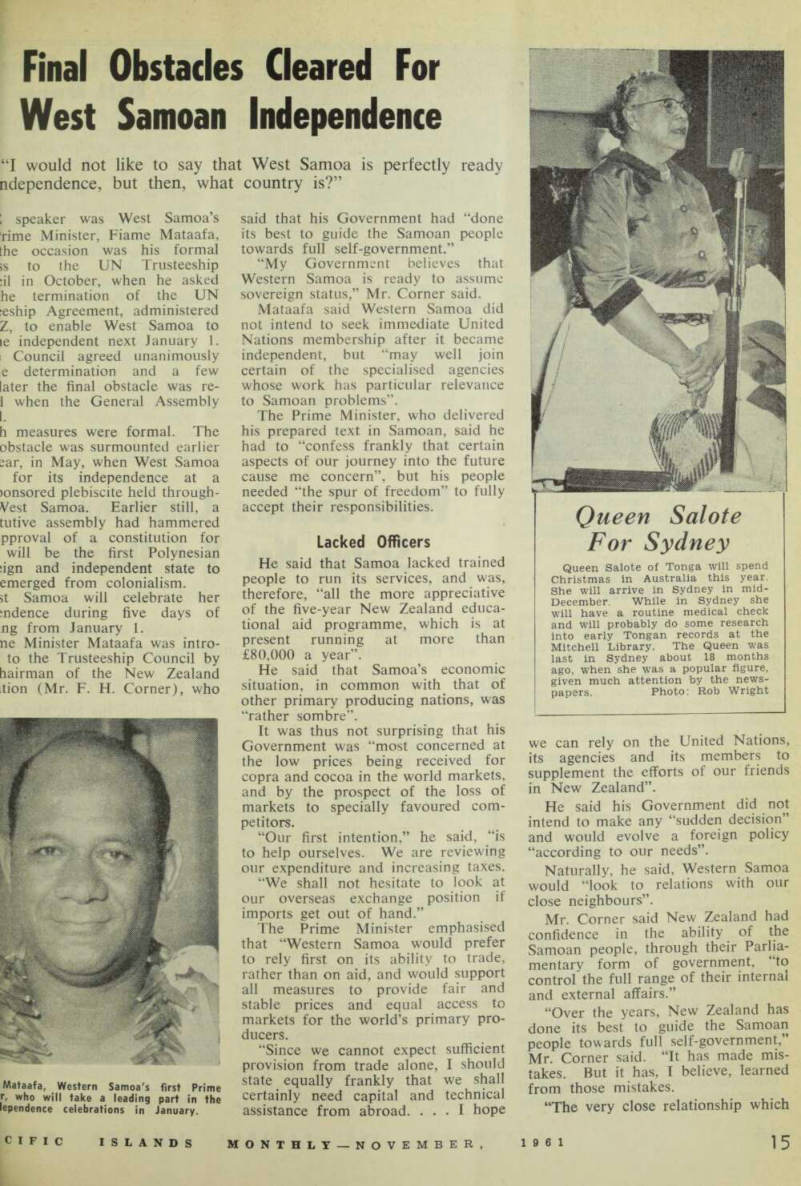
Mataafa, Western Samoa's first Prime [?]r, who will take a leading part in the [?]ependence celebrations in January.
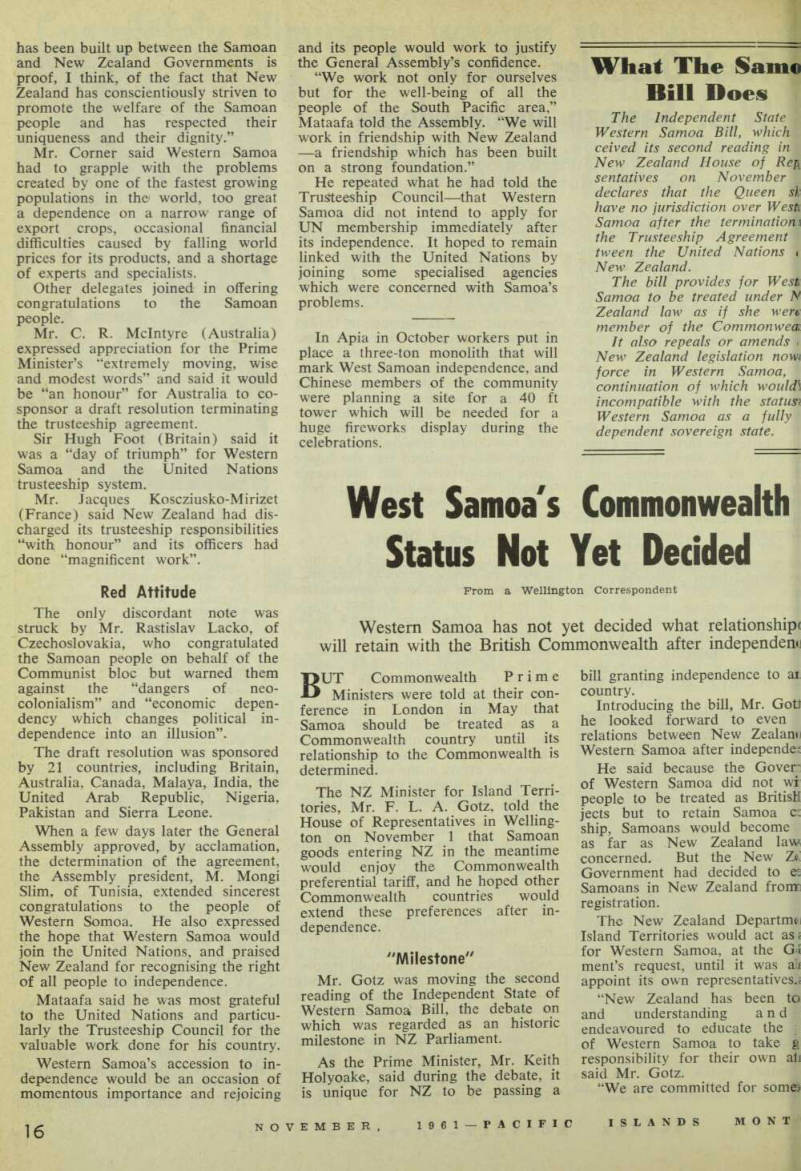
Queen Salote
For Sydney
Queen Salote of Tonga will spend Christmas in Australia this year.
She will arrive in Sydney in mid- December. While in Sydney she will have a routine medical check and will probably do some research into early Tongan records at the Mitchell Library. The Queen was last in Sydney about 18 months ago, when she was a popular figure, given much attention by the news papers. Photo: Rob Wright
has been built up between the Samoan and New Zealand Governments is proof, I think, of the fact that New Zealand has conscientiously striven to promote the welfare of the Samoan people and has respected their uniqueness and their dignity.”
Mr. Corner said Western Samoa had to grapple with the problems created by one of the fastest growing populations in the* world, too great a dependence on a narrow range of export crops, occasional financial difficulties caused by falling world prices for its products, and a shortage of experts and specialists.
Other delegates joined in offering congratulations to the Samoan people.
Mr. C. R. Mclntyre (Australia) expressed appreciation for the Prime Minister’s “extremely moving, wise and modest words” and said it would be “an honour” for Australia to co sponsor a draft resolution terminating the trusteeship agreement.
Sir Hugh Foot (Britain) said it was a “day of triumph” for Western Samoa and the United Nations trusteeship system.
Mr. Jacques Koscziusko-Mirizet (France) said New Zealand had dis charged its trusteeship responsibilities “with honour” and its officers had done “magnificent work”.
Red Attitude The only discordant note was struck by Mr. Rastislav Lacko, of Czechoslovakia, who congratulated the Samoan people on behalf of the Communist bloc but warned them against the “dangers of neo colonialism” and “economic depen dency which changes political in dependence into an illusion”.
The draft resolution was sponsored by 21 countries, including Britain, Australia, Canada, Malaya, India, the United Arab Republic, Nigeria, Pakistan and Sierra Leone.
When a few days later the General Assembly approved, by acclamation, the determination of the agreement, the Assembly president, M. Mongi Slim, of Tunisia, extended sincerest congratulations to the people of Western Somoa. He also expressed the hope that Western Samoa would join the United Nations, and praised New Zealand for recognising the right of all people to independence.
Mataafa said he was most grateful to the United Nations and particu larly the Trusteeship Council for the valuable work done for his country.
Western Samoa’s accession to in dependence would be an occasion of momentous importance and rejoicing
and its people would work to justify the General Assembly’s confidence, “We work not only for ourselves but for the well-being of all the people of the South Pacific area,”
Mataafa told the Assembly. “We will work in friendship with New Zealand —a friendship which has been built on a strong foundation.”
He repeated what he had told the Trusteeship Council—that Western Samoa did not intend to apply for UN membership immediately after its independence. It hoped to remain linked with the United Nations by joining some specialised agencies which were concerned with Samoa’s problems.
In Apia in October workers put in place a three-ton monolith that will mark West Samoan independence, and Chinese members of the community were planning a site for a 40 ft tower which will be needed for a huge fireworks display during the celebrations.