Pacific Commerce and Produce
pp. 155-156 · Read in the full issue
[?]Antas Figures
Reflect Loss
Of P-Ng
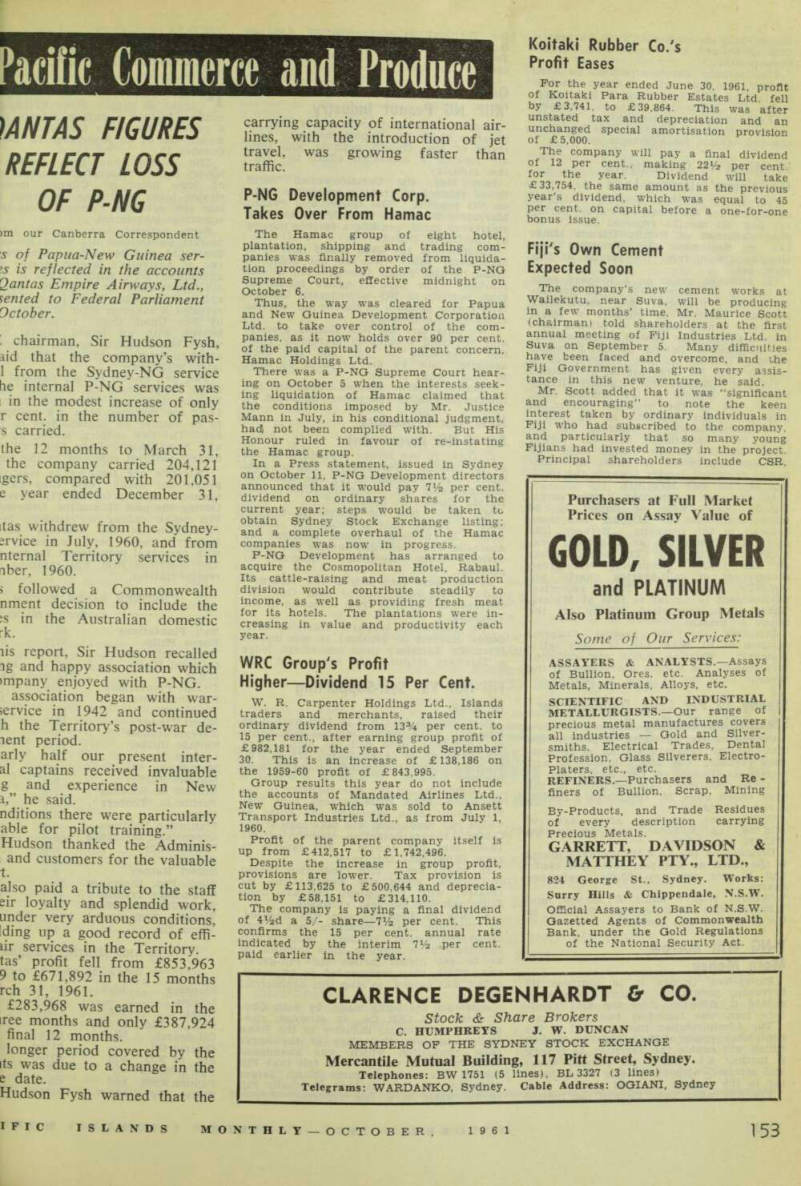
>m our Canberra Correspondent s of Papua-New Guinea ser -s is reflected in the accounts Qantas Empire Airways, Ltd., vented to Federal Parliament October. chairman, Sir Hudson Fysh, aid that the company’s with -1 from the Sydney-NG service be internal P-NG services was in the modest increase of only r cent, in the number of pas s carried. the 12 months to March 31, the company carried 204,121 igers, compared with 201,051 e year ended December 31, itas withdrew from the Sydney "rvice in July, 1960, and from nternal Territory services in nber, 1960. > followed a Commonwealth nment decision to include the ;s in the Australian domestic rk. lis report, Sir Hudson recalled ig and happy association which impany enjoyed with P-NG. association began with war >ervice in 1942 and continued h the Territory’s post-war de icnt period. arly half our present inter al captains received invaluable g and experience in New a,” he said. nditions there were particularly able for pilot training.”
Hudson thanked the Adminis and customers for the valuable t. also paid a tribute to the staff eir loyalty and splendid work, under very arduous conditions, [ding up a good record of effi ur services in the Territory, tas’ profit fell from £853,963 9 to £671,892 in the 15 months rch 31, 1961. £283,968 was earned in the tree months and only £387,924 final 12 months, longer period covered by the its was due to a change in the e date.
Hudson Fysh warned that the
carrying capacity of international air
lines, with the introduction of jet
travel, was growing faster than
traffic.
P-NG Development Corp.
Takes Over From Hamac
The Hamac group of eight hotel, plantation, shipping and trading com panies was finally removed from liquida tion proceedings by order of the P-NG Supreme Court, effective midnight on October 6.
Thus, the way was cleared for Papua and New Guinea Development Corporation Ltd. to take over control of the com panies, as it now holds over 90 per cent, of the paid capital of the parent concern, Hamac Holdings Ltd.
There was a P-NG Supreme Court hear ing on October 5 when the interests seek ing liquidation of Hamac claimed that the conditions imposed by Mr. Justice Mann in July, in his conditional judgment, had not been complied with. But His Honour ruled in favour of re-instating the Hamac group.
In a Press statement, issued in Sydney on October 11, P-NG Development directors announced that it would pay 7Vs* per cent, dividend on ordinary shares for the current year; steps would be taken to obtain Sydney Stock Exchange listing; and a complete overhaul of the Hamac companies was now in progress.
P-NG Development has arranged to acquire the Cosmopolitan Hotel, Rabaul.
Its cattle-raising and meat production division would contribute steadily to income, as well as providing fresh meat for its hotels. The plantations were in creasing in value and productivity each year.
WRC Group's Profit
Higher—Dividend 15 Per Cent.
W. R. Carpenter Holdings Ltd., Islands traders and merchants, raised their ordinary dividend from 13% per cent, to 15 per cent., after earning group profit of £982,181 for the year ended September 30. This is an increase of £138,186 on the 1959-60 profit of £843,995.
Group results this year do not include the accounts of Mandated Airlines Ltd., New Guinea, which was sold to Ansett Transport Industries Ltd., as from July 1, 1960.
Profit of the parent company itself is up from £412,517 to £1,742,496.
Despite the increase in group profit, provisions are lower. Tax provision is cut by £113,625 to £500,644 and deprecia tion by £58,151 to £314,110.
The company is paying a final dividend of 4 1 / 2 d a 5/- share — IV 2 per cent. This confirms the 15 per cent, annual rate indicated by the interim TVs per cent, paid earlier in the year.
Koitaki Rubber Co.'s
Profit Eases
For the year ended June 30, 1961, profit of Koitaki Para Rubber Estates Ltd. fell by £3,741, to £39,864. This was after unstated tax and depreciation and an unchanged special amortisation provision of £5,000.
The company will pay a final dividend of 12 per cent., making 22»/ 2 per cent, for the year. Dividend will take £33,754, the same amount as the previous year’s dividend, which was equal to 45 per cent, on capital before a one-for-one bonus issue.
Fiji's Own Cement
Expected Soon
The company’s new cement works at Wailekutu, near Suva, will be producing in a few months’ time, Mr. Maurice Scott (chairmani told shareholders at the first annual meeting of Fiji Industries Ltd. in Suva on September 5. Many difficulties have been faced and overcome, and the Fiji Government has given every assis tance in this new venture, he said.
Mr. Scott added that it was “significant and encouraging’’ to note the keen interest taken by ordinary individuals in Fiji who had subscribed to the company, and particularly that so many young Fijians had invested money in the project.
Principal shareholders include CSR,
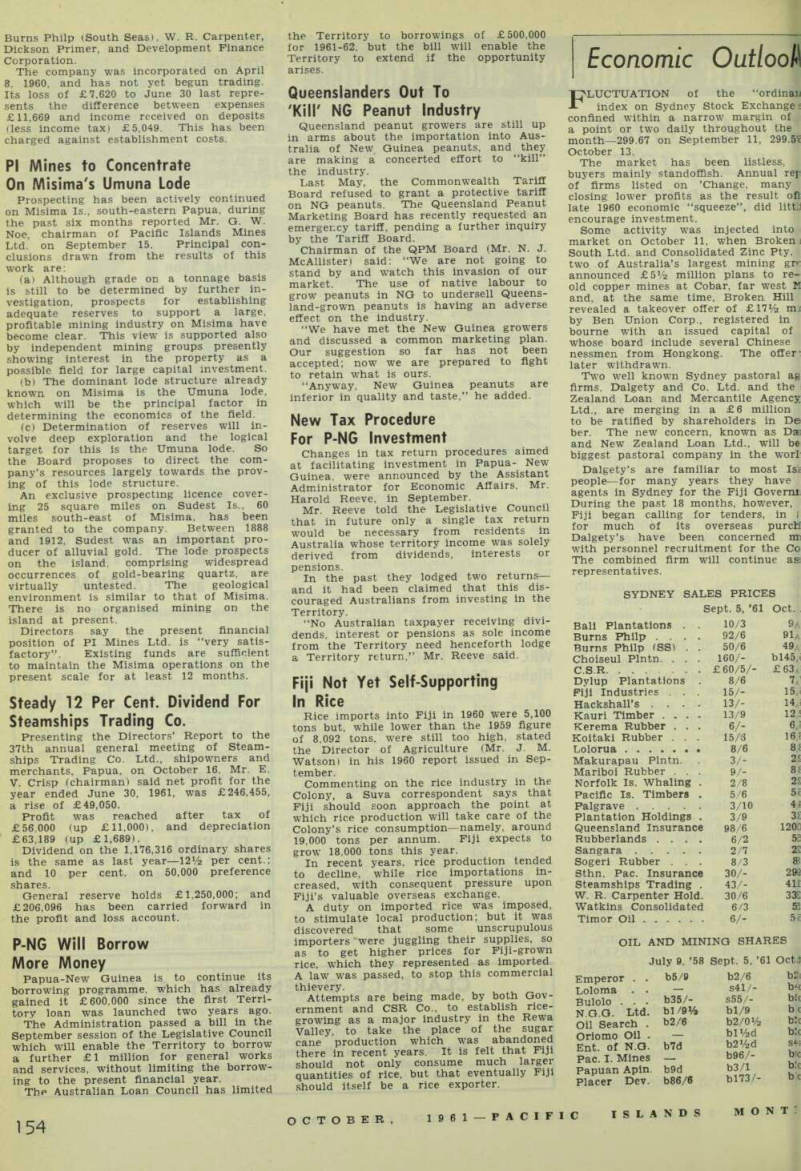
Burns Philp (South Seas). W. R. Carpenter, Dickson Primer, and Development Finance Corporation.
The company was incorporated on April 8, 1960, and has not yet begun trading.
Its loss of £7,620 to June 30 last repre sents the difference between expenses £11,669 and income received on deposits (less income tax) £5,049. This has been charged against establishment costs.
PI Mines to Concentrate
On Misima's Umuna Lode
Prospecting has been actively continued on Misima Is., south-eastern Papua, during the past six months reported Mr. G. W.
Noe, chairman of Pacific Islands Mines Ltd. on September 15. Principal con clusions drawn from the results of this work are; (a) Although grade on a tonnage basis is still to be determined by further in vestigation, prospects for establishing adequate reserves to support a large, profitable mining industry on Misima have become clear. This view is supported also by independent mining groups presently showing interest in the property as a possible field for large capital investment. (b) The dominant lode structure already known on Misima is the Umuna lode, which will be the principal factor in determining the economics of the field. (c) Determination of reserves will in volve deep exploration and the logical target for this Is the Umuna lode. So the Board proposes to direct the com pany’s resources largely towards the prov ing of this lode structure.
An exclusive prospecting licence cover ing 25 square miles on Sudest Is., 60 miles south-east of Misima, has been granted to the company. Between 1888 and 1912, Sudest was an important pro ducer of alluvial gold. The lode prospects on the island, comprising widespread occurrences of gold-bearing quartz, are virtually untested. The geological environment is similar to that of Misima.
There is no organised mining on the island at present.
Directors say the present financial position of PI Mines Ltd. is “very satis factory”. Existing funds are sufficient to maintain the Misima operations on the present scale for at least 12 months.
Steady 12 Per Cent. Dividend For
Steamships Trading Co.
Presenting the Directors’ Report to the 37th annual general meeting of Steam ships Trading Co. Ltd., shipowners and merchants, Papua, on October 16. Mr. E.
V. Crisp (chairman) said net profit for the year ended June 30, 1961, was £246,455, a rise of £49,050.
Profit was reached after tax of £56,000 (up £11,000), and depreciation £63,189 (up £1,689).
Dividend on the 1,176,316 ordinary shares is the same as last year— l2V2 per cent.; and 10 per cent, on 50,000 preference shares.
General reserve holds £1,250,000; and £206,096 has been carried forward in the profit and loss account.
P-NG Will Borrow
More Money
Papua-New Guinea is to continue its borrowing programme, which has already gained it £600,000 since the first Terri tory loan was launched two years ago.
The Administration passed a bill in the September session of the Legislative Council which will enable the Territory to borrow a further £ 1 million for general works and services, without limiting the borrow ing to the present financial year.
The Australian Loan Council has limited
the Territory to borrowings of £500,000 for 1961-62, but the bill will enable the Territory to extend if the opportunity arises.
Queenslanders Out To
'Kill 7 NG Peanut Industry
Queensland peanut growers are still up in arms about the importation into Aus tralia of New Guinea peanuts, and they are making a! concerted effort to “kill” the industry.
Last May, the Commonwealth Tariff Board refused to grant a protective tariff on NG peanuts. The Queensland Peanut Marketing Board has recently requested an emergency tariff, pending a further inquiry by the Tariff Board.
Chairman of the QPM Board (Mr. N. J.
McAllister) said: “We are not going to stand by and watch this invasion of our market. The use of native labour to grow peanuts in NG to undersell Queens land-grown peanuts is having an adverse effect on the industry.
“We have met the New Guinea growers and discussed a common marketing plan.
Our suggestion so far has not been accepted; now we are prepared to fight to retain what is ours.
“Anyway, New Guinea peanuts are inferior in quality and taste,” he added.
New Tax Procedure
For P-NG Investment
Changes in tax return procedures aimed at facilitating investment in Papua- New Guinea, were announced by the Assistant Administrator for Economic Affairs, Mr.
Harold Reeve, in September.
Mr. Reeve told the Legislative Council that in future only a single tax return would be necessary from residents in Australia whose territory income was solely derived from dividends, interests or pensions.
In the past they lodged two returns— and it had been claimed that this dis couraged Australians from investing in the Territory.
“No Australian taxpayer receiving divi dends, interest or pensions as sole income from the Territory need henceforth lodge a Territory return,” Mr. Reeve said.
Fiji Not Yet Self-Supporting
In Rice
Rice imports into Fiji in 1960 were 5,100 tons but, while lower than the 1959 figure of 8.092 tons, were still too high, stated the Director of Agriculture (Mr. J. M.
Watson I in his 1960 report issued in Sep tember.
Commenting on the rice industry in the Colony, a Suva correspondent says that Fiji should soon approach the point at which rice production will take care of the Colony’s rice consumption—namely, around 19,000 tons per annum. Fiji expects to grow 18,000 tons this year.
In recent years, rice production tended to decline, while rice importations in creased, with consequent pressure upon Fiji’s valuable overseas exchange.
A duty on imported rice was imposed, to stimulate local production; but it was discovered that some unscrupulous importers ' were juggling their supplies, so as to get higher prices for Fiji-grown rice, which they represented as imported.
A law was passed, to stop this commercial thievery.
Attempts are being made, by both Gov ernment and CSR Co., to establish rice growing as a major industry in the Rewa Valley, to take the place of the sugar cane production which was abandoned there in recent years. It is felt that Fiji should not only consume much larger quantities of rice, but that eventually Fiji should itself be a rice exporter.