Pacific
pp. 144-145 · Read in the full issue
Travel
Talk
What do tourists look for during their tours? How are they attracted to one place more than another? American tourist and travel expert Bill Mullahey gave some of the answers in Port Moresby in September—and what he had to soy is of more than ordinary interest to South Pacific islands other than Papua-New Guinea.
MR. MULLAHEY is Pan American Airways’ Regional Director for the Central and South Pacific, and also chairman of the Research and Survey Committee of the Pacific Area Travel Association, He had just taken in a week’s tour of the Territory and will make a report on its tourist potential to the 11th annual conference of PATA in Hongkong in January. P-NG is look ing around at the moment for ways of building up its tourist income.
Mr. Mullahey said that while the tourist potential of the Territory was unlimited, a lead from the Govern ment was essential. He said that for every £1 the Government contributed towards the development of a tourist trade, it would receive many more times the amount back in various ways.
The Government profited from excise on liquor and customs duties, and when employment was created, it benefited from increased earnings, because more income and company taxes were paid.
In Hawaii, it had been established that the Government received back, in direct and indirect taxes, 20 to 30 more times the amount of money it spent to attract tourists.
Mr. Mullahey said he was particu larly impressed by the NG Highlands, and also by Madang. He suggested that accommodation facilities should be planned along tourist roads, so that the places where visitors stayed over night had the external appearances of native villages.
The sites, localities, basic layout, and planning of these “visitor villages” should be controlled, so that an initial installation of, say, 20 units, could be easily increased to 40, or 80 more units. It was important to plan such essentials as the dining room, lounge room, office and kitchen,
so that pre-planned additions could be easily made to the central block.
Mr. Mullahey said that the build ings could be constructed with local materials, but it was essential that the design should be unique to the Territory.
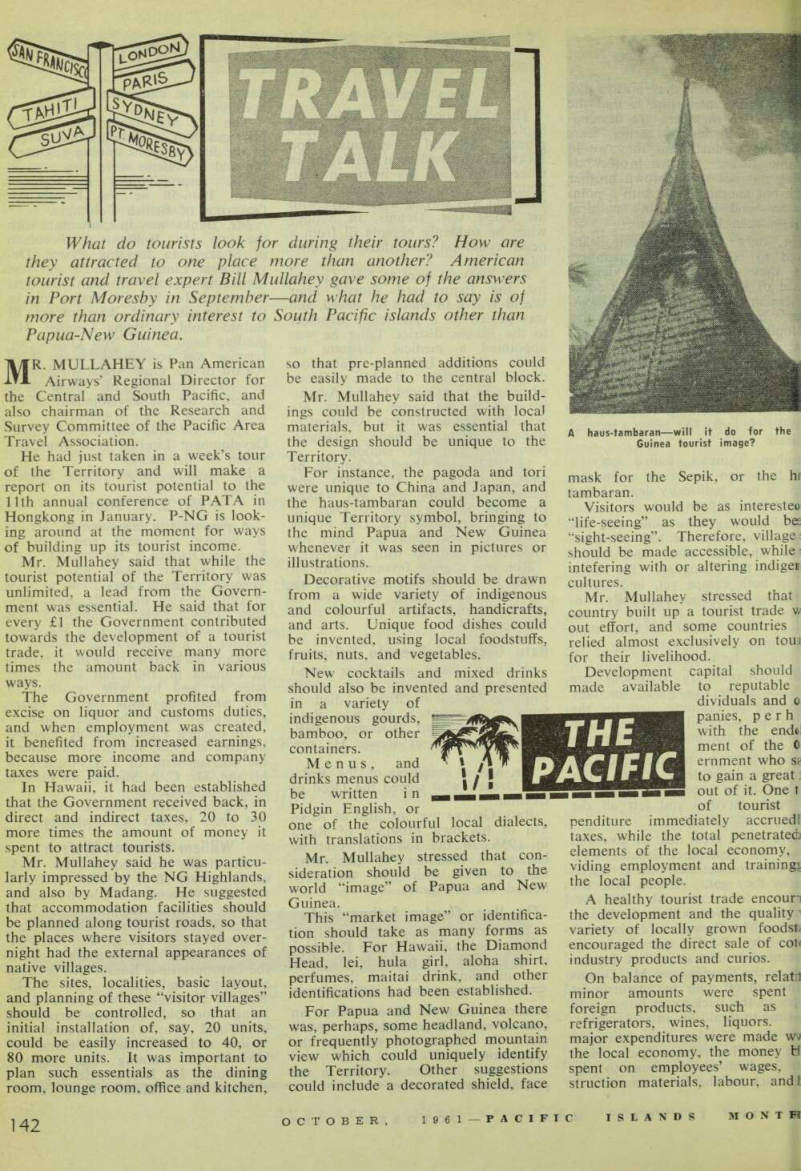
For instance, the pagoda and tori were unique to China and Japan, and the haus-tambaran could become a unique Territory symbol, bringing to the mind Papua and New Guinea whenever it was seen in pictures or illustrations.
Decorative motifs should be drawn from a wide variety of indigenous and colourful artifacts, handicrafts, and arts. Unique food dishes could be invented, using local foodstuffs, fruits, nuts, and vegetables.
New cocktails and mixed drinks should also be invented and presented
in a variety of
indigenous gourds,
bamboo, or other containers.
Menus, and drinks menus could be written i n Pidgin English, or
one of the colourful local dialects, with translations in brackets.
Mr. Mullahey stressed that con sideration should be given to the world “image” of Papua and New Guinea.
This “market image” or identifica tion should take as many forms as possible. For Hawaii, the Diamond Head, lei, hula girl, aloha shirt, perfumes, maitai drink, and other identifications had been established.
For Papua and New Guinea there was, perhaps, some headland, volcano, or frequently photographed mountain view which could uniquely identify the Territory. Other suggestions could include a decorated shield, face
mask for the Sepik, or the hf tambaran.
Visitors would be as interesteo “life-seeing” as they would “sight-seeing”. Therefore, village should be made accessible, while: intefering with or altering indigei cultures.
Mr. Mullahey stressed that country built up a tourist trade w out effort, and some countries relied almost exclusively on toui for their livelihood.
Development capital should made available to reputable
The
Pacific
dividuals and o panics, perh with the endo ment of the 0 ernment who s? to gain a great; out of it. One t of tourist
penditure immediately accrued! taxes, while the total penetrated! elements of the local economy, viding employment and training* the local people.
A healthy tourist trade encoun the development and the quality 1 variety of locally grown foodst; encouraged the direct sale of cot< industry products and curios.
On balance of payments, relatil minor amounts were spent foreign products, such as • refrigerators, wines, liquors, major expenditures were made wv the local economy, the money H spent on employees’ wages, struction materials, labour, and!
A haus-tambaran —will it do for the Guinea tourist image?
ruction and promotion of the of local goods. , Mullahey concluded: “What ins, now, to be done, is for body, the Government, business s, particularly hotels, and the e generally to co-operate fully veloping the tourist trade. With ing and sufficient support and iragement, the tourist trade become the Territory’s most able industry”. s The Time To Norfolk Island RFOLK Island seldom rates a nention in the Federal Parlia but in September it found an >ected champion in Mr. Clyde iron. returned from a holiday in )lk Island full of praise for its t attractions. s island was the best and pos the cheapest place in Australia quiet holiday, he said. . Cameron urged the Govern to seal the island’s air strip, raised the Government’s decision ;nd £20,000 on restoring the old ct relics. is all very well for Norfolk lers to say, ‘Let us forget about ,” he said. was a tragedy when the early rners decided to set fire to the elics and burn the settlements, ever we have an opportunity to nber how inhuman were the ; of the British Empire not much than a hundred years ago, we only to go to Norfolk Island to le evidence.” . Cameron appealed to the rnment to preserve the cottage Norfolk Island in which the lal W. C. Wentworth was born. . Cameron’s praises of Norfolk 'ell deserved, and now is a good to plan a holiday there. Qantas,
the only company to provide air ser vices, in December will begin a weekly Skymaster service from Syd ney for the summer.
At present the service is fort nightly, which means you spend either one night or a fortnight on the island. After calling at Norfolk from Sydney, the Skymaster goes on to Auckland and returns to Norfolk and Sydney the next day. Times are in PlM’s air schedules.
You can also get there aboard BP’s Tulagi from Sydney, taking five days, but the Tulagi makes a six weeks’ trip to northern groups too, and since she has passenger accom modation only for 12, she is always booked out.
By air is the best way to visit Norfolk. Distance is 900 miles from Sydney and 600 miles from Auck land.
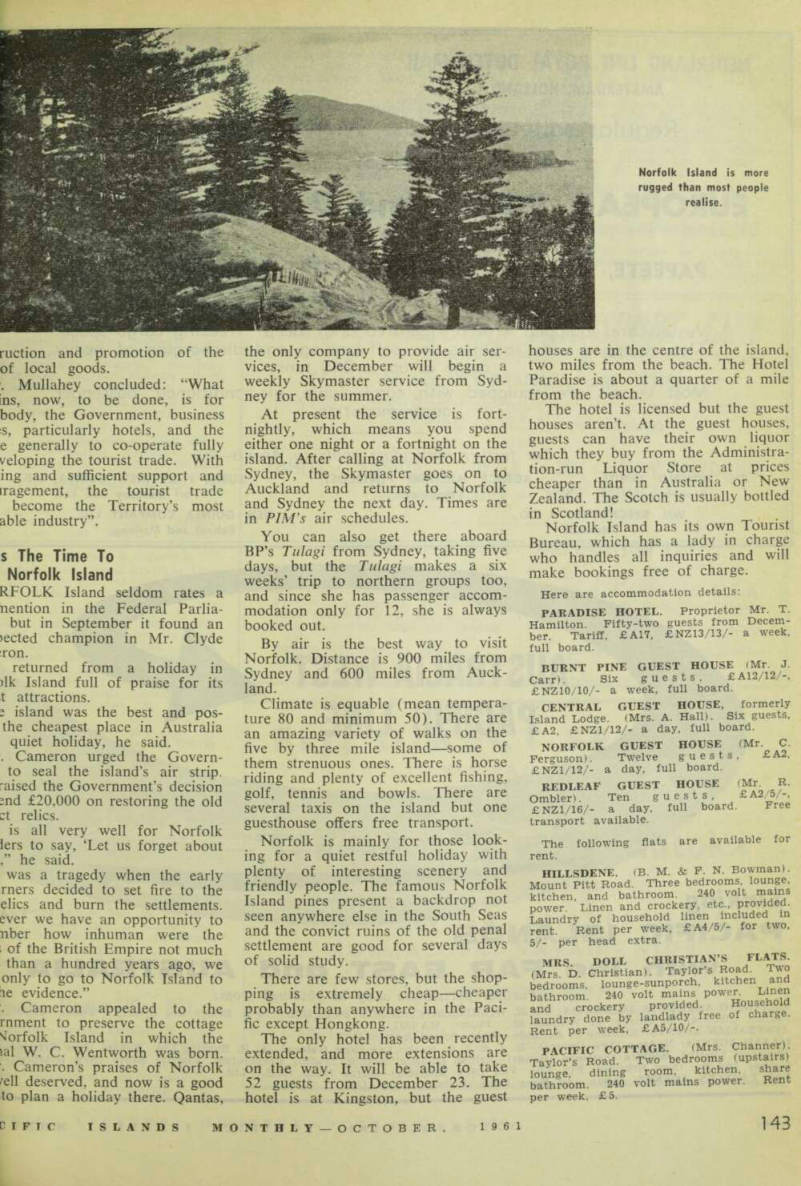
Climate is equable (mean tempera ture 80 and minimum 50). There are an amazing variety of walks on the five by three mile island —some of them strenuous ones. There is horse riding and plenty of excellent fishing, golf, tennis and bowls. There are several taxis on the island but one guesthouse offers free transport, Norfolk is mainly for those look ing for a quiet restful holiday with plenty of interesting scenery and friendly people. The famous Norfolk Island pines present a backdrop not seen anywhere else in the South Seas and the convict ruins of the old penal settlement are good for several days of solid study.
There are few stores, but the shop ping is extremely cheap—cheaper probably than anywhere in the Paci fic except Hongkong.
The only hotel has been recently extended, and more extensions are on the way. It will be able to take 52 guests from December 23. The hotel is at Kingston, but the guest
houses are in the centre of the island, two miles from the beach. The Hotel Paradise is about a quarter of a mile from the beach.
The hotel is licensed but the guest houses aren’t. At the guest houses,
guests can have their own liquor
which they buy from the Administra
tion-run Liquor Store at prices
cheaper than in Australia or New Zealand. The Scotch is usually bottled
in Scotland!
Norfolk Island has its own Tourist
Bureau, which has a lady in charge
who handles all inquiries and will
make bookings free of charge.
Here are accommodation details: PARADISE HOTEL. Proprietor Mr. T.
Hamilton. Fifty-two guests from Decem ber. Tariff, £ Al 7, £NZI3/13/- a week, full board.
Burnt Pine Guest House (Mr. J.
Carr). Six guests, £AI2/12/-, £ NZIO/10/- a week, full board.
CENTRAL GUEST HOUSE, formerly Island Lodge. (Mrs. A. Hall). Six guests, £A2, £NZI/12/- a day, full board.
Norfolk Guest House (Mr C.
Ferguson). Twelve guests, £ A 2, £ NZI/12/- a day, full board.
Redleaf Guest House (Mr R.
Ombler). Ten guests, £ A2/5/-, £ NZI/16/- a day, full board. Free transport available.
The following flats are available for rent.
Hillsdene. (B. M. &F. N. Bowman).
Mount Pitt Road. Three bedrooms lounge, kitchen, and bathroom. 240 volt mams power. Linen and crockery, etc., Provided.
Laundry of household linen included in rent. Rent per week, £A4/5/- for two, 5/- per head extra.
Mrs. Doll Christian’S Flats.
(Mrs. D. Christian). Taylor’s : Two bedrooms, lounge-sunporch, kitchen and bathroom. 240 volt mains power. Linen and crockery provided. Household laundry done by landlady free of charge.
Rent per week, £AS/10/-.
PACIFIC COTTAGE. (Mrs. Channer).
Taylor’s Road. Two bedrooms (upstairs) lounge, dining room, kitchen, share bathroom. 240 volt mains power. Rent per week, £5.
Norfolk Island is more rugged than most people realise.