Pacific Report
pp. 117-142 · Read in the full issue

The month’s round-up of news and pictures of people and events, from PIM correspondents in the South Pacific.
i's Hibiscus Festival
'Best Yet'
e 1961 Hibiscus Festival came vent at Suva in September and al opinion was that it was the yet, in spite of unfavourable ter. Suva had a week of fun with y h variety to satisfy even those ed to be choosey about their tainment.
He events which featured in vals in years gone by were )ed (the wheelbarrow derby, and night of feasting and dancing - the coconut trees at Nukulau 1 were two examples), w this year were a radio and ical goods exhibition, a trade a handicraft exhibition and a lesian night. e Miss Hibiscus contest when of the most beautiful young en of the Colony vie for a orous trip overseas again took of place. years gone by the name of Miss ;cus was not known till about p.m. on the last night of the r al. But the Suva Junior Cham »f Commerce, who runs the con had to bow to the wishes of the 'al organisers, and announce the ; early in the week so that Miss ;cus could be guest-of-honour at various functions, issing this year was the mounting ement and tension as followers le candidate speculated on their ;e’s chances, and the breaking of ension as the winner’s name, after ble delays, was finally announced ; the balcony of the Grand Pacific 1. The public was so critical of 961 procedure, that 1962 is likely ee a reversion to the 1957-60 tice. lis year’s contest was flat—not use of the 18 beauties who vied the title and a 42-day Pacific ;e by one of the Matson liners other fine prizes—but because of change. tie 1961 Miss Hibiscus is 17-year- Laurayne Thurley, a stenographer
employed by Hunt’s Travel Service, who sponsored her. Her prizes were worth between £1,200 and £1,300.
Second was Miss Mary Keni, 23, a hospital nurse, and in third place was Miss Lois Gibson, 18, a broad casting panel operator.
Unfortunately this year there was no Manoora to bring free-spending Australians to Suva for the fun. But the Oronsay and Mariposa provided compensation. The Oronsay on a trip south delayed her departure for an hour so that passengers could watch the Fijian firewalking cere mony.
The climax to the festival was a procession of floats through Suva on the last day, a procession which was gay and colourful and thoroughly en joyed by upwards of 23,000 people, in spite of the threatening rain. This annual procession seems to get better
and better every year, and is the result of much thought, imagination,
ingenuity and improvisation.
Many persons thought the Club Hotel float the best of all. It featured its “Starlight” barbecue and wonder of wonders those on the float produced real barbecued chicken and the real liquor to go with it. This float deservedly won first prize in its section!
When the spectators became tired of looking at the floats and trying to work out what they represented they were able to concentrate on the Miss Hibiscus candidates who were float passengers. And one previously as-
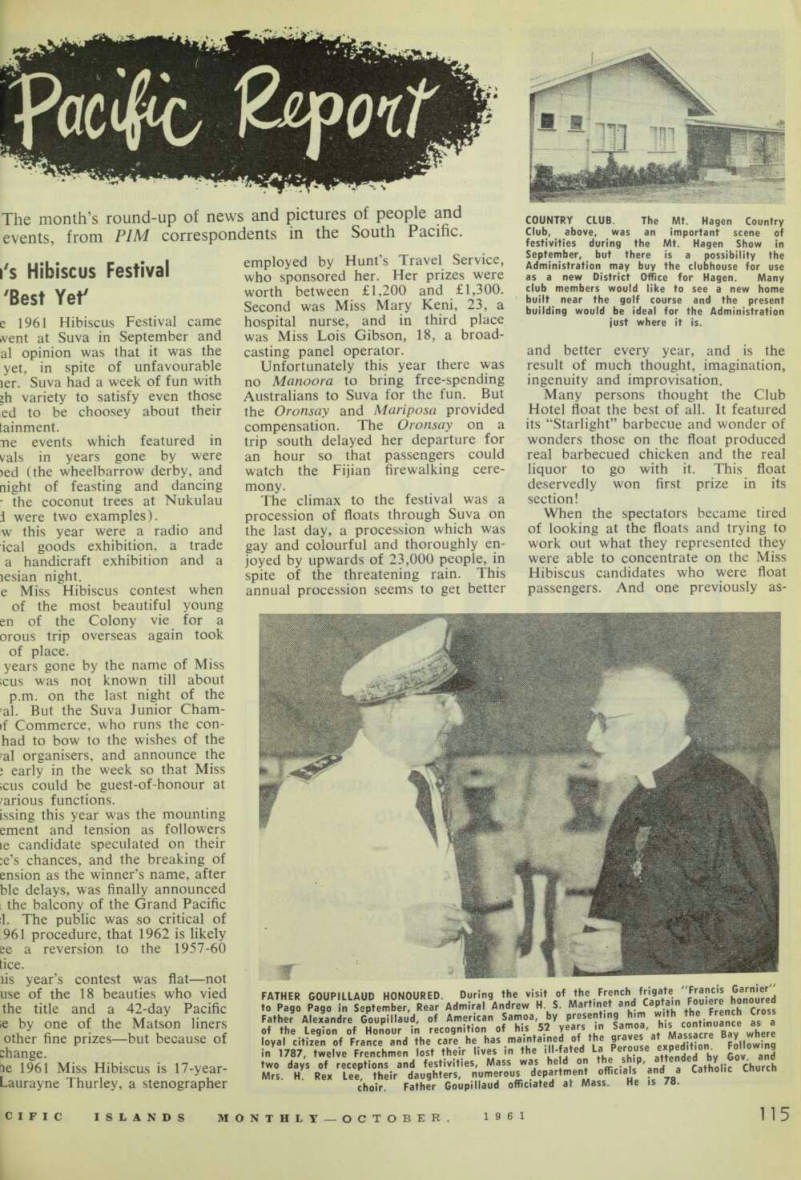
COUNTRY CLUB. The Mt. Hagen Country Club, above, was an important scene of festivities during the Mt. Hagen Show in September, but there is a possibility the Administration may buy the clubhouse for use as a new District Office for Hagen. Many club members would like to see a new home built near the golf course and the present building would be ideal for the Administration just where it is.
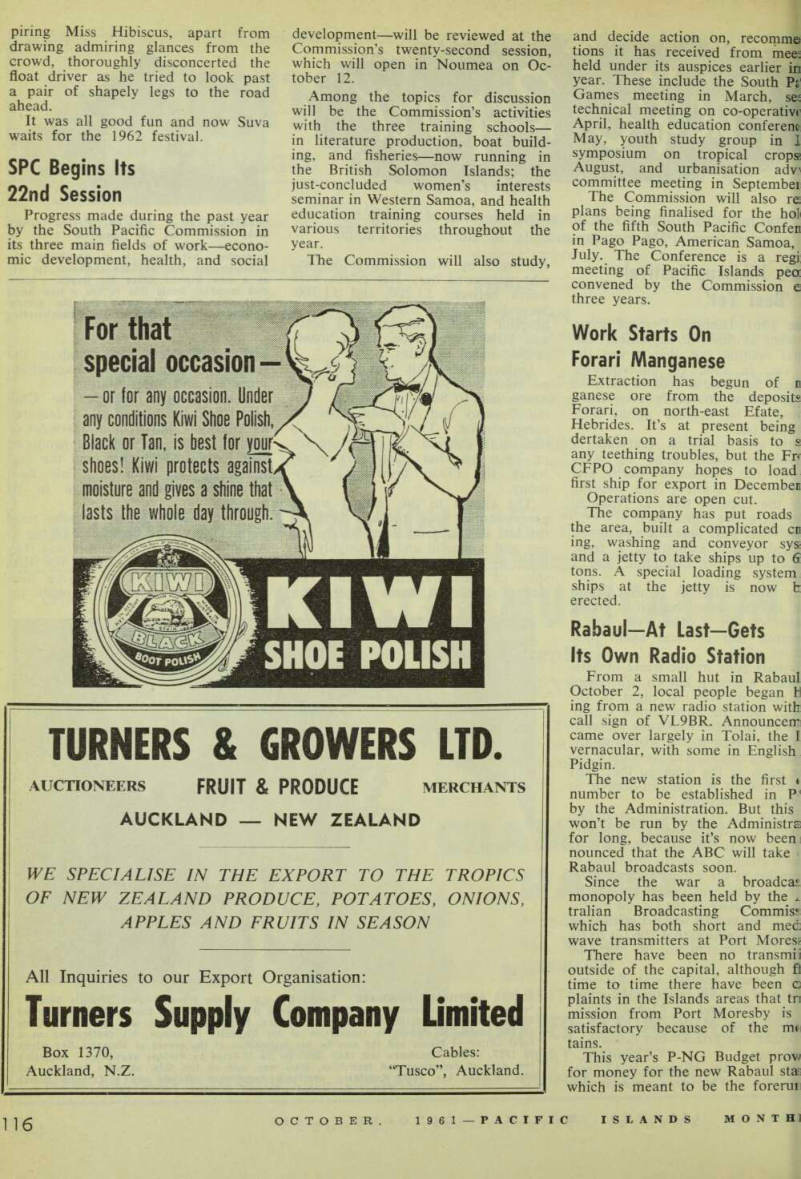
FATHER GOUPILLAUD HONOURED. During the visit of the French Frigate Francis G to Pago Pago in September, Rear Admiral Andrew H. S. Martinet and Captai n french Cross Father Alexandre Goupillaud, of American Samoa by presenting him with the French Cross of the Legion of Honour in recognition of his 52 years in Samoa his w here loyal citizen of France and the care he has maintained of the graves a Massacre Bay where in 1787, twelve Frenchmen lost their lives in the ill-fated La Perouse expedition Following two days of receptions and festivities, Mass was held on the ship, Catholic Church Mrs. H Rex Lee, their daughters, numerous department officials and a Catholic Church choir. Father Goupillaud officiated at Mass. He is 78.
piring Miss Hibiscus, apart from drawing admiring glances from the crowd, thoroughly disconcerted the float driver as he tried to look past a pair of shapely legs to the road att r* ‘ 11 j r , It was all good fun and now Suva waits for the 1962 festival. rn/- n • n
SPC Begins Its
qq j Coceinn ZZnu session Progress made during the past year by the South Pacific Commission in its three main fields of work—economic development, health, and social
development—will be reviewed at the Commission’s twenty-second session, which will open in Noumea on Oc tober 12.
Among the topics for discussion will b e Commission’s activities wit h the three training schools— in literature production, boat build in S’ anci fisheries — now running in the British Solomon Islands; the just-concluded women’s interests seminar in Western Samoa, and health education training courses held in various territories throughout the year.
The Commission will also study,
and decide action on, recommo tions it has received from mees held under its auspices earlier in year. These include the South Ps' Games meeting in March, see technical meeting on co-operativr April, health education conferenoi May, youth study group in 1 symposium on tropical crops August, and urbanisation adw committee meeting in September The Commission will also res plans being finalised for the holt of the fifth South Pacific Confen in Pago Pago, American Samoa, July. The Conference is a regi; meeting of Pacific Islands pea convened by the Commission e three years.
Work Starts On
Forari Manganese
Extraction has begun of n ganese ore from the deposits Forari, on north-east Efate, Hebrides. It’s at present being dertaken on a trial basis to s any teething troubles, but the Fa CFPO company hopes to load! first ship for export in Decemben Operations are open cut.
The company has put roads the area, built a complicated cn ing, washing and conveyor sys and a jetty to take ships up to 6c tons. A special loading system j ships at the jetty is now h erected.
Rabaui—At Last—Gets
Its Own Radio Station
From a small hut in Rabaui October 2, local people began H ing from a new radio station with call sign of VL9BR. Announcerm came over largely in Tolai, the I vernacular, with some in English.
Pidgin.
The new station is the first ♦ number to be established in P' by the Administration. But this won’t be run by the Administrs for long, because it’s now beeni nounced that the ABC will take • Rabaui broadcasts soon.
Since the war a broadens, monopoly has been held by the tralian Broadcasting Commiss; which has both short and medb wave transmitters at Port Mores?
There have been no transmii outside of the capital, although fi time to time there have been a plaints in the Islands areas that tn mission from Port Moresby is satisfactory because of the mu tains.
This year’s P-NG Budget prow for money for the new Rabaui stas which is meant to be the forerun
assibly six stations located hout the Territory, all with :overage only.
Rabaul one has a frequency 40 k/c in the 60 metre band, i power of only 250 watts. It ig the normal communication litters of the Posts and Tele- Department, and the Exten- Services Branch is providing mmes and studio staffs. ;n the ABC gets going in 1 it will put in a separate studio ransmitter. A site has already selected for the ABC in 1. mwhile, new station manager ic Administration’s VL9BR is Loger Wilson, who has been a :ast officer with the Adminis i’s Broadcast Section for two He will be the English an er, and Samson, of Nodup, will ilai announcer. adcast times will be from 5.55 ;o 9 p.m. Mondays to Fridays, /eek-ends broadcasts will be 6.40 p.m. to 9 p.m. The even icws sessions will be relayed the ABC in Port Moresby. : new Rabaul station will be d officially on October 30. ison behind the Administration’s st in having its own broadcast tations is that the ABC must illy cater for European ices and cannot be expected to a big percentage of its time to tiinating the kind of official ial the Administration wants lay to the natives.
ABC, as a separate commis of the Commonwealth, is not ident in any way on the Ad tration, nor does it take in ions from the Administration— int which many P-NG people, ling Admin, officials, are not e of.
One of the most enthusiastic sup porters of a separate station for Rabaul has been the New Britain District Commissioner, Mr. I. R.
Foldi, who has felt, like other local residents, that the Islands area has been badly done by with radio broad casting. Many people listen regu larly to Radio Honiara, because the reception is often better than recep tion from Port Moresby.
Shortage of Tradesmen
Holds Back NC Building
As everybody forecast, the build ing industry in New Caledonia, now enjoying a boom, is finding itself
short of technicians following the de parture of the Vietnamese. Good bricklayers, masons and plasterers are worth their weight in gold. Foremen tradesmen especially are hard to find.
A survey of the labour shortage in the building trade was recently conducted by a local newspaper and the various builders of Noumea aired their grievances and offered a few suggestions. These ranged from train ing young labourers at night courses, to suggestions that tradesmen be brought from France.
The young New Caledonian does not seem to favour entering into the various branches of the building trade. He would much rather drive a truck or work at the smelters, earn
[?]npretentious building—formerly the Commissioner's office —is headquarters [?]ul's new radio station, to be officially on October 30. It has been air conditioned. See below.
Photo: M. R. Hayes
higher pay. Others favour serv in shops whilst a considerable ber continue their studies in ce for the higher professions. sumea’s oldest established builder the shortage of tradesmen is ing back the industry. He cited ise where he had to lop two ;s off a building, being unable omplete it in the time needed to lack of tradesmen. ! himself is turning more and ! to Australian techniques. He already constructed several ;d buildings by the “lift slab” lique and others are going up. of the builders are in favour ringing specialised labour from ce, the main objection being that pecialists brought out may take ;o their heads to become build themselves instead of working mployers. This has happened in al cases recently, e most popular solution seems ; to give accelerated training to youngsters already in the trade.
End To
oration Carrot''
e New Caledonian Government -eptember 1 stopped “Operation Dt”, under which, by arrange with a New Caledonian firm, as flew to Noumea from Sydney week family pack cartons of ables ( PIM, August, p. 15).
Government stopped Australian rts of potatoes and vegetables to ct local production, which has led glut proportions. However, oes and vegetables are still ling New Caledonia from pe. igetables should become scarce i before the end of the year, i locals hope “Operation Carrot” begin again.
lezzlement Charge:
I to "Stop Drinking"
member of one of Papua’s most linent native families was put on -months good behaviour bond in Papua-New Guinea Supreme t in September on a charge of jzzling £95 from the funds of native Local Government Coun or whom he works, le native, Rima Gavera, clerk Hanuabada Council, Port esby, is the brother of Willie sra, an unsuccessful candidate le last Papua-New Guinea Legis e Council elections, tie Chief Justice, Mr. A, H. n, granting Gavera a bond, ned him to stop drinking alcohol.
Rains Cause Delays
in the New Hebrides
Heavy rains in September caused serious flooding of Vila’s Bauer field, resulting in the airstrip being closed to TATs Skymaster from Noumea. The aircraft was diverted to Santo on several occasions.
Partway through the month Vila had recorded more than 10 inches of rain, although the average for September is less than four inches, and the record for a September is 11.44 inches.
The rains did not make any easier
the work on construction of Vila’s important new Central Teacher Training College, although the frame work was erected by mid-September and the entire contract is expected to be finished by the end of November.
The construction is being handled by an Australian firm.
P NG Offers Help
On Rattan Industry
The development of an export rat tan cane industry which could ulti mately be worth at least £lOO,OOO yearly to the Territory was envisaged
in September by the P-NG Direc of Forests, Mr. W. R. Suttie.
Mr. Suttie said surveys carried by the Forest Project Manager, Ron Prior, during the past months, had shown that there w excellent supplies of natural c: suitable for the manufacture of c: furniture. Commercial varieties rattan cane grew in tropical i forest areas and in the foothills? the coastal rain forests.
Samples of this natural cane ! been sent to Australia during last few months to trade test Australian market. Manufactun reports from Australia w “promising”.
It was now proposed to se samples to Hongkong, where the port of cane for furniture manua ture during a six-months’ period year amounted to more tl £700,000.
Australia spent about £150„ yearly importing cane, principc from Malaya, for furniture mas facture. Australian buyers paid tween £235 and £325 per ton rattan.
Mr. Suttie said it was anticips that first quality rattans from Territory could be competitiv marketed in Australia. Prelimim basic surveys gave every indicat that there were first class projects ; private enterprise—European and i digenous— to exploit the Territoc rattan cane potential as a n economic project.
To gain the confidence of the ov seas markets, Mr. Suttie contino it was essential that standard gras for cane be strictly observed.
Papua and New Guinea expom should concentrate on high quae
BACK AT WORK. After 12 months' leave, of it spent in Australia, Rabaul police o t Inspector E. B. (Ernie) Young, has retu[?] to Rabaul to take up his duties.
Photo: M. R. H
initially, and should also be in sition to guarantee continuity of y. ■. Suttie estimated that the ill preliminary cost for a private idual to start a rattan cane ex ig business was somewhere be i £5,000 and £lO,OOO, which 1 be spent mainly on buildings, ng, drying racks, and treatment and chemicals. art from the Australian market was a big potential in the Ter r, not only among Europeans mong the natives who were en l an increasingly high standard dng, and who were looking for conventional type furniture, said the Department of Forests 1 be happy to supply anyone :sted in the potential of the i cane industry with all avail information, and would also con to provide extension services.
M. G. Ragg
es Fiji
pular Mr. M. G. (Mossie) Ragg, ;rly Fiji police quartermaster and laster, who became secretary of iloyal Suva Yacht Club on his ment in 1960, left the Colony in September to make his home uckland. He was succeeded by A Hawksley, local-born like Mr. , but who had lived in New md for the last 16 years.
1“ a "Secret Army"
Dreak in Noumea?
Noumea one night in Septem unknown persons painted on us buildings in black paint the s “OAS” (Organisation Army t). Buildings so labelled were in offices of the High Commis t, the office of the Secretary ral, the Post Office and a Hotel, Laperouse. The letters “OAS” itute the sign of the secret army Mgeria and France. Members sworn to keep Algeria as ch territory by every means pos- Noumea correspondent says that *Jew Caledonian cares one hoot ) what may happen in Algeria, that it would be unwise to ne that the many metropolitan ch are of the same mind. The e are hoping that the signs are work of a prankster, but are ig nothing for granted.
Years For
Arsonist
tssing sentence of 10 years’ im )nment on a man found guilty
ting fire to a neighbour’s house a mother and seven children sleeping, Mr. Justice Knox r said in the Supreme Court utoka, Fiji, in September: e gravity with which the legis has rightly viewed the offence son is not perhaps sufficiently dated in certain quarters. This a particularly shocking case. were seven children sleeping kum Chand’s inflammable little when the accused, a neighbour Id acquaintance, wilfully set it He did this with stealth and ; dead of night. By the grace rod all the children were out unharmed. I consider the • sentence is one of ten years’ onment.” accused was Ram Swami , alias Rama, a farmer of Yasi Tavua.
a Gets First
lon Tower
en Salote and her sons, Crown Tungi, Premier of Tonga, and Tu’ipelihake, Minister of , were present on a great in for the Seventh-day Adventist n in Tonga recently the tion of the largest church be g to the denomination in the d Pacific. dedication was a nice blending iristian and Tongan custom, lurch is in Nukualofa, m the Queen arrived, she was J by Pastor A. G. Jacobson, int of the Advent Mission in
Tonga, and together they walked up the church driveway covered by the traditional “red carpet” of Tonga— a single piece of native tapa 100 feet long and nine feet wide, prepared for royal occasions.
Beulah Mission school children in white formed a guard of honour, young girls reclined gracefully on either side of the church steps, and the band played the Tonga National Anthem.
The Queen unlocked the church door, and then pressed the button to start the chimes ringing out loud and clear from Tonga’s first carillon tower.
Pastor R. R. Frame, assistant secre
tary of the Australasian Division of SDA’s, in Sydney, gave the dedicatory address, and Pastor O. D. F.
McCutcheon, president of the Central Pacific Union, offered the dedicatory prayer. Dr. C. M. Churchward, of the Free Wesleyan Church and translator of the revised Tongan Bible, pronounced the benediction.
Much of the work of building the modern church was done by church members from 3 a.m. till they had to go to their daily employment, and again in the evenings. The basement of the building is a youth hall.
There were nearly 1,000 people at the feast following the service. The banquet “tables” extended for 300 yards and carried literally tons of food. The British Consul and his wife, Mr. and Mrs. E, J. Coode, and many officials of Government and other mission bodies were among the visitors at both service and feast.
BSIP's Serious 'Flu
Outbreak On Wane
Honiara’s Asian ’flu outbreak in August turned out not to be Asian ’flu but a different type of influenza.
Nevertheless, it was still a serious outbreak, with several deaths follow ing complications and with about 70 per cent, of the native population of Honiara affected ( PIM, Sept., p. 20). . , , „ , The Central Hospital was full to overflowing and because there was only a skeleton staff on at the hospi tal (due to sickness among the staff) all surgical operations were cancelled for a week. , t Red Cross volunteers helped at the hospital.
In September the epidemic was on the wane in Honiara although cases
The Seventh-day Adventist's new church in Nukualofa, Tonga. See below.
Photo: K. Fanaika
began to appear along the Guadal canal coast and on other islands.
The same epidemic took a toll in the Gilbert and Ellice Islands Colony in July, and there is no doubts held in the BSIP that the epidemic was brought back from the GEIC aboard the Coral Queen , the Government ship. The Government has been criticised.
It'll Be Toot-toot
In Suva Soon!
Suva will soon hear the toot of a train whistle. The Suva wharf con tract involves casting about 900 pre stressed concrete piles some distance
from the wharf site, and as these piles will range between 80 and 100 feet in length they will need something substantial to carry them.
The contractors for the wharf, Christiani-Nielsen and Gammon (Fiji) Ltd., have laid a railway from the casting site, across the Queen’s Road, thus creating something of a level crossing hazard. The gauge is 3 feet 6 inches (the same as Western Australia from where the contractors obtained their locomotive wheels and shafts) and much wider than the CSR train lines in north-western Viti Levu.
But the contractors are not leaving themselves open to action for
damages, for they plan to install elaborate warning system motorists. The first appearance; the train led by a diesel loconw is likely to cause much raising eyebrows among the Fijian Indian population who have n seen a train before.
In 1932 the firm of Fiji Buii laid rails across the Queen’s H while a loco with 20 waggons cs; spoil for a reclamation job. A 3 6 inch gauge line ran to se T ; places in the town.
Three Fijians Die After
Eating Fish
The bodies of three Fijian yoi( aged 18, 14 and 13, were all fo lying not far from each other Labasa, Vanua Levu, in Septenr It is believed the boys all ate poist; fish. The three boys had left horn go fishing and it is thought they; sumusumu fish, which is knowi the “puffer fish” because it inft itself when it is touched. II poisonous during the spawning see and its roe is particularly viruhl
P-NG Enters The
'Questioning Phase'
Some interesting points on nar alism—and how it is likely to as Papua-New Guinea—were mad«l Sydney in September by Mr. A.- Healy, of Kenya’s Education vice, who is at present on a resea scholarship at the Australian Nati; University, Canberra. Mr. H was addressing a symposium on Guinea organised by the Austrn Institute of International Affairs Among the points Mr. Healy n were: • Internationally, Australis very much on the defensive over Guinea. Its special social and pr cal limitations are being pleades extenuation, but this is beginnim wear a little thin, for “one m almost imagine that there ares primitive peoples anywhere else” • What has been done in Guinea represents a compromise tween what the old guard wantsz what new ideas and new pres?? compel. There is still emphasis!
Government from above, on grati ism. Australian policy is in “founded on the theory of an state; founded on a presumption! what the natives become and will accord with Australian iii tions”. • If modern colonial hi:i shows anything it is that event! a point comes at which poll' liberty, in the sense of the rejeo
netropolitan control, becomes lount, and to that everything yill be sacrificed. It is Baldwin’s i that “good government is no tute for self-government”.
The colonial nationalist has, in wn way, a stereotyped and un d notion of liberty, but he re it as a fundamental right is being withheld. Anything 10 matter how well intentioned, nt, or benevolent, he regards as suit and an imposition. For this i the very governments which their own preconceptions about ays in which nationalism should )p, and the pace at which it 1 develop, are the least prepared adle it. No government has yet a way round it. Britain began ognise the new order of priori t the end of the war.
Because a prior sense of com y is lacking in colonial nation nationalists usually appear to iistrators as merely political 3rs. The result is the familiar sion of “prison graduates” be g political martyrs, becoming ministers, for which British es are so renowned.
New Guinea is just beginning iter the questing, questioning which will test our basic as ions.
Fhe principle of self determina mplies not only that dependent ;s choose what their futures be, but that they choose the it which to choose. To say that etermination may come sooner ve expect is not to advocate it, to advocate hasty Australian :awal; but “if we recognise that y come, we should be better red when it does come.”
As An Example
-NG Troops
at’s wrong with the Pacific s Regiment? Why has it been
bedevilled by mutinies and near mutinies?
And why is it not spreading en lightenment through its former mem bers in the way that the Indian Army spread knowledge through the Indian villages?
These were some of the questions posed in the Australian House of Representatives when the Defence Estimates were under discussion in September.
Mr. Dan Mackinnon (Liberal.
Vic.) suggested that some of the trouble might be due to the size of the unit. If it were expanded to brigade strength it might be possible for its officers to make service in P-NG a career, he said. (Over)
DANS IN NZ. This group of West Samoan public servants is the third group to undergo training in New Zealand, where they recently arrived. Their training is arranged by Department of Island Territories and other NZ Government departments, with the cost by NZ under its scheme of educational aid for West Samoa, which is designed among things to help the Samoan Public Service take over when independence comes next ary. Occupations in this group include those of stores officer, clerk, immigration officer road foreman. Photo: Samoana
Mackinnon said that the short of service with the regiment it impossible for Australian s and NCO’s to learn either mguages of their men or how atrol native troops, te average Papuan is not an man to handle,” he said. “He an approach completely dif from that adopted by officers J Australian Army toward the they command. we maintain the idea of hav i Pacific Islands Regiment it be as well for ourselves and -NG if the officers achieved a understanding of their men.”
Mackinnon suggested that the 1 of the Fiji Regiment should msidered when examining the •ility of increasing the size of IR. ie Fiji Regiment was of great to Malaya in the campaign it Communist terrorists,” he ‘‘lts service in Malaya reflected glory and credit on the Fijians comprised it.” • Mackinnon said that when in he had heard that it was not s easy for members of the PIR ■establish themselves when they tie force.
In many instances they were no longer fitted for village life and they became disgruntled, he said.
Mr. Mackinnon suggested that the PIR could be given technical and trade training which would enable its members to play a useful role when they returned to civilian life.
Mr. Bryant (Labour, Vic.) sup ported the plea for trade training, particularly in engineering services.
He urged, too, the granting of commissions to native members of the regiment.
If a free and independent New Guinea were to be developed, the country must have its own people running its affairs, Mr. Bryant said.
“Surely one place in which we could start to develop that kind of spirit is in the defence services,” he added.
“If these men are good enough to be made warrant officers, they are good enough to become commis sioned officers.”
Mr. Bryant’s suggestions were more constructive than those of his col league, Mr. Johnson (Labour,
Nsw).
Said Mr. Johnson: “Moving about the Territory one sees nothing of de fence significance apart from the Pacific Islands Regiment, playing its Scottish band, and half disciplined, as recent events have proved.” (Over)
Suva, Like Tonga,
Wants Roller Skating
A Fiji firm, the Whan Com tion Company, has asked the; Council for permission to I roller-skating rink in a buildii Ellery Street, Suva. A director < company, Mr. Eric Embersonr in September that if the applii was approved the company hog have the rink operating in Deo: at the latest.
Suva had a temporary skating during the war, but it was down afterwards.
Mua, a few miles oc Nukualofa, Tonga, has had a skating rink since about 1957. owned by a Swiss, Mr. Julius J
Sudden Death in Suva
Of Tongan Delegate
A Tongan delegate to the I Youth Fellowship Conference j near Nausori, Fiji, in Septerm Tevita Solofoni, 35—died in a few hours before he was dt return to Tonga.
He had become ill suddenly o morning of September 16, ano taken to the Colonial War Men Hospital Suva, but died two later. More than 300 people, ii ing Tongans living at Suva, attf his funeral.
Rev. and Mrs. S. G. C. Co<
Retire from Fiji
After 25 years in Fiji, the man of the Methodist Mission Mr. S. G. C. Cowled, and Cowled, left Suva at the end oi( tember on retirement. Because ■ ness Mr. Cowled was not at! accompany his wife to all the: well functions arranged in honour. A long report of the of Mr. and Mrs Cowled in Fiji published in PIM in August, pc They will settle in Sydney.
Suva Hopes For Regular
South Pacific Trade Fair
Suva may become the homes South Pacific-wide Trades an.r dustries Fair. This is the hope o T. Blanchard, chairman of the ? mittee which organised the Hir Festival Trades and Industries? in Suva in September. The Smw was the first of its kind in Fiji was confined to firms tradiii Fiji.
Mr. Blanchard said the orgar were looking ahead to make thl
next year and hoped it would :e other islands in the South He said already considerable t had developed in the UK, lia and New Zealand. plan is to run the fair in :tion with the Hibiscus Week les each year.
in Fiji At
\ge of 101
Indian who first went to Fiji the indentured labour system 2 died at Muanivatu, Fiji, on her 8 at the age of 101. vas Mr. Ghulam Hussain, who his term of indenture at Koro md then settled at Muanivatu rest of his life. He left a wife, hildren, 57 grand-children and jat-grandchildren.
uva Point Airport
t Least Five Years
i Nausori Airport, about 12 Prom Suva, is to be kept ser _e for the next five years, so ities will have time to decide :r an airstrip to replace it can It on the coral at Suva Point, was decided by the Develop
ment Priorities Committee in Suva in early October, when the question came up as to whether money should be spent on improving Nausori or whether a new airport should be built at Suva. It is a subject that has been discussed a lot in Suva in the last 12 months.
The Committee decided that there was no prospect of funds becoming available for large scale work at either Nausori or Suva. However, they agreed that one of the improve ments necessary at Nausori in the interim would be the sealing of the road from the town of Nausori to the airport, which would give air passengers an all-sealed road from Suva.
Arrests Made By
Papuan Patrol
P-NG Administration patrols in vestigating tribal killings 22 miles south of Menyamya, made a number of arrests in September.
The killings occurred in a tribal clash on the Papuan side of the Papuan-New Guinea border, and earlier reports (PIM, Sept., p. 119) said about 30 were dead.
The patrols were led by ADO A.
T. Carey, and PO T. Steen, of Kerema, and ADO J. Hastings, of Menyamya.
The killings occurred among the Kukukuku people, who are well
known for their fierceness and fight ing abilities.
While the native people in the vicinity of Menyamya are friendly now, Kukukukus who live on the Papuan side of the border, in very rough, mountainous country, are still liable to carry out traditional fighting raids.
Copra Prices Continue
A Gloomy Descent
Copra is continuing its gloomy descent and the lowest price this year for Philippine FM copra was recorded during September when the average for the month was £Stg.sB/17/6 a ton.
The Papua-New Guinea Copra Marketing Board predicted in its Sep
tember report that “such is the gloom over the market at present many dealers believe we will see even lower levels in the near future”.
Most European consumers are well covered for the next two or three months, and there are still plenty of supplies coming forward.
The P-NG report says prices are causing considerable concern in the Philippines and the Government there is reported to be planning some kind of control over pricing and marketing, although it is not known what measures are proposed. Indo nesia is said to be actively support ing the Philippine scheme.
Indonesia has already declared copra an essential commodity and the Government now controls mar keting and distribution.
Copra is still getting active cok tition from other oil seeds, pan larly soya bean. Recently the of edible oils has dropped and J dictions are that coconut oil pj will follow them down. (For a more detailed repon the influence of other oils one copra market see p. 63, “Lot Predicts a Lean Time for Coo Planters”.)
Gilbert Islanders
In Copra Boycott
Natives on several central isi< in the Gilberts in September tl a copra boycott.
They were reported to be gruntled with the 2id a lb they receiving for Grade 1 sun copra, and refused to cut.
The islands concerned are Mae Tarawa and Butaritari, but a correspondent reporting in tober said it was possible the boc might have spread to other isla* The correspondent said that di September many letters had sent from Tarawa to all isll asking islanders to stop cutting c: The letters bore no signatures? were postmarked Tarawa. The Id sent to northern islands boref legend, “From Your Brothers ii South”, and letters going to< south bore the signature “From Brothers in the North”.
Gilbert and Ellice Islands’ o production is marketed in Eu through the official Copra Boan prices based on Philippines less stabilisation fund charges.
New Luxury Hotel
Opens at Nadi
Fiji’s newest luxury hotel, thes Mocambo, opened on Namakai near Nadi Airport, on October The hotel has a 24 hour a la meal service.
The hotel was created in just d 200 working days, with ownen Barry Philp on the job aboiu hours a day. There are 32 bedn so far available.
Like the old Mocambo at thej port, the new one has Fijian » in many places, with a buree decorated with masi and bam The ceiling of the lounge is alsl masi and bamboo and coconut til hold up the ceiling there. Cote thatch is used for decorative < in other places in the modern 1 which has air conditioning.
There is also a swimming p}
ht Rescued After
ssing 24 Hours
light persons were rescued from island of Malomalo, about 10 ;s off Nadi Bay, Fiji, in early aber, after their yacht had been rdue at Nadi for more than 24 rs. hey were Mr. Paddy Doyle, of th Pacific Hostings, Nadi; Cap- Jack Adriance, Flight Officer K. ghorne, Flight Stewardess Peggy :her, Flight Stewardess Stella arro, Flight Stewardess Guldrun sner, all of Pan American Air s, Captain lan Gemmell and ht Engineer Derek Stubbs, of he party left Nadi for a picnic Malomalo aboard the yacht ika, and were on their way home n she capsized. The party was in water for about 22 hours. [iss Navarro could not swim and was helped by the others with aid of an inflated car tube. Over t the party lashed themselves to overturned Levuka, making a call every five minutes to help themselves awake and as a k that everyone was there, ley saw flares fired by searching s during the night but they were found. During the next day they unable to attract the attention passing boat or a searching air ley finally decided to abandon the t and swim for Malomalo with aid of anything buoyant, but ig this successful move they some bad moments with two by sharks.
rt Story Over
iged Wreck
series of stories published in earlier this year about an old k believed to be that of HMS lora, of mutiny of the Bounty !, had a sequel in Sutherland, 1, Court on October 6. 31-year- yachtsman was charged having obtained a cheque for ' by falsely pretending that he discovered a wreck, and re red a bell from it, on the North msland coast last year. The tsman is Donald Frederick h, mercer, of Munro Avenue, iwee. He was alleged to have ined the cheque from John Ed -1 Linghan of Killara, NSW, on :h 20. :cording to the charge the bell iscribed “the gift of Lady Her daughter of Sir John Knatch of Mearchim Hatch, in Kent, in Kingdom of England, Nov. 30,
1711”. The charge said that a syn dicate called the Pandora Salvage and Recovery Syndicate had been formed to recover the wreck “and that for payment of £5OO Linghan would receive one-eighth share of all income from the wreck”.
Police described Smith’s story of the finding of the wreck as “a giant hoax”. They said the bell claimed to have been recovered from the wreck had been at Lockhart River Mission for 35 years, and that the charge stemmed from publicity given to the
wreck in newspapers all over the world.
Smith was remanded to Nov. 3 on bail.
NZ Takes a Closer
Look at Islands Trade
Following the success of Australia’s recent South Pacific trade mission, which visited New Caledonia, Fiji, Samoa and the New Hebrides, the Wellington (NZ) Manufacturers’ As sociation will make an urgent in vestigation into ways of building up exports of NZ manufactured goods to the Islands.
In September the association ap pointed a committee to look at the possibilities of boosting exports, in cluding a private enterprise trade mission to undertake a sales survey in the South Pacific.
The retiring association president, Mr. G. S. Amos, told the association how he had met in Noumea and Fiji members of the Australian trade mission, and how he had been im pressed with the way the task was handled.
Another member, Mr. D. Hudig, said, “If we leave it to the Austra lians, we will be denied this market for all time.”
Elsewhere at about the same time, the NZ Trade Commissioner for the Pacific, Mr. K. W. Davies, who al ways works hard in the interest of
FRENCH VISIT TO SUVA. When the French navy frigate “Francis Gamier" sailed into Suva in September after visiting Tahiti and American Samoa, Rear-Admiral Martinet, Commander-in- Chief of the French Forces in the Pacific, was given an official welcome at the wharf by the Fiji Military Forces. Later the Governor, Sir Kenneth Maddocks, returned a call made by Rear-Admiral Martinet to Government House. The "Francis Gamier" was launched in 1937 as an Italian naval frigate. She has 170 officers and men, most of whom were able to take part in Suva's Hibiscus Festival celebrations. The vessel later left Suva for Noumea.
See also photo on p. 115.—Photo: Rob Wright.
boosting NZ trade, urged NZ manufacturers to support the Government in actively increasing exports to the Islands. He emphasised the necessity for personal contact with Islands importers.
He said NZ would make use of increased shipping services to New Caledonia and the New Hebrides when they began soon.
In the same month, NZ Prime Minister Holyoake said the Pacific offered an expanding outlet for NZ’s exports, but the task of getting it “would require enterprising salesmanship.”
He said Western Samoa, following its independence, should become a
market of increasing importance to NZ.
This last comment of the Prime Minister’s brought a reply from West Samoan businessmen, They agreed that NZ had a po tential market in West Samoa, but they said NZ prices were often too high.
Mr. Angus Macdonald, president of the Apia Chamber of Commerce, said NZ goods had to be competitive, “It seems that after all these years of protection and shortages, that the New Zealand businessman has grown used to the customer accepting with out question what is offered,” said Mr. Macdonald. “However, it must
be remembered that Samoa is 1 to buy from anywhere in the woe and, in such conditions, no busim man is going to pay £1 for someth! from New Zealand that he can 1 for 10/- elsewhere.”
Mr. Macdonald said that, in sj< of the relatively large volume trade with New Zealand, few N Zealand salesmen visited Sam ‘Those who do come usually i resent old established lines.”
Mr. S. V. MacKenzie said that w businessmen from the rest of world interested in the Samoan nr ket, the time was passed when Islands could be regarded ase “dumping ground for poor quas produce”.
A major point of criticism agar New Zealand exporters and mas facturers is that they make practice no effort to see that their prodi are made known to the buying p} lie, said Mr, R. F. Rankin, manag director of Samoa Newspapers LJ and editor of Samoana.
“During the past year,” he se “we have carried a large advertisements for Australian, Aim can, English and German goods, during the whole of that period only New Zealand goods advertit were a best selling brand of tobas and washing soap.”
He said that falling trade figu; were the result of complacency inaction on the part of New Zealf businessmen.
;y're Hoarding
)m. {They Say)
cards of notes and silver total £lom. are hidden in natives’ ics and villages throughout aa-New Guinea, a committee of aul accountants has estimated, he accountants believe that the ■d will increase without benefit nyone unless a wide policy of in ment education comes into opera he accountants are supporting es for safe and attractive in ment so that the native people learn to use the money, i the Legislative Council in Sep ber an elected member for New ain (Mr. John Chipper) appealed a unit trust investment plan on lines of plans now operating suc fully in Australia. ’e suggested an honorary board of nessmen and Government officers dminister the trust. e said the plan would put idle ley to work, give investors a e of proprietorship in their itry, assist economic progress provide maximum returns consis with safety of capital, practising accountant, Mr. Ray id Lord, said in Rabaul that Mr. 3per’s suggestion followed an ex ive survey of taxation and in ment Rabaul accountants recently ied out. usinessmen in Rabaul said that n natives’ hoards existed for :ific purposes, which meant that money was not lost to circula but was merely delayed, i Rabaul motor trader, Mr. J. K. vling, has told how one group of ves paid entirely in silver for a >OO truck. They brought the aey from their village in sacks boxes.
Senator Thinks Papua's
Oil Find is Sealed Off
The old bogy of international cartels manipulating oil finds—this time in Papua—was trotted out by Tasmanian Labour Senator Justin O’Byrne during the second reading of the Petroleum Search Subsidy Bill, 1961, in the Senate at Canberra on October 3.
Senator O’Byrne had earlier re ceived answers to questions upon notice about Oil Search Ltd., and Australasian Petroleum Co. Pty. Ltd., and whether the Minister for National Development would investi gate a report that oil was present in
the two Papuan wells drilled at Bari kewa and lehi but had been sealed off for future reference.
During the debate on the bill.
Senator O’Byrne urged the Govern ment to investigate the circumstances of developments in the Barikewa-lehi basin. He referred, in particular, to an article about drilling there writ ten by Dr. Gerrit Mulder, Fellow of the Australian National University, which contained “certain deductions and certain statements, the authen ticity of which should be tested to the ultimate”.
Senator O’Byrne alleged that a vital section of lehi well, between 5,790 ft and 8,923 ft, had been left
Mr. John Chipper, MIC.
untested. Why is not further testing being done now? he demanded.
“1 believe there is oil there, in the Barikewa-lehi area,” said Sena tor O’Byrne. “I believe that that is the only place in Australia or in its territories from which we shall get oil. I do not believe that we will find oil in commercial quantities on the Australian continent. This continent is too old for that purpose. It came up from the sea too long ago.
“Papua, however, came up from the sea comparatively recently, geo
logically speaking. The sedimentary
basins there are newer than those on the Australian continent. Plankton is compressed under the sea to form oil pockets. The strata in which those pockets are held in Papua rose to the surface comparatively recently. There is more likelihood of our getting oil from Papua than from anywhere on
the Australian continent, “There is oil all over that archi pelago. In Sumatra, to the north, there is oil in plenty, and Sumatra is on the same continental shelf as Papua. . . .
“I agree with Dr. Mulder when he says that the presence of oil in the Barikewa-lehi basin has been more or less established, but at the moment it is in the hands of the powerful international oil organisa tions.”
The Senator went on to give de tails of alterations in shareholdings in the operating company in Papua agreed to by British Petroleum Co. and Standard Vacuum Co., following meetings by their top representatives in London and New York. He indi cated that these transactions could mean that, over a period of four years, BP and Vacuum could be pay ing only 60 per cent, of future oil drilling costs while the balance would be maue up of 20 per cent, from Aus tralian investors in Oil Search Ltd.
and 20 per cent, from Federal Go subsidies.
In a brief reply, Senator Spooc (Minister for National Devell ment) said: “There is not the slig est ground for any thought that a £ wnere in this field of oil search thr has been any concealment of resuj To think that there has been is i being foolish. If ever a door v wide open, it is the door of tt company. It is open to the officers? my Department and of the Pag and New Guinea Administratii Those officers see the results as t! come to hand.”
Nauruans Told To
Leave Guest-house
Racial discrimination by Austral! hotels has been causing the Comrm wealth Government some embarra ment, says PlM’s Canberra conr pondent.
A Townsville publican was pc licly rebuked by the Prime Minisi after he had refused a drink to Kenya education officer, Mr. Gen Kalya.
Said Mr. Menzies: “I deplore a discourtesy to any visitor to tr country from overseas, whatever
CHASED TO TAHITI. In a hectic threes 10,000 mile flight along the TEAL Coral R[?] to Tahiti, host-compere of the Austra[?] television programme "Revue 61", Digby [?] (right) and scriptwriter Chris Beard (left) filmed in a "chase" sequence for a se[?] of a national programme. The "chase" [?] commenced in the TEAL Sydney travel of continued through the South Pacific inclu[?] New Zealand, Fiji, Eastern Samoa and clim[?] in Tahiti with Digby borrowing the local engine in his endeavour to catch Chris Be
r of his skin and from what country he comes. I am sure Australians will share my feel •n this.” e hotel-keeper did nothing to matters when he explained that id not know of Mr. Kalya’s I had known who he was I i have told him to go into the te bar, have a couple of drinks hen go,” he said, e ink on newspaper reports of surprising remark had barely when three Nauruan women ran racial discrimination in Mel ic. ey were asked to leave a guest : by a proprietress who sought ggest that her rooms were re -1 for “naice” people (like diplo -2 Nauruans were Miss K. Keke, Elinor Harris and Mrs. Agnes , who were returning from the en’s Interests Training Seminar ged by the SPC in Apia in mber. 2 guest-house, described as a ry private hotel” at South i, told the women there had been •take in their bookings, and the :n then stayed at a Salvation hostel. The Nauruans behaved dignity and told the Press they want to comment. The mana
geress said she had been “shocked” at their arrival.
The incident got wide publicity in Australian newspapers, and among the people who wrote to the Press at tacking the guest-house’s action was the Rev. John Robinson, now Chair man of the Congregational Union of NSW, who was on Nauru for seven years until 1953. He said both Agnes Waga and Elinor Harris w?re his friends and both had stayed in his own home.
He added: “Such treatment as this is worse when viewed in the light of the fact that it is not many months since the Australian representative on the UN Trusteeship Council in New York said that the Australian Government was prepared to consider receiving the Nauruan community (numbering about 2,000) into Australia when, due to the total removal of the phos phate deposits, Nauru is no longer habitable.
“Should this come to pass, is this the sort of treatment they may ex pect?
“It needs to be remembered, sir, that such happenings as this could very well have very serious reper cussions for Australia in the Trustee ship Council.
“Let it not be forgotten that the phosphate deposits on Nauru are vital to Australia.
“We have been responsible for bringing about an almost complete change in the ways of life of the Nauruan people and surely this puts us under some obligation to them.”
60 Indonesian
"Invaders" in NNG
About 60 Indonesians, heavily armed, “invaded” Netherlands New Guinea south of Sorong in mid-Sep tember. Local natives reported their arrival from prows, and police caught six of the party the first day.
The military then moved in and rounded up others, but not before police Sergeant W. E. Carli was caught by the infiltrators and killed.
A number of Indonesians was also killed.
A Hollandia correspondent said morale of the group appeared not to be high—on one occasion a number of them fled when troops appeared and left their weapons behind, includ ing mortars, and sabotage material.
By the end of September most of
SIGN CLOCK. New Zealand has got its first direct read sign clock, which now operates at the foot of Emily Place, Auckland, and can be seen along Custom Street and across the Queen Street intersection. The clock operates 24 hours a day, with five foot figures in lights changing the time every minute.
nvaders had been either killed or ired. me of those captured said the ose of the landing was to cause st among the natives, and stir ;rouble against the Administra
ks 7 Departures
ious Problem 7
ie September call of the Matson Mariposa to Rarotonga com d the first twelve months of iar calls to the Cooks by Matson :1s on their southbound voyages, ie figures show that for the 12 ths 376 people travelled from the cs to NZ by Matson vessels— ; than 330 of them Cook ders. great majority were people in vorking age group, and many of left jobs to seek higher paid in NZ. report from Rarotonga in Sep er said that “if migration of g people continues on the pre scale for another year or two, >uld lead to a serious shortage ibour here for essential services pose some serious problems for Government”.
i an Old
Blank
;w Zealand and America were lly to blame for the fact that ern Samoa was at present a c in the archaeological world, J. Crate Larkin, Jun., of the ropology department of the ice P. Bishop Museum, Hono said at Pago Pago. ■ • Larkin claims the area was Jcted from an archaeological :t, because America thought New and was covering the field and Zealand thought it was being lied by America through Hawaii.
Consequently, neither had done any research.
Dr. Larkin would like to see a combined American-New Zealand re search team move into West Samoa.
75 Years Of
Tongan Stamps
The seventy-fifth anniversary of postal services in the Kingdom of Tonga will be commemorated by a special issue of stamps to be put on sale on December 1.
The stamps were designed by Mr.
D. M. Blakely, of Nukualofa, and will be on sale for nine months or until stocks are exhausted. There will be five stamps, Id, 2d, 4d, sd, and Is, and first-day covers will be available from the post office in Nu kualofa on the day of issue.
Samarai For a
Nautical School?
The Milne Bay District of Papua would like the Samarai area to be
considered as the site of an Adminis tration nautical school. Mr. John Stuntz, MLC, said in the September meeting of Legco in Port Moresby that he understood the Administra tion was looking for a slipway for a nautical school, and Milne Bay people suggested that the Samarai area was the place for it because it was “the most geographically central point in the Territory”, The bulk of the Administration’s small-ship fleet was centred at Samarai, and a slip way was already handy.
Germans "Should Get Credit
For W. Samoa''
It was essential that NZ realised the whole foundation of West Samoan development had been laid by the German Administration of the
Matson liner "Monterey" at Rarotonga on one of the regular southbound calls. Cook riders now make use of her to head for the bright lights—and not come back. See below.
Territory, said Father A. J. McKay, in Christchurch, NZ, in September.
Father McKay was a Roman Catholic missionary in the two Samoas for many years and returned to Christchurch last year, where he is now teaching.
“To be fair, New Zealand only had to carry on where the Germans left off,” he said. “We did no real pioneering but were just content to follow.
“With their dignity, integrity, their capable training of leaders, and their whole administration, the Germans did a brilliant job in spite of some mistakes. I don’t believe this is fully appreciated in New Zealand.”
Probably New Zealand’s initial mistake in the whole administration had been her entering into the assign ment “without any clear idea of just what she wanted to do. And she pro ceeded to do the wrong thing in the most blatant way possible,” he said.
And now with self government im minent, New Zealand had shown no clear-cut policy of preparation for the change.
The responsibility for the deficiency in New Zealand’s administration should lie at the feet of the politi cians, said Father McKay. Frustra tions in Western Samoa had been largely caused by their general in difference.
In spite of such criticism, howe; there was much that could be ! on the credit side of New Zealai administration in Samoa. A g]; deal has been done in the fields; health, medicine, education and administration of justice.
It was still possible to feel cc dent about the future. With goodl on the part of Western Samu leaders who were “wise, shrewd prudent”, the nation’s independe could be furthered happily andl prosperity, he said.