[?]Ar From The Madding
pp. 95-99 · Read in the full issue

dneysider Goes Walkabout
Crowd's Ignoble Strife
No one in their right mind would choose to live next door an Australian pub—for some of the reasons set out in June M. But when we were offered this house on Littlewick een, Berkshire, separated by only a lane and a strip of grass >m the Cricketers’ Arms, we had no qualms about accepting it.
far our optimism has been istified. The glorified beer —that new type hotel of Aus i suburbia that has everything a drive-in bottle department to >r show on Saturday nights— invaded England yet. : honours still go to the übi is pub that, ranging all the way the depressingly decrepit to agrantly picturesque, flourishes lusands upon every road, by and village green, dispensing slightly flat (to the Australian ), dark beer in pints and half in the dozens of brands in beer comes in this country; onal nips of spirits; ham sand ; and wedges of Melton ray pie. loesn’t pretend to be anything hat it is—a calling place for ayfarer who wants a pint and :k in a hurry; and the nightly ig place of local customers yant a place to relax, to chew the state of the crops, the of the Clay Pigeon Club and □nday’s cricket match, archaic law, more honoured breach, that in Australia re a publican to provide food xommodation as well as drink “stabling for his horse”) has tossed into the discard in the id that originated it. Inns are impelled to provide accommo or meals and few do, other d supply those doubtful victuals “snacks”.
Mrs. Publican of the Cricket hms does not “do” morning > or snacks in the ordinary but on Saturday nights things at sausages come in in a large, : pan and go into circulation; you are above that, there is :ued chicken. business part of our inn con if a “public” and a “saloon”, about as big as an ordinary ian living room; and a “bottle ig” that is a hatchway through ter wall patronised by the local ;sters buying Pepsi and Coke.
No Swill for The Odd-bods Mr. and Mrs. Publican, with at weekends a third helper, serve in both public and saloon simultaneously by using the opening behind the bar, and can carry on a conversation in one while drawing beer from the wood in the other.
They’ve been a fund of informa tion to us—about local history and current affairs as well as about run ning an inn. And for our part, we’ve been able to give out about such things as the six o’clock swill, after hours trading, sly-grogging and the rest of Australian folk-lore.
They reckon that they have never heard of any of them and with this plus our strange drinking habits— we are the only people in the village
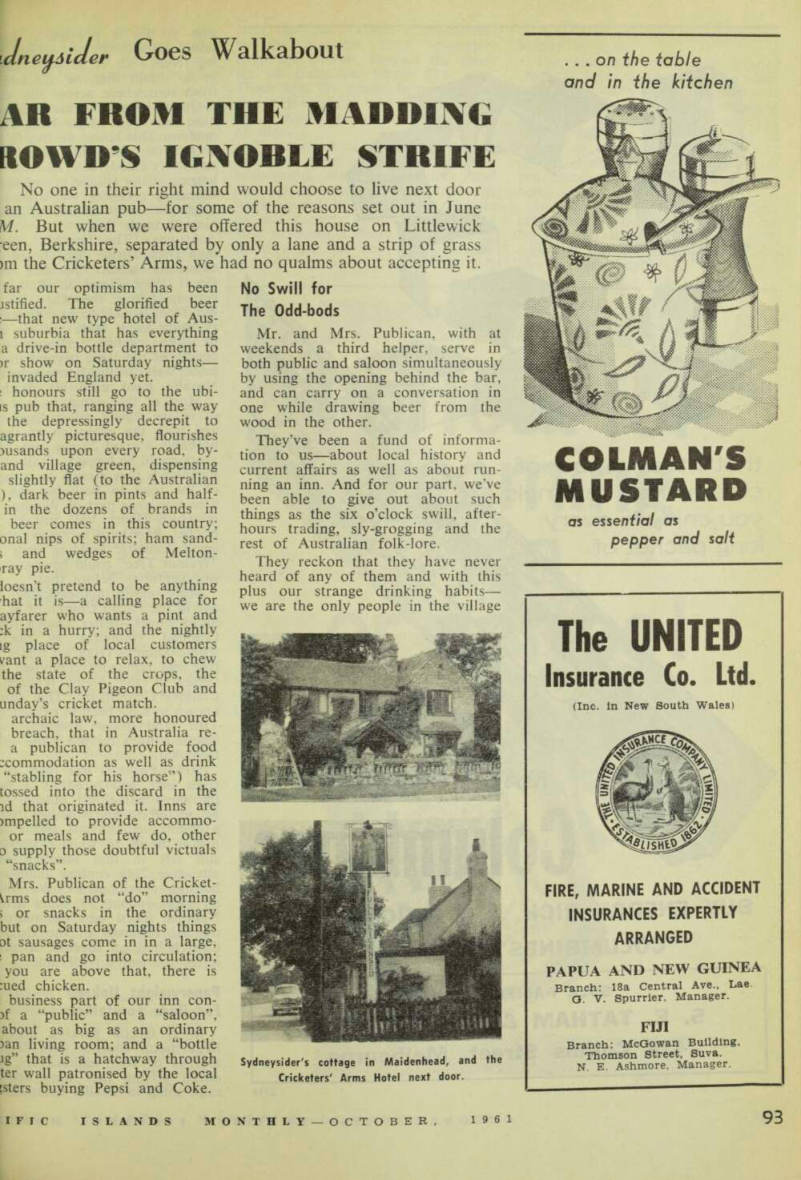
Sydneysider's cottage in Maidenhead, and the Cricketers' Arms Hotel next door.
who go for a pre-dinner drim seven instead of post-supper d> ing from 8 to 10.30 p.m.—they; in no doubt that we are odd from somewhere across the seac Our Cricketers’ Arms is thouga have been built about 1808, whii modern. This house we live in is to be 300 years old, which is paratively modern. The two o houses in the village are of the : timbered variety white-pas brick with dark beams of oak: ning through them.
At one, “The Thimble”, high man Dick Turpin once holed up casionally when operating onr Great West Road to Bath, v runs near here; the other, the “ nut Tree”, is said to be 600 years (Getting away from antique an to 20th century glamour—atf corner of the lane, beyond the ’ brick wall, is the house where ; Novello lived until his death)!
Most of this antiquity is a m of village legend rather than res and with the exception of the probably a good 20 per cent, of : years could be lopped off all of t Farmlands now stretch on eithen of the road to Bath but the w area was once part of Windsor ft in which Henry VIII and his 0 hunted. It is hard to believe thau small domestic building such au “Walnut Tree” could have stood I two centuries before that.
More easily authenticated is age of the Parish Church of St. 0 Stoke Poges—better known to \ Colonial youngster as the where Thomas Gray sat under as tree and reputedly composed thi verses of the Elegy Written Country Churchyard. This chun known to have been in existence 1107 and there probably Saxon church on the same spoc fore that.
Stoke Poges is less than 10 from here and lured by a lam the same name just outside Slol we set off to find whether there a country churchyard and a lowing herds to wander slowly \ still left in that borough ofi attractive 20th century industry\ housing developments. We founi all right—about 37 years afterr National Trust and the more mercial elements of the Establl Church had got together to pres it for tourism for all time.
Paperweight Upkeep
For Rude Forefathers In a special parking area large motor coaches were disgoc tourists of four nationalities, ar dozen private cars were doing same thing in smaller quantities..;
[ us converged on the ancient i like an advancing army, shly keeping to the path and ie grass as instructed by the 5. churchyard has been enlarged since Gray’s day, the part t the road being modern. But i go up to the church porch, ;ely turn your back on the i group which is looking suit )lank while a guide instructs ralubly in their own language; jrmans who are taking photos odd angles; and swarms of :ans who are interested in the lat the adjacent Manor once ed to the Penns, and that Penn -both before and after n who became a Quaker, sailed ie New World and founded Ivania—lie in the family vault the church; you will recapture chyard not very different from . Like he said . . . h those rugged elms, that yew f shade, here heaves the turf in many a mould’ring heap, n his narrow cell for ever laid, ie rude forefathers of the hamlet sleep. i graves have subsided un -1 into the turf since those >ut many ancient headstones and even a few of the i “hurdles” that seemingly i graves at an earlier period, yew tree is still there—bigger, gnarled and just as church ly sombre. Today they use the hat drop off to make polished i paperweights and paper which are on sale in the porch with postcards, pamph d history books. was buried in a tomb in the in August, 1771—that is, Australia became a penal or had even been visited by before the mutiny on the that gave Tahiti its first niche )ry; and at a time when any Islands on the map were here as a result of accident than design. )ugh he wrote other poems— Favourite Cats drowning in h Bowls and Distant Prospects n College—the Elegy is his iduring monument and has, as one a deal of good for the of St. Giles which inspired church, of course, is an monument in its own right such is attacked by death beetle (not the Black Watch, ;ard a tourist say), and other eparable from age. For these the church, the grounds and
even the “lea”, which is maintained by the National Trust separately from the church, support the finest set of collection boxes I’ve seen.
These with the profits from the yew tree paperweights and the postcards in the porch, help stave off the march of time.
The amount of money needed an nually to prop up Britain’s ancient monuments must be fabulous and although it is a good thing that this work should be done, most visitors to this country would probably be glad to make a lump sum payment towards this on entry, and for the rest of their time in the UK be left
to their illusions and enjoyment of history in peace.
The guardians of ancient monu ments in other parts of Europe seem to manage better—at least there you can enter a cathedral without being informed by cunningly contrived notices that the whole edifice is in danger of collapsing on top of you if you don’t immediately put a few lira, francs or marks in the collection box.
In England, ancient edifices other than public, are maintained far beyond the time when they would naturally fall down. This house we live in, for instance. (Over)
lectrician's tare tarted life as two cottages, down the middle with a party t has long since been made le house and is owned by a i solicitor as a week-end re 'he money that has been spent since it was built, perhaps at i of the 17th century, would uilt several modern houses but ould have spoiled its atmo which here is more important he latest in domestic con ies. s most recent form it has had lathrooms added; it’s been d; wired for electricity in a on of unconduited wires and : flex that would make an ian building inspector swoon; ntrally heated from a thermo' ly controlled, oil-fired gadget iasement. dining room, and the drawing hat opens onto the garden at ir, are charming; the kitchen, not being quite 1661 is cer early 1900 (apart from a refrigerator and an electric and the whole thing is full irises—like guessing where the staircase must have been, and isting surviving staircase that eady thrown one member of ty, on her nose, into the centre hall mat; and the five oddly bedrooms; and the cellar we know was there until we put m ironing-board and it disap through what we had imagined
broom cupboard.
the house comes an amiable woman who has never lived
anywhere else, to scrub and polish (on her knees—no electric polisher); and a gardener, two days a week, who has never lived elsewhere either.
His working costume is tweed trousers, shirt with collar and tie, ™ S ‘™' . a f nd , “ ea P. He, looks like y' d .l °, Lady Chatterley s lover, £nri„, k him ’~ ° °-e xce P t for the four-letter words.
We have passionate conversations about there being too much loime, loike, in the soil, a lot of which (in his estimation) is no good for noth ing. Nonetheless, just at the moment this poor soil is producing apples,
rhubarb, cabbages, cauliflowers, beet, vegetable marrows, carrots and so many scarlet-runner beans we bulge in the middle trying to cope. Lady C’s pal tells me that the damned things will go on producing, loike, until the first frost.
While I have been writing this we have been having a junior heat wave and on several days of the last week I have been able to wear, for the first time in England, ever, shorts and a sun-top.
In these circumstances, the late warmth, this house with its antique quaintness, the pub, the Green, Gray’s Elegy church and the hired help, combine into what might be called the expatriate Englishman’s fanciful dream of home.
Alas, the weather boys promise us, tonight or tomorrow morning early, a cold front and a deep de pression moving on the British Isles from Iceland, accompanied by high winds and rain. In such moments the bubble of the expatriate’s dream— and mine—bursts. The house looks dark; the central heating is pushed up a notch or two; and we all climb back into wool suits.
But while the sunshine lasts, all that every homesick Englishman ever wrote from outposts of far-flung Empire comes true. And, even if the fantasy of it has to be financially supported by sixpences and shillings extracted from tourists and from the sale of paperweights hewn from famous yew trees, it’s awfully easy to take.
TONGA. Once Nukualofa, Tonga's capital, was noted for its streets of grass. But arch of progress and the increase in traffic, has now made that impossible and these lukualofa's main street, above, looks no different from those in most South Pacific towns.
Photo: Rob Wright