(And Woman] In New Guinea
pp. 85-87 · Read in the full issue
The Future Of The White Man (And Woman] In New Guinea
That most unpopular word to the official mind, ”in scurity”, is discussed this month by two New Guinea authors /riting in books which otherwise have about as much in ommon as Paul Hasluck has with Mick Leahy.
4E writer looks at the situation from the point of view of the linistration official who wants to :e his career in the Territory. The ;r, the wife of an Assistant Dis- Offlcer, says bluntly what she ks about the situation as it affects ife and mother. he Administration official’s view it is given by Mr. Brian Essai, merly principal of the P-NG lie Service Institute, in Papua New Guinea: A Contemporary vey. He has since left P-NG. he book is published by Oxford, ch manages, I think, to give the mg impression in its dust cover :b about the contents. The blurb, ch is usually the piece read by a son in a bookshop while he is iding whether to buy or not, says t Brian Essai’s book is meant to sent “for the first time within the
pages of a single volume”, a compre hensive survey of the Territory and its developmental activities. The book, says the blurb, is designed to take the facts and put them together as a whole, and make them available to the public in a concise and easily read form.
Thus, the suggestion is that the book is a Papua-New Guinea hand book, and that there is no handbook available. But The Handbook of Papua-New Guinea has been avail able since 1954, and its third edition, 1961, was published earlier this year.
It sells for 15/-.
Brian Essai’s book is in reality what the cover says it is, “a con temporary survey”, and it does what the author himself in a foreword says it is meant to do—it accents descrip tion and interpretation.
There is the difference. The Hand
book gives the plain untarnished facts of the Territory, including a business directory, and makes no effort to interpret, and if this is what the reader wants there is no reason why he shouldn’t save some shillings and buy the Handbook.
Mr. Essai’s book also gives the facts, but he interprets them. He does a good and accurate job of this and his book can be recommended to anybody wanting a simple overall picture of what is going on in the Territory, and what the aims of the Government are for the future—all of it laced with facts and figures.
The book covers, briefly, the his tory of the Territory, its geography its native people (including such things as co-operative enterprise and cargo cults) the government, public facilities, economy, education and health. There is also a very short bibliography—much too short prob ably—and statistical tables. All this gets into 255 pages.
A preface by Dr. John Gunther, one of the Territory’s two Assistant Administrators, comments on the author’s views about an elite. He says he does not agree with Mr.
Essai’s contention that the elite will be thwarted by the Administrations policy of uniform development. Dr.
Gunther says that if the philosophies of the elite are sound the Adminis tration will not frustrate them
(although who, one wonders, is to decide whether they are sound?) Dr. Gunther’s preface has nothing to say about Mr. Essai’s comments on insecurity of employment for Administration officers—which are just as important for NG as his views on the place of an elite.
Mr. Essai makes an appeal for the Government to rethink its policy in positive terms, not only for the benefit of the natives “but for the European resident who cannot be anything but unsettled in view of the uncertain political and economic future of the country.”
He speaks up in particular for the young Administration officers who have 40 years of work ahead of them in the Territory, and who will face an uncertain future because they do not known how speedily the Papuanisation of the service will proceed and how speedily local political agitation will result in their being kicked out of the country • . , , .^ b f n I ffi M r mameS a ,? d , h 'f fh P™ blems a ; e ,. mUl , P lied 0 What of his children and their future?
JV ere will he and they go when he has to leave the country?
This problem has, of course, been iiscussed frequently in PIM and slsewhere, and it is good to see Mr.
Essai taking up the cudgels publicly.
Tis appeal, generally, is for the Government to think much more serimsly of the future of the very men vho are bringing the natives towards
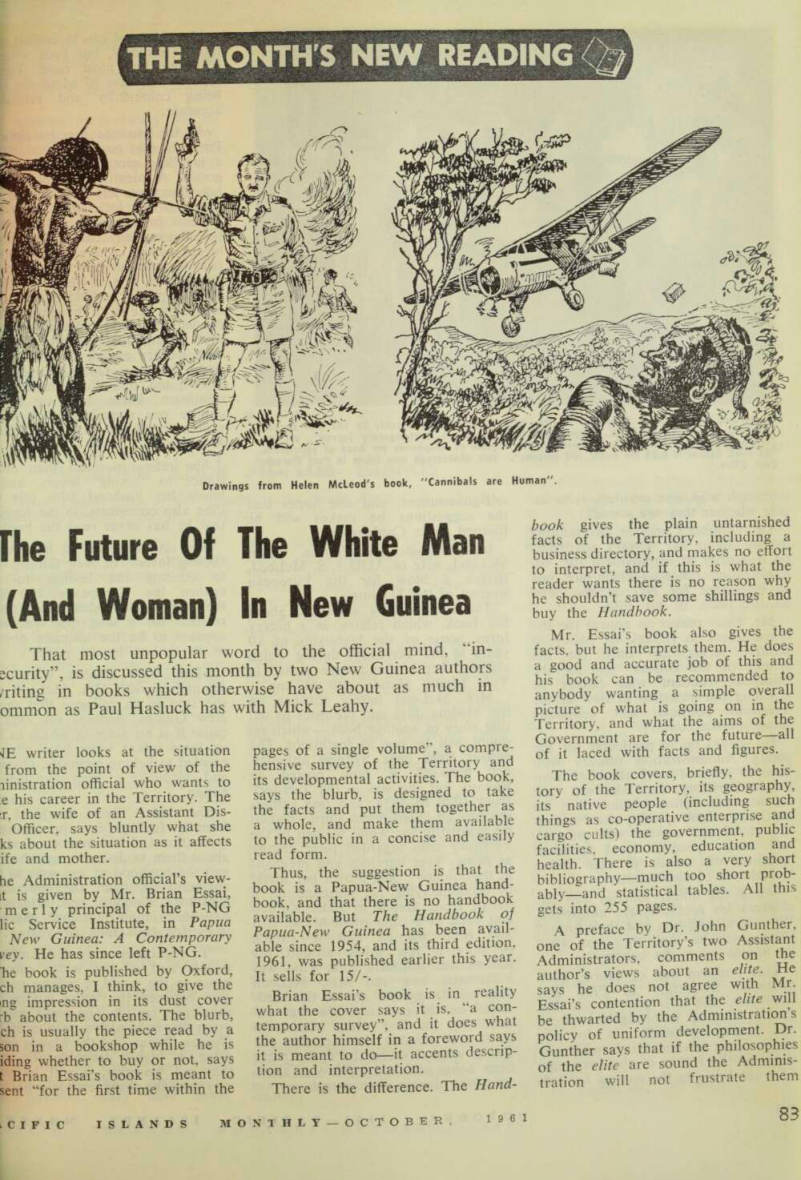
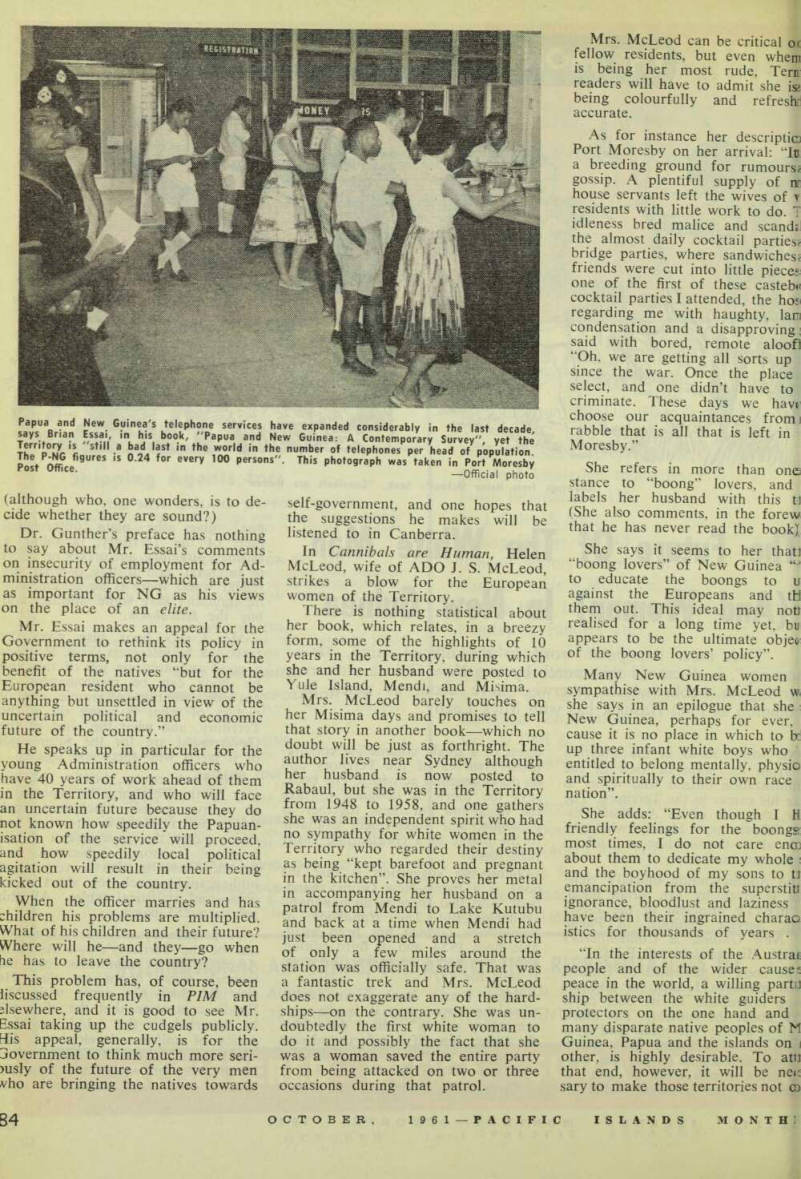
self-government, and one hopes that the suggestions he makes will be listened to in Canberra, In Cannibals are Human, Helen McLeod, wife of ADO J. S. McLeod strikes a blow for the European women of the Territory, There is nothing statistical about h er book, which relates, in a breezy form, some of the highlights of 10 years in the Territory, during which she and her husband were posted to Yule Island, Mendi, and Misima.
Mrs. McLeod barely touches on h er Misima days and promises to tell that story in another book—which no do, i bt w ' l l be l’ ust as forthright. The authorr lives near Sydney although ber . husband 18 n 9 w posted to ? abau ’ but sh ?^ as ln , the Tem fory *T om to 1958, and one gathers she was an independent spirit who had 29 sympathy for white women in the Territory who regarded their destiny ? s bem S £ ept ba F efoot and pregnant m the k,tchen • she proves her metal m accompanying her husband on a Patrol from Mendi to Lake Kutubu and back at a time when Mendi had just been opened and a stretch G f on |y a f ew m ji es around the station was offlcially safe . That was a fantastic trek and Mrs. McLeod does not exaggerate any of the hard ships—on the contrary. She was un doubtedly the first white woman to do it and possibly the fact that she was a woman saved the entire party from being attacked on two or three occasions during that patrol.
Mrs. McLeod can be critical oc fellow residents, but even whem is being her most rude, Tern readers will have to admit she is being colourfully and refreshd accurate.
As for instance her descriptio Port Moresby on her arrival: “Itl a breeding ground for rumours? gossip. A plentiful supply of nn house servants left the wives of v residents with little work to do. T idleness bred malice and scandsl the almost daily cocktail parties? bridge parties, where sandwiches? friends were cut into little pieces; one of the first of these castebK cocktail parties I attended, the host regarding me with haughty, lam condensation and a disapproving j said with bored, remote aloof!
“Oh, we are getting all sorts up since the war. Once the place select, and one didn’t have to criminate. These days we havr choose our acquaintances fromi rabble that is all that is left in Moresby.”
She refers in more than one stance to “boong” lovers, and labels her husband with this tJ (She also comments, in the forew that he has never read the book}: She says it seems to her that} “boong lovers” of New Guinea to educate the boongs to u against the Europeans and tH them out. This ideal may not} realised for a long time yet, bu appears to be the ultimate objeo; of the boong lovers’ policy”.
Many New Guinea women sympathise with Mrs. McLeod w she says in an epilogue that she : New Guinea, perhaps for ever, cause it is no place in which to bd up three infant white boys who entitled to belong mentally, physio and spiritually to their own race nation”.
She adds: “Even though I H friendly feelings for the boongs: most times, I do not care enco about them to dedicate my whole ; and the boyhood of my sons to tt emancipation from the superstiti ignorance, bloodlust and laziness have been their ingrained charao istics for thousands of years .
“In the interests of the Austras people and of the wider causes peace in the world, a willing parti} ship between the white guiders protectors on the one hand and many disparate native peoples of M Guinea, Papua and the islands on j other, is highly desirable. To att} that end, however, it will be nets sary to make those territories not o
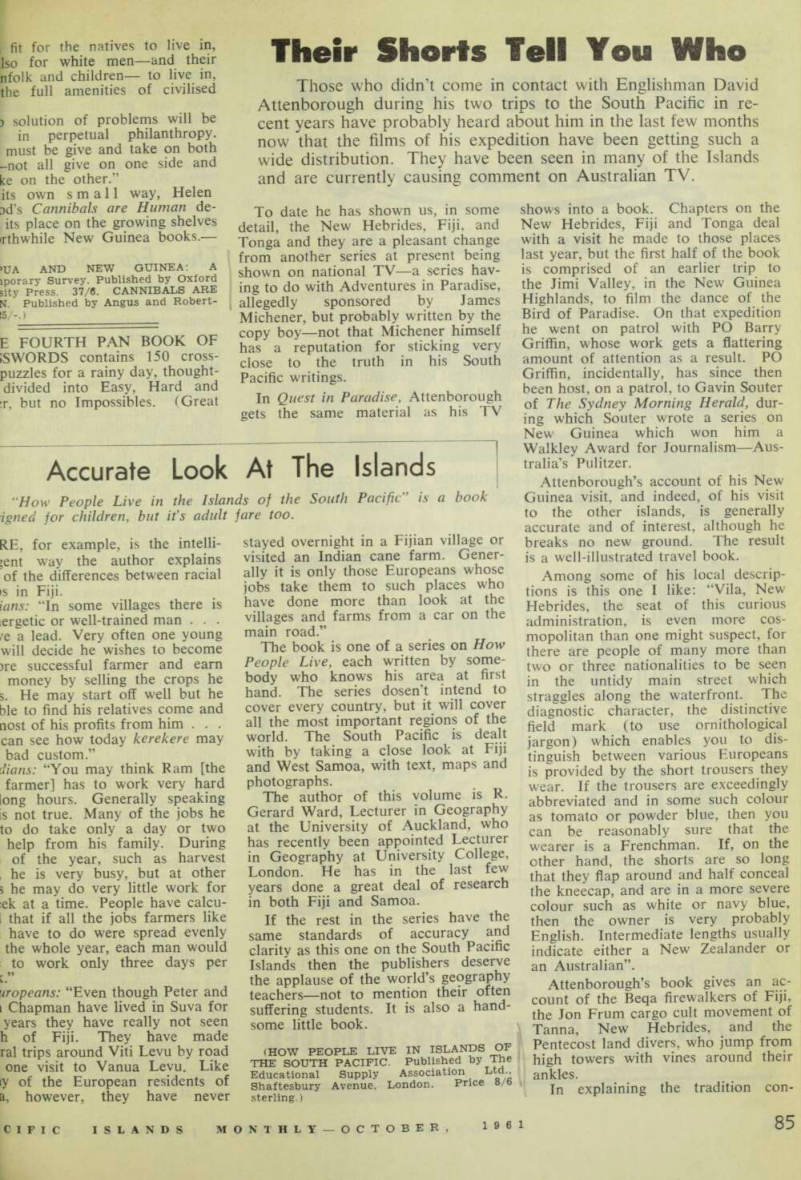
Pap u a and New G uinea's telephone services have expanded considerably in the last decade, says Brian Essai, in his book, "Papua and New Guinea: A Contemporary Survey", yet the Territory is "Sti l l a bad last the world in the number of telephones per head of population. the P-NG figures is 0.24 100 persons ". This Photograph was taken in Port Moresby
Post Office. —Official photo
; fit for the natives to live in.
Iso for white men —and their nfolk and children — to live in, the full amenities of civilised j solution of problems will be
in perpetual philanthropy,
must be give and take on both -not all give on one side and ke on the other,” its own small way, Helen Dd’s Cannibals are Human de its place on the growing shelves irthwhile New Guinea books.—
>Ua And New Guinea; A
iporary Survey. Published by Oxford sity Press. 37/fl. CANNIBALS ARE N. Published by Angus and Robert -15/-.)
E Fourth Pan Book Of
ISWORDS contains 150 cross puzzles for a rainy day, thought divided into Easy, Hard and ;r, but no Impossibles. (Great