War On The Stevenson Legend
pp. 79-80 · Read in the full issue
Robert Louis Stevenson’s claim to fame during his residence in Samoa was not as a story er but as a man with money. He was known to the Samoans not as Tusitala (“Teller of les”) as history has it, but as Miliona (“the millionaire, the rich man”). And the Samoans ren’t terribly happy about his interference in local politics.
This will all sound like heresy to admirers of Stevenson, but the authority for it is West Samoa’s sent Chief Judge, C. C. Marsack. His recently published book, “Samoan Medley” (reviewed in September i) contains an attack on what the author calls the “Stevenson legend” which could have Stevenson fans king their fists from one end of the globe to the other!
idge Marsack’s estimation, the venson Legend has snowballed it has “acquired a size and out of all proportion to the lets”.
Judge says a little soft-hearted icism about RLS and his con i with Samoa can do no harm, lodern Samoans in fact felt
gratitude to his memory because his work had the effect of putting the country on the map.
Rllt f tU , ® ut a P art from that • • .
Tourists with preconceived ideas make a habit of visiting Stevenson’s tomb, says the Judge.
Visitors from foreign parts, he
says, and especially from the United States, “visitors who would not think of making a pilgrimage to Stratford on-Avon, or to the Abbey, to the tombs of the real glories of British letters, feel that something funda mental in their visit to Apia would be lost if they did not toil up the muddy, stoney, and badly kept track
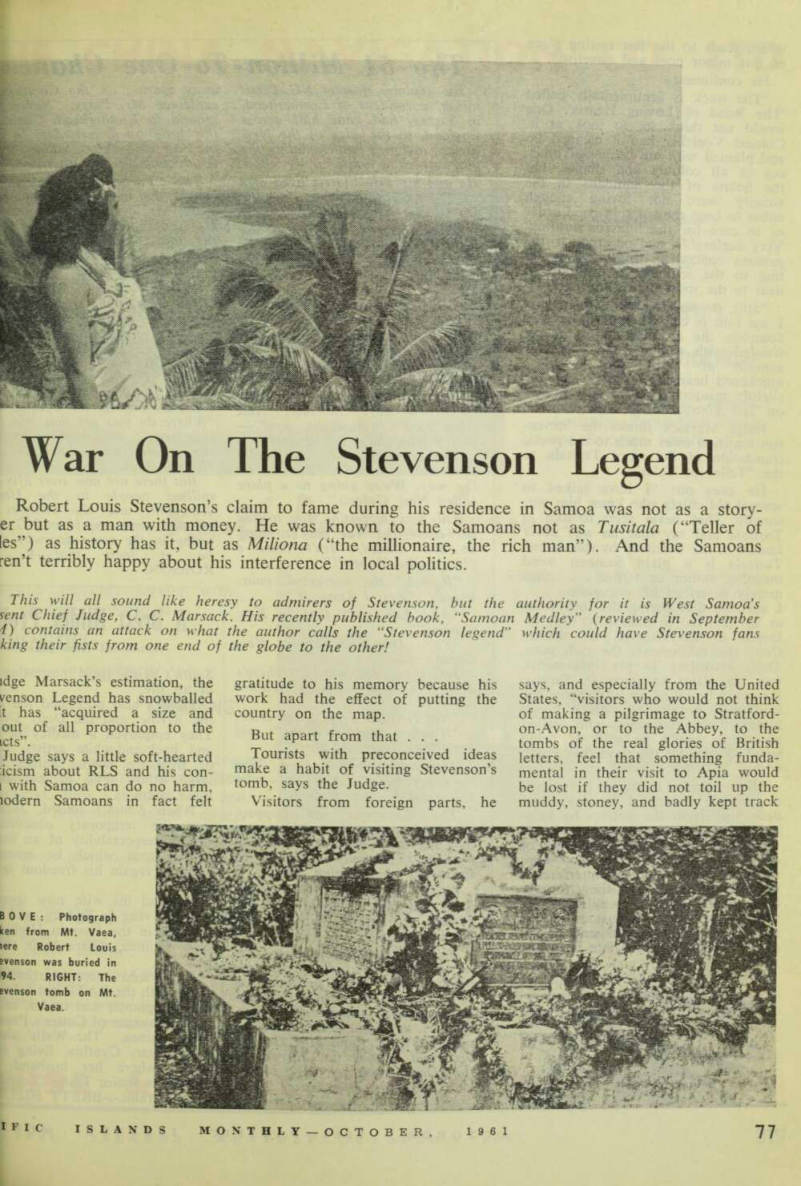
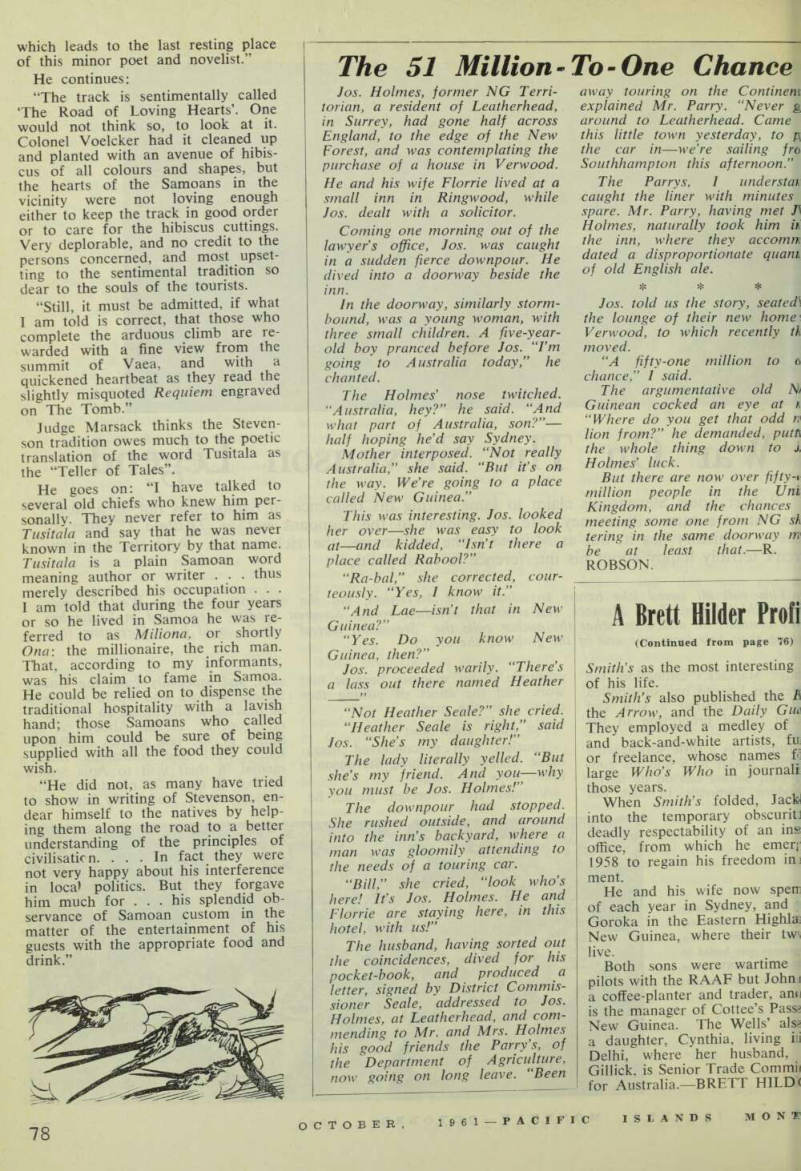
BOVE: Photograph
ken from Mt. Vaea, [?]ere Robert Louis evenson was buried in
[?]94. Right: The
evenson tomb on Mt.
Vaea.
which leads to the last resting place of this minor poet and novelist.”
He continues: “The track is sentimentally called ‘The Road of Loving Hearts’. One would not think so, to look at it.
Colonel Voelcker had it cleaned up and planted with an avenue of hibis cus of all colours and shapes, but the hearts of the Samoans in the vicinity were not loving enough either to keep the track in good order or to care for the hibiscus cuttings.
Very deplorable, and no credit to the persons concerned, and most upset ting to the sentimental tradition so dear to the souls of the tourists.
“Still, it must be admitted, if what I am told is correct, that those who complete the arduous climb are re warded with a fine view from the summit of Vaea, and with a quickened heartbeat as they read the slightly misquoted Requiem engraved on The Tomb.”
Judge Marsack thinks the Steven son tradition owes much to the poetic translation of the word Tusitala as the “Teller of Tales”.
He goes on: “I have talked to several old chiefs who knew him per sonally. They never refer to him as Tusitala and say that he was never known in the Territory by that name.
Tusitala is a plain Samoan word meaning author or writer . . . thus merely described his occupation . . .
I am told that during the four years or so he lived in Samoa he was re ferred to as Miliona, or shortly Ona: the millionaire, the rich man.
That, according to my informants, was his claim to fame in Samoa.
He could be relied on to dispense the traditional hospitality with a lavish hand; those Samoans who called upon him could be sure of being supplied with all the food they could wish.
“He did not, as many have tried to show in writing of Stevenson, en dear himself to the natives by help ing them along the road to a better understanding of the principles of civilisatic n. ... In fact they were not very happy about his interference in local politics. But they forgave him much for . . . his splendid ob servance of Samoan custom in the matter of the entertainment of his guests with the appropriate food and drink.”