territories TALK-TALK
pp. 44-47 · Read in the full issue
With Tolala
There were no punches pulled when Vin To Baining, the elected member for New Britain in the Legislative Council, spilled the beans about the Tolai Cocoa Project at the Council meeting in June. His candid comments on the operations of both native growers and “hungry” traders and the neglect to patronise the official fermentaries, put the spot light on a situation which has unofficially been known to exist for many a moon, and he challenged the government to do something about it and thus enable the £lOO,OOO still owing on the loan to be repaid. And in the September Legco something was done about it.
Keith McCarthy’s somewhat naive reply, after his diplomatic opening ambit, congratulating the speaker on his eloquence and clear explanation, pointed out eventually that the government could make an iron law to compel growers to sell cocoa beans to only government sponsored fermentaries but this, he added, was against our principles. “I do not think we are right in inter fering with trade.”
This brought forth an interjection from Horrie Niall of: “The Copra Board!”
I think the doughty Keith must have had his tongue in his cheek when he uttered that remark. Usually he is very down-to-earth and prac tical in his analogies.
But surely he could not have for gotten the numerous bureaucratic Boards that flourish in Australia con trolling trade, prices and production of such things as eggs and milk, potatoes, fruit, wool, wheat and a dozen other of our primary products.
Incidentally, the present position of the Tolai cocoa growers is somewhat reminiscent of the early thirties in the Gazelle Peninsula, especially when the much discussed Two Mile Limit Ordinance was being debated in the TNG Legco. In those days planters were complaining of the loss of many coconuts from their estates when it was the practice for trading stations to be operating close to the boundaries of plantations and the nuts were sold to traders in the husk. Steps were taken to cancel such trading stations and a limit of two miles was stipulated for the granting of trading licences to other than the plantation owners. But profits were peanuts in those days of low copra prices; nothing compared to present potential profits on cocoa and/or copra.
Alerting Salesmen
It was only a few weeks ago that P-NG newspapers were complaining of missing out on the Australian
Trade Mission that was touring the Pacific to drum up trade, spurred on by the European Common Market.
Now that some financial wizards in Rabaul have worked out that there should be over £lO million hoarded away in native hiding places, we may expect to see an exodus from Australian commercial centres of high-pressure salesmen, eager to get their hands on this hoarded money and bring the careful New Guineans into line with the money-spending natives of Australia, who have such weak control of their appetites that they go into the red to the extent of over £4OO million on H.P. (or is it merely an altruistic urge to maintain employment in secondary in dustries?).
It will be interesting to see whether the government is prepared to en courage this natural tendency amongst the natives to hoard or whether they will allow the experts at separating a man from his money all the privileges of changing the
present-day satisfied native in individual intent on keepin with the white Joneses.
The potentialities of modenr tralian economics being whai are it is a moot question whether some of the hoarding Guineans could not be benes used in Australia to give us lessons in the gentle art of living within our limitations.
But hoarding is an old I Guinea custom. I remember terview with a new Ireland some forty years ago, whi opened a medium-sized cau wood trade box in his hut a £ eyes popped out when I saw it : filled with gold and silver cor A large percentage of thes consisted of the old Neu < Compagnie bird-of-paradise cv; which I vainly attempted to . by offering him twice their face but there was nothing doing.
Much of this hoard, I unde was purchase money paid fo down on the east coast of Nil land.
We have successfully taug New Guineans to relinquish! of their old tribal customs; then become adept in the use and) of alcoholic liquor, embezzs forgery, drunken driving and) other of our civilised vice: virtues, so I suppose we will . satisfied until we teach them become spend-thrifts and nn their souls for the goods they \ need but which we want them.
On with the rat race in the name of progress!
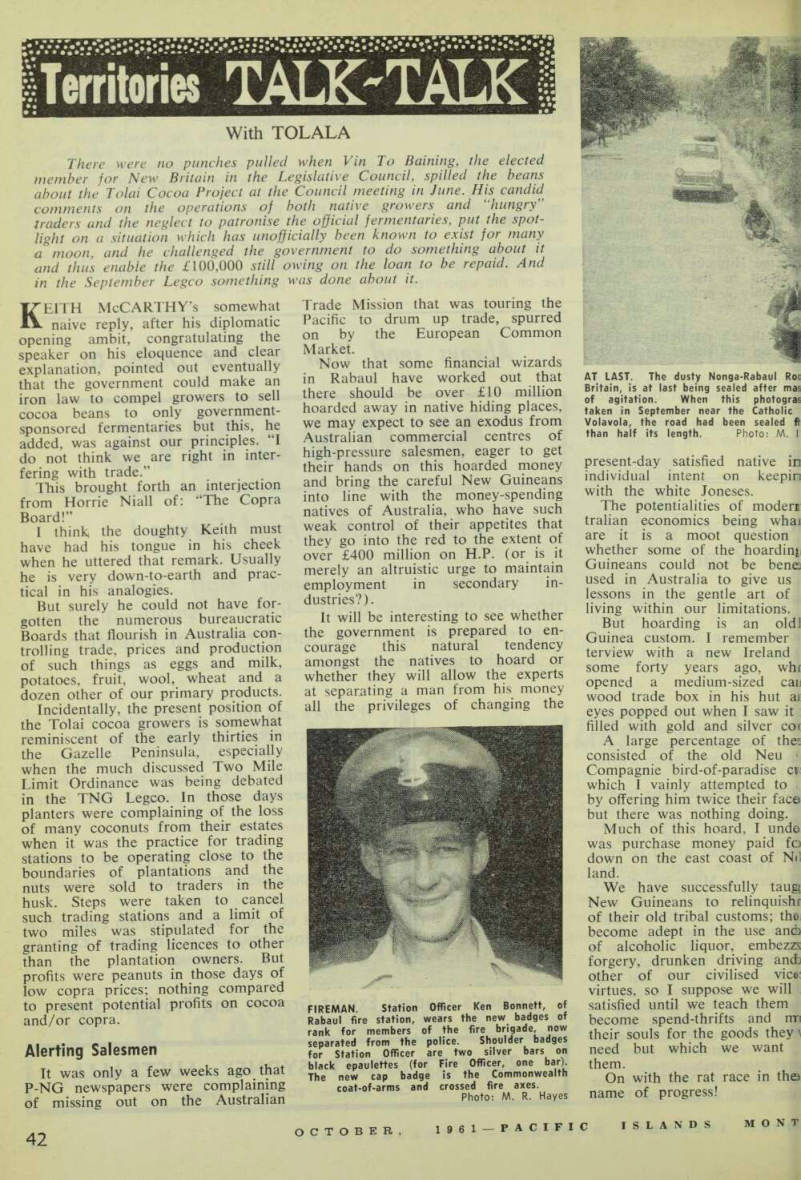
AT LAST. The dusty Nonga-Rabaul R[?] Britain, is at last being sealed after mas of agitation. When this photogras taken in September near the Catholic Volavola, the road had been sealed ft than half its length. Photo: M. I
FIREMAN. Station Officer Ken Bonnett, of Rabaul fire station, wears the new badges of rank for members of the fire brigade, now separated from the police. Shoulder badges for Station Officer are two silver bars on black epaulettes (for Fire Officer, one bar) The new cap badge is the Commonwealth coat-of-arms and crossed fire axes.
Photo: M. R. Hayes
Rabaul nt i might have imagined that, ing the Rabaul fracas at the f July, there would have been ;e of letters to the editor ap l in southern newspapers deal th the matter, offering varying s and solutions but, insofar as 'dney papers were concerned, rate, this was not the case, ley editors, probably, and wisely, realised the initial had greatly over-played the t and “least said, soonest i”. icy’s modernised Bulletin 1) did, however, run a post i from the pens of V. H. nder, “formerly an employer >ur in Rabaul”, as the period scribed him but better known Is in the Territory as a scribe ■ Rabaul Times some six years id D’Arcy Ryan, “an anthro t with wide experience in New ”. Neither of whom broke rticular new ground.
F.’s “obvious solution” was triate the Sepiks. “It takes two :e a quarrel and this action eliminate one of the two. But lically it would be ruinous to businesses, which depend for f their labour on the Sepiks.” ; has something there, for un ed “foreign” tribesmen allowed tin in areas, hundreds of miles heir homes, are bound to rouble in the end. agrees up to a point with but suggests “one of the first e could take in that direction be to avoid the patronising 3t for natives shown by Mr. ider. His attitude is unfor r typical of many Europeans Guinea and has done noth ncrease our popularity there”, includes; riots in Rabaul are just an episode underlining New s general problem : the don’t like us, they don’t like her, and they lack any imme ’conomic incentive to work nd develop their country. It be naive to suggest that ~er to them and pay them would solve a problem as c as this one; but it might be start. e September 23 issue of The our old friend “Kassa” nd had a finger in the pie. Of timers none is more capable ssing the position, especially }8 the Sepiks whom, he it was absurd to class as one and in conclusion said; J years of administration and
exploration in New Guinea, I found no evidence of any racial clash.
Headhunting and other tribal affrays there were, to be sure, but invariably caused by trespass and more often than not between peoples speaking the same language. The Rabaul riot was serious enough; and might have been much worse, but for Heaven’s sake let us not make a Congo out of it.
The “post riot” peace feast, which received much publicity, was appar ently another incident well over played by the Press, which is greatly to be pitied. Surely it is time that
accredited newspaper correspondents in P-NG adopted a more moderate and more truthful attitude towards local incidents for the good of Aus tralia generally and the retention of confidence in their news value in particular.
My own advice to “foreign labourers” in Rabaul, if they desire to avoid such incidents in the future, is to stop pinching the bottoms of female Tolais.
It may be an old Roman custom, but it is definitely frowned on in Rabaul, sophisticated and all as it may be! (Over.
They Fade
Away
Bill Watson, DSO, DCM,, and bar, passed to his rest in i York on September 11, and an colourful old NG identity take count. He was one of the on members of the AN&MEF in j to take over NG from the Gen I remember Bill as one oc early Exproboard employees stau on the east coast of New Irelanr one of the Red Cycle Mob, included such well-known chan as “Blue” and K. T. Allen, Braddon, “Tony” Edgell, Tom ! and the Moccatto Brothers, Frankie Saunders sitting at his in Kavieng as District Super dent.
Several of them owned Red ! motor cycles, which tore up down the road at regular intd They were all a good teamr Bill (perhaps because he was. tain of the AIF Rugby Unionc in the UK in 1919), was an ao ledged leader.
He spent some time on the M goldfields after leaving the and later on he and Herk Bn had a gymnasium and fl school in Sydney before Bill hi the land of the Stars and S He was Australian Vice Cone New York for a period. . . M rest peacefully.
Left or Right Foot?
“Supercargo’s” story about the Recruits Went Home”
PIM, p. 76) had some good m it, and I was glad to see the a to debunk the idea that all birders were unscrupulous s so’s.
The writer’s reference Charles Read, the elongated : that boarded island vessels * into Sydney to give pratique, . back vivid memories of So.
Islands’ and New Guinea pas? leaning over the rail when tH tor’s launch came alongside t«j fully watch which foot he first! on the gangway.
It was an old Islands cus? those days for passengers to whether it would be the right; foot. And I have seen big change hands over this flutto; That New Guinea
Seaport
Last month I tossed a casual tion into the pool of suggest!!; garding “Lae and Leahy” anu result, received several lettoi and against.
a cross-word enthusiast: it do you suppose those mys is gentlemen who construct word puzzles would do if they their three-letter word for A Guinea seaport?” He’s got some there, of course. But I still Leahy is a good idea. i in i talking about P-NG ports, it nesting to compare the amount ide carried on in the Papuan Vew Guinea ports respectively ie nine months ending March, Total imports were 16,658; exports £11,333,685. uch a healthy balance. In de-
le wonder that occasionally re are passed favouring decen tion. ood Kanda" ;ctor of Forests Suttie is I as saying there is a £100,000 [ export market for rattan cane the Territory. ms always surprised me why atural product of P-NG has been properly organised and es established for the manu ; of cane furniture for the nds of new homes being 1 for Administration officials 1 of importing the weird 1 modern chairs, tables, and lots which have become a la in the Jones’ home over the ecade or so. Sales promotion isly on the part of southern ire dealers. why not organise some sales tion for P-NG cane furniture, is the natural material to be n tropic countries all over the 1 ’Tis an industry awaiting de lent and working cane comes 1 to the native people of both and would not be competing either Australian primary or lary industries.
I as an adjunct, what about um (often incorrectly called baskets? They stand on their a that particular line of goods.
Imports Exports (in (in £ millions) £ millions) [oresby 6.6 2.0 li .6 .4 4.2 4.5 3.5 2.1 7 9 * * 2.9 1.5 g .3 .7 1U .1 .1 .7 .04