Beer and Transistors
pp. 34-39 · Read in the full issue
Highlights of the P-NG Budget Session
Beer and Transistors v Court Houses
From a Staff Writer in Port Moresby Now who would have guessed, before this 1961 Budget Session of the P-NG Legislative Council got going in its swank new Council Chambers in September, that the trappings of justice in the form of £70,000 worth of new court houses would have made such an impression on its members?
IT was a long session, but those court houses came up for heated discussion during the first hours, and were still being hurled about the chamber, as it were, at the closing stages.
One way or another, everybody, including the spectators, learned things one wouldn’t expect to learn from a court house.
The court houses were listed in the Works Programme, which happened to mention that new ones were to be built on the outstations of Kerema, Tapini, Popondetta, Finschhafen and Kavieng and that additions were to be made to the court house at Kai ruku.
Not Unnoticed Ordinarily they would have passed unnoticed among the print, but not this time. For this was the time Harold Reeve, the Territory’s brand new Assistant Administrator for Economic Affairs, unfortunately chose to tell the House that cash was short and that the Administra tion planned to whack up the price of beer, spirits, lolly-water, cameras, radios and cars to balance the budget.
Tariff increases on all these things and a few others, said Mr. Reeve, would get the country another £85,000 for the remainder of the year.
The elected members didn’t think this was a very good way of balanc ing the budget.
“In private enterprise when you plan to spend more money than you have,” said nominated member B.
Fairfax-Ross, “you cut your spend ing plans!” Whereupon he moved that the bill for the tariff increases be shelved for six months—which is the same as wanting to throw it out.
The Government got mad at this, and what followed then—and again later in the session when the question again came up—was rather fascinat ing.
Twice the opposition put their at tack to the vote, firstly in the attempt to throw out the bill, and secondly in an effort to reduce the estimates by shelving the court houses until next year. They never came near to suc cess either time.
All through the fighting, most op ponents insisted that they weren’t moving a vote of no confidence—they didn’t want to overthrow anybody— they just wanted to indicate how some money could be saved.
Government members, although not by a long shot unanimous in their attitude until leader of the House Dr. John Gunther was able to get among them, took the stand that any attack on a financial measure was an attack on the Government and couldn’t be allowed to succeed.
This is the attitude any Govern ment has to adopt, but it’s not a principle that’s accepted in the Terri tory yet, where members are liable to shoot from the shoulder, frontier fashion—and leave the finer points of political strategy to the Canberra professionals.
As lan Downs said, once tan creases are put on they are in<i to stay on. Because every dt mental head happens to be since his appeal for things to be adeb the Works Programme, it dt mean that they should be pro T c and the opposition’s job is toe money.
Mr. Fairfax-Ross, still the: speaker in the House, said 9S cent, of the increased charges T fall on the white population. Tlf patriate community at present! resented li per cent, of the ; population, yet found about 5 95 per cent, of the revenue. Thee munity was already carrying as as it should be expected to bean nobody could tell him that j could not be served this year out those court houses. There been an increase in tariff on II items in 1959, when income ta:r been introduced.
Wau planter, former-ADO Hurrell said a lot of things cou looked at with the idea of s money—such as Administration r entitlements.
Perilous Mr. Keith McCarthy, Direct: Native Affairs; Why didn’t your of that when you were an AU Mr. Hurrell: I have only; covered it since I have had years without leave in private prise!
Although this was not the H debate it became perilously nn at times as the Government mes somehow found themselves g up to defend (a) the need fon wretched court houses and (W need for just about everything in the budget.
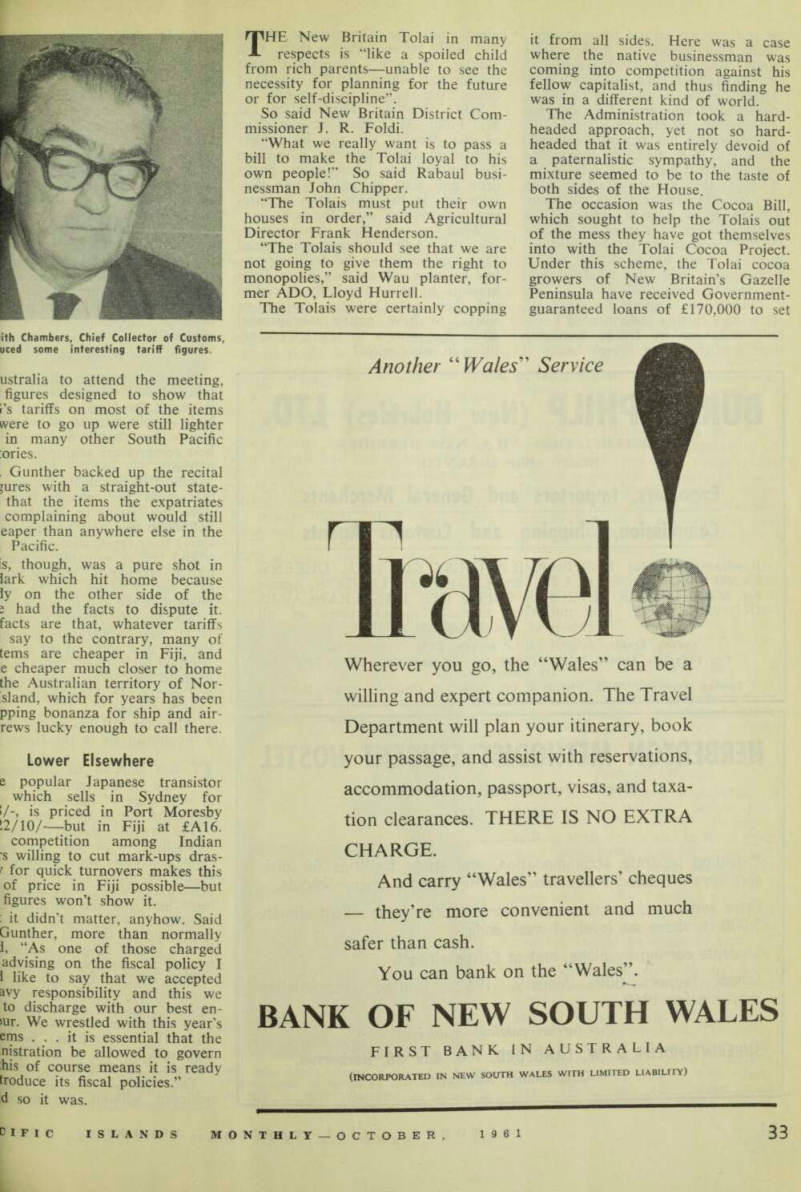
Chief Collector of Customs ; Chambers, who interrupted his s
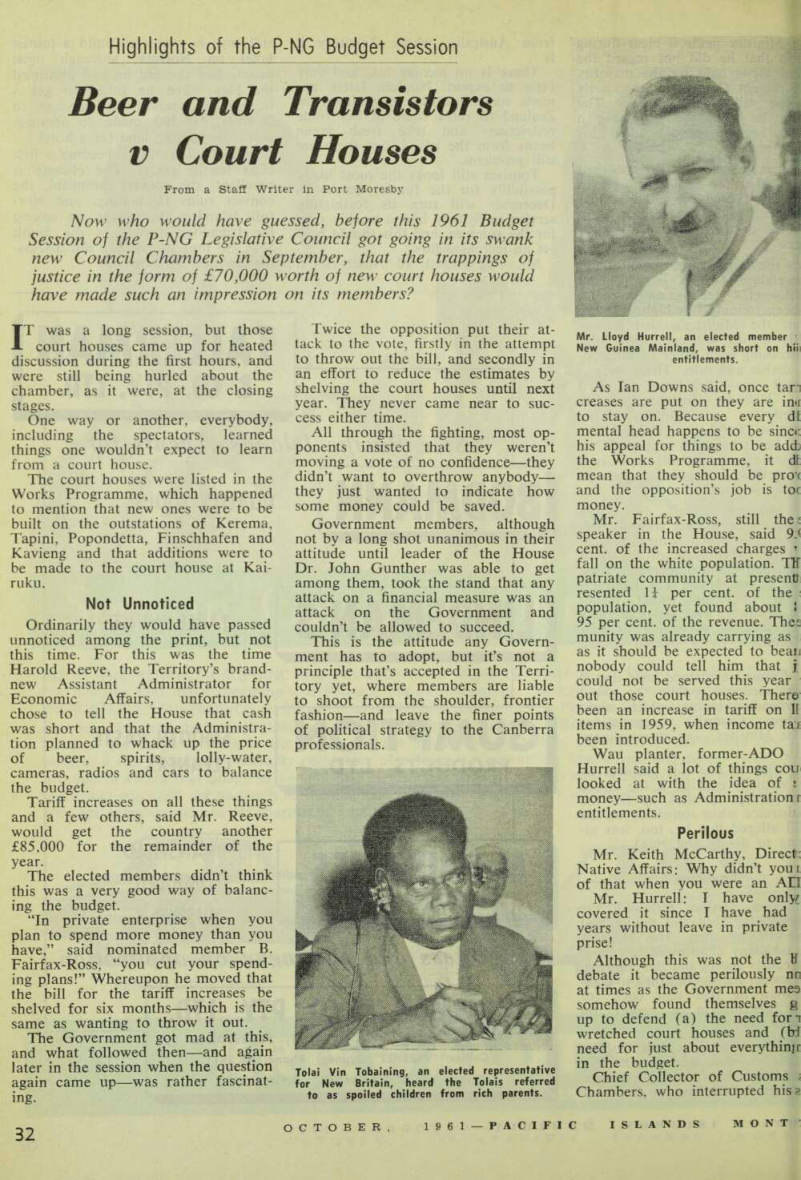
Tolai Vin Tobaining, an elected representative for New Britain, heard the Tolais referred to as spoiled children from rich parents.
Mr. Lloyd Hurrell, an elected member New Guinea Mainland, was short on hi[?] entitlements.
ustralia to attend the meeting, figures designed to show that f’s tariffs on most of the items were to go up were still lighter in many other South Pacific ;ories. , Gunther backed up the recital ;ures with a straight-out state that the items the expatriates complaining about would still eaper than anywhere else in the Pacific. is, though, was a pure shot in lark which hit home because ly on the other side of the j had the facts to dispute it. facts are that, whatever tariffs say to the contrary, many of terns are cheaper in Fiji, and e cheaper much closer to home the Australian territory of Nor island, which for years has been pping bonanza for ship and air rews lucky enough to call there.
Lower Elsewhere e popular Japanese transistor which sells in Sydney for !/-, is priced in Port Moresby 12/10/ —but in Fiji at £AI6. competition among Indian •s willing to cut mark-ups dras f for quick turnovers makes this of price in Fiji possible—but figures won’t show it. : it didn’t matter, anyhow. Said Gunther, more than normally i, “As one of those charged advising on the fiscal policy I 1 like to say that we accepted avy responsibility and this we to discharge with our best en »ur. We wrestled with this year’s ems ... it is essential that the nistration be allowed to govern his of course means it is ready troduce its fiscal policies.’’ d so it was.
rpHE New Britain Tolai in many A respects is “like a spoiled child from rich parents—unable to see the necessity for planning for the future or for self-discipline”.
So said New Britain District Commissioner J. R. Foldi.
“What we really want is to pass a bill to make the Tolai loyal to his own people!” So said Rabaul businessman John Chipper.
“The Tolais must put their own houses in order,” said Agricultural Director Frank Henderson.
“The Tolais should see that we are not going to give them the right to monopolies,” said Wau planter, former ADO, Lloyd Hurrell.
The Tolais were certainly copping
it from all sides. Here was a case where the native businessman was coming into competition against his fellow capitalist, and thus finding he was in a different kind of world.
The Administration took a hard headed approach, yet not so hard headed that it was entirely devoid of a paternalistic sympathy, and the mixture seemed to be to the taste of both sides of the House.
The occasion was the Cocoa Bill, which sought to help the Tolais out of the mess they have got themselves into with the Tolai Cocoa Project, Under this scheme, the Tolai cocoa growers of New Britain’s Gazelle Peninsula have received Government guaranteed loans of £170,000 to set
[?]ith Chambers, Chief Collector of Customs, [?]uced some interesting tariff figures.
up and operate central fermentaries.
The management has been in their hands, and the 17 fermentaries in their area have been producing high quality cocoa as well as being a valuable training ground in business and agricultural problems.
The project has received universal plaudits as a success, but in the last year or two it has struck trouble.
When the project started there were no other fermentaries, but competition from outside interests has brought things to a stage where new private fermentaries are handling almost as many beans as the project fermentaries, with the resultant loss of project revenue.
Traders are touting for business, sometimes carting unfermented beans long distances by truck, damaging their quality. Some accept beans at
night, and the Government thinks this might be encouraging theft. One planter recently complained that thieves had stolen £lO,OOO worth of beans from his trees in 12 months, Some “bootleg” fermentaries (as Mr. Foldi called them at one stage of the debate) are run by traders with many other interests, who close the fermentaries when cocoa prices drop and start up again when they improve. In the poor times the pro ject fermentaries carry the baby, What was to be done about protect ing the Administration - guaranteed loans and bolstering the declining pro ject business without bowing to Tolai pressure to have everybody forced to sell their beans to the project—or worse, to have native management given the powers to restrict compe tition in other ways?
As Dr. John Gunther said, ] to restrict free enterprise wouii be delegated from central Gd ment to anybody. To force anr to sell was too drastic.
The answer has been to drs a bill designed to give the Ten breathing space so they can irrr on their competitive tactics, and) to attract back from their own \ the beans that are going to thr siders.
The new law forbids transpK unfermented beans to outside it controls the number of fermen; in the Tolai area and ration competition; it restricts movemr beans to daylight hours. Thu provision for appeals and traden have a complaint can demau explanation.
Intelligent
Majority opinion during th telligent and earnest debate was it wasn’t the kind of bill that body would like to see befon House, but that it was probabd best compromise available, and 1 a trial.
John Chipper made the good that since the present fermei: were not going to be (although new ones probably co start) their registrations in good would “be as valuable as somei tralian taxi-plates” (where poss; of a set of plates can be won more than the cab to put them i And Morobe District Commisi H. H. Niall was frankly unhapp the bill was going to set a pres and that the natives everywhere : demand similar assistance with i and copra. In Finschhafen thr already started.
When the bill was passed thee a thoughtful air in the House. .
IT was difficult to distinguisi tape from industrial act: at one stage of the session, an confusion for a time was proo The trouble started followii troduction of a bill on ind safety, health and welfare, sought to make every village : drier a “factory”, with a licentr inspectors and the normal rec associated with registration, was more to the bill than th;r it also sought to give additions tection to genuine factories.
The united European nw launched an attack—not on thir ciple of the bill as it affects i (“all members will support said Mr. Fairfax-Ross) but bf they said it went so far that ridiculous. It should be redran The aims of the bill com achieved without the necesse,
ing and binding the natives :d tape”, and involving in costs at a time when the y couldn’t afford them if we ill to believe Mr. Reeve’s Christopher Colombus and Cook subscribed to all the egulations we have today, the nd the Arunta would doubt lain undisturbed in their hunt mds in the continent of North i and in Australia,” com- Mr. Fairfax-Ross, who was 1 at this further instance of sing taken from Australia and willy nilly on to the Terri here conditions were so dif 'eship rules in a rowing boat,” . lan Downs, who used to be "Lethal" e is no more lethal weapon ands of a native than an iron 3tary mower, but neither is here,” said Mr. Jack Chipper, led that in any case the num iccidents in Rabaul in the last s could be counted on the Jf one hand, and that he had I a sawmill for sixteen years t anyone losing a finger”, h Director Roy Scragg came that and threw some figures ie floor of the House that surprised Mr. Chipper and dy else. ie last five years, said Dr. 190 natives had died in the y in industrial accidents, out tal employment figure in in of 7,000. 118 of these acci
dents had occurred on the New Guinea side.
There had been 200 industrial accidents a year in the Territory in the last five years and this was a higher rate than in Australia. These figures were for natives only.
The bill was needed, said Dr.
Scragg, who felt that “certain things said by certain members” had in dicated an “unawareness of the im portance of industrial accidents”.
The private members wouldn’t have that, and stressed again they weren’t objecting to industrial pro tection but to slow strangulation from red tape.
Yet there wasn’t any doubt that somewhere along the way, despite their best intentions, the accident angle kept getting prominence and anyone could be pardoned for think ing the opposition was attacking what it said it wasn’t.
You could probably put it down to the enthusiasm of the debate.
There were some surprised looks when things turned out better than most people had hoped for. The Ad ministration adjourned the debate and altered the bill in committee so as to delete some of the battleship rules for rowing boats. Village copra driers were not now “factories”.
IT’S a good thing for most of the outer areas of Papua-New Guinea that there is usually somebody to champion their needs every so often
in the Legislative Council. Most people in the Sepik, Bougainville or New Ireland probably suspect that without a mention in Legco now and again Port Moresby would forget they were there. Maybe Port Moresby already has, as it continues to add stretches of kerb and guttering out there in Boroko.
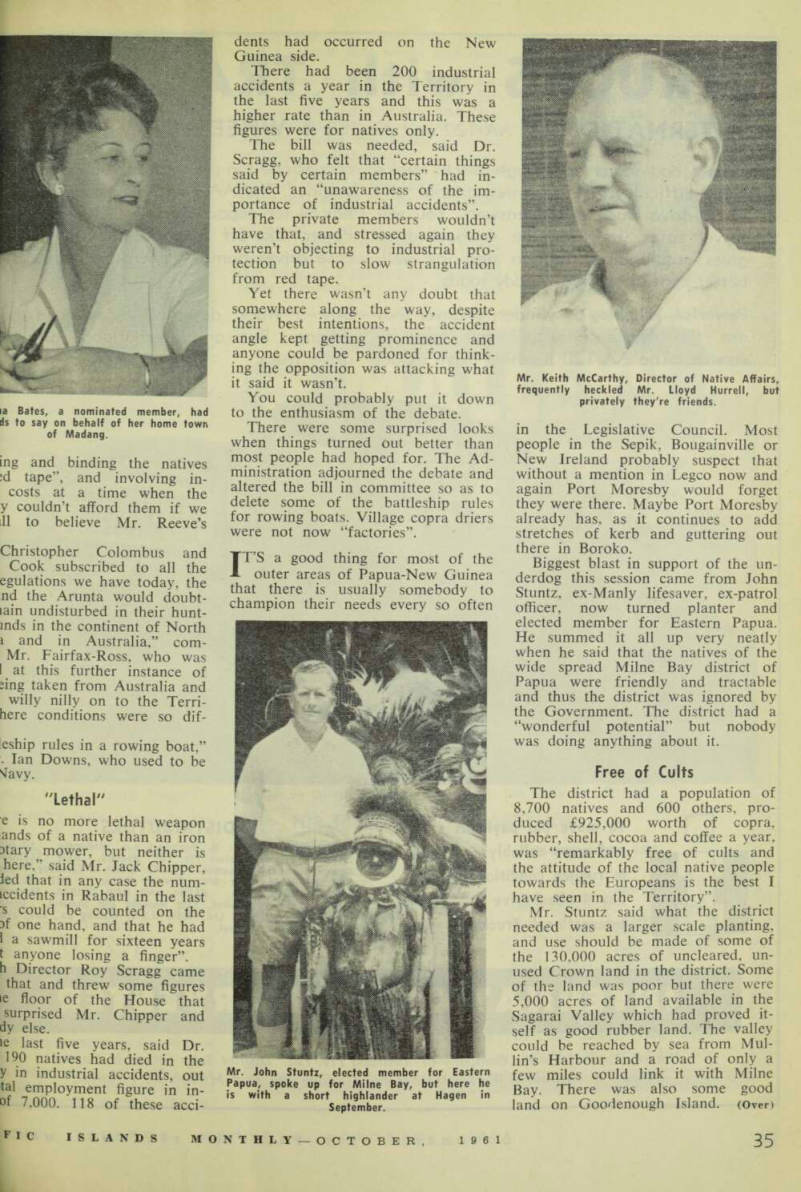
Biggest blast in support of the un derdog this session came from John Stuntz, ex-Manly lifesaver, ex-patrol officer, now turned planter and elected member for Eastern Papua.
He summed it all up very neatly when he said that the natives of the wide spread Milne Bay district of Papua were friendly and tractable and thus the district was ignored by the Government. The district had a “wonderful potential” but nobody was doing anything about it.
Free of Cults The district had a population of 8,700 natives and 600 others, pro duced £925,000 worth of copra, rubber, shell, cocoa and coffee a year, was “remarkably free of cults and the attitude of the local native people towards the Europeans is the best I have seen in the Territory”.
Mr. Stuntz said what the district needed was a larger scale planting, and use should be made of some of the 130,000 acres of uncleared, un used Crown land in the district. Some of the land was poor but there were 5,000 acres of land available in the Sagarai Valley which had proved it self as good rubber land. The valley could be reached by sea from Mul lin’s Harbour and a road of only a few miles could link it with Milne Bay. There was also some good land on Goodenough Island. (Over)
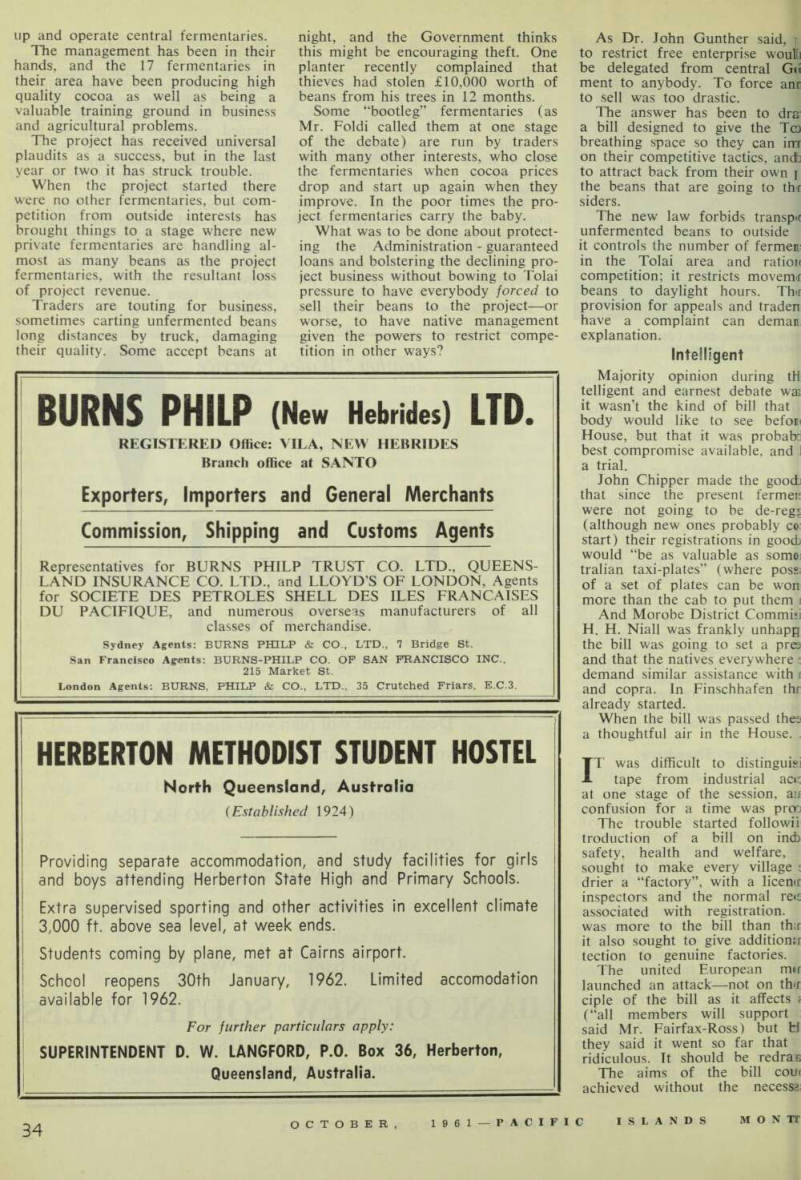
Bates, a nominated member, had to say on behalf of her home town of Madang.
Mr. John Stuntz, elected member for Eastern Papua, spoke up for Milne Bay, but here he is with a short highlander at Hagen in September.
Mr. Keith McCarthy, Director of Native Affairs, frequently heckled Mr. Lloyd Murrell, but privately they're friends.
the areas could be developed nly a few roads, and what was was a campaign to advertise lands for settlers.
Stuntz said local people I to see more money spent on is for the district—particularly ima and one in the Es’ala dis sum up,” said Mr. Stuntz, “we ncerned by the lack of recent JS.”
Roma Bates, widow of a Madang District Commis put a word in for her home as a “ghostly town” these days d, because it was covered with om the roads, with wear and n drivers, pedestrians, throats es as the dust fogged the town, cal natives walked about with of rag or handkerchiefs cover sir faces to keep out the dust, was coral and abrasive, years people had promised to le roads, but Madang people isking, “How much longer?”
STUNTZ paid tribute to the ccess of the Ex-servicemen’s icheme in the Popondetta area by European and native ex men are given long-term loans mting) and suggested the time rived to extend it to people than ex-servicemen, this matter was taken up in ietail by Mr. John Chipper, of I, speaking shortly after Mr.
He said there were men who mething to offer the Territory ad been too young to partici n the war, or who had been to join the services for various s. re were many men who had capital and were prepared to it and work it up in the in
terests of primary production, if there was a scheme that would give them assistance.
Territory bankers were already tied to a credit policy “formulated for, and in, Australia, and for some time past virtually no funds have been available from the banks for new primary development.”
Mr. Chipper said even if funds were released in the future by the banks they would not be of the order which could help this kind of de velopment.
Mr. Chipper * suggested a Credit Development Scheme which proposed that loans of a £25,000 maximum be made available to men not older
than 50, who had lived for at least three years in the Territory, who could provide at least 15 per cent, of the total development cost.
The borrowers would have to prove they had financial ability enough to conduct their development.
Interest and repayment would be along the lines of the present Ex servicemen’s Loan Scheme.
Footnote : The ex-servicemen’s scheme has been operating for three years and has made 90 loans to European ex-servicemen, with an other 12 at present being handled, and 70 loans made to native ex servicemen. Loans approved total £1,970,000.
Brokam, elected member for the New Islands, took a special interest in the cocoa bill.