Legislative Council
pp. 20-143 · Read in the full issue
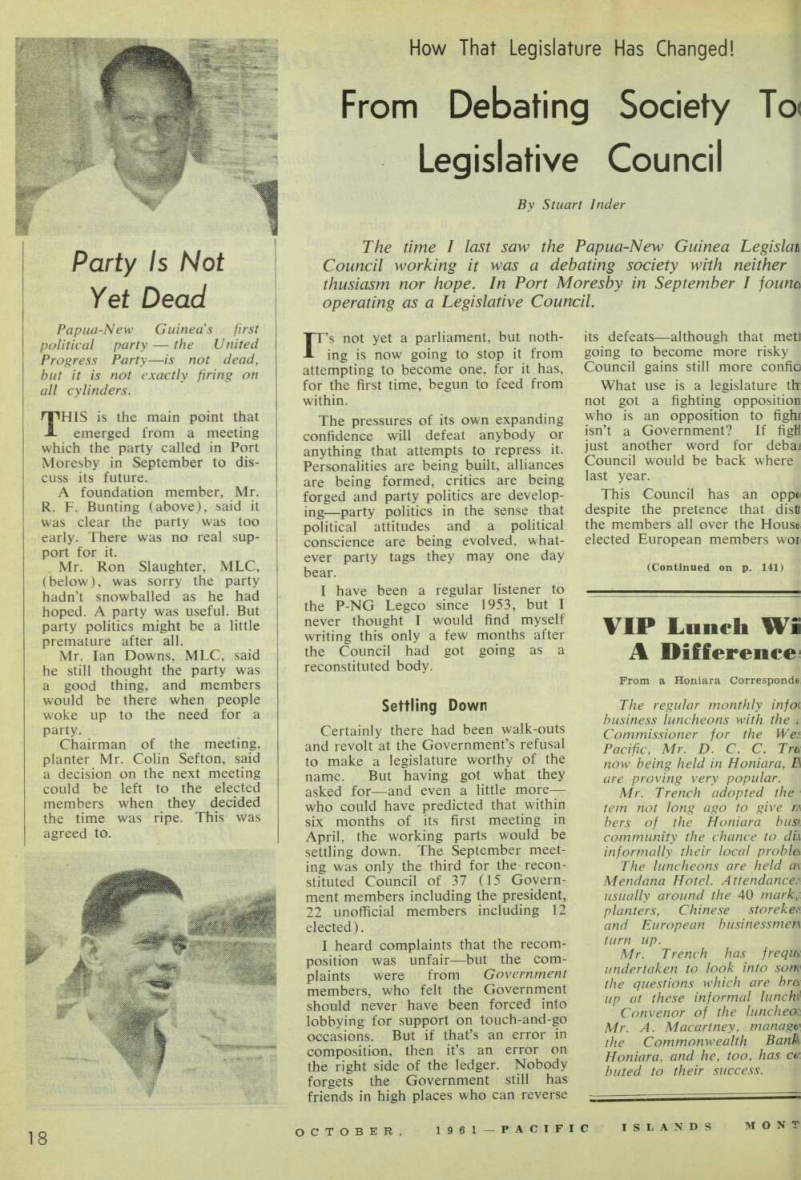
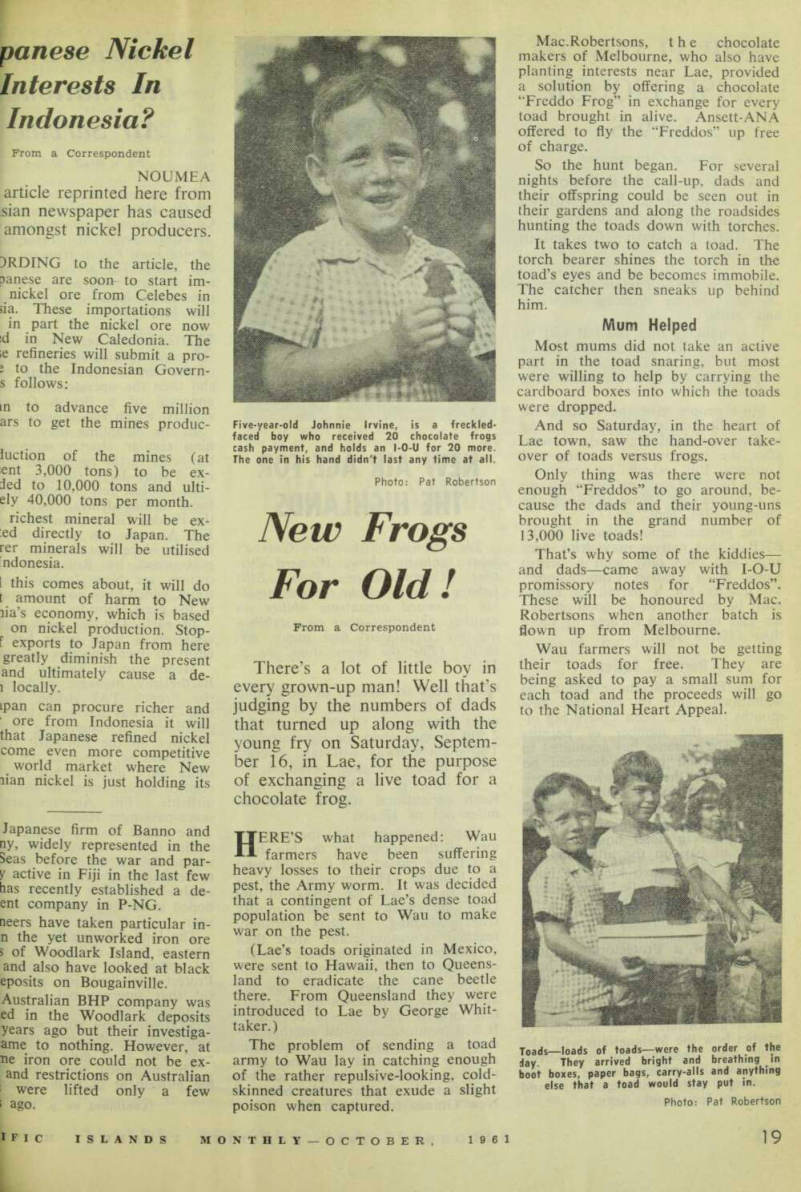
How That Legislature Has Changed!
From Debating Society To Legislative Council
By Stuart Inder
The time I last saw the Papua-New Guinea Legislu Council working it was a debating society with neither thusiasm nor hope. In Port Moresby in September I foum operating as a Legislative Council.
r’s not yet a parliament, but noth ing is now going to stop it from attempting to become one, for it has, for the first time, begun to feed from within.
The pressures of its own expanding confidence will defeat anybody or anything that attempts to repress it.
Personalities are being built, alliances are being formed, critics are being forged and party politics are develop ing—party politics in the sense that political attitudes and a political conscience are being evolved, what ever party tags they may one day bear.
I have been a regular listener to the P-NG Legco since 1953, but I never thought I would find myself writing this only a few months after the Council had got going as a reconstituted body.
Settling Down
Certainly there had been walk-outs and revolt at the Government’s refusal to make a legislature worthy of the name. But having got what they asked for —and even a little more— who could have predicted that within six months of its first meeting in April, the working parts would be settling down. The September meet ing was only the third for the recon stituted Council of 37 (15 Govern ment members including the president, 22 unofficial members including 12 elected).
I heard complaints that the recom position was unfair —but the com plaints were from Government members, who felt the Government should never have been forced into lobbying for support on touch-and-go occasions. But if that’s an error in composition, then it’s an error on the right side of the ledger. Nobody forgets the Government still has friends in high places who can reverse
its defeats—although that met] going to become more risky Council gains still more confic What use is a legislature th not got a fighting opposition who is an opposition to fighi isn’t a Government? If figH just another word for debaj Council would be back where last year.
This Council has an opp* despite the pretence that dish the members all over the House elected European members woi
(Continued on p. 141)
team, but then, they always did. t is more interesting is that the id native members are develop a pattern despite earlier fears n the Council that they would ime ducks. “Brown brother” is ng out not to be brown brother I, but another bloke with a point iew—and if that isn’t political •ess then I’m a Tolai! >t only have the Europeans :d to tell the native members they think of their views— id of sitting quietly while some em made painful asses of them >; but the natives are also oping political views about each •sonalities stand out. The native aer developing most prominently > to be Somo Sigob, a shrewd man representing New Guinea ;al. He looks like being a natural can. □ben Taureka, hailed only a time ago as being a Papuan r, is now politically dead—killed overnment patronage. t-European John Guise still has roblem ahead of him—whether e identified with the native e or the European. He has a in both camps yet, and stands ance of being politically un ar in both. His gift of the he is a better speaker than European members—may even out to be a handicap.
: parliamentary traditions are
on people like these, for they eople to examine, and for the time Council members are rung to examine each other. j Government members too have given a new lease of life. The lays have gone when most sat Sepik carvings and left all the g to one or two. ire was a great deal of give and in the September debates, with Government members giving as as they got. At one time the ;ary for Law, Mr. W. W. ins, was even willing to dive in »ffer Mr. Downs an explanation ) why P-NG now had two ant Administrators, but fortun for the Government Mr. Downs leaded off with an adjournment n so the back-room boys could time to think out an explanation.
John Gunther has developed a real Government leader, with aajor fault—he continues to take attack on the Government as a
personal whack on his own head, an attitude which is guaranteed to create ulcers for himself but none for the opposition.
But men like that are also in the parliamentary tradition.