In Defence
pp. 17-18 · Read in the full issue
An End to Petty Rivalry!
In Defence Of Suva
From a Correspondent Fiji has come out in a rash of festivals this year. We’ve al ready had Nadi’s Commerce Week, in September we hailed Hibiscus Week and early October saw Lautoka’s Cession festivities complete with a Miss Sugar.
ADMIRABLE, each in its own way, the fun and games unfortunately underline yet another issue on which Fiji is in danger of being split—the scramble for tourists. Always, it seems, Suva is the villain.
Ensnaring the precious tourists into its beautiful harbour, it divests them of dollars or sterling to the benefit of Suva’s businesses and traders . . . while the rest of Fiji, for the most
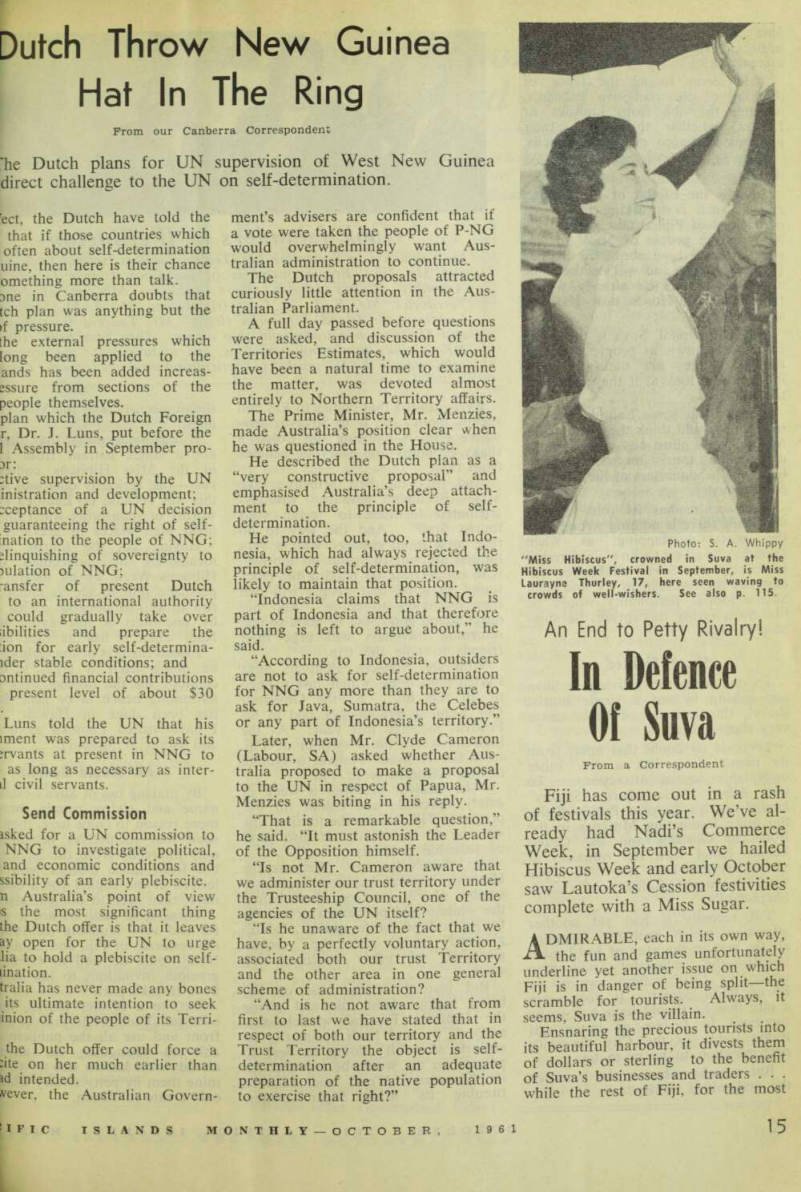
Photo: S. A. Whippy "Miss Hibiscus", crowned in Suva at the Hibiscus Week Festival in September, is Miss Laurayne Thurley, 17, here seen waving to crowds of well-wishers. See also p. 115.
part as beautiful, is ignored and neglected, Korolevu’s cash customers excepted.
This seems to be the tenor of thinking of the non-Suva residents, whether they be from Lautoka or Labasa, whether they voice their opinions in Legco or local councils.
But surely it is very muddled thinking.
Suva is the capital of the Colony and as such is it asking too much of the rest of Fiji to take some pride in it, as the people of NSW for in stance like to brag about the Sydney Harbour Bridge and will be the same no doubt about the already world famous Opera House now shooting skyward?
As Fiji’s capital, Suva is the name most well-known to people overseas, the place they are naturally most interested to look at if they ever visit the islands.
Yet, to hear some Lautoka spokes men, one would think they would like to see Suva a ghost city with Lautoka a flourishing tourist mecca as well as being the headquarters of the Colony’s chief industry.
Each centre has its role to play and while there is nothing wrong with the parts overlapping, as when Lautoka entertains interested travellers, or Suva establishes in dustries, for Lautoka to try and steal Suva’s tourist personality would be like Suva trying to capture the ship ping of sugar.
Short Sighted
To one temporarily living in Suva and raking in not a single tourist shekel, this jealousy of Suva seems very short-sighted.
There is no doubt that apart from its name, Suva has a few other undeniable tourist attractions. To wit, Albert Park where “Smithy” landed on his historic Pacific flight, the quite fascinating Museum in the Botanical Gardens and the Grand Pacific Hotel with the romance of years past that have put it on a par with Singapore’s Raffles and Cairo’s Shepheard’s.
Till recently it had yet another attraction which probably outshone all the rest in the eyes of just-landed tourists—the colourful policeman under his little yellow awning on Burns Philp corner. It does seem a pity that he should have had to be sacrificed in favour of impersonal traffic lights in the City Council’s determination to be up-to-date.
But anyway what is the point of the undignified rivalry?
Every tourist that comes to Fiji and spends money, be it in Suva or any where else, is assisting the Colony’s shaky economy and everyone benefits from that.
And isn’t the best principle, like Mrs. Beeton’s perhaps wrongly attributed formula, to “catch your tourist first?” And the way to do this, in a small country with a very limited amount to spend on tourism, is to concentrate on making the place sound so good that people will feel they just have to come. And not only “sound good” but be good so that returning travellers will urge their friends to take the trip.
With its Hibiscus Festival, Suva started something which just seemed to fill this bill. As the Governor (Sir Kenneth Maddocks) said in his Festival message this year: “As the hibiscus is the floral symbol of Fiji, so is the Hibiscus Festival a symbol of the friendliness of Fiji.
“The festival provides a week of gaiety, spectacle and colour for our people in Fiji and for the tourists who visit us at this time. It also gives us valuable publicity. . .
Ay, there’s the rub. Because the Hibiscus Festival has now become a symbol of Fiji overseas where before the white-sulu’d policeman practically fought a lone battle against Tahiti’s glamour girls and the various gimmicks of other tourist-seeking spots.
But instead of the rest of Fiji being happy about this and giving the Hibiscus Festival wholehearted support, we find Nadi (primarily an airport, after all) doing its best to pounce on the would-be traveller for its Commerce Week, and Lautoka running its Miss Sugar contest
simultaneously with the Miss Hi quest.
It was noteworthy that then not a single entrant from L:. in the Miss Hibiscus contes?
year—one seriously questions m
this was because no Lautoka gi worthy of sponsoring when they filled high places in previous Having got the tourist hef means of the policeman oc Hibiscus Week, by all means, persuade him to see as much rest of Fiji as possible. This i by one who is just dying to Nadi when it has its race mx Indeed the rest of the Colony be doing itself a great servr clamour for the making of a ] swimming beach in or near Sv< has been done in Hawaii.
I have visited Lautoka as a and swam at Saweni).
All Would Benefit By making use of Suva’s estaU name and giving people mon more reason to come here, they soon find themselves benefitim only indirectly from the Suva tt but from those tourists who I looked at the capital for a coibj days, then seek to fan out else’e These local festivals are a wv ful and very laudable institutioi the residents of Fiji, and LautoH Nadi would do well to extendi; gracious invitations to the peoc Suva to take part.
But, to a former tourist, thri overseas should be to present a front and use all the publicity \ able to strengthen the attrs’ already well known not try to mine them by petty rivalry whioi only create confusion.