Pacific Commerce and Produce
pp. 155-156 · Read in the full issue
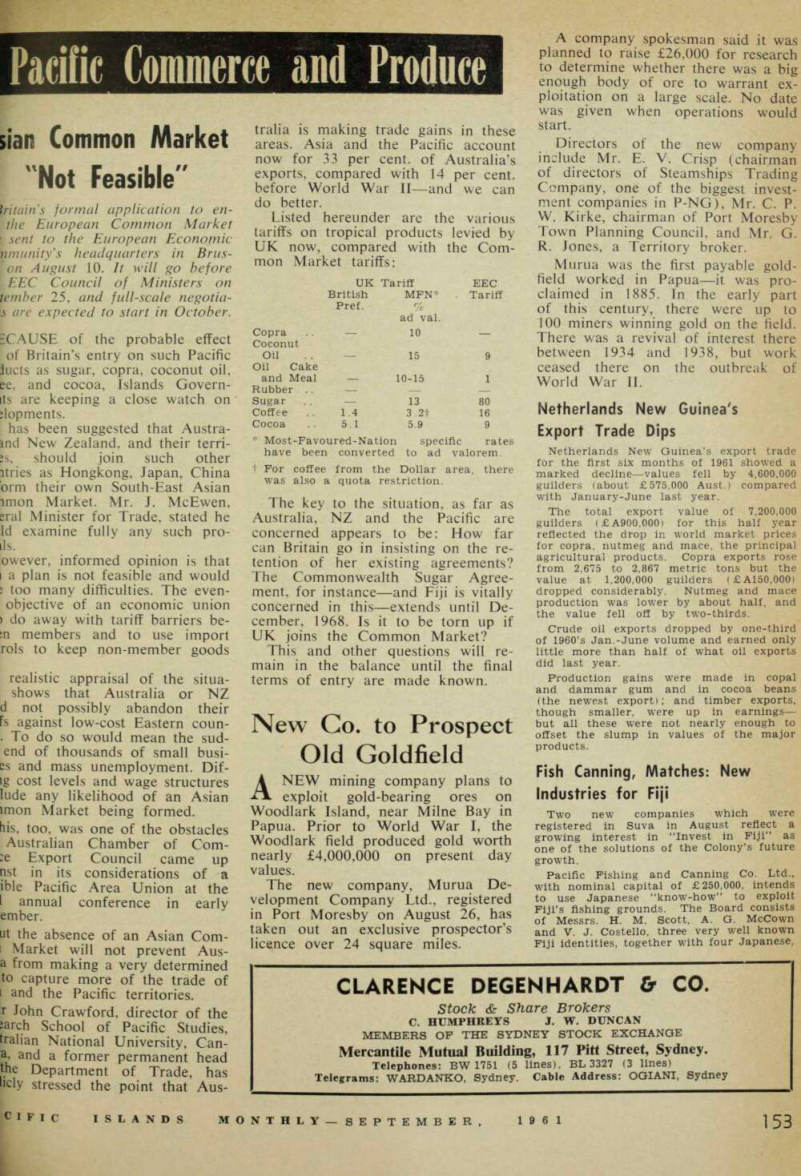
sian Common Market "Not Feasible"
Britain’s formal application to en . the European Common Market t sent to the European Economic nmunity’s headquarters in Brus *on August 10. It will go before [ EEC Council of Ministers on tember 25, and full-scale negatio ns are expected to start in October.
ECAUSE of the probable effect of Britain’s entry on such Pacific iucts as sugar, copra, coconut oil, ee, and cocoa. Islands Govern its are keeping a close watch on dopments. has been suggested that Austra md New Zealand, and their terri ts, should join such other itries as Hongkong, Japan, China drm their own South-East Asian imon Market. Mr. J. McEwen, eral Minister for Trade, stated he Id examine fully any such pro ils. owever, informed opinion is that i a plan is not feasible and would 5 too many difficulties. The even objective of an economic union ) do away with tariff barriers he rn members and to use import rols to keep non-member goods realistic appraisal of the situa shows that Australia or NZ d not possibly abandon their Fs against low-cost Eastern coun . To do so would mean the sud end of thousands of small busi es and mass unemployment. Dif ig cost levels and wage structures lude any likelihood of an Asian imon Market being formed, his, too, was one of the obstacles Australian Chamber of Com :e Export Council came up nst in its considerations of a ible Pacific Area Union at the 1 annual conference in early ember. bt the absence of an Asian Com i Market will not prevent Aus a from making a very determined to capture more of the trade of i and the Pacific territories, r John Crawford, director of the iarch School of Pacific Studies, tralian National University, Can a, and a former permanent head the Department of Trade, has hcly stressed the point that Aus
tralia is making trade gains in these areas. Asia and the Pacific account now for 33 per cent, of Australia’s exports, compared with 14 per cent, before World War II —and we can do better.
Listed hereunder are the various tariffs on tropical products levied by UK now, compared with the Com mon Market tariffs;
: Most-Favoured-Nation specific rates have been converted to ad valorem. 1 For coffee from the Dollar area, there was also a quota restriction.
The key to the situation, as far as Australia, NZ and the Pacific are concerned appears to be: How far can Britain go in insisting on the re tention of her existing agreements?
The Commonwealth Sugar Agree ment, for instance—and Fiji is vitally concerned in this—extends until De cember, 1968. Is it to be torn up if UK joins the Common Market?
This and other questions will re main in the balance until the final terms of entry are made known.
New Co. to Prospect
Old Goldfield
ANEW mining company plans to exploit gold-bearing ores on Woodlark Island, near Milne Bay in Papua. Prior to World War I, the Woodlark field produced gold worth nearly £4,000,000 on present day values.
The new company, Murua De velopment Company Ltd., registered in Port Moresby on August 26, has taken out an exclusive prospector’s licence over 24 square miles.
A company spokesman said it was planned to raise £26,000 for research to determine whether there was a big enough body of ore to warrant ex ploitation on a large scale. No date was given when operations would start.
Directors of the new company include Mr. E. V. Crisp (chairman of directors of Steamships Trading Company, one of the biggest invest ment companies in P-NG), Mr. C. P.
W. Kirke, chairman of Port Moresby Town Planning Council, and Mr. G.
R. Jones, a Territory broker.
Murua was the first payable gold field worked in Papua—it was pro claimed in 1885. In the early part of this century, there were up to 100 miners winning gold on the field.
There was a revival of interest there between 1934 and 1938, but work ceased there on the outbreak of World War 11.
Netherlands New Guinea's
Export Trade Dips
Netherlands New Guinea’s export trade for the first six months of 1961 showed a marked decline—values fell by 4,600,000 guilders (about £575,000 Aust.) compared with January-June last year.
The total export value of 7,200,000 guilders (£A900,000) for this half year reflected the drop in world market prices for copra, nutmeg and mace, the principal agricultural products. Copra exports rose from 2,675 to 2,867 metric tons but the value at 1,200,000 guilders (£A150,000) dropped considerably. Nutmeg and mace production was lower by about half, and the value fell off by two-thirds.
Crude oil exports dropped by one-third of 1960’s Jan.-June volume and earned only little more than half of what oil exports did last year.
Production gains were made in copal and dammar gum and in cocoa beans (the newest export); and timber exports, though smaller, were up in earnings— but all these were not nearly enough to offset the slump in values of the major products.
Fish Canning, Matches: New
Industries for Fiji
Two new companies which were registered in Suva in August reflect a growing interest in “Invest in Fiji’’ as one of the solutions of the Colony’s future growth.
Pacific Fishing and Canning Co. Ltd., with nominal capital of £250,000, intends to use Japanese “know-how” to exploit Fiji’s fishing grounds. The Board consists of Messrs. H. M. Scott, A. G. McCown and V. J. Costello, three very well known Fiji identities, together with four Japanese,
UK Tariff
Eec
British Pref.
Mfn"
% ad val.
Tariff Copra Coconut — 10 — Oil Oil Cake — 15 9 and Meal 10-15 1 Rubber .. — Sugar — 13 80 Coffee 1.4 3.2t 16 Cocoa 5.1 5.9 9
Messrs. K. Nagashima, Y. Banno, F.
Suesada and T. Yamada.
The company proposes to base opera tions at Levuka, where there are good waterside facilities and buildings suitable for conversion to a canning factory.
Crews of vessels and all technical experts will be Japanese. This move should give a deserved lift to “forgotten Levuka”, the one time capital.
The other company plans to make safety matches in Fiji, and Legco recently granted protection to the industry, which will be established by Pacific Manufacturers Ltd. All machinery and materials for the manufacture of matches will be admitted duty free and the industry declared a “protected” one.
Mr. M. H. Akbar, a director, has declared confidently that the firm will soon capture the Fiji market; it hopes to ex port later to nearby territories. Other directors are reported to be three members of Legco, Messrs. A. I. N. Deoki, B. D.
Lakshman and H. B Gibson, together with Mr. R. A. Emery, recently retired Comptroller of Customs.
Extensive use of local materials is planned and the industry should partly relieve unemployment in the area where the factory is planned.
Dylup Cleared £30,000
On Finance Co. Sale
Dylup Plantations Ltd., New Guinea, sold its interest recently in Island Finance Company Ltd. (an unlisted NSW company acquired late last year) for £72,000 cash.
Payment is by a substantial deposit (already received) and the balance over 12 months. The company realised capital profit of approximately £30,000 on the sale of this asset.
BSI Cocoa Price
To Be Reviewed
Government officials in BSI have been taking a close look recently at the economics of the Protectorate’s cocoa in dustry.
The cocoa price, c.i.f., Liverpool, in July, was £214 Aust. per ton, against £287 Aust. per ton in July. 1960. They calculate that in order to justify the BSI price of 6d per pound for wet beans, after taking into account processing and marketing costs, an overseas price of £233 Aust. per ton must be available.
Latest reports about the overseas cocoa market emphasise that, while both pro duction and consumption of cocoa are in creasing, the rate of consumption is nowhere near equal to the production in crease.
The Government price for wet beans throughout 1961 has been higher than the market warrants, and it seems unlikely that any significant rise in cocoa prices can be expected at present.
The local price for wet beans will be maintained at its present level until October 1, when it will be reviewed, to take account of the world price, process ing and transport costs.
Meanwhile, UK has approved a supple mentary grant of £101,164 Aust. for the Protectorate’s Cocoa Development Scheme, which will bring the total expenditure, from the start of the scheme to March 31, 1964, up to £283,500. About £45,000 of this will be contributed by BSI and the rest, including the new grant, will come from Colonial Development and Welfare funds.
The grant will enable the Government to recruit additional overseas extension staff, in order to keep pace with cocoa plantings and increase their total acreage, appoint additional local staff; and meet housing and transport requirements.
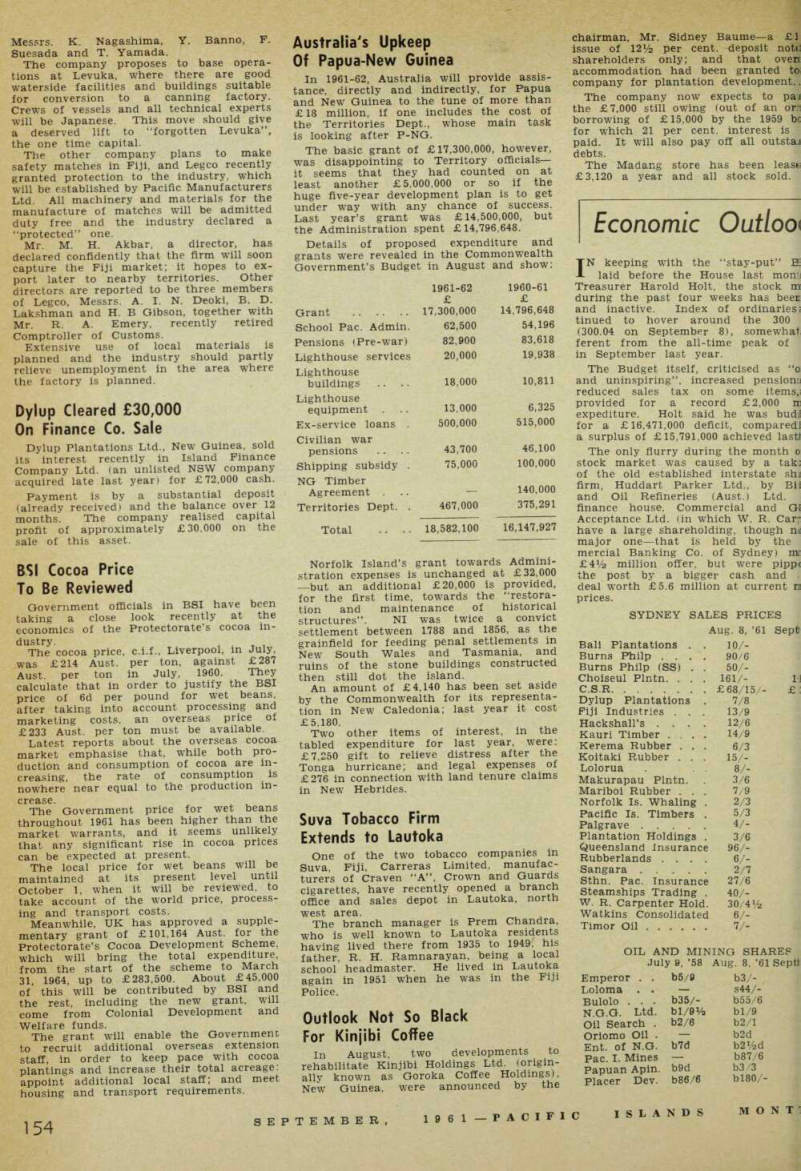
Australia's Upkeep
Of Papua-New Guinea
In 1961-62, Australia will provide assis tance, directly and indirectly, for Papua and New Guinea to the tune of more than £lB million, if one includes the cost of the Territories Dept., whose main task is looking after P-NG.
The basic grant of £17,300,000, however, was disappointing to Territory officials— it seems that they had counted on at least another £5,000,000 or so if the huge five-year development plan is to get under way with any chance of success.
Last year’s grant was £14,500,000, but the Administration spent £14,796,648.
Details of proposed expenditure and grants were revealed in the Commonwealth Government’s Budget in August and show;
Norfolk Island’s grant towards Admini stration expenses is unchanged at £32,000 —but an additional £20,000 is provided, for the first time, towards the “restora tion and maintenance of historical structures”. NI was twice a convict settlement between 1788 and 1856, as the grainfleld for feeding penal settlements in New South Wales and Tasmania, and ruins of the stone buildings constructed then still dot the island.
An amount of £4,140 has been set aside by the Commonwealth for its representa tion in New Caledonia: last year it cost £5,180.
Two other items of interest, in the tabled expenditure for last year, were; £7,250 gift to relieve distress after the Tonga hurricane; and legal expenses of £276 in connection with land tenure claims in New Hebrides.
Suva Tobacco Firm
Extends to Lautoka
One of the two tobacco companies in Suva, Fiji, Carreras Limited, manufac turers of Craven “A”, Crown and Guards cigarettes, have recently opened a branch office and sales depot in Lautoka, north west area.
The branch manager is Prem Chandra, who is well known to Lautoka residents having lived there from 1935 to 1949, his father, R. H. Ramnarayan, being a local school headmaster. He lived in Lautoka again in 1951 when he was in the Fiji Police.
Outlook Not So Black
For Kinjibi Coffee
In August, two developments to rehabilitate Kinjibi Holdings Ltd. (origin ally known as Goroka Coffee Holdings), New Guinea, were announced by the
chairman, Mr. Sidney Baume—a £1 issue of 12V2 per cent, deposit notf. shareholders only; and that oven accommodation had been granted to company for plantation development.
The company now expects to pa. the £7,000 still owing (out of an orr borrowing of £ 15,000 by the 1959 b( for which 21 per cent, interest is paid. It will also pay off all outstaj debts.
The Madang store has been lease £3,120 a year and all stock sold.
1961-62 1960-61 £ £ Grant 17,300,000 14,796,648 School Pac. Admin. 62,500 54,196 Pensions (Pre-war) 82.900 83,618 Lighthouse services 20,000 19,938 Lighthouse buildings 18,000 10,811 Lighthouse equipment 13,000 6.325 Ex-service loans . 500,000 515,000 Civilian war pensions 43,700 46,100 Shipping subsidy . 75,000 100,000 NG Timber Agreement — 140,000 Territories Dept. . 467,000 375,291 Total .. .. 18,582,100 16,147,927