Pacitic Report
pp. 117-140 · Read in the full issue

The month’s round-up of news and pictures of people and events, from PIM correspondents in the South Pacific.
ier Cheques Are A
Fiji Problem!
ering a cheque when there are unds to meet it will be an :e in Fiji subject to a maximum ty of a year in gaol, if the Fiji [ative Council approves proposed dments to the law shortly. » new proposals, if approved, place on the drawer of the le the obligation to prove that mestly believed he had sufficient in his account when he made he cheque. b prevalence of “rubber” cheques irly wide spread in the South c, but a lot of Fiji people got a when the Attorney General, Mr.
I. Greenwood, in explaining the proposals in August, mentioned in Fiji the “number of cheques noured through lack of funds g the last two years has been dy stated to be just over 18,000”.
f'll Sail The
fic The Hard Way
'o parties of would be South adventurers were having starting in different United Kingdom in late August. le was Jim Wakefield and two nates in the 18 ft 6 in. Bermuda d sloop Spartan Spirit. The other ipt was organised by a super list named Victor Hudson, who Tying to get the 250 ton schooner ’more under way with a mixed and female crew, who each had £Stg.l3o for the pleasure of a months “cruise” to Australia by of the Panama Canal and the Ic Islands. ven of the adventurers have quit are demanding their money back lich puts Mr. Hudson in a spot, says he will have to mortgage ship to get that much money, rot seems to have set in when ‘kipper—Captain Graham Gain— >inted 19-year-old Janet Adams as
mate. (Captain Gain and a crew of nine set out for New Zealand from the UK in a 47 ft fishing boat about three years ago. They crossed the Atlantic but were wrecked off British Guiana).
Spartan Spirit sailed from Bristol on August 26 but didn’t get further than Avonmouth due to a leaking valve. Nonetheless this is a much more workmanlike adventure and Wakefield and the two young men who are sailing with him expected to get going shortly afterwards. They plan a two years cruise around the world but they are doing everything the hard way.
They will sail east about—which means into the wind and currents for most of the way; and they will under
take starvation diets and other survival exercises for the Admiralty.
They expect to take two years and after crossing the Mediterranean and Indian Ocean be in mid-Pacific about a year from now. If successful Spartan Spirit will be the smallest craft to have made such a voyage (Trekka was about 18 inches longer).
The cabin in which the three men will live is only 8 ft 3 in. by 6 ft 6 in. and “sitting height”. Owner skipper Wakefield has had good train ing for this, however—l 2 years in submarines.
Mrs. Kaputin Replies
To Critics
Mrs. John Kaputin, 24, the West Australian girl who married Tolai John Kaputin, 22, in Port Moresby on July 17 ( PIM, August, p. 130) pro tested in a letter to the Perth Press in August that her doings had been misreported.
In a letter published in The West Australian on August 5 she said she was amazed at the inaccuracy of some reports in Perth newspapers and wanted to clear up a few details.
She said: “Up to now we have tried, unsuccessfully, to avoid all publicity, in spite of certain ‘state ments’ my husband and I are reported
These Won Awards in TEAL Competition
Photographs of Islands scenes won places In TEAL’S Anniversary photographic competition, results of which were announced in Ausgust. First prize was shared by an Australian, Father Leo Dundon, of Port Lincoln. South Australia (for a water ski scene), and a New Zealande r,Olaf Petersen, of Auckland (for an early morning scene at Milford Sound). They will Share first and second prize money of £75. Fourth prize was won by Mr. E. C. Wilson, of Sydney, for his photograph, above, of palms at Levuka, Fiji and a. merit award was won by Mr. T. S. Withers, of the ‘Blue Lagoon cruise. Lautoka, Fiji, for the portrait above of a Fijian boy. The Competion a ttracted 83 entries. 50 of them, Including all prize winners, will be displayed shortly in Auckland, Wellington. Christchurch, Sydney and Suva.
iave made. We have made no iment to date other than that we face our problems when we eto them. My parents also were »rted as being ‘far from happy it their daughter’s wedding’, reas they, too, have made no ment.” [rs. Kaputin made these points: She and her former husband, »01-teacher John Lake, had never i asked to leave the Territory, nor John Kaputin been asked to leave Teachers’ College. Kaputin had loubtedly realised the difficulty supporting a wife on a trainee her’s allowance”. i The Administration had not le any attempt to discourage her riage.
Her husband had not been lished” by his people, and they been told that when they wanted eturn to Rabaul, which might be e time in the future, there would 10 opposition. i The report that her husband had i seen “barefooted, wearing a d shirt leaning against their ugated iron flat” had caused them isement because it tried to create impression which was far from Kaputin was a better dresser i many Australians, added Mrs. utin.
tival and First
:ific Games Coincide
isitors to Suva in 1963 for the igural session of the South Pacific ties will also have the opportunity seing the famous Hibiscus Festival, formally the Festival is held in the d week of September each year, the date will be altered in 1963 that the Festival will follow im liately on the Games, which are ie held in the first week of Sep ber. approval for the Games was given the South Pacific Commission last r, and in March a special meeting South Pacific sportsmen and Gov ment officials mapped out the fils and established the South ific Games Council as the or ising body for the Games ( PIM, ril, p. 53).
•rfolk Whaling
'Slow 7
rhe Norfolk Island whaling season progressing slowly this year, inly because of bad weather. If 1 rate of catching is not stepped .soon it is possible the full quota 1 not be taken. The two additional all chasers which began operating
for the first time last year are not being used this year.
Reports say that one heartening feature of the season is that the over all size of the whales caught this year on the average are larger than last year’s. It is possible that the whales caught are based on a different stretch of Antarctica than has been thought, and proof of this could result in a larger quota for the Norfolk Island sector. Bigger profits for the company would mean better economy for Norfolk.
The season got off to a difficult start when the local whaling in spector resigned and employees demanded a wage increase. The company made an offer which was rejected, and the matter was deter mined by agreement by an arbitrator, Mr. T. Jackson, the Chief Magistrate.
This resulted in wages better than the company offered, but less than the men had asked for.
Mr. Calwell Supports
Citizenship Claims
The long fight by the Euronesians of Rabaul for Australian citizenship may finally get somewhere now that they have a strong supporter in the form of the Australian Leader of the Opposition, Mr. Arthur Calwell.
In the closing stages of a tour of the Territory in July Mr. Calwell offered his support to the 500 mixed race people who want citizenship.
Most of them live in Rabaul and district.
They are descended in general from Australians, Germans, Malayans and New Guinea natives.
Immigration rules prevent their naturalisation as Australians, but their part-European background prevents them from being New Guinea nationals.
Their major grievance is that Aus tralia has extended citizenship to Chinese born in New Guinea or with residential qualifications in New Guinea.
The mixed race people claim that their part-Australian background gives them greater rights to citizenship than those of pure Asians.
Mr. Calwell said their numbers were so small that their naturalisation would have no practical impact on any Australian racial policy. In ad dition, they did not want citizenship as a means of mass entry into Aus tralia. Their homes were permanently in New Guinea.
PIM, of course, has been saying this for years, and the mixed race people have many other champions, yet so far there has been little result — although Mr. Hasluck almost gave them relief a few years ago.
P-NG Police Force
Will Be Separate
The P-NG Legislative Council possibly see in its Budget sessic September 19 a bill to create Royal P-NG Constabulary « separate authority, distinct fron P-NG Public Service.
The Police Force has been pa the Department of Civil Affairs in August this department abolished. At the moment, pei enactment of new legislation, a Department of Police has been e lished within the Public Service when the force becomes a sep authority it will be directly respoi to the Administrator.
Pumice Suggested As
New Fiji Industry
In the search for new ways to money for Fiji (or to save mone using Colony products instead o; ports), attention has been dir recently to experiments carried o the Mines Department with pu stone.
As Dr. M, J. Rickard, Geolc Survey Department, told membe; the Fiji Society recently in a lec pumice has wide application building, road-making and in culture.
Two known deposits exist in Colony—at Malau, eastwards Labasa (Vanua Levu) and at I near Suva (Viti Levu). Malau posits appear to be extensive.
Dr. Rickard suggested that pu might not only be used locally might form the basis of an er
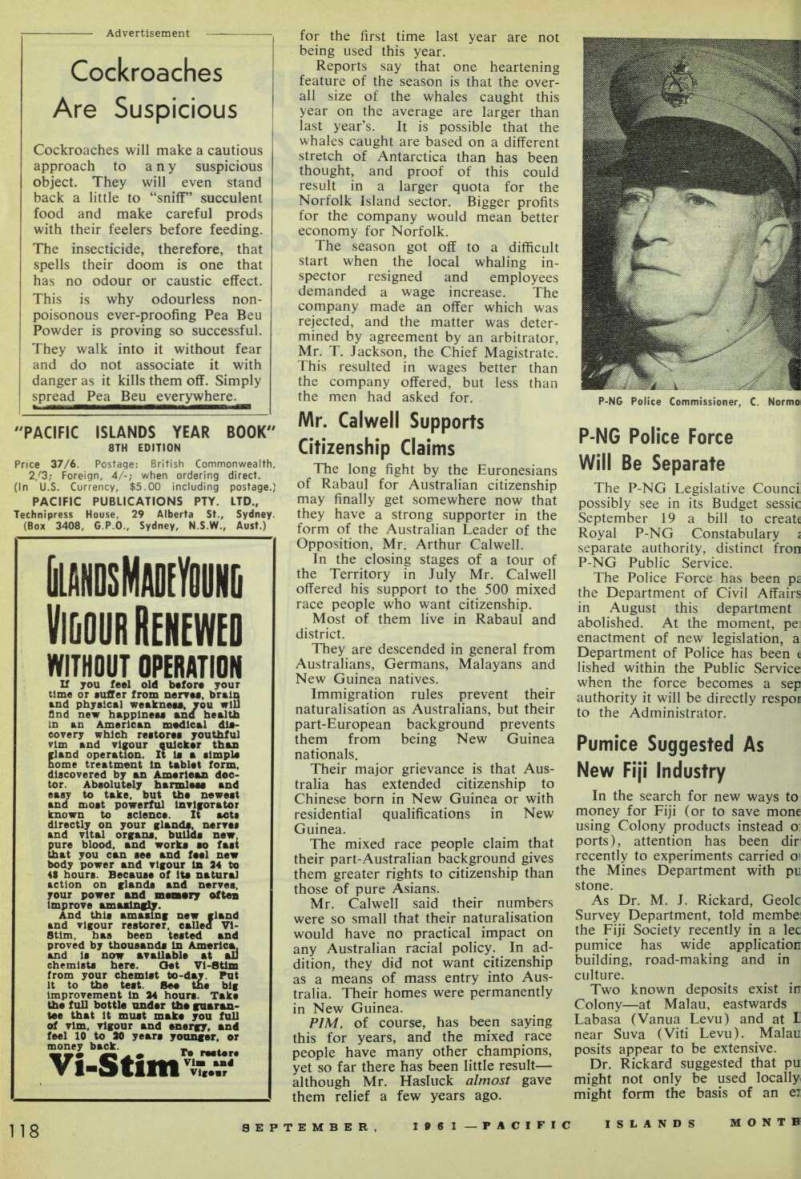
P-NG Police Commissioner, C. Normo[?]
try, say, to Australia. The :e concrete block industry is ng in USA, where it has been ished for nearly 20 years, far as local use is concerned, fe r, one experienced builder had 0 say: “The inherent difficulties otrolling the water-cement ratio ther difficulties, in Fiji, are likely so high that only high-grade ictors would possess the neces iquipment and staff to handle it. »ntractors are plainly careless mdling cement concrete: they [ be far harder to supervise handling this rather ‘touchy’ ;te. The obvious saving in first ; likely to be well offset by extra r handling charges.”
Fests for New-Type
able Huts
1 Australian Army, according to ort we’ve got, at last believes the comfort of its soldiers Id also be considered where tossible”. To this end, it is now I in New Guinea, at Wewak an ingenious develop-
ment in portable accommodation—the “Billy-Hut”.
Brisbane-manufactured, it folds up into a strong carrying case measuring 12 in. x 48 in. x 96 in. This case be comes a solid waterproof wooden floor when the hut is erected. It can be taken out of its case and put up in 15 minutes, without tools.
Close fitting joints, wooden side panels and fibre glass screening seal out wind, rain and insects. The hut is claimed to be cool in hot weather, warm in cold and dry in wet. The standard unit has a floor space of 8 ft. x 8 ft. and provides sleeping accommodation for four, but units can be joined to make double sizes.
Many units are now in use in Aus tralia by geological and oil exploration parties, construction gangs, etc., be cause of their ease of transportation and erection.
Father and Daughter
Drowned in Ba River
When the borrowed Land-Rover he was driving at night ran off a bridge at Yalalevu, Mr. Hari Shankar and his two-year-old daughter, Rajani, were drowned in Ba River, Fiji, in August.
Though police were soon at the scene and dived repeatedly into the river, Shankar drowned before he was found and brought to the bank.
They were guided in their search by the vehicle’s lights which still shone under the water.
The child’s body was not recovered until the following morning.
Mr. Shankar, aged 48, was a well known businessman in the NW district, where he was manager of Pacific Agencies Ltd. at Ba. He was a Ba Town Board member, and secretary of Ayra Samaj and DAY College.
Thirty Reported Killed
In NG Tribal Attack
Two Government patrols went into Kukukuku tribal country south of Menyamya in August in search of natives who had massacred about 30 villagers in a single raid. One patrol left from Menyamya and the other from Kerema, planning to meet in Yaba village, where the massacre took place. Director of Native Affairs, Mr. J. K. McCarthy, said that the work of the patrols might take some time—possibly two months.
Report of the murders was received in Port Moresby on August 9. The report said that warriors from nearby villages had visited Yaba on the pretext of acknowledging a chief.
FDNEY. These two young ladies of [?]ly related branches of the Tahitian [?], met at the Polynesian Association of [?]. Left, Miss Myra Quintal, Norfolk [?] and Mademoiselle Louise Taarea, of Tubuai, Austral Islands.
They had gathered the Yaba together and then suddenly ai and killed them.
Most Kukukuku are peaceful days but those who live on the; side of the border, in extl rough country, are still liable U out traditional fighting raids.
Some of the reports from Moresby of the affair free referred to the Kukukuku at; as pygmies and this brought a in a letter to The Sydney M Herald from former Patrol J. P. Sinclair.
Wrote Sinclair: “I had consic patrol experience of the Kuk 10 years ago and I can assui these people are not pygmies, are typical New Guinea me dwellers, shorter than many but a long way from fitting t cepted definition of a pygmy”,
New Trans-Pacific
Air Record
A Qantas Airways Boeinj turbo-fan jet on August 19 ma fastest flight ever by a comn airliner between San Sydney. The trans-Pacific cr took 13 hours 44 minutes, c 70 mph headwinds on the fim tor of the 7,600-mile journey.
The Qantas aircraft Wintoi San Francisco at breakfast, tool for morning tea in Honolulu, re Fiji for lunch and was in Sydn afternoon tea. The sector times San Francisco-Honolulu 4 hor minutes; Honolulu-Nadi 5 hou minutes; Nadi-Sydney 4 hoi minutes.
The turbo-fan bettered by hours 9 minutes the previous C record for a trans-Pacific cr between San Francisco and S of 15 hours 53 minutes set in It also reduced from 9 hou: minutes to 9 hours 28 minute previous unofficial flight i Honolulu-Sydney set by Panan February.
Qantas will introduce the i fans into commercial service i a month. They will cut an hoi the regular trans-Pacific flight.
American Samoa Now
A TEAL Stopping Place
On September 3, TEAL aga eluded regular stops at Samoa < Coral Route flights linking NZ Fiji and Tahiti.
The Samoan link uses Tafun port in American Samoa. Call; be made on both eastbound westbound weekly Coral Route
. From Tafuna there will be ar connections by the local Poly n Airlines with Western Samoa. ;w schedule is: (Local times) e Auckland 7 p.m. Sunday, e Nadi 10.45 p.m. Depart Nadi a.m. Monday, arrive Tafuna a.m. Sunday (crossing Inter nal date line). Leave Tafuna a.m., arrive Tahiti 12.50 p.m. ay. turn services depart Tahiti 7 Monday, arrive Tafuna 10.25 Leave Tafuna 11 a.m, Monday, e Nadi 12.40 p.m. Tuesday, De- Nadi 1.30 p.m. Tuesday, arrive land 5.20 p.m. e new timetable improves the ection at Nadi for North rican-bound passengers from land and also enables Tahiti d passengers from Sydney to fer at Nadi from Qantas to the L Electra serving the Coral e. r eight years to last September, L made regular calls by Solent ;-boat at Apia, Western Samoa. connection stopped when the it was withdrawn from service.
Cook Islands, which were also of the Solent service, are still mt an air service because there ) suitable airstrip.
mean Yacht
rested" in Madang
i American whose yacht was sted” at Madang, New Guinea, ugust, says he will claim damages the shipping line which towed r acht into Madang.
The American is Mr. W. L.
Phillips, owner-master of the round -the-world yacht, Blue Peter.
The 5,000 ton British freighter, Fleetbank, had towed Blue Peter into Madang two weeks previously when she broke down on the way to Rabaul.
Later, the ship’s owners, Bank Line Ltd., issued a writ in the Papua-New Guinea Supreme Court, claiming £3OO salvage in respect of the tow.
A court officer flew from Port Moresby to Madang and nailed the writ to the mast, “arresting” the yacht.
Mr. Phillips, who is an American businessman, left the yacht at Madang and flew to Rabaul where he had talks with a solicitor.
Blue Peter, 63 tons, was built in Hongkong of teak and Mr. Phillips and his wife and a crew are sailling her to the American Pacific coast.
Port Moresby's
Intolerable' Over-crowding
Over-crowding in native homes in Port Moresby was reaching “intoler able proportions” according to a senior officer of the Port Moresby District Office in August.
He said officials the previous week had discovered 11 families, totalling 58 natives, living in a one-room shanty on the outskirts of the town.
Earlier, the Central District Com missioner, Mr. F. Kaad, had told a meeting of the Central District Advisory Council that the influx of out-back natives into the town was causing serious town problems. Out back villagers were also being divested of their young men.
Authorities estimate that there are about 19,000 natives in Port Moresby now, with the figure being enlarged daily.
This problem is to be investigated in the next few months by a team from the Australian National Uni versity’s New Guinea Research Unit, which will look into urbanisation problems in the Territory (P/Af August, p. 18).
Apia Reported To Be
Planning a 'Cabaret'
According to an Apia report, a local man, Mr. Emelio Fabricius, will shortly submit to the Adminis tration for approval plans to con struct a cabaret dance hall on the Apia foreshore. The cabaret will be designed in the manner of a ship’s
Ige and “the whole construction be along the lines of a pirate lof old”. Work is expected to two years, ecause of West Samoa’s peculiar or laws, the term “cabaret” has fferent meaning in Apia than else re. Liquor is tightly controlled [ Samoa keeps up the pretence it must be rationed out for dicinal purposes only”.
|o Wages Hearing
npletes Job
special Wages Committee at the of July completed its investiga into wages in American Samoa, forwarded its findings to the Sec y of Labour. le Committee recommended fil es in minimum wage rates for mber of industries in American )a, including fish canning and sssing (from 75 cents an hour to snts). ie committee comprised em les, employers and members of public. Three of its members from America for the sittings.
esby Trouble
r Baby-Sitter
Port Moresby native—one of al who behaved threateningly Central District Officer Dave h was picking up his baby a native girl, from the local markets—was fined in August barges of insulting behaviour >f having behaved in a threaten mnner. p court was told that Mr. Marsh picking up the girl in his car a whole group of natives ly gathered. One native tried to the car when Marsh started to away. The native who was Mohea Moro, spoke rudely to irl and said he didn’t believe /hen she said she was merely to baby-sit for the Marsh /. er at the police station he had ‘it was wrong for Europeans to aative girls out”.
I Ram Publicly
Thanks
trim white bungalow with wide of sparkling Laucala Bay was ibject of an unusual “Thanks” t. in the Fiji Times in August.
M. O. Ganga Ram in his tisement frankly told the world 'ithout the advice and encourage of Mr. J. B. Jagannath and Shiv secretary and controller of
supplies, Narain Construction Co.
Ltd., and of Mr. Hiralal, of Millers Ltd., his housebuilding would have been a “nightmare”.
The house in question is in Ragg Ave,, Tamavua, where AMO Ram had bought a block of land for £750 about five years ago. When he started leave in February this year he had ideas of going to New Zealand but finally decided he could put the time to better use by building a house on the land. By subcontracting he has erected a substantial concrete block home, with two bedrooms, carport and basement toolroom, and
all for £2,500. “I knew nothing about building and so I appreciated the help I got from these men when I was buying my materials—they gave me a lot of very helpful advice and the house would have cost a lot more otherwise”, said AMO Ram, in his advert.
Islands Ministers
On The Future
Cabinet Ministers responsible for a vast area of South Pacific Territories gave brief views on the future of their islands in late July. (Over)
tralian Minister for Territories, asluck, spoke at a Perth Rotary uncheon, and the New Zealand er of Island Territories, Mr. spoke at a luncheon of the gton branch of the Royal onwealth Society.
Hasluck said for the next 30 Australia would still have to e the engineers, doctors, ad ators and agricultural advisers pua-New Guinea, said the work of building up sibility was “one of the most ix tasks being performed by Australian Government” and nic independence was a iry prelude to political in lence. site outside pressures for the y’s independence, “99.99 per )f the natives would not want lia to leave. They knew they 1 Australia”.
Gotz warned in Wellington New Zealand was not pre to make sacrifices to support territories someone else would.
Gotz said the territories would rain on New Zealand for years le. “But they are our respon peoples of the Pacific looked v Zealand as a leader in Pacific “What are we to do? Do it let them live like natives?” r Zealand had a responsibility e it had gone into places like X)k Islands and the Tokelaus
and introduced a civilisation that had helped give them the lowest infant mortality rate in the world. This had produced population problems that would not have otherwise occurred.
Now they could not even spread to other islands, because these suffered from the same troubles; the only outlet was migration to New Zealand.
As Minister of Island Territories, Mr. Gotz said the responsibility was largely his and he had “conjured up every thought” he could. “Now I pass the buck to you”.
He would be grateful for any suggestion on how to cope with the problem for which the country had responsibility and which it must solve.
Mission Centenary in
Ellice Islands
En route to England on leave, with his wife and three children, Rev.
Brian Ranford, LMS missionary and
chairman of the Ellice Church As sembly, arrived in Suva by John William VI from Funafuti in August Communication with the Ellice Islands is in f requent . and he brought news of the centenary celebrations , here at the end o( une t 0 m k the coming of the Gospel to the Group It was brought about in a dramatic way . A Cook Islands christian named E e kana was wrecked 100 years ago on Nuku i ae lae reef a ft er his canoe had drifted for some six weeks j n tbe open sea westwards from Manihiki (Northern Cooks), ... , . . , Flv P otbers with him survived, i °. ug u a man and child were lost when the canoe was flung on the reef. They were hospitably treated by the Ellice people, and Elekana gave them his Bible and h y mn book - When his companions were eventually rescued and returned to the Cooks, he stayed on.
Later, Elekana went to Samoa to
ENCE CONGRESS. Dr. Fana'afi Ma'ia'i, [?]rer in Education at NZ's Victoria [?]ty, in August-September, acted as a [?]t at the 10th Pacific Science Con- Honolulu. Dr. Fana'afi, who comes [?]estern Samoa, received much of her [?]n in New Zealand on a Government [?]ip. She later graduated Ph.D. in [?]ation at the University of London.
train at Malua Theological Cc and in 1865 went back to Nukui with a European LMS mis&io Rev. A. W. Murray, and two Sa pastors. The Ellice Islanders emt Christianity and adopted Samoi the language of the church.
At the centenary celebration Putoko, great-grandson of Ele who made a special trip to Nuku from the Cook Islands.
Pacific Youth Get
Together in Fiji
A Pacific Youth Conferene tended by about 1,000 young p held at Davuilevu, Fiji, from A 26 to September 5, spent its mo in religious study and disc groups and its afternoons in petitive sports.
While the majority were Fijian Methodists, represem from other Pacific territories churches also were present. Del included 52 Tonga, 40 Samoai Australians (with two aborig 13 New Zealanders, and a spri from Nauru, Niue, Gilbert and and New Caledonia.
One of the main speakers i conference was Dr. Cliff Wrig Melbourne, a well known Ausi youth leader.
Organisation of the conferene in the hands of Rev. Se Tuilovoni, director of the Met Young People’s Department ii He began organising these youtl ferences in 1952, when 300 atl the first camp. Because of his work, the Union Theol Seminary in New York has se him to undergo a programr advanced studies which he wil soon.
University View on
Research Worker Row
The Australian National Uni' has devised new rules for re to the Territories Department f admission of research worke Papua-New Guinea, PlM’s Ca correspondent reported in late A This follows the internatiom which followed the Depart refusal of an entry perm distinguished British anthropc Professor Max Gluckman, difficulties with permits for research workers.
Existence of the new rule revealed in the university’s ; report, presented to Federal ment in August.
But top-level university me
I secretive about the form of the ie report of the Research School Pacific Studies, written by the ig Director, Professor Jim Ison, is guarded in its references elations with the Territories ttment. says that in general members of chool have maintained excellent 3ns with the Minister for Terri , Mr. Hasluck, his department ie P-NG Administration, ie school has reason to be 'ul for the sympathetic interest dial science research shown by linister and his officers, and for ractical help given to research :rs both in Canberra and in the ory,” it says. )ne the less. Professor Gluck difficulty does not stand alone i school’s experience. iere have been previous ons on which apparent lack of ence in a new member of the or doubts about the granting nlities necessary for a particu ■oject have seriously hindered :h. e school has always sought to p a substantial programme of :h in P-NG, on account both of ientific interest of the area and university’s particular respon ds as an Australian institution, at programme is about to be led —with the full support of overnmental authorities con the other hand, planning of h in P-NG has always been difficult than planning of work ere. wever a more satisfactory ure for the consideration of the s requests for the admission of h workers to the Territory has ieen decided upon.”
e Fiji's Money
s From
four months that Mr. P. D. nald, Colonial Secretary, has Acting Governor of Fiji, have •owded with official duties, and lout August he was on the /' in the month he toured in the Lomaiviti Group and drywhere welcomed with Fijian nies when he arrived to inspect activities, schools, road i, and new installations. He rigued at one island, Gau, with iy the Fijians have provided iwn telephone service by an us use of surplus and out equipment and fencing wire.
On August 21 he was back in Lautoka to lay the foundation stone of the new Lautoka High School, which will cost £240,000, and which will give a new impetus to technical education in the North-West. The Acting Governor took the opportunity of pointing out that only £24,000 of this huge cost would be supplied by Fiji herself—the balance is com ing from Britain.
He further drew attention to the fact that, although Britain has just increased her own taxes and is struggling with an unenviable
economic plight at home, she has provided Fiji with outright grants of over £2,000,000 between March and July this year, apart from assis tance for the Lautoka wharf scheme and the new high school A couple of days later he was off on a 10 days’ tour of other small islands (including tiny Tavua Southern Mamanuca group, never before visited by a Governor and where he found an impressive example of self-help—the 20 men there have bought a concrete block making machine from copra sales to
build seven concrete homes), he also visited the colourful Yai Group of “Blue Lagoon” fame.
UK Army May Seek
Fijian Recruits
An approach has been made t Fiji Government about the possi of obtaining recruits from the Cc for service in the British Arrm Certain corps and trades in Army are well below even p time strength, and a recent scher Britain to persuade National Se men to stay in the Army as re soldiers was a washout. The B Government now is making a ( mined effort to fill the gap attracting non-European men t( service, with special inducement for a shorter term than normal) While Fijians have shown selves to be first-class soldiers f to military life, the Fiji Goven is not making any hasty mo encourage recruitment for ov because of the adverse effec village life, when the young men
Suva's Oldest Hotel
Changes Hands
From September 1, the old bourne Flotel in Victoria P Suva, opposite the Town Hall, under the control of Pearce an Ltd.
Pearce and Co. bought it ai block of land behind the (Gregory House, formerly flats, was demolished in August) f undisclosed sum from Mr. anc J. H. Millett. A Suva lane the hotel is the capital’s oldest ing been built in 1881, for Mr Reading. It was run for manj by Mrs. Amelia Reading, wh Mrs. Millett’s mother.
An old-style, two storey v building, it had a wide verandah both the Macarthur St. and V Pde, sides, but the 1952 hui wrecked part of it, which w moved.
Mr. B. D. G. Lawlor, direc Pearce and Co., said that ft Prentice, formerly of Kadavu r Co., will be the new manager, are in hand to renovate and rebuild the hotel.
New Control: Hamac
Tangle Ends
Papua and New Guinea H ment Corporation Ltd. has been successful in obtaining of the eight associated Hamai panics, whose tangled affain
I the subject of court proceedings the past 18 months ( PIM , June, 49). n July 28, in the P-NG Supreme rt. Mr. Justice Mann handed n a reserved judgment in an ap ition to have the Hamac group >ved from a liquidation order, decision provided for a stay of dation proceedings and, in a very thy document, he set out the con ns and guarantees to be fulfilled, hat creditors would receive all jnts owing in full. his judgment, His Honour re d to a claim by Karlander Com against Eriama Shipping Co. for £24,000, which had been in ite. An indemnity bond for ►OO would be lodged with the t to cover the disputed amount up to £3,000 costs, us, instead of having to content with 5/- in the £ in a liquida- Karlander Company will get settlement—if its claim is sub ated at law. mac Holdings Ltd., parent com [ of the other seven (Hotel Ltd., Morobe Hotels Ltd., aa Estates Ltd., Eriama Estates Ela Services Ltd., Eriama Ship- Co., and Wanigela Plantations is now almost-wholly owned ■NG Development Corporation. )m the end of September, the management will direct opera of the hotels, plantations, trad ad other interests as the Hamac isation is re-established, recon ed and put on a paying basis.
Copra is Sun Dried
i a Difference
Valentine Tarte, of the iaqera Estate, Taveuni, has ssed solar heat to dry his copra, stimates that it can provide him in additional £1,750 annual in- Hot air dried copra is worth /- a ton more than sun dried. . Tarte can, with his solar heat dry 10 tons of green copra to ms of dry copra with a moisture it of 6 per cent, in 20 hours.
I total cost of drying it is 12/i—a big difference from the ited £2 to £2/10/- a ton for fuel driers, recommended by ‘iji Department of Agriculture w years before Tarte evolved m drier). i 12/- includes the cost of husks red to the solar heat drier :e, the cost of diesel fuel for in engines, and all labour costs he operation of the plant, ciation is not included.
Tarte built his drier for about >, but expects similar driers cost more as he had some
materials on hand on his estate, and also some foundations and buildings were in position.
To obtain the best from solar heat he estimates that the area of the heat absorber could be trebled without reducing the efficiency of the rest of the plant. He intends later to erect a second absorber to absorb and feed more solar heat to rockpiles, which are an essential factor in storing and passing heat through the green copra. increasing the absorber area will mean less coconut husks will be required for the husk furnace which will, in turn, lower the cost per ton for drying the copra.
The plant is simple to operate and supervision by a senior or skilled estate officer is only necessary at the start and finish of drying a batch of copra. Once the plant has been put in operation it is supervised by a semiskilled estate employee.
The plant has operated very satisfactorily and has shown a saving of £l/14/- a ton in the cost of drying copra, compared with other types of oil fired hot air driers in Fiji. The total quantity of copra to be processed at Waimaqera each year will be about 700 tons.
This will mean a saving of about £1,200 a year in drying costs. On this basis the initial cost of £3,000 for the drier will be cleared in two and a half years. Thereafter the annual saving is £1,200.
Statistical data about the number of days of sunshine a year at Waimaqera Estate was not available when Mr. Tarte set out on his project, He realised there was a greater pro portion of rainy and overcast days, Therefore he considered, and sub sequently proved by experiment, that because of the high ambient tem perature, much solar heat could be trapped for use on overcast as well as sunny days.
The husk furnace was combined with the solar heat to guarantee the higher initial temperature required at the start of drying a batch of copra, The furnace also assures operation of the drier during rainy periods and the part of the night for which solar heat, absorbed and stored during the day, is inadequate.
Mr. Tarte obtained technical in formation about solar heating from Professor Bliss, of Arizona Uni versity, and the Commonwealth Scientific Industrial Research Organ isation, Melbourne. (Over)
Mr. Val Tarte, a Fiji plantation owner, has harnessed solar heat to dry his copra. Here are two views of the heat absorber—a series of glass panels covered with protective wire netting. Hot air heated by the sun passes through the outlets seen underneath the absorber in the lower picture.
Photo: C. N. Friend
He has been told by the C that his drier, as far as they is the first of its kind in the ’
He conceived the idea for the from the hot water solar s which is now used in many pz the world.
Qantas To Build
New Sydney Hotel
Australia’s overseas airline, ( will build a 400-room world st; hotel in central Sydney at a c £5 million. The site, next i Qantas building, has a 200 ft age on Bligh Street, and a frontage on Elizabeth Street.
It is proposed to float a nev pany which will arrange for £ side loan of £3 million agah security of a first mortgage ( hotel. In addition, the compai invite the public to subscribe million equity capital required project. The subscription ma Qantas itself will be from its c sources and would involve caf tion of the current value of tl Senator Paltridge, Australia’ ister of Civil Aviation, said tl Qantas hotel would not “ov the amount of first-class hotel modation in Sydney. Sydney h over 1,000 first-class hotel roor baths, and studies by the Au National Travel Association that these did not meet the demand. Hotel projects plam under-way, would barely keep i the estimated increase in demi first-class accommodation.
He said the number of c visitors to Australia had incre; per cent, in the last 12 montl number would increase with t tinuation of jet frequencies i introduction of new ocean liners. Tourist interest in A had increased as a result of planned overseas publicity c£ and the full effect of jet tra vantages had not yet been fi in Australian tourism.
Senator Paltridge said th£ 1950, Qantas had held a maj< terest in the Wentworth Hot ney, and this arrangement woi tinue at least until the was in operation.
Cook Islands To Begin
Flaglining Soon
The Cook Islands is anx cash in on some of the mil dollars of tuna which is fish her surrounding waters eac The Cooks don’t get a cent
loment —it all goes to the Ameri una factory at Pago Pago, anwhile the Cook Islands im large quantities of fish—in tins places like South Africa. 3ks Fisheries Officer Ron Powell ts shortly to begin flaglining Cook Islanders in a small way, i hope of building it up into a idustry. Flaglining is tuna fish ith the aid of hooks suspended lines underwater, glining gear has been ordered Japan (20 baskets of five hook and should arrive soon. It will bly be used in conjunction with 7-ft ketch Siren, which two local >men, Don Silk and Bob Boyd, recently rebuilt after about 18 is’ work, and which they have begun to use for trading. : and Boyd have agreed to make vailable for the experiments. i flaglining is planned to get fish >cal consumption and there are ans at the moment for a more >ive organisation, Mr. Powell that may come, with possibly elp of a local canning factory. 3 of the big problems in starting ina fishing has been in acquiring but Mr. Powell has been experi ng with two kinds of imported nets, both of which have proved jsful. One of them is the net ini Hawaii, a conical hop net the opelu. am very hopeful things will out well on this tuna fishing le,” said Mr. Powell, when he J through Sydney in August on ay to Auki, Malaita, BSIP, where 11 lecture the SPC-FAO fisheries . Powell is also going ahead with lell experiments in the Cooks.
August, the Manihiki lagoon ipened for shell for the first time 1957. It was closed because re -5 were being depleted, e hundred tons a season can be fished, from August 1, and ‘goon will be closed immediately
the target is reached. “In the last few years the lagoon has showed good regeneration and 100 tons can be taken now without causing any dam age,” said Mr. Powell, “It is a good thing now that shell should be taken.”
A message from Rarotonga re ported that everything which would float and everyone who could walk went diving on August 1. The six licensed diving machines, which are restricted to deep water, had a poor day, but skindivers reaped a good harvest on shallow rocks and coral heads.
In training for the reopening of the lagoon, the leading skindiver of the Cook Islands, Tekake William, recently made several dives to a depth of 30 fathoms.
The export value of the shell may be up to £5OO a ton, which accounts for the interest shown in the re opening of the lagoon, the report added.
While in Sydney Mr. Powell visited Mr. Hynd, of the CSIRO, who has been assisting in the shell experi ments in the last few years. They have planted shell in a variety of con-
ditions on sand, rocks, wire mesh, and even suspended on nylon rope—in the hope of farming it, so that the shell can be grown commercially.
Mr. Powell said the results of the nylon rope experiment so far seemed to be very good indeed. The shell was growing three times quicker than other methods. Presumably it was get ting its food—such thing as plankton —much easier.
Managing director of W. Gregg & Co. Ltd., of Dunedin, Mr. Chas D.
Baker, told PIM in August that the activities of the firm’s subsidiary can ning company at Rarotonga was at present restricted to the processing of oranges and pineapples, but “if and when tuna are available at Rarotonga the company will certainly investigate the establishment of a tuna canning industry.”
The company had no comment to make about reports that it was in terested in establishing a tuna in dustry in conjunction with the Jap anese.
P-NG Budget Up
—But "Not Enough"
Australia’s Territories fared better than most forms of Government activity in the 1961-62 Federal Budget.
The Papua-New Guinea vote rose to £17,465,000, compared with actual spending of £15,094,000 in 1960-61.
Most of the increase was in the grant to the Administration, £17,300,000, against £14,796,000.
The lift was regarded, in Canberra, anyhow, as a clear indication of the Government’s concern at the overseas image of Australia’s effort in P-NG.
Federal Treasurer Harold Holt said as much when explaining why Australia’s Colombo Plan contribu tion was no larger. He pointed out that Australia had heavy commit ments nearer home in P-NG.
Nevertheless the figure was re
Mr. Ron Powell, Fisheries Officer for the Cook Islands.
garded with far less enthusiasm by top Administration officials in P-NG.
The Administration wanted far more than it has been allocated.
And there are now likely to be some handsprings to get plans back into some kind of shape before the P-NG Legco’s Budget session due to begin on September 19. Many plans will have to be shelved for the new year.
The Norfolk Island vote of £52,000 compares with £32,000 last year, the extra <£20,000 being for restoration and maintenance of historical structures.
NNG Natives Will
Get Officer Training
The training of 200 NNG natives as jungle fighters will start in No vember next year at Manokwari, it was announced in Hollandia in August.
The new Papuan Infantry Corps is to consist of 600 men, and each year 200 volunteers will join and serve for three years.
NNG Papuan infantrymen next year will also be trained as officers, although it is not yet known where the training will take place. The an nouncement came at a time when on the other side of the border Aus tralian officials apparently were still bickering about whether native mem bers of the Pacific Islands Regiment should be trained as officers. (See Canberra Commentary, p. 42).
NNG Underground
Wiped Out
An underground Indonesian military orgaisation in Sorong, NNG, was stamped out in August.
The organisation, established in 1958 by Indonesians, was designed to assist Indonesian troops during an invasion of NNG territory. It was called Operasi Pemuda Irian (OPI), which is “Operation of West New Guinea Youth”. There were about 100 members, but Dutch officials cracked down on the leaders after they tried to make followers of Papuans of Cape Casuaris and gave themselves away.
Most of the members of the organ isation were Indonesian.
There are about 2,000 Indonesians still living in Sorong, mostly former workers of the oil company.
The Indonesians are now being re patriated, and 700 of them left in August. The 3,000-ton MV Robina is taking the Indonesians direct to Singa pore and they are shipped home from
there. In an earlier voyage there complaints from the Indon about the standard of accommo* on board; but alterations have been made. The Robina sails the Panama flag.
A company announcemen August said that the last shiplo employees would probably Sorong about September 30.
Repatriation of workers first s in 1959 directly from Sorong tc Indonesian ports but this was st when the Indonesian Army r( entry permits.
Yaws "Defeated" in
The South Pacific
The crippling tropical disea yaws is on its way out from the Pacific. A few years ago the d affected 15 per cent, of the p< tion in some island territories, ing recently concluded mass paigns assisted by the World I Organisation (WHO) and the I Nations Childrens’ Fund (UNI the infection rate has been redu< less than one per cent. In some tories eradication of the disej now within reach.
This was reported by Dr.
Fang, Regional Director of W 1 the Western Pacific, in his anni] port submitted to the WHO Re Committee, meeting in Wellii New Zealand, from August 31 t< tember 5.
Tarawa Takes a Look
At Its Water Supplies
An expert in the study of resources was on Tarawa, GE July, investigating the island’s supplies.
Little is known of the capal of coral atolls to hold ground and it is feared that the great creased population at Tarawa cent years may be causing the of the water table to fall. Tai water supply is almost entire! pendent on ground water.
South Seas Trade
Mission a Success
The Australian Trade Missii the South Seas in August v success, according to its leader T. H. F. Spalding.
The mission, comprising 19 nessmen representing almost all tralian enterprises, was the fii visit the South Pacific area. 11 organised by the Australian D( ment of Trade and sponsored b Central Square branch, Sydne
Australian Junior Chamber of imerce. irst port of call was Noumea, re PlM’s correspondent, Fred n, reported members were “wined dined, generally feted, and where made a big impression”, unn reported that a display of ufacturers’ samples caused a t deal of interest, and the Press mented loudly on the diversity of lucts manufactured in Australia, the newspapers also pointed out there seemed little in New donia to offer Australia, any businessmen said it was a that the recent trade ship which flown the Australian flag in h-east Asia had not included Caledonia in its itinerary, ew Caledonia gave assurances to mission that the exchange purse gs would be loosened to enable i merchants to buy more from ralia. Officials suggested that ralia might like to buy coffee, ng other things.
Dunn reported that the Australian businessmen found a great deal of goodwill towards Australia in New Caledonia, and all agreed that the Commonwealth Government should take up the matter of exchange with the French Government to enable more business to be done in both directions.
From Noumea, the trade mission went on to Fiji, where a small dis play of Australian goods and pro ducts at Suva Town Hall attracted a constant stream of visitors.
Members of the mission booked substantial sales to Fiji merchants; but it was not all a one-way project —a Suva correspondent reported that members were conscious of the fact that Australia exports a far larger proportion of goods than she im ports produce, etc,, from Fiji.
Dealing with this very point, Mr.
T. H. F. Spalding urged Fiji exporters to make a bigger effort to secure a larger share of the market.
“If you have anything to sell in
VERNOR-GENERAL IN WEST SAMOA. The NZ Governor-General, Viscount Cobham, comes [?]ore at Apia in August from HMNZS "Royalist", during his Pacific cruise (see p. 18). th him here is the High Commissioner, Mr. J. B. Wright, Mrs. Wright and Lady Cobham.
The Hon. Tamasese can be seen in the rear between Lord Cobham and Mr. Wright.
Photo: Samoana
Australia, there is absolutely no reason why you Fiji businessmen could not go there and make sales,” he told the Suva Chamber of Com merce. “You must not sit back— pack your bags, get your ticket and go over there and see what you can sell. You will be most welcome,”
Mr. Spalding said that someone had to make a start at reciprocal trade, or it would never happen.
“While we are basically here to try to sell you goods that are made in Australia, at the same time I want you to know that, in Australia at present, in 95 per cent, of cases im port licences are unnecessary and the way is open to any producer or
manufacturer to sell in the market,” he added.
Mr. S. A. Tetzner, president of the Suva Chamber, said that at present there was little that Fiji can send to Australia, “We once sent bananas —and Mr. Spalding says we still can—but there are shipping difficul ties involved,” he remarked.
Mr. Tetzner said he was glad to know that trade mission members were looking out to see what Fiji had to offer, and that members might see opportunities to open branches of their firms in the Colony. Fiji has industrial land and electricity avail able; it is central, as far as the Paci fic is concerned; and labour is plenti
ful. The Government is willing make certain duty and tax con sions to help establish new indust) Some of the members of mission went to Tonga, Samoa Tahiti, but the majority returnee Sydney on August 31.
Mr. Don Walker, recently pointed Australian Trade Conn sioner for the South Pacific, headquarters in Sydney, acc panied the mission in NC and and also reported on his return its success “exceeded all expe tions”.
Fiji Airways 7 New
Service to Samoa
Commencing in November, Airways Ltd. will operate a reg fortnightly air service from Nau (near Suva) to Faleolo airfield Western Samoa.
The service was approved by various authorities in late An and licences issued for Heron craft.
At present, air connection betv Fiji and Western Samoa is by P/ DC7C or TEAL’s jet-prop Lockl Electra from Nadi to Taf American Samoa, then by Polyne Airlines’ Percival Prince aircraft Faleolo.
Fiji Airways continue to in charter flights to Honiara, Soloi Islands, via Vila and Santo, in I Hebrides, on behalf of the E Government. The August re: flight was the ninth since a pro: trip in December, 1960. Fiji Aina is awaiting approval of a sub from the UK Government before; service becomes regular.
Fiji Airways scheduled service; tween Suva and Nukualofa, Toi is proving to be both useful successful. Occasionally, H« planes make special additk charter flights from Suva to Nu 3 lofa—one such for the Mon Mission, at the end of August, • tinued on to Tafuna (Am. Sam and Faleolo (West Samoa). On way back to Fiji, it was to cal Wallis Islands (French possession! inspect the airstrip facilities then
They're Training Them
To Be Postmasters
The P-NG Post and Telegrr Department has begun the first four-year training courses for ns postal assistants, aimed at turning future postmasters and “potei; postal executives”.
The course is being conducted the Postal Training College Boroko, near Port Moresby. Stud
• at the college and receive lecture practical work and on-the-job ling at various post offices, ents will be coached up to the jnsland Junior Certificate stan i Their examinations will be up le same standard as in the Aus in PMG Postal Training School, even students are undergoing the course. Some already have had years’ postal experience and •s were recruited recently, me Territory people hope the se will soon mean that many peans can be taken from behind ounters of the post offices. From to time there is criticism that peans in P-NG are doing jobs that quite adequately be done by es, and which are being done ;ntly by natives in other Pacific tories.
iable Move To
) P-NG Coffee Crop
e Commonwealth Government’s to assist the New Guinea coffee try, announced by the Minister Territories, Mr. Hasluck, in st has been received with en ism among Territory coffee srs because it comes at a time it will do most good towards ig the problem of disposal of /ear’s native parchment crops, rge quantities of native coffee n hand in the New Guinea high —clean and of high quality, ac ng to observers—which hitherto not be sold. New Guinea agents ed that unless something was soon native confidence in the try would be lost. Two main s then took the risk of buying e native crop although they had respects of selling it. There was it in price. ue of this coffee was sold in ?e. en followed Mr. Hasluck’s an :ement, which said that the of threepence a lb on overseas and kiln-dried coffee would be ted to coffee buyers if 28 per of their coffee requirements purchased from P-NG. is meant Australian users would themselves thousands of pounds buying a percentage of New ea coffee. In early September it still too soon to know whether users would take advantage of Commonwealth Government’s and absorb the unsold New ea native coffee but New Guinea ers were extremely hopeful that would. e Highlands Farmers and Jrs’ Association regarded Mr.
Hasluck’s move as a valuable attempt to save this year’s native crop, which had been the victim of cheap coffee importations from overseas.
W. Samoa Will Make
Economic Plans
An important policy speech con cerning West Samoa’s economic de velopment was made by the Terri tory’s Economic Development Min ister, Mr. G. F. D. Betham, in Apia, in August.
He said the situation was one of “concern” and unless production figures, or world prices, improved soon, “more drastic measures” could
not be postponed. Even if emergency measures were taken to bolster up the economy now, there still re mained the future problem of popu lation outstripping food production and unemployment increase.
He said the recently appointed Economic Development Committee would have to take stock of resources and form a sound plan for the future —a plan for five to ten years, in which development projects would be assigned a priority.
Mr. Betham added that he hoped a preliminary plan for economic de velopment would be formulated by the Committee no later than Novem ber.
Fijians Make a
Variety of Handicrafts
One of the side benefits of the growing tourist traffic in Fiji has been the establishment of home in dustries to cater for the demands of visitors seeking curios to take back home.
Nowadays in Suva Markets and in the shops that line the narrow streets of the Indian business section, as well as in the big stores and in the kiosks at Nadi and the beach hotels at Korolevu and Deuba, tourists can take their pick of a score of attractive, well-made local articles in addition to coconut-shell ornaments and woven baskets.
Turtleshell ware, decorative masi (tapa) lengths, useful woven mats and fine shell necklaces and bracelets meet with a ready sale. The raintree, with its superb grain, has come into favour, too, in recent years as wood for tanoa bowls, prong forks, book ends, trays and small tables.
While most of the items are made in Suva, the people of the Lau Group also have been active in catering for the curio trade.