When The Recruits
pp. 78-99 · Read in the full issue
There Was an Entire Band and a White Wife
Went Home
By “Supercargo”
An article appeared recently in one of the Sydney daily newspapers concerning early recruiters of Islands labour for Queensland, and an impression may have been made in the minds of some readers that all recruiters were blackbirders, men who were unscrupulous in their methods of recruiting the labour and so harsh in their treatment of the “boys” as to put them on starvation rations and otherwise so ill-treat them that they died.
I SUGGEST that those who were recruiters of this calibre were few in number —just as there are few solicitors who rob their clients, or company directors who fleece their shareholders.
I remember taking part in the re patriation of many of those boys after the Australian Colonies had federated. It was decided that ten ders should be called for the repatria tion of all the native labour which had been brought to Queensland to work the sugar plantations. They had come mostly from the New Hebrides and the Solomons.
Burns Philp were the successful tenderers and I think it was the SS Moresby which lifted the first batch from Port Douglas, on September 14, 1906. The ship landed them at Gavutu, in the Solomons, at the end of October.
Various other vessels of the BP fleet completed the job during later months.
The vessel I was on at that time was the SS Titus. We loaded 250 natives at Pinkenbah about Decem ber 8, 1906. At Vila we transferred the labourers to the SS Ysabel, which had the job of landing them at the various islands. The instructions were to get them as near as possible to the exact spots at which they had been picked up in the first place.
We made a second voyage, during which we had the job of landing them at their islands ourselves.
Troubles!
I remember we had with us a dear old retired sailing-ship master, Cap tain Cater, as Government Agent, and he wanted to be landed at Pen tecost—the last island in which we were landing labourers. There were no white traders there, so Captain Cater and I visited the Mission sta tion to see if he could get accommo dation until the next BP vessel called to pick him up. The missionary was away and we discussed for some time with the lady missionary in charge as to the propriety of the dear old captain staying on in the circum stances.
Although he was 75, honour won, and there was nothing else for it but to take him on the whole trip, to the Gilbert and Ellice Group.
Among the labourers aboard on that repatriation trip was one man who had been recruited in 1866. He was an old man. He came from Mer lav, and on arrival .we noticed a couple of natives, come out of the bush. The old fellow looked, and then asked the captain to steam round the coast a, bit. that. if. he saw- some,. rocks-Avtufeh' he
used to swim to as a boy he know it was his island.
Well, he saw the rocks at was delighted, and we steameo; to the landing spot and dropped Also among a remarkable of passengers was an entire Sat Army band. They went back ti homes in the New Hebrides.; used to play every day at their • meetings, but half an hour aftes ing, all instruments had company with their owners. . uniforms went, too. Natural!! hard for a native to refuse a ; on his return home after a 1m sence among the bright light* as a matter of fact, this pn< applies to whites, too.
We also had aboard one labourer with a white wife. Sr three children with her. TH born was a half-caste, the appeared to be white, and thd was a half-caste. We land© family at Vanua Lava.
The white woman was noth perturbed during the voyag when we arrived and she there were no whites on thea and that very few vessels < there, she seemed concernes
(Continued on p, 97.)
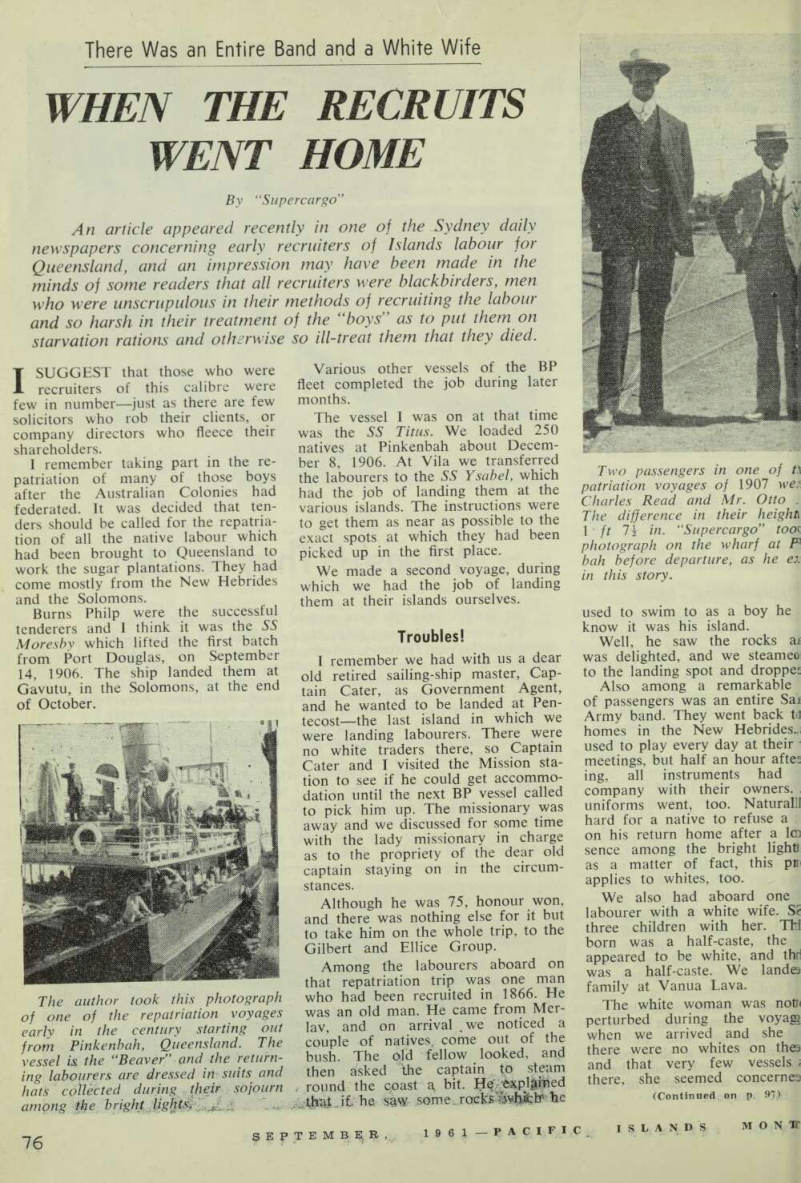
The author took this photograph of one of the repatriation voyages early in the century starting out from Pinkenbah, Queensland. The vessel is the “Beaver” and the return ing labourers are dressed in suits and hats collected during their sojourn among ike bright lights.
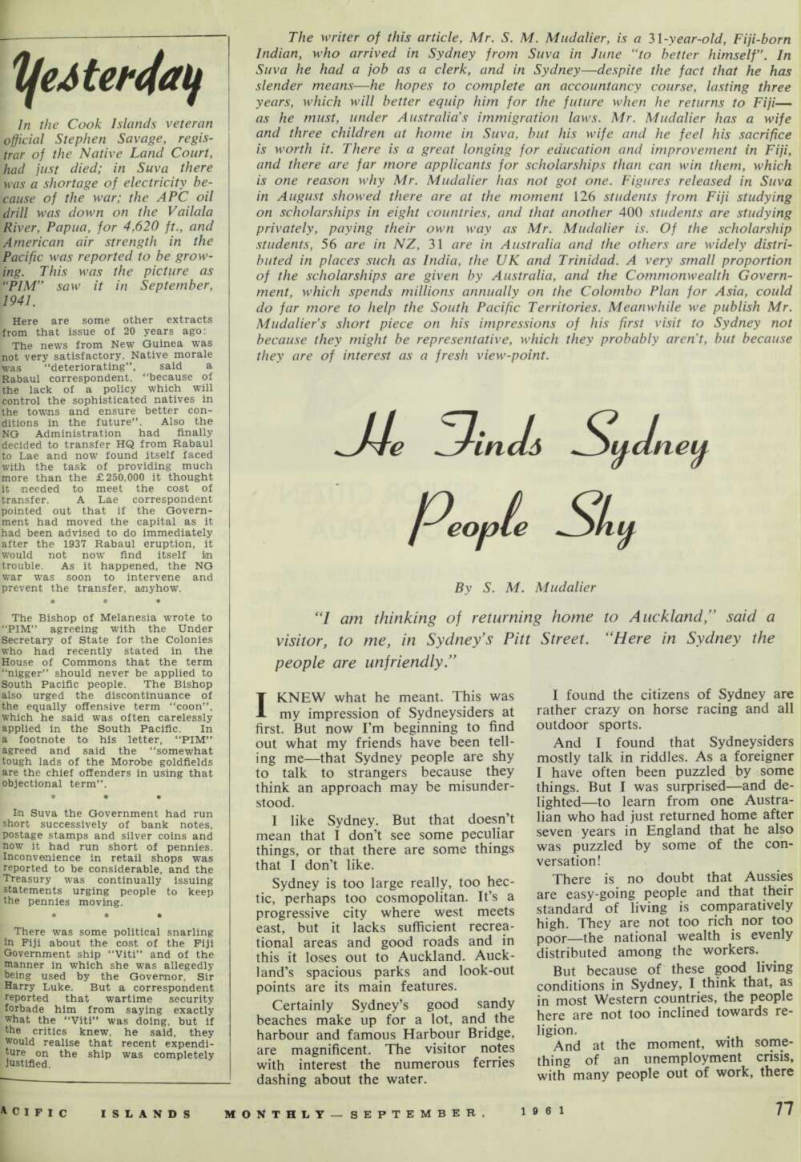
Two passengers in one of t[?] patriation voyages of 1907 we Charles Read and Mr. Otto The difference in their heights 1 ft 7½ in. “Supercargo” too photograph on the wharf at p[?] bah before departure, as he e[?] in this story.
some emotion when she asked : was a post office on the we made our last voyage bourers from Pinkenbah, in 907, we had as medical offi well-loved port doctor at Syd '• Charles Read. We had to medical man during our re in voyages and Dr. Read a holiday. oon as we had left the wharf 2y we found we had one diffi le was 6 ft Si in. tall, and n’t have a berth he could We put him in the chart where there was a settee an around two sides of the coincidence on that trip we i Otto Flood, who was going 0 the Gilberts to join his D. Flood, an old-time super- Jtto was 5 ft 1 in. tall, and wharf at Pinkenbah I took tograph reproduced on p. 76 wo of them standing together.
Flood was later an officer Ps, and was personally in wth the OBE by the Prince ps when he was in Australia “ Renown. Dr. Read was 1 m the Greycliff disaster.