Magazine Section
pp. 75-77 · Read in the full issue
Pacific Islands Monthly
Ming Voyage Ended In
Massacre, Shipwreck
By Robert Langdon
On the eastern end of Kangaroo Island, 70 miles south of delaide, South Australia, is an unpretentious tourist resort that 'joices in the name of American River. It is the only place me in South Australia, as far as I know, that has a Yankee ivour about it.
\CE names have always had a fascination for me, and, as a i Australian, I had often won- I how American River got its cently I did some delving g old records to find out, and shed up unearthing a story of arly 19th century Pacific about issacre in Tonga, a shipwreck le coast of Fiji, and a cargo of ikins! e story began in 1791 when George Vancouver, in HMS very, put into King George’s 1, on the southern coast of :rn Australia. ncouver, who was on his way e South Pacific, found a great >er of seals at King George’s 1 which he duly described in a on his voyage that was pub l in London in 1798. ncouver’s description of these caught the eye of Capt. Edmund ing, an American sea-dog, who amassed a large fortune during al voyages to the Pacific begin in 1792.
Fanning, who was ever-alert to make a quick dollar, decided to send a ship to King George’s Sound to gather seal skins, and the 120ton brig Union was fitted out for this purpose.
The command of the Union was given to a Capt. Isaac Pendleton.
Pendleton sailed from New York in October, 1802, and reached his destination, via the Cape of Good Hope, four months later.
The Union was riding at anchor in one of the many bays of King George’s Sound when the French navigator Capt. Nicolas Baudin put into the sound in his ship Le Geo graphe.
Baudin invited Pendleton to dinner on board his ship, and dur ing the meal, Pendleton complained that he had been disappointed to find only a few seals in the sound when he had expected to find them thronging the shores in thousands.
Baudin replied that Pendleton had arrived on the coast at the wrong time of the year, but he said there were plenty of seals on a large island to the eastward which he had sur veyed only three weeks earlier.
The island that Baudin referred to was Kangaroo Island.
Pendleton pricked up his ears on the mention of this and asked Bau din to give him a chart of it.
Baudin obliged, and threw in a chart of Bass Strait for good measure.
Off to Kangaroo Pendleton sailed for Kangaroo Island at 8 o’clock next morning. He anchored a few weeks later at a place which Capt. Matthew Flinders had called Pelican Lagoon, but which subsequent sealers named
American River in honour of Pendle ton’s visit.
Seals were as plentiful in the vici nity of his anchorage as Baudin had promised, so Pendleton put a sealing gang ashore to kill and skin as many as possible while he continued east ward to Bass Strait on a reconnais sance voyage.
After collecting skins at several small islands in Bass Strait, Pendle ton returned to Kangaroo Island to spend the winter.
During this period, the Americans built a small vessel as an auxiliary for sealing.
This vessel—a schooner of 35 tons—was built of local timber and materials aboard the Union, and was named Independence.
Bottle Message
When the winter was over, Daniel Wright, the mate of the Union r sailed the Independence to King George’s Sound to make a new search for seals there and to leave an account of Pendleton’s doings in a bottle for the benefit of other ships belonging to Capt. Fanning.
Meanwhile, Pendleton sailed in the Union to Sydney and Norfolk Island for stores and repairs.
On returning to Kangaroo Island
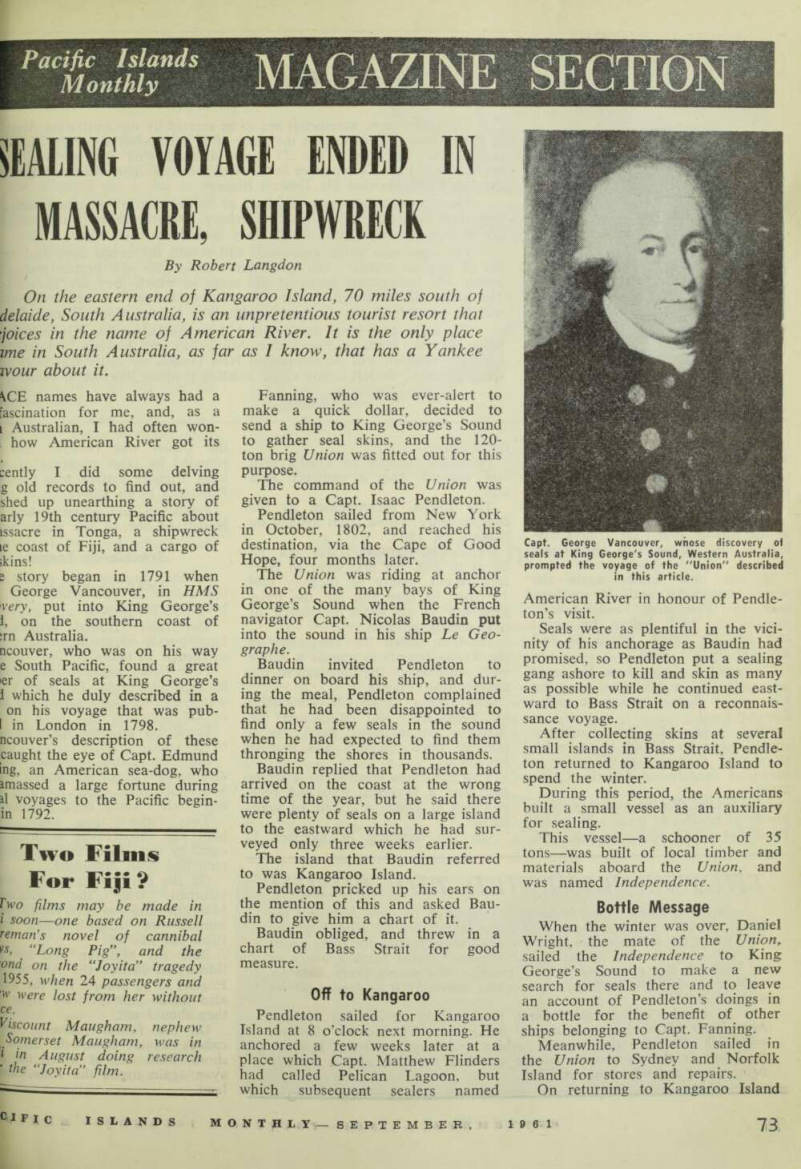
Capt. George Vancouver, whose discovery of seals at King George's Sound, Western Australia, prompted the voyage of the "Union" described in this article.
in May, 1804, Pendleton found that Wright had come back from King George’s Sound without encouraging news, so it was decided to make for Sydney again.
The two vessels reached Sydney at the end of June—the Union hav ing on board a cargo of 12,000 seal skins.
It was now winter again—the wrong season for seals in southern seas—so Pendleton had several months to “kill” before he could complete his cargo, which he had fixed at 20,000 skins.
He was wondering how he could profitably fill in his time when he ran into a Sydney merchant called Simeon Lord.
Lord suggested that Pendleton should leave his 12,000 skins in his store and then go to Fiji for a cargo of sandalwood for the China market.
Lord added that he would provide plenty of articles of trade with which Pendleton could make friends with
the Fijians.
Pendleton agreed to Lord’s plan and entered into a contract with him.
The Union, accompanied by the Independence, sailed from Sydney on August 29, 1804.
Pendleton, however, did not go direct to Fiji. He first went to Nor folk Island, where he illegally sold 15 casks of rum and left the Inde pendence to go south in search of new sealing grounds.
He then sailed for Tongatabu in the Tonga Islands to engage a native who could speak the language of the cannibalistic Fijians.
The Union arrived at Tongatabu on September 30, 1804, and the Tongans immediately fixed on a plan to seize the ship and murder her crew.
This plan was inspired by a white man and a Malayan who had been stranded in Tonga a couple of years earlier.
On the morning of October 1,
the Union was boarded and rounded by large numbers of s ingly friendly natives who persuj Pendleton to go ashore.
Pendleton and seven armed landed in one of the ship’s bo Trouble on Tonga As soon as they were out of j the natives in and around the i became troublesome.
The mate, Daniel Wright, hard put to clear them off bu succeeded in doing so.
Four hours later, he saw thn his spy-glass that Pendleton’s was lying broadside on in the H of the natives.
Pendleton and his men were to be seen.
Scenting more trouble, W cleared the decks for action, b was not until next morning any natives came near the ship Two canoes then came w hail, and the natives in them cated by signs that Pendleton am men had been murdered.
On the third morning, the na returned with the treachc Malayan and—to everyone’s s ishment—an Englishwoman c Elizabeth Morley.
Both the Malayan and the lishwoman invited the Americas English to go ashore. But the w-\ also made surreptitious signs ; they should not.
On the fourth morning, se: canoes again came off frorai shore, from one of which the ayan again urged the Americas land.
•anwhile, Elizabeth Morley, who in another canoe, called out Pendleton and the others had murdered. She then sprang into water and swam towards the n. ight ordered his men to fire on atives, and, under cover of their , he took the woman on board, then directed the cables to be put out to sea; and reached y without further incident. route, Wright learned that >eth Morley had been spared le Tongans when they mas l the crew of a ship called the of Portland in 1802.
Sydney, Wright recruited re nents for the lost members of nion’s crew, and on November 804, the Union sailed for Fiji another American vessel, the American, to fulfil the contract Jimeon Lord. ir Fiji, the two ships parted my. The Union was not seen months later, however, the I of the Fair American re in Sydney that he had heard natives on the small Fijian of Koro that the Union had wrecked on that island and II hands had been lost.
"Independence" Again
nwhile, the schooner Indepen had left a gang of sealers at des Island, south of New Zea and had returned to Sydney oin Capt. Pendleton, n it was learned that Pendle d been murdered and that the had been lost, the skipper of dependence decided to throw lot with the captain of another :an vessel, the Favorite, and to Antipodes Island to pick i sealing gang and the skins lad collected.
Favorite returned with 60,000 kins and the news that the ndence had been lost while ling on discovery of advan s situations for procuring seal”, entire crew of Capt. Fanning’s had thus been killed off, so was no one to dispute the >hip of the 12,000 seal skins Pendleton had deposited in i Lord’s store. d Lord did with these skins is recisely known. But it was ards reported that he had them aboard a ship bound overseas port; had sold them; ad settled comfortably in Eu >n the proceeds.