Is Kenya A Lesson For
pp. 65-71 · Read in the full issue

The South Seas?
From Judy Tudor, after a visit to Kenya Not all—or even the majority—of the 400 white East ifricans who embarked for UK at Mombasa on the ship on vhich I recently travelled to London, were fleeing the country, 'ut sufficient of them were to make it significant.
[OST of those who are going can alford to go. At least they have fare, and possibly a pension, or ital, or both. Some went to Kenya [he first place on short-term cen ts, and to these it is now a good e to quit. Next year about 350 te Civil Servants will be leaving lya, Uganda and Tanganyika, for d; 1,000 will go the following year, 'hese are the lucky ones. There many who can’t leave because r entire capital is tied up in their 1 or in business in Kenya, and in present state of political un ainty, there are no buyers for ier.
Tie ramifications of local party itics split not only the majority Africans (further split by I affiliations), but also the 60,000 opeans who might be expected to g together in these dark times, 'here seems to be no uniform te Kenyan point of view, or, if is, it would take a life-time in country to understand it. lowever, the similarities between iya today and what is brewing in te of our own South Pacific terri ies particularly in Papua-New mea—is so obvious to be of demic interest, if nothing else.
Kirne of the settler class of Kenya v descend into the third and fourth Orations, with roots that go as deep
into the soil as Australian roots go down in Australia.
These people have about as much personal responsibility, no more or no less, for the original alienation of the land in Kenya as have the
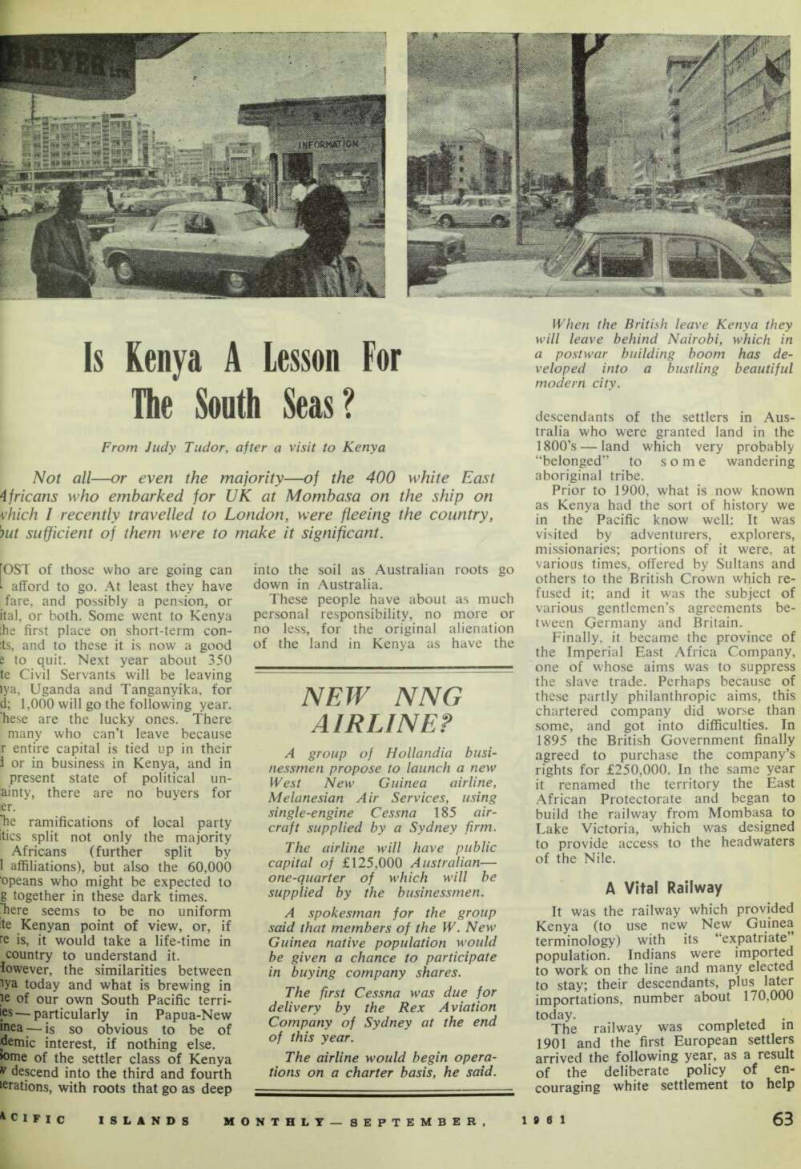
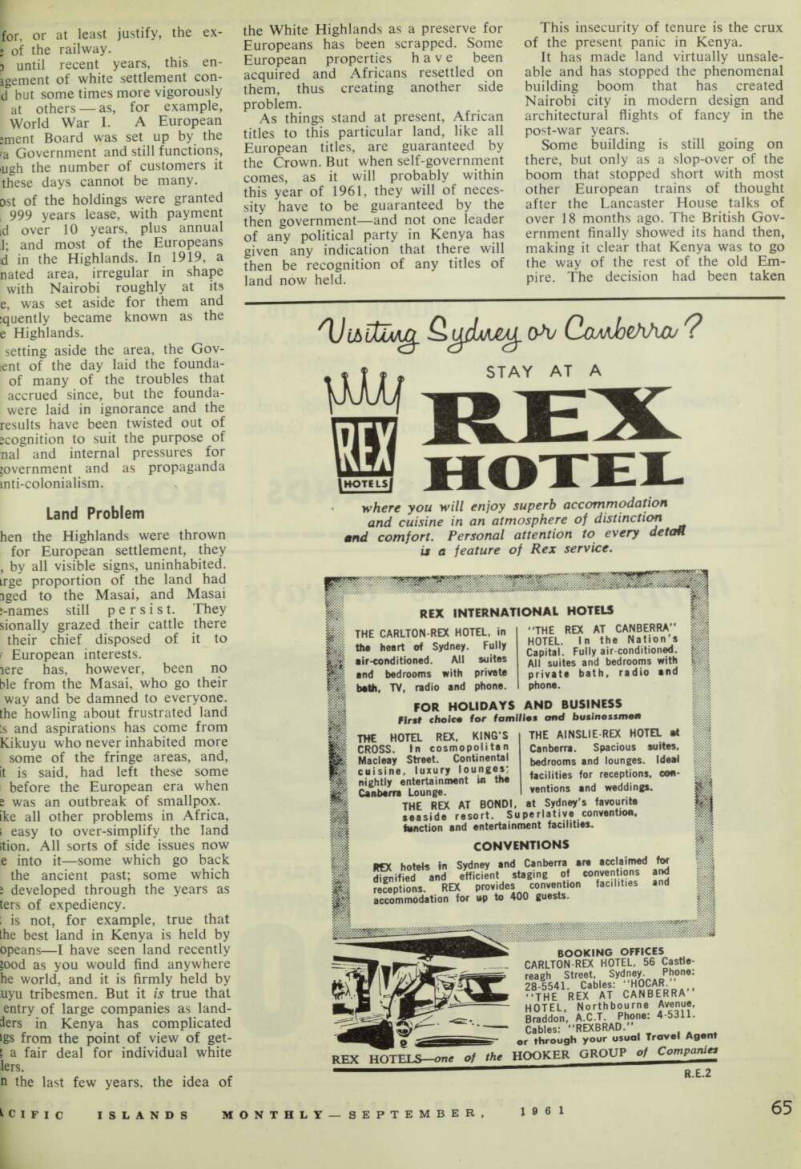
When the British leave Kenya they will leave behind Nairobi, which in a postwar building boom has de veloped into a bustling beautiful modern city. descendants of the settlers in Aus tralia who were granted land in the 1800’s land which very probably “belonged” to some wandering aboriginal tribe.
Prior to 1900, what is now known as Kenya had the sort of history we in the Pacific know well: It was visited by adventurers, explorers, missionaries; portions of it were, at various times, offered by Sultans and others to the British Crown which re fused it; and it was the subject of various gentlemen’s agreements be tween Germany and Britain.
Finally, it became the province of the Imperial East Africa Company, one of whose aims was to suppress the slave trade. Perhaps because of these partly philanthropic aims, this chartered company did worse than some, and got into difficulties. In 1895 the British Government finally agreed to purchase the company’s rights for £250,000. In the same year it renamed the territory the East African Protectorate and began to build the railway from Mombasa to Lake Victoria, which was designed to provide access to the headwaters of the Nile.
A Vital Railway It was the railway which provided Kenya (to use new New Guinea terminology) with its “expatriate’’ population. Indians were imported to work on the line and many elected to stay; their descendants, plus later importations, number about 170,000 today. , The railway was completed in 1901 and the first European settlers arrived the following year, as a result of the deliberate policy of en couraging white settlement to help
for, or at least justify, the ex f of the railway. 3 until recent years, this en jgement of white settlement con d but some times more vigorously at others as, for example, World War I. A European »ment Board was set up by the ra Government and still functions, iugh the number of customers it these days cannot be many, ost of the holdings were granted 999 years lease, with payment id over 10 years, plus annual 1; and most of the Europeans d in the Highlands. In 1919, a nated area, irregular in shape with Nairobi roughly at its e, was set aside for them and squently became known as the e Highlands, setting aside the area, the Gov ern of the day laid the founda of many of the troubles that accrued since, but the founda were laid in ignorance and the results have been twisted out of to suit the purpose of nal and internal pressures for government and as propaganda inti-colonialism.
Land Problem hen the Highlands were thrown for European settlement, they , by all visible signs, uninhabited, irge proportion of the land had aged to the Masai, and Masai ;-names still persist. They sionally grazed their cattle there their chief disposed of it to r European interests, lere has, however, been no ble from the Masai, who go their way and be damned to everyone, the howling about frustrated land ts and aspirations has come from Kikuyu who never inhabited more some of the fringe areas, and, it is said, had left these some before the European era when e was an outbreak of smallpox, ike all other problems in Africa, i easy to over-simplify the land ition. All sorts of side issues now e into it—some which go back the ancient past; some which i developed through the years as ters of expediency. ; is not, for example, true that the best land in Kenya is held by opeans—l have seen land recently ?ood as you would find anywhere he world, and it is firmly held by uyu tribesmen. But it is true that entry of large companies as land flers in Kenya has complicated igs from the point of view of get -5 a fair deal for individual white lers. n the last few years, the idea of
the White Highlands as a preserve for Europeans has been scrapped. Some European properties have been acquired and Africans resettled on them, thus creating another side problem.
As things stand at present, African titles to this particular land, like all European titles, are guaranteed by the Crown. But when self-government comes, as it will probably within this year of 1961, they will of necessity have to be guaranteed by the then government—and not one leader of any political party in Kenya has given any indication that there will then be recognition of any titles of land now held.
This insecurity of tenure is the crux of the present panic in Kenya.
It has made land virtually unsale able and has stopped the phenomenal building boom that has created Nairobi city in modern design and architectural flights of fancy in the post-war years.
Some building is still going on there, but only as a slop-over of the boom that stopped short with most other European trains of thought after the Lancaster House talks of over 18 months ago. The British Gov ernment finally showed its hand then, making it clear that Kenya was to go the way of the rest of the old Eng pire. The decision had been taken
g before, and although the en iched interests of thousands of lers had been embarrassing, in ' ultimate analysis, they were
ged expendable.
'he white residents of Kenya to ’ are far from united either in pose or opinions; but most of n are bitter. hey are bitter about the British rernment which has “given them y”; they are bitter about the lion of the outside world and the is information media about the ase of convicted Mau Mau leader, 10 Kenyatta—a release that has :ially “pleased” the British Gov nent, the British Parliament and present Governor of Kenya in ; of the latter’s hard words about subject matter only months ago. enyans see Kenyatta, the man onsible for the blood-bath of the jrgency, a white-washed martyr; r say they can now expect to see day when he is knighted or nier of Kenya, or both, and as i, dining with the Queen at Buck -lam Palace. The idea makes them Multi-Racialism? [any are bitter with each other, individualists each has met the ent situation in an individual mer. Some still cling to the idea multi-racialism, although it be es increasingly difficult for them lo so in the face of some of the ;ments of the wilder boys of local can politics. thers, who see no future for ti-racialism in a society composed 66,000 Europeans, less than ,000 Asians and over six million icans, expect violence worse than Congo when independence comes ith the conflict not only between opean and African but between lean and African where tribal igonisms go deep, lany who are financially unable eave the country pin their hopes he British Government finally see the light and compensating them )rding to the terms of the petition has been placed before Parlia it. ome who don’t pin their hopes in thing of the sort, and can’t see other way out of the mess, are )lved to dig in and stay put, 'ing that when the present African ■air merchants are actually run g their own country, the realities J responsibilities of government 1 temper the nonsense that is being £d at present and that common se will prevail. )n the surface—the tourist’s eye w—all is much as before. In spite
of the current drought, the game re serves have the same number of wild animals. The hotels are good; the servants are willing and polite; the food is excellent. The Africans look decorative, happy and contented, and guides point out new housing develop ments, schools and hospitals that have been constructed for their benefit.
The Europeans go briskly about their affairs and have learned not to discuss their troubles with outsiders.
The local newspapers headline African unemployment and economic recession because the inflow of de
velopment capital from overseas has petered out, and they contain a lot about local politics, the significance of which entirely escapes the visitor, who is more interested in the fact that giraffe are cute and lion cuter.
I spoke to a newspaperman in Nairobi. He had been there eight years, and likes it. His wife loves it and their small son thrives on it.
But his contract is up next year, and they are going back to the UK. Why, seeing that there must be need of newspapers even after independence?
There may be need, he said, but if the new rulers of the country ran true
ie form of other newly “liber * African states, the Press would nuzzled in short order.
Iditionally, he hates the tensions ; false racial interpretation the i advanced Africans with whom ad to deal put on innocent Euro s’ actions. It was no place, he to bring up a child—even with the possibility that independence bring violence. was he who said that professional were cutting their losses and get out; and that several score doctors threatened to go in a body, leav things, as they put it, to the :ans with their “third-class de ' three settlers I spoke with, two bewildered, apprehensive and ■ in the knowledge that economic they were in a cleft stick. The was determined to look on the it side—in effect, to dig a hole pull the rest of his farm in after to ignore or discount the pre political situation, in the hope if he didn’t think about it the tion might cease to exist.
Affection for People i the ship between Mombasa and try I saw a lot of one Kenya ly going to England for good, had elected to resign from the nial Service as his job with the /a. Government had folded up, as been Africanised, as they say \ [Papuanisation, in relation to j and NNG, means the same ; and is just beginning to be one ie popular words of new thinkers tat area.] ie was Kenya-born, the daughter )ne of the early settlers. They : four children all born in Kenya, they were leaving behind her r, husband and six children who \ working the original family i and holding on because, lomically, they had to. s with most East Africans, they : a great affection for the African )le and a great sadness at leaving r homeland. In order to cheer a up and to prove that Africa is the only country with problems, ive them a few copies of PIM to 1. Each came back at different is and said that apart from places names, a great deal of it could e been lifted in its entirety from iya papers of two years ago. To n, of course, that spelled one ig only: the writing on our walls, tt this stage of the game I am prepared to agree or to disagree, I thought back to over a year ago sn, in answer to a direct question native members of the P-NG Legis
lative Council, one member came back with the answer that after self government, European settlers could stay only if they had been nice to the natives.
At the time it seemed so politically immature as to be funny, but even a short visit to East Africa is sufficient to convince me that even more im mature statements than this, and even more childish visions of power and glory, have a way of becoming most terrifying facts in Africa.
And if Africa today, why not the Pacific tomorrow?