Overcoming
p. 47 · Read in the full issue
Fiji Flood
Problem
From a Nadi Correspondent This year floods have been less damaging than usual in Viti Levu. Almost every year the road around the island goes under water for periods of from hours to days.
CERTAIN points such as Semo near Sigatoka, Nadi and districts, Ba, Tavua, Raki Raki go under regu larly. And this happens sometimes after only short rainfalls.
A look at the map shows that all these points are near the mouths of rivers. A look at the bridges show that engineers of that time allowed ample latitude for sudden rises.
History records that when most of these bridges were built vessels of quite respectable dimensions used the rivers for cargo carrying, and that this traffic was of considerable volume.
Obvious inference, when nowadays nothing bigger than a small launch can get up most of the rivers of Viti Levu, is that the silting of the en trances causes much of the flooding, and also over the years, has resulted in much loss of land use.
Experts say also that lack of care of upper river drainage channels has added to the problem.
What is the Remedy?
Dredging of all the previously navigable rivers would undoubtedly relieve much of the flooding and by deposit of the silt would also reclaim valuable acres of land. It would be
first class agricultural land.
A dredge would be fully employed, and would cost about £250,000.
When probable results are measured against this cost, it would appear that a dredge for Fiji would rank far above some of the present Gov ernment projects. Floods every year cost in the aggregate millions in lost time, inconvenience and actual struc tural damage to buildings and roads.
Bridges are often overlooked in discussions on Viti Levu roads, but many road bridges today are danger ous.
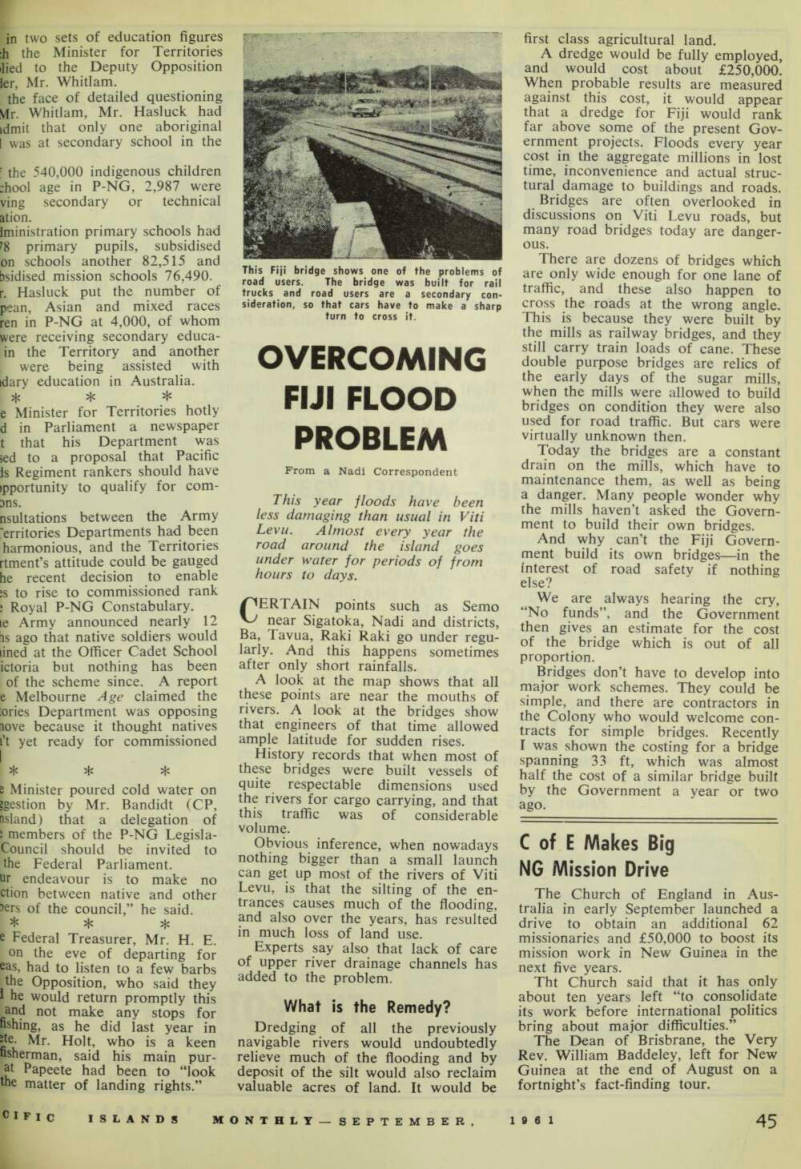
There are dozens of bridges which are only wide enough for one lane of traffic, and these also happen to cross the roads at the wrong angle.
This is because they were built by the mills as railway bridges, and they still carry train loads of cane. These double purpose bridges are relics of the early days of the sugar mills, when the mills were allowed to build bridges on condition they were also used for road traffic. But cars were virtually unknown then.
Today the bridges are a constant drain on the mills, which have to maintenance them, as well as being a danger. Many people wonder why the mills haven’t asked the Govern ment to build their own bridges.
And why can’t the Fiji Govern ment build its own bridges—in the interest of road safety if nothing else?
We are always hearing the cry, “No funds”, and the Government then gives an estimate for the cost of the bridge which is out of all proportion.
Bridges don’t have to develop into major work schemes. They could be simple, and there are contractors in the Colony who would welcome con tracts for simple bridges. Recently I was shown the costing for a bridge spanning 33 ft, which was almost half the cost of a similar bridge built by the Government a year or two ago.
This Fiji bridge shows one of the problems of road users. The bridge was built for rail trucks and road users are a secondary con sideration, so that cars have to make a sharp turn to cross it.