The Editins' Mailbag.
p. 26 · Read in the full issue
History of a Steamship
Company
Mr. N. L. McKellar needs some help. He writes: “As you doubtless know, the AUSN Co. has ‘folded up’. I am writing the history of the company—not for profit, but because of a love of ships and an interest in shipping generally.
“I am seeking information about the association of the AUSN with Fiji. You will recall that in the years gone by, the AUSN used to run, firstly, the Suva, and later the Levuka on the Fiji trip. Now the Suva was built in 1906; there must have been earlier vessels on the run —the only one I can find mentioned is the Tenterden.
“Has any reader anything in his files which might throw some light on early steam connections with Fiji? I know that Nicoll’s Fijian was running there in the 1880’s; I have heard that Jas. Patrick (or his father) ran there even before Burns Philp.
“Any help given will be gratefully received and duly acknowledged. Be assured that if any PIM reader does lend me any notes or files they will be accorded the respect due to them; having (I am told) the largest private shipping library in Australia, I am almost a fanatic so far as re cords as concerned!” Mr. McKellar’s address is c/- Tamworth Base Hospital, Tamworth, NSW.
UN Wants to Hear From
The Man on The Spot
“Kassa”, of Palmwoods, Queens land, is more than happy at the se lection of Sir Hugh Foot as chair man of the United Nations Mission to Nauru and New Guinea next year {PIM, August p. 20). And he has equal respect for a previous mission chairman, Sir Alan Burns. He says both Sir Hugh and Sir Alan have had long years of distinguished colonial service, and when speaking about them even the most critical members of the Trusteeship Council realised that the word “colonial” was not to be considered a dirty one.
The point “Kassa” makes is that while Britain and other countries know that men like Sir Hugh and Sir Alan can do remarkable work in turning a now outdated colonial em pire into an association of free peoples, Australia will still “have
none of the idea that the experienced colonial administrator is the right man to be either her representative at UN, or as a director in Canberra”.
He thinks that the credit for the enlightened administration of Pacific territories is principally owing to the men who happen to be there on the spot and that this should be recog nised by the Australian Government.
UN members themselves would like to hear directly from the men on the spot.
With all of which we heartily con cur. And what do Mr. Menzies and Mr. Hasluck think about it?
Those Musical
Norfolk Islanders
The letter on Norfolk Island’s Council difficulties from Council President Mr. F. J. Needham, in the August issue, brings a reply from former councillor A. B. Bathie. A Norfolk correspondent had reported in April PIM that general opinion was that the “Gilbert and Sullivan comic opera regularly being per formed at Rawson Hall was rapidly developing into a tragedy”, and Mr.
Needham last month pointed out that
the “opera”, far from being a tragedy, was in fact receiving a great deal of popular applause.
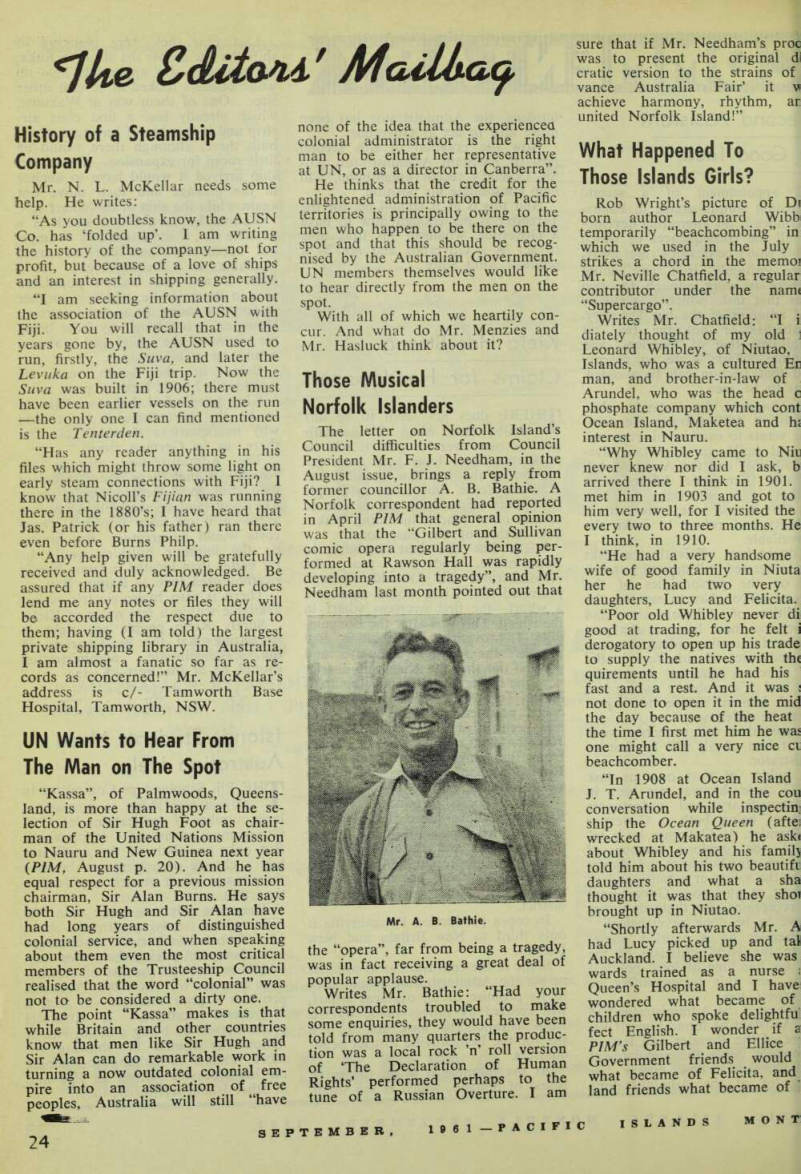
Writes Mr. Bathie: “Had your correspondents troubled to make some enquiries, they would have been told from many quarters the produc tion was a local rock ’n’ roll version of ‘The Declaration of Human Rights’ performed perhaps to the tune of a Russian Overture. I am
sure that if Mr. Needham’s proo was to present the original dl cratic version to the strains of vance Australia Fair’ it w achieve harmony, rhythm, an united Norfolk Island!”
What Happened To
Those Islands Girls?
Rob Wright’s picture of Dt born author Leonard Wibbi temporarily “beachcombing” in which we used in the July strikes a chord in the memoi Mr. Neville Chatfield, a regular 1 contributor under the name “Supercargo”.
Writes Mr. Chatfield: “I ii diately thought of my old 1 Leonard Whibley, of Niutao, Islands, who was a cultured En man, and brother-in-law of Arundel, who was the head c phosphate company which cont: Ocean Island, Maketea and hz interest in Nauru.
“Why Whibley came to Niu never knew nor did I ask, b arrived there I think in 1901. met him in 1903 and got to him very well, for I visited the every two to three months. He I think, in 1910.
“He had a very handsome wife of good family in Niutai her he had two very daughters, Lucy and Felicita.
“Poor old Whibley never dl good at trading, for he felt i derogatory to open up his trade; to supply the natives with the quirements until he had his fast and a rest. And it was s not done to open it in the mid the day because of the heat the time I first met him he was one might call a very nice cu beachcomber.
“In 1908 at Ocean Island J. T. Arundel, and in the cou conversation while inspectin; ship the Ocean Queen (aftei wrecked at Makatea) he ask* about Whibley and his family told him about his two beautifi daughters and what a sha thought it was that they shoi brought up in Niutao.
“Shortly afterwards Mr. A had Lucy picked up and taH Auckland. I believe she was wards trained as a nurse : Queen’s Hospital and I have; wondered what became of children who spoke delightfu feet English. I wonder if a PlM’s Gilbert and Ellice Government friends would what became of Felicita, and land friends what became of
Mr. A. B. Bathie.