Of Fiji
pp. 19-143 · Read in the full issue
Main Points Of Fiji Sugar Report
By Radio from Suva
the report of the Fiji Sugar miry Commission, just released, kes no attempt to apportion the me for the many troubles in the ustry in recent years. The report i that the Government, millers, \e growers and mill workers must i in respect of one period or an er, share the responsibility.
HE inquiry was ordered at the end of last year by the British lonial Office at the urgent request the Fiji Governor, Sir Kenneth iddocks, in an effort to sort out the raomics of the Fiji sugar industry which is the mainstay of Fiji )nomy.
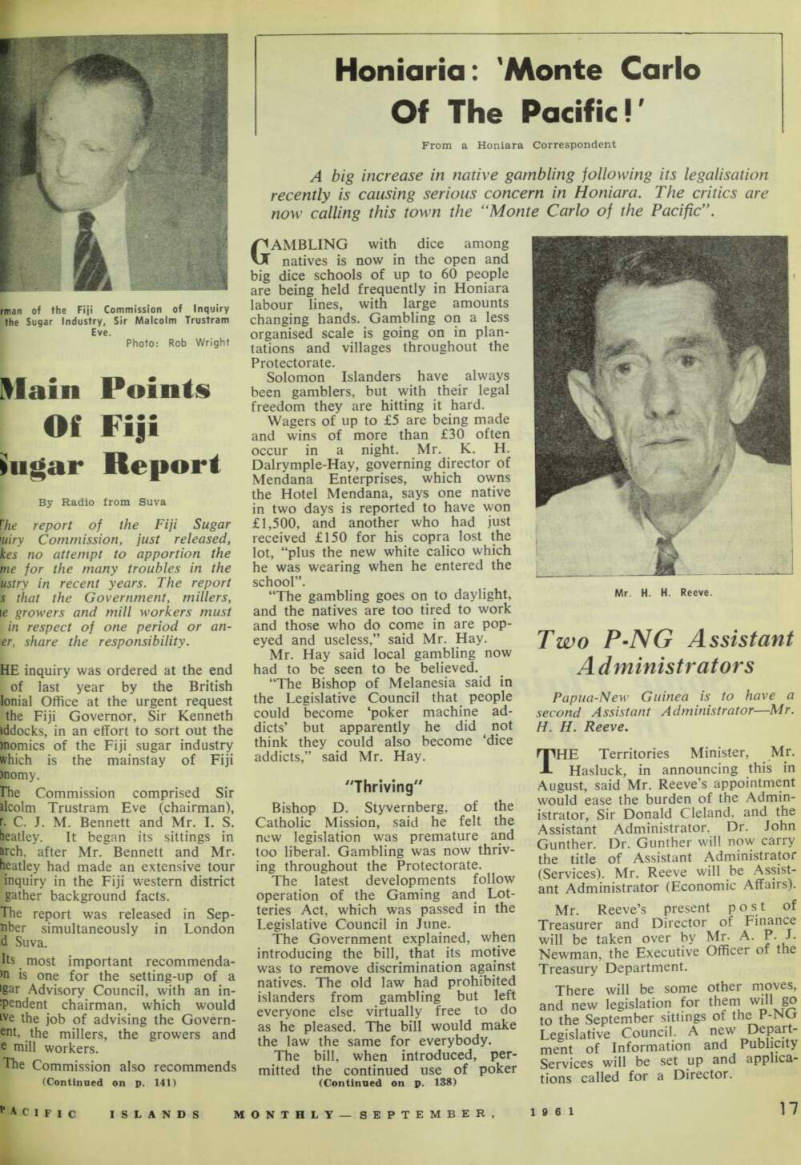
The Commission comprised Sir ilcolm Trustram Eve (chairman), [. C. J. M. Bennett and Mr. I. S. heatley. It began its sittings in arch, after Mr. Bennett and Mr. heatley had made an extensive tour inquiry in the Fiji western district gather background facts.
The report was released in Sep nber simultaneously in London d Suva.
Its most important recommenda >n is one for the setting-up of a l gar Advisory Council, with an in ipendent chairman, which would we the job of advising the Govern ent, the millers, the growers and e mill workers.
The Commission also recommends
(Continued on p. 141)
[?]rman of the Fiji Commission of Inquiry the Sugar Industry, Sir Malcolm Trustram Eve.
Photo: Rob Wright
the establishment of a Sugar Board, who would help arrange annual quotas.
On the matter of quotas, the Com mission suggests Fiji could be given a bigger share of the international market if Australia and South Africa, which had substantial and expanding home markets, and markets in neigh bouring areas, were willing to surren der part of their quotas.
“This would be an act of great generosity to small neighbours,” it says.
The report recommends that Fiji should be allowed to export to the UK 50,000 more tons of sugar every year.
It recommends a ten year contract to expire in 1970 (the Commission included 1961-62, which have ad hoc agreements).
The Commission suggests farm quotas should be fixed on a tonnage basis instead of an acreage basis, and suggests penalties for burnt, stale, dirty cane.
It also suggests suspension of the sugar price Stabilisation Fund levy, as it says the fund is large enough at £3.2 millions for normal require ments.
The Commission also recommends that the sugar milling activities in Fiji should be handed over to a wholly owned subsidiary of CSR, based either in Suva or Lautoka, in stead of being a Fiji division based in Sydney.
This was the only change of im portance which the Commission sug gests in respect of milling activities.