Irishman McCuaig's
pp. 117-143 · Read in the full issue

Pac ific Report
The month’s round-up of news and pictures of people and events, from PIM correspondents in the South Pacific.
rtime Bombers Give
Their Dead
i Australian-United States Air e team in New Guinea in June /ered bodies from two wartime ber wrecks sighted in March dur an air search for a crashed an Air Transport aircraft. By July the team was on the trail vo more aircraft it had sighted during an aerial survey, e team comprises Wing Corn ier K. W. Rundle, of the RAAF; Lieutenant W. J. Wheeler, of igo, and Sergeant First Class H. 10, of Honolulu, both based at lii. e three men recovered the re -5 of nine American airmen from 5 Mitchell and a C 47 aircraft, of which had been lost against ipanese in 1944, They then went i search for two other aircraft, ht to be an Anson and a 827. the wrecks were north of Port sby.
ien Golfers in
-Islands Tournament
men golfers from Fiji, Papua 3uinea and West Samoa in June arranging the play-off for the Pacific Islands Golf Trophy— nly regular inter-territory golf iment in operation in the s.
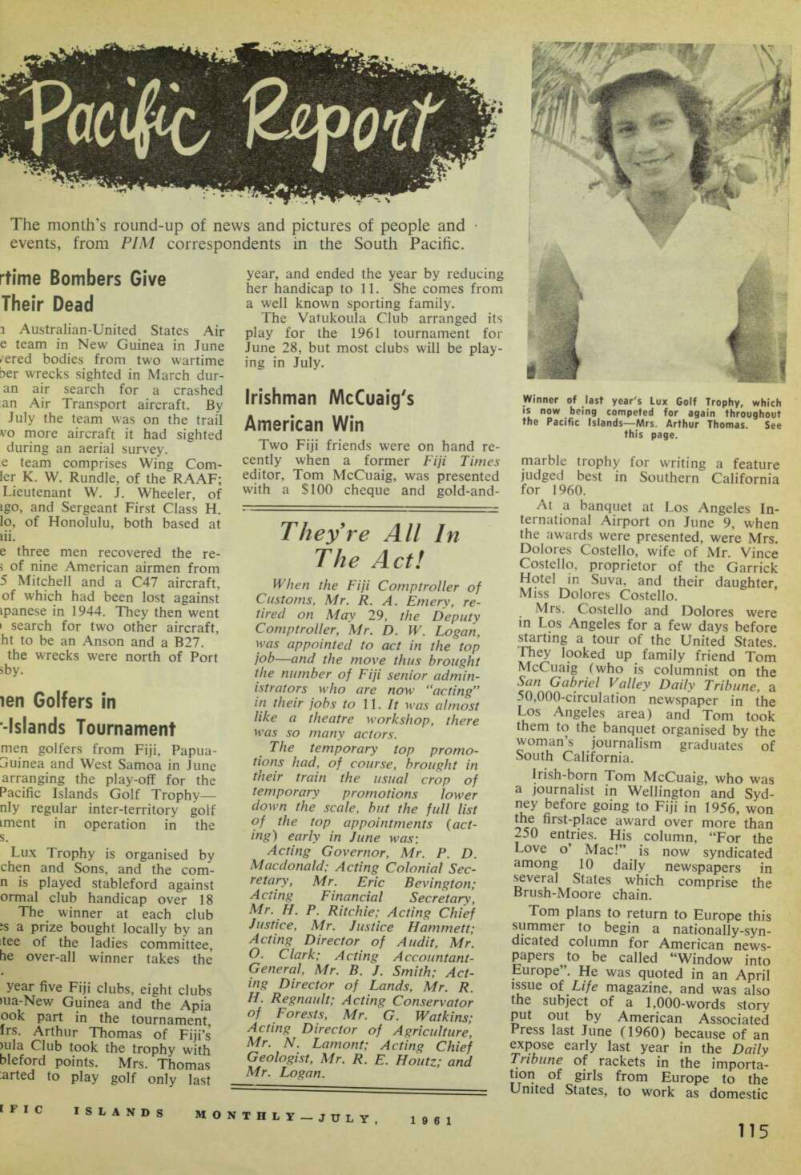
Lux Trophy is organised by chen and Sons, and the com n is played stableford against ormal club handicap over 18 The winner at each club ; s a prize bought locally by an tee of the ladies committee, he over-all winner takes the year five Fiji clubs, eight clubs >ua-New Guinea and the Apia ook part in the tournament, Irs. Arthur Thomas of Fiji’s >ula Club took the trophy with bleford points. Mrs. Thomas arted to play golf only last
year, and ended the year by reducing her handicap to 11. She comes from a well known sporting family.
The Vatukoula Club arranged its play for the 1961 tournament for June 28, but most clubs will be play ing in July.
Irishman McCuaig's
American Win
Two Fiji friends were on hand re cently when a former Fiji Times editor, Tom McCuaig, was presented with a $lOO cheque and gold-and-
marble trophy for writing a feature judged best in Southern California for 1960.
At a banquet at Los Angeles In ternational Airport on June 9, when the awards were presented, were Mrs.
Dolores Costello, wife of Mr. Vince Costello, proprietor of the Garrick Hotel in Suva, and their daughter, Miss Dolores Costello.
Mrs. Costello and Dolores were in Los Angeles for a few days before starting a tour of the United States.
They looked up family friend Tom McCuaig (who is columnist on the San Gabriel Valley Daily Tribune, a 50,000-circulation newspaper in the Los Angeles area) and Tom took them to the banquet organised by the woman’s journalism graduates of South California, Irish-born Tom McCuaig, who was a journalist in Wellington and Syd ney before going to Fiji in 1956, won the first-place award over more than 250 entries. His column, “For the Love o’ Mac!” is now syndicated among 10 daily newspapers in several States which comprise the Brush-Moore chain.
Tom plans to return to Europe this summer to begin a nationally-syn dicated column for American news papers io be called “Window into Europe”. He was quoted in an April issue of Life magazine, and was also the subject of a 1,000-words story put out by American Associated Press last June (1960) because of an expose early last year in the Daily Tribune of rackets in the importa tion of girls from Europe to the United States, to work as domestic
Winner of last year's Lux Golf Trophy, which is now being competed for again throughout the Pacific Islands—Mrs. Arthur Thomas. See this page.
rvants. McCuaig’s campaign se red him a nomination for the veted Pulitzer Prize award.
Tom retains a close interest in Fiji airs and is a subscriber to Fiji mes and Pacific Islands Monthly, th of which he quotes occasionally his column.
ative Carving For
r Donald
The P-NG Administrator, Sir maid Cleland, in June, was pre ited with a sample of some of the iod carving work of the natives of : New Ireland district.
Sir Donald and Lady Cleland were king an official visit to New land and called at Taskul, on New nover, to open a new Local Gov ment council. Some hundreds of agers travelled for up to two days see the Administrator. \fter the opening Sir Donald was sented with a wooden statue of ises holding the tablets of the Ten mmandments symbolising a ive impression of “The Law yer”. A native named Atakuk, of taboi village, carved the statue in week’s hard work, and later posed a photograph with Sir Donald. illustrated article on the carving that and the Manus area—written Captain Brett Hilder—was pub ed in PIM of April, 1960.
Tourist Increase
Not Enough"
uva’s mayor, and chairman of the Visitors Bureau, Mr. Charles son, had something to say about s tourist trade in June, te said the rate of increase of ists to Fiji last year was a little e than 12 per cent., which was enough. Some other areas had vn by as much as 27 per cent. [r. Stinson said that Fiji was in ng competition with other South fic territories, which were getting easing numbers of tourists, and e support simply had to be given :he Visitors Bureau if Fiji was ?et its share of the trade. The Jau wanted more money. [r. Stinson deprecated the lack of •ort by local businesses, and said e businessmen still did not realise benefits of tourism to their com es. r. Stinson said unless more help given to the hotel industry, fs could not be kept in line with seas competitors, r. Stinson’s comments were re ed, as usual, as being intelligent valuable, but many people in
Fiji don’t see new hotels as the complete answer to increased tourism.
They would like to see more organised entertainment for the visitors, and more things done to make the visitors welcome.
Samaritan W/ac Jamal nail WdS A Faunal Vicitnr u *' ° When the US Coast Guard cutter Ironwood visited Pago Pago, American Samoa, earlier this year, a Hos- Pital Corpsman, Vincent Gentiluomo, of Texas, paid a casual visit to the hospit a l.
There he saw an 18-years-old
Samoan girl, Tifitifi Liufau, who was having her third heart attack. She suffered from a special heart condi tion and was in need of surgery, Gentiluomo was told the only place near enough to provide it WOuld be Hawaii > but the cost of such an operation might run into thousands of dollars, an amount which the S irl ’ s P a rents could not pay.
Gentiluomo took the girl’s medical history back to Hawaii with him in the hope that he could have some thing done.
There he heard that a columnist on the Honolulu Advertiser had
helped raise a heart bank known as the Eddie De Mello Fund, named after the first boy who had benefited from an operation, thanks to dona tions from the public.
This fund was almost depleted but the staff at Queen’s Hospital became interested in the case and offered to do the operation free.
Tifitifi was flown to Honolulu on June 4.
In mid-June, news went back to Pago from Dr. Lawrence Klein that Tifitifi had been operated on on June 13 and that the operation was completely successful.
Australian Leader
On P-NG's Future
Leader of the Australian Parlia mentary Opposition, Mr. Arthur Calwell, said in Port Moresby on July 1 that he could not envisage P-NG ever gaining representation in the Australian Parliament.
“When independence comes, the closer associations between Papua and New Guinea and Australia will be as fellow members of the Com monwealth of Nations,” Mr. Calwell said.
Mr. Calwell and his wife arrived at Port Moresby in the liner Orsova for a ten day “Meet the People” tour of Eastern Papua and New Guinea.
There is a Federal election in Aus tralia at the end of this year.
Mr. Calwell told a Port Moresby Press conference that the people of Australia had to continue to help financially the Territory of P-NG. It had to assist “to the extent of mil lions”, Mr. Calwell said: “Australia is not a Colonial Power.
“A Colonial Power is one which
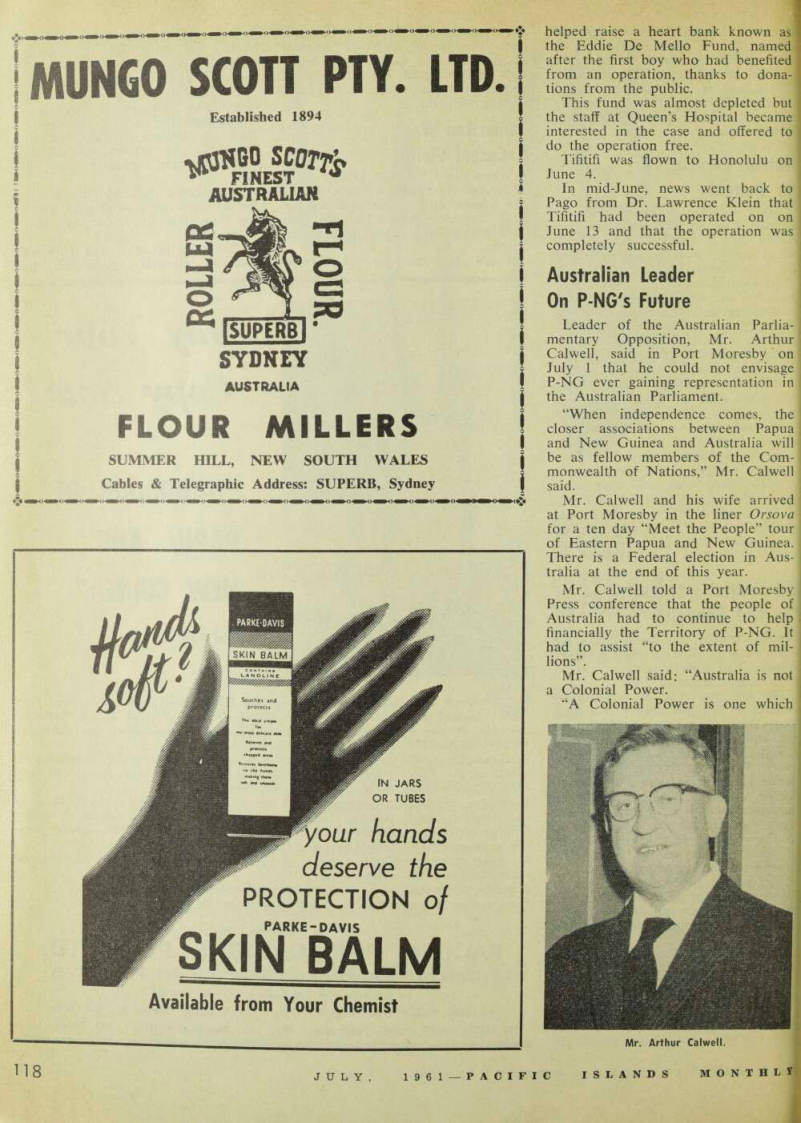
Mr. Arthur Calwell.
loits. Australia has never done fe said he estimated it to be lerations before the people of Territory are ready to rule them es, despite some United Nations gates who believe self-rule should granted earlier.”
Ir. Calwell, the day of his Press ference, visited Sogeri, a rubber ving area near the beginning of Kokoda Trail. He was, said a espondent, “impeccably dressed ropical white”.
Nice Crowd' For
! Pacific Bowls
3r the second year in succession, bowler Archie Gardner, in early , won the South Pacific Singles ling Championship. Playing on a green in Suva he won the final i New Zealander K. Potter. ie tournament, which included is from Australia and NZ, was y hampered by atrocious weather, at one stage the organisers were )tful if the contests would be fieted. it apparently the weather didn’t any of the fun out of the trip the visitors. They told a PIM spondent at Nadi airport before
flying home: “It was great, and so was the hospitality.”
Said Suva Bowling Club vice patron, Mr. V. J. Costello, in pre senting the trophies: “This is the best overseas crowd in the history of the tournament.”
New Lautoka Store
Rises from the Ashes
The Lautoka, Fiji, branch of Burns Philp (SS) Co. Ltd. moved into their new store building in June. The previous building caught fire at 2 a.m. one day last March and in about an hour had burned to the ground.
No damage of any consequence was done to the new store, which had been partly completed around the
old one. Steel windows were twisted and ceilings burned out but the con crete work was found to be sound.
With £60,000 stock destroyed in the fire, store manager Les Pearson drew stores and stock from other branches, and in three days was again in business in an old theatre build ing on the opposite side.
Since then, the contractors have been rushing to completion about 3,000 square feet of the new build ing, and by erecting partitions, have prepared a fairly good store section, despite some temporary make do and mend.
When fully completed, the store will cover a triangular block with very long frontages to three streets, and the existing service station, which
zingly escaped the fire, on the r, urns Philp has had bad luck with ss being burned down in Fiji, asa, Ba and Lautoka have all ted down. An unusual coincid , and one which has resulted in h friendly bantering, is that in case Albert Waddingham was armer manager of the burned is, having left each about a year re the fires. r. Waddingham these days is busy Tida, retired from business, but engaged in light farming, bee ing and poultry raising, as PIM reported recently.
it of the Month
lew Police Station
ent of the month in Lautoka, in June was the formal opening le town’s new police station, ilt by the Fiji Public Works irtment, designed by Govern architects, the building is cer ! a modern addition to the Great hwest. Opening ceremony was rmed by the Acting Governor.
P. D. MacDonald, aervisor of the job was Mr.
Price, who also built the ter l building at Nadi airport, e police station has two floors, includes a well-equipped radio icer in charge is S/Superin nt J. Beatt, who has with him intendent D. Saint, D/Supt. lan ’ A/Supt. Brian Finch and ant/Supt. Walli. Total staff is >ver 50 Indians and Fijians of inks. his address, the Acting Gover alked on the role of the Press nacular as well as the English age Press. He said it could do it deal to build up, or harm the e of the force, and he hoped the would use its good offices to
foster good relations between the force and the public.
About 200 official guests were pre sent.
Different Slant to
Hibiscus Festival
Fiji’s Miss Hibiscus 1961 will probably be named from the bridge of the liner Mariposa this year.
And furthermore, she will be named early during the Hibiscus Fes tival celebrations, instead of having to wait until the evening of the last day of the festival. This will enable Fiji’s glamour girl of the year to be guest of honour at Hibiscus Week functions.
According to a tentative pro gramme drawn up in Suva in June, the naming will be on September 18 aboard the Mariposa, which is bring ing tourists for the festival.
The programme starts on Septem ber 16, with a march through the city and an official opening at Suva’s Albert Park.
The procession of floats will be on September 23, after a full week of festivities, including concerts, exhibi tions, fairs, receptions, sports meet ings and demonstrations.
Hibiscus Week is quickly becom ing the kind of popular tourist attrac tion that Bastille Day is in the French Pacific.
Festivals appear to be on the increase in Fiji, with the Northwest putting on the Nadi Commerce Week Festival and the Lautoka Junior Chamber of Commerce planning an event of the same kind just before the opening of the Suva Festival.
P-NG Sportsmen Are
Out for a Win
Papua-New Guinea is moving into gear in its efforts to make its debut in international sport at the British Empire and Commonwealth Games in Perth next year, reported an AAP- Reuter correspondent from Port Moresby in June, The Australian-administered Terri tory hopes to be represented at the Games by a team of European bowlers and at least six native athletes.
But before these hopes are realised a number of obstacles have first to be overcome.
These include the setting up of athletics clubs throughout Papua- New Guinea under a parent body, and affiliation with the Australian Amateur Athletics Association. (Over)
The new Lautoka store of Burns Philp, as it looked in June.
Photo: Akbar
The Acting Governor of Fiji, Mr. p. D. MacDonald, opens Lautoka's new police station.
Photo: Akbar
Only when this is done will the Territory be given the green light by the Games Federation in London to compete at Perth.
Prominent local sporting identity, Mr. A. L. Michel, chairman of the Territory’s first Empire Games Assol ciation, will not hear of defeat.
“We have a lot of hard work ahead of us, but have no fear, we’ll be in Perth next year,” he said.
“We have the full support of the Administration and the Minister for Territories, Mr. Paul Hasluck, and many local organisations have offered to do all they can.”
Papua-New Guinea, while only a young and comparatively primitive country, has an enthusiastic sports minded native population.
In the more civilised areas the natives have, under training and en couragement from a hard core ol Europeans, excelled in soccer, rugb) league, basketball and baseball, and are skilled sailors.
In 1956 the Territory made it< first attempt to step onto the inter national scene.
A team of Port Moresby da) pigeon shooters sought permission tc compete in the Melbourne Olympia but met ignominious failure.
The Olympic Committee turnel down its application on the groum that Papua-New Guinea was “not I country”.
Smarting under the insult, Terri tory sportsmen last year decided t( make a determined bid for a placi in the Perth Empire Games.
Initial approaches to the Game organisers in Western Australia drev encouraging replies, and further over tures to Mr. S. Duncan, secretary o the Games Federation, won provi sional affiliation for Papua-Nev Guinea.
Plans are now well under way t( seek out the Territory’s best nativi athletic talent in the 16 months re maining before the Games are to to held.
Athletics Promotion Committee; have been set up in Port Moresb] and Lae.
Port Moresby will begin holdinj regular inter-club athletic meets nex; month. Lae, Rabaul, Madang anc Wewak will follow suit by Septein ber. The first inter-town carnival scheduled for January next year. The aim of local organisers is tc hold Territorial championships aboui August next year at which athlete; from NNG and the British Solomon Islands might also compete.
The team to go to Perth will to chosen on the results of this carni val, and the successful athletes ’Wii then undergo intensive last minute
ing at the hands of an Australian i. lance will be raised by public ription and an Administration dy. it how much potential the native te has was demonstrated at the tory’s first native sports meeting )rt Moresby early this month, nnmg in bare feet on an un uphill grass track a 19-year-old :e teacher was timed by three les over the hundred yards in seconds. the 4 x 440 yards relay one again in bare feet, covered leg” in 52 seconds flat. 2 winning leaps in the broad ! and high jump were 21 feet nches and 6 feet one inch re vely. Both winners wore no and neither had ever before -ted in an athletics contest of :ind. ; carnival did more than high a few exceptional performances, ary to expectations it empha that the New Guinea native is more than mediocre in throw
ing events and long distance running.
“We thought that with his back ground the native would be ideally suited to both,” Mr. Fred Kaad, an executive member of the Port Moresby Athletics Promotion Com mittee, explained.
“We were quite wrong. His best potential appears quite definitely to be in the sprints and the jumps.
Even now, untrained and uncoached, they look very good in these.”
Canton Tracking
Station Working
The American satellite tracking station erected at Canton in connec tion with America’s man-in-space
project is in operation. Residents at Canton have been given a conducted tour of the station, to see the equip ment that will help keep track of America’s first round-the-world spaceman satellite.
Fiji Cocoa Prospects
Are Still Good
In spite of world depressed prices for coffee and cocoa, Mr. V. E. Sills, Fiji Agricultural Officer, thinks the future of cocoa in Fiji as an export item is still good.
In a review of the cocoa industry, which is still in its infancy in Fiji, Mr, Sills says the proper develop ment of cocoa in Fiji is of “great
uportance”, and it might one day ecome an “immense enterprise”.
Not so happy are the figures for offee. It was announced recently lat three South American States lone had sufficient reserve stocks to apply the world for a year.
The suggestion that coffee will be “hedge crop” for Fiji and be used jainly for local consumption has lerefore some merit.
icean Is. and Nauru
abour Settles Down
Reports from the Gilbert and Ilice Islands Colony in June said tat the new labour arrangements on cean Island seemed to be working ell.
The arrangements were made fol wing the strike in April of GEIC bourers employed on Ocean Island, hich later spread to Nauru.
As well as better conditions, the bourers got an increase in wages, at the trouble wasn’t fixed until tra police were called out from e Solomons, an RNZN frigate was from Auckland to “wait er the horizon” and senior Phos ate Commission officers had rived.
Agreement was reached after dis ssions between the strikers and the
top brass, during which the Ocean Island labourers, who had their prob lems discussed first, made it clear that one of their main complaints was that it was difficult to have their opinions brought to the notice of the management.
There was also need for new hous ing, and a new type of house, and such things as transport to distant places of work, and increased rations, they said.
The new arrangements on Ocean
consist of a new Workers’ Commit tee of six, the members elected by island groups. Chairman of the new committee is the Labour Officer, who is also newly appointed to that post.
The committee meets weekly or as required and receives complaints which can’t be settled by the Labour Officer in the course of his normal routine.
There is now also a Labour Rela tions Council, under the chairman ship of the Assistant Manager at Ocean, to deal with matters that can’t be settled by the committee.
Final appeal lies with the Manager.
The Ocean Islanders also have a new Welfare Officer.
The complaints at Nauru mostly concerned matters of detail, although they asked for an increased basic wage, which they got.
The increased wages and allow ances at Nauru (£2 a month increase on the basic wage, plus a child allowance of £2/3/4 a month) also apply to Ocean Island labour.
The labour organisation at Nauru will be remodelled on the same lines as the Ocean Island arrangement.
In both Ocean Island and Nauru, the proportion of married workers is to be increased as quickly as possible.
FOOTNOTE : The NZ frigate Pukaki, which arrived at Tarawa as final agreement was reached, had a
ctic time. There was a party in the :tio Club on Saturday evening, a icket match the following day, plus sight seeing tour of the Betio ttlefields. Then there was a soccer itch, followed by a cocktail party, is another cricket match and an ler cocktail party.
ho Were Those Natives
ho Rescued the President?
The group of Solomon Islands lives who during the last war res jd a party of Americans including mtenant John F. Kennedy, now I President Kennedy, consisted of i Methodists and three Seventh y Adventists.
Ehis has been established by stor J. P. Holmes, president of Western Solomon Islands Mission Seventh-day Adventists. Pastor Imes had already been making tie investigations on behalf of an lerican editor.
"rom his headquarters at Kukudu June 21, Pastor Holmes reported: ist week two Americans came here 1 spent eight days, having obtained address from denominational dquarters in Washington.
They we:,* from the New York wld Tribune, and the leader, Mr. novan, was commissioned to write ook on the wartime experiences of sident Kennedy. He had already ;rviewed the President and all the er survivors from the PT boat 1 had access to the American val files.” he story of the rescue, and the t played by Australian coast cher Reg Evans, has been dealt h fully in issues of PIM from last ober on.
nders Called For NG
mac Companies
'enders were called in June for subsidiary companies of the New nea trading company, Hamac dings Ltd,, which went into liqui on last year with liabilities lling £500,000. lamac Holdings has interests in •ping, plantations, hotels, meat duction and motor vehicle distri on. he order liquidating Hamac in il last year was the largest ever died by the Papua-New Guinea reme Court. he Official Liquidators, Mr. J. H. lison, of Sydney, and Mr. R. d, of Port Moresby, called tenders the five companies on June 20. he companies are Hotel Cecil . Wanigela Plantations Ltd.,
Eriama Estates Ltd., Aroana Estates Ltd., and Morobe Hotels Ltd.
Available for tender are hotels in Wau, Goroka and Lae, an abattoirs and a 4,800-acre pastoral estate near Port Moresby, and rubber, cocoa and peanut plantations.
Tenders close on August 15. (See PIM, June, p. 149, and classified ad vertisements of this issue.)
Klinkii Pine
For Vanikoro
A new phase in reafforestation has begun at Vanikoro, BSIP. Since 1959 work has been concentrated on areas where felling has taken place within
the past 10 years. But now new planting has been extended to areas felled more than 20 years ago, be cause it has been found that worth while amounts of young kauri are found to be surviving.
The kauri seems to be an unusual species, in that it is able to survive for long periods under heavy shade, and yet is capable of extremely rapid growth when freed from competition.
Plots of experimental hoop Klinkii pine, of the same type that is growing in Bulolo, New Guinea, and from which plywood is being made, has also been introduced to Vanikoro. It seems to be very promising. (Over)
Solomons, Too, Will
Have Native Bishops
Two appointments of Melanesian priests as Assistant Bishops are ex pected to be made in the Solomons shortly.
The Bishop of Melanesia, Bishop A. T. Hill, said in Honiara that he had the authority of the Primate and Synod of New Zealand to appoint the priests.
He said the two men appointed would probably go to Australia for three months for their preparation, and the Primate of New Zealand would probably come to Honiara for their consecration, which might be some time next year.
The new Assistant Bishops will have the same duties and rights as the Bishop of Melanesia, and will act under his direction. It will be the first time that bishops have been chosen from Melanesian clergy in the dio cese, Papua appointed Anglican George Ambo as Assistant Bishop of New Guinea last year—the first native bishop to be appointed in the South Seas.
5,000 Hear The *•
Kieta Choral Festival
A little known Choral Festival held its third meeting on Bougain ville, New Guinea, in June—with 26 choirs, 1,600 voices and a crowd of almost 5,000 people to hear them.
The Choral Festival is held yearly at Kieta—and is open to all schools and villages on Bougainville. There are few rules, the main one being that a native must lead the choir.
The Choral Festival as an annual event was organised three years ago,
ith the idea of it being a friendly ;t-together of schools on Bougain- Tle. The objects of the festival are o allow children of different areas » meet and mix, to engender a spirit f friendly competition”. It was quite laid down that the festival as a festival and not an eisteddfod, rganisers are Kieta ADO M. J. enehy, planters R. S. McKay, H.
Kroening and F. R. McKillop and issionaries Brother Cornelius, Rev.
Taufa and Mr. G. Wilson.
A record number of visitors at nded this year, from as far off as fin, in the south, Sohano in the >rth and from Rabaul, New Britain, d the general improvement in all e singing and presentation was gen ally hailed as a “tribute to the co eration between missions, adminis ition and private settlers”.
The Kieta Club shield for the best oir was won for the third time in by the Methodist Mis s’s Roreinang Choir. They are w the permanent holders of the •phy.
The choir master, Tongan Minister v. John Taufa, had postponed an portant eye operation so that he aid participate.
Hie festival was held in conjunc n with the Queen’s Birthday cele itions, which included a shoot by Kieta Rifle Club and a Ball, fn Rabaul on June 12 the male fir of the Jones Missionary Col e, operated by the Seventh-day ventists, successfully defended the rns Philp Shield at the Rabaul oral Festival for the third year in cession. The choir now retains the fid permanently.
Native conductor was Dan Masolo and the choir was trained by Pastor Doug Martin.
BSIP Fijians Greet
High Commissioner
The High Commissioner for the Western Pacific, Mr. David Trench, appointed earlier this year, was given a traditional Fijian welcome at the Fijian village on the west bank of the Matanikau, Guadalcanal, when he made an official visit there.
The local Fijians in the Solomons can remember only having once be fore welcomed a representative of the Queen in the traditional cere monial manner—and this was when the late Sir Brian Freeston, then the Governor of Fiji and High Commis sioner for the Western Pacific, visited the BSIP about 11 years ago.
Mr. Trench has served in Fiji with the British Colonial Office. He re minded the villagers of the very close association which had existed be tween Fiji and the Solomons since the Fiji battalion’s sterling service in the Protectorate during the war.
The Fijians gave Mr. Trench a yaqona ceremony, and presented a whale’s tooth and yaqona root, and finally presented the chiefly foods, pork and yams. In reply, Mr. Trench presented the Fijians with a whale’s tooth.
Mr. David French, Western Pacific High Commissioner.
It a Sample Of
ehistoric Man?
\ rock which may be the fossilised ill of a prehistoric man was re itly brought into Lae, New inea.
''lew Guinea pioneer, Mr. Michael ihy, said he believed the skull-like ect could not be anything but a II of either very early man or historic ape. rhe rock or skull was found by ler George Clark, in dredgings : up by the Bulolo Gold Dredging nted at the junction of the Bulolo Watut Rivers.
'ossilised pieces of log have been
found in the same area. Mr. Leahy said he believed that the formation of the eye sockets with very distinct nose and jawbones and other features were much too pronounced to be just an accident of water sculpture, from the river bed.
A gold nugget weighing 20 ounces and valued at £3OO has been found by natives at Timmee waters, 35 miles from Lae, toward Bulolo, NG.
The nugget, a perfect specimen, was found in an area worked before and since the war by European pros pectors but now worked only by natives. The nugget has been described by old-time miners as the best ever found in Morobe District.
[?]P-NG'S TECHNICAL TRAINING WEEK. P-NG was right in step with other British Territories of the South Pacific-and the British Commonwealth generally—when it staged Common [?]ealth Technical Training Week in June. There are probably few countries anywhere [?]hose need for technical training of youth is greater than in the Territory-and p-NG's [?]esponse to the Duke of Edinburgh's idea of promoting interest in the week was a [?]redit to a lot of hard working P-NG citizens. Port Moresby put on the biggest show of any in the Territory, because there is a greater concentration of training facilities here. These photos show (top), part of the parade of floats through Post Moresby's streets [?]n Saturday, June 3, which showed the technical work being done in schools, colleges and workshops of Moresby. Trainee operators of mechanical equipment for the Idubada echnical School are in the forefront here. Lower photo shows the Idubada School Choir [?]t an evening cocert on Ela Beach oval during presentation of trade certificates for [?]pprentices.
Photo: J. Malik
In Trouble In
Hospital Visit
A hospital visit to the son of a veil-known Australian Communist ;ot Fiji union leader Mohammed fora into trouble at Lautoka, Fiji, in une.
Tora, a Fijian turned Muslim, has •een prominent in Fiji since his part a the December, 1959, strike of oil adustry workers, which led to riot ag in Fiji.
In the Lautoka Magistrate’s Court n June 22, Tora was fined £5 for isorderly conduct and £lO for resist ig a police officer. He was acquitted f charges of criminal trespass and f having uttered words with intent > insult the modesty of a woman.
The charges rose from an incident t Lautoka hospital, where Tora had ane to visit Vincent Healy, son of rominent Sydney Communist and nion leader Jim Healy. [Jim Healy ied in Sydney on July 13.] Vincent Healy is a crew member F the CSR sugar ship Rona, which loves regularly between Sydney id Fiji. He was in hospital follow g injuries he received in a car acci mt in Lautoka.
There were allegations that Tora id used stairs reserved for staff, ‘ter being asked not to do so.
The magistrate, Mr. A. J. Jeddery isher, in convicting Tora, said he as sorry the incident had been own up out of all proportion to its iportance, and that it was rather a ty that such a man as Tora, who id possibilities, should have been volved in such a case.
Cairn For
immy' Joyes?
There is talk of scattering the ashes “Jimmy” Joyes—NG old-timer cently dead in Queensland—over s Iwi plantation near Kieta, in mgainville.
His long-term neighbour and end, Fred Archer, has suggested the executors of his estate that they ight mix Jimmy’s ashes with ment, and with river-stones and ach sand erect a cairn near the ot where he landed, in September, 27, full of zest and hope, to take er the plantation from that in tution of more-or-less fond Emories, the Expro Board.
“They used the ashes of ‘The achcomber’ (E. J. Banfield) in this ty, to mark the spot where he lived r so many years on Dunk Island, the Queensland coast,” writes Fred cher.
Mainland Political Party
For Papua-New Guinea
Following a public meeting in Port Moresby on June 23, a Territory branch of the Australian Labour Party may officially come into being.
About 50 people, including natives, attended the meeting called by Mr.
G, F. B. McVeagh, a Government surveyor.
Later Mr. McVeagh said he ex pected Australian Opposition Leader Calwell would address a meeting in July to officially launch the branch.
However, when the Federal Labour Leader reached Port Moresby on cruise ship Orsova on July 1, he said “he did not know anything about it”.
He made some suggestions for the new set-up.
Meanwhile, in answer to fears that public servants in the Territory couldn’t belong to a political party, the Administration issued a statement that they could join any party they desired.
But, in effect, the Administration jargon, once decoded, seemed to imply that public servants brought up in the old tradition of loyalty, fraternity, etc., could join in the fun as long as they cared little for the loaded pistol levelled at their fore heads. The announcement said, that a public servant “shouldn’t put him self in a position where his integrity as a public servant would become
suspect”, and must avoid becoming a party politician.
Mr. McVeagh has been working to form the ALP branch for seven months Papua-New Guinea’s own political party—the nine-months-old United Progress Party—is criticising the move as “unnecessary Australian interference” on the Territory’s political front
New Caledonian Finances
/7I - In Excellent Shape ‘ f , An excess of receipts over expen diture was forecast by Acting High Commissioner Poulet when the New Caledonian Territory Assembly be gan its first session for 1961 in June Once again accent was made on th e fragility of the local economy whose prosperity depends com pletely on nickel mining, M. Poulet warned that every effort would have to be made to reduce nickel mining costs, to hold the pro fitable Japanese market. If costs rose.
Japan might look elsewhere, Present financial outlook, how ever, was excellent, ..
New Township For
• w n
WaranQOl Valley
Now that new settlers have m over the worst of their battle of clearing jungle, caterpillars and vast quantities of huge S introduced
by the Japanese, the P-NG Adminis tration plans a township for Waran goi, New Britain, with airstrip and recreation areas.
This rich valley, 40 miles from Rabaul, was opened in 1959 for general settlement.
Sir Donald and Lady Cleland, during their three-weeks Territory tour end of June, visited the valley and lunched in a new school opened there for all races.
Power of Advertising
Proved in Tonga
Station ZCO, Tonga, to be offi cially opened by Queen Salote on
July 4, has already illustrated the pulling power of commercial ad vertising.
Two recruitment commercials broadcast on the Tongan pro gramme resulted in 295 men apply ing for the Tongan Defence Force.
All of them claimed to have heard the word on station ZCO.
Earlier in May, the station manager, and the Secretary to the Government, visited Apia and Suva for the purpose of selling advertising time on ZCO.
Response from many contacts made was said to be “most en couraging”.
Kuril Victims Won't
Go to Hospital
Victims of New Guinea’s mystery disease, kuru, which continues to baffle scientists, prefer to die in their villages, instead of coming into the hospital built especially for them at Okapa, headquarters of the sub district.
The P-NG Assistant Administrator, Dr. John Gunther, said in June that the hospital had thus become a general hospital instead of a special kuru treatment centre. Because of this, the Administration would buy the Okapa Hospital from the Lutheran Mission, which had built it, and use it as a general hospital.
The Lutheran Mission plans to build another hospital especially for kuru victims away from Okapa, in the hope that this will encourage kuru victims to come in for treatment.
Nz Bid On Nng
Mountain Fails
A New Zealand expedition of alpinists in June failed in its bid to conquer NNG’s Carstenz Peaks.
In early July five of the six members of the team were staying with Dutch friends in Hollandia, awaiting the botanist member of the party, Mr.
D. E. Cooper, who was collecting botanical specimens.
Leader of the expedition, Mr. C. P.
Putt, said there would not be a second attempt to climb the peaks. He said all six members were in good health, but very tired. Lack of supplies and the extremely difficult country had caused them to abandon the climb.
However, the party had succeeded in finding an approach towards the peaks for any second expedition.
Geologist Mr. D. B. Dow, who accompanied the party, said it was the most difficult terrain he had found in almost three years’ service in New Guinea.
The Carstenz Peaks are 16,500 ft high and are extensively snow capped.
Use Forced Labour 7
On the Roads
Forced native labour should be used for Papua-New Guinea road construction, coffee planter and elected Legislative Council member, Mr. lan Downs, said in June.
He told a meeting of the Eastern Highlands District Advisory Council at Goroka, that forcing natives to work on roads was preferable to the present “head” tax imposed on them.
The International Labour Organisa-
ion agrees that where there is a Toject of major importance such as oad building or water conservation, □reed labour is permissible, Mr. )owns said.
He added: This is written into he international labour convention.
“The present system of native taxa on is highly inequitable and a large art of native tax is not collected at Ik “In some cases taxation is bulked igether—three years at once in one istance.”
Mr. Downs said when the “head” ix was introduced three years ago, atives became “much less zealous nd interested” in their approach to lads.
Australia Sells More,
ut UK Best Customer
Other than football players, what m Fiji hope to sell to Australia to Drrect the imbalance of trade be veen the two countries?
Figures released in Suva in June low that although Britain is Fiji’s 2st customer, Australia sells most Dods to the Colony.
Fiji is worth £4,500,000 in exports ► Australia, whereas Australia isorbs only £1,314,000 worth of the
olony’s exports.
On the other hand, Britain bought 7.000. worth of Fiji’s exports st year and in return sold the olony goods worth £4,170,000. An lalysis of other figures showed: India sold Fiji more than £750,000 orth of goods but bought from Fiji ss than £2,000 worth. United States lies in Fiji totalled £400,000 while irehases from Fiji were a quarter : this figure, £lOO,OOO.
Canada bought goods worth 1.000. and New Zealand took )ods worth £1,341,000 from Fiji.
An example of how the money is spent: Cosmetics, £120,000 (major sup pliers: Australia, Britain, India).
Motor cars, £380,000 (Australia supplied £lBO,OOO and Britain £lOO,OOO worth).
Cotton, silk and apparel, £1,000,000 (principal supplier of apparel, Hong kong, £250,000. India dominated sales of cotton fabric with £200,000).
"Blue" Allan Enterprise
Excites Coff's Harbour
One of the best known of New Guinea’s “Befores”, Colonel H. T.
Allan (popularly known as “Blue”
Allan) has come into the money at the place of his selection—Mullaway, near Woolgoolga, on the North Coast of NSW.
“Blue” and one or two old friends bought a large area of virgin, almost uninhabited country there some years ago. It had an attractive beach in front, and some banana plantations on the hills behind. They cut up the country alongside the beach into township and bungalow lots, put in roads and amenities, and started land selling and banana-farming. Then, near the junction of the Mullaway road with the main coastal highway,
Mr. lan Downs.
they built a luxury motel; and now he Pioneer Tours people (Ansetfs) have switched their regular overnight stop from Coffs Harbour to the Suncoast Motel at Mullaway.
The fact that “Blue” now is in the money is indicated by the screams of Coffs Harbour tradesmen m the June 1 issue of Coffs Harbour Advocate. They say that th i s monstrous change in Pioneer Tours accommodation means that 20,000 tourists and £21,000 per annum has been switched from Coffs Harbour to tdVh7cH U Crambe S r U TcLm?rt is going to appeal to Caesar, in the person of the tireless Reg Ansett.
The overnight stay of thousands of tourists should boost the further sale of lots by the other Allan enterprise, Mullaway Estates Ltd.
Now It S 3 Lumo
nnprativpl L.u-upci dll vc. with a capital of £5OO, accumula ted f rom the previous sale of curios, 20 Sepik natives working in Bulolo and - n L ae New Guinea, have opened a to se u curios to tourists! rieland wife of the P-NG Administrator, opened the shop on Jul y Mr. W. Knoll, Administration Wel
fare Officer, assisted the natives in organising the establishment of their curio business. The curios comprise a wide range of Sepik carvings.
P NG May Restrict
Tolai Cocoa Sales
The P-NG Administration is con sidering legislation to ensure that native cocoa growers of the Tolai Cocoa Scheme will send their cocoa beans to established Local Govern ment Council fermentaries.
The Administrator, Sir Donald Cleland, told a meeting of combined Local Government Councils this in Rabaul in June.
The Tolai cocoa scheme was established about five years ago with a bank loan, which is being repaid from money received from growers, but some growers have been selling their beans to outside traders, and this has caused problems.
Sir Donald told the Councils that the law which the councillors wanted was really “a restrictive law” and therefore the Administration had to give it careful consideration. (See PIM, April, 1960, p. 47.)
Results Already From
"Crash" Teacher Scheme
Enrolments at primary schools in Papua-New Guinea had increased by nearly 9,000 since December under the Administration’s new accelerated education scheme, Mr. G. T. Ros coe, Director of P-NG Education, said in early July.
The new enrolments were “nearly all native, with a sprinkling of white pupils,” he said.
The increase was a direct result of the Administration’s special school building programme, and the work of the first batch of 55 teachers re cruited in Australia to teach native children.
The teachers were recruited fol lowing representations by senior Administration authorities in August, 1960, to the Federal Government.
The minimum requirements were school Intermediate Certificate and an interest in native welfare.
Most of the recruits had had no previous teaching experience.
The first batch went out to remote back country native schools in all districts last April, after a six months’ “pressure cooker” course in teaching techniques at a training school in Rabaul.
Mr. Roscoe said the education scheme had resulted in an increase from 18,934 to 27,765 pupils—a rise of about 50 per cent.
He said there was now a total of ,948 students attending 388 Gov iment Infant, Primary and Second f schools throughout Papua-New tinea.
In Rabaul meanwhile, the Ad nistrator, Sir Donald Cleland, ad ;ssed the second course of 60 inees in the “crash” programme, i mentioned that only the previous ek he had met some members of first student course who were v teaching in New Ireland. -Je made it clear that they were rking in “salubrious” areas, but re were, elsewhere, some “bad its in shocking country”. But dents were entering a Public Ser e with a great tradition. ‘There are men who have served the Public Service for many years, I their sons are following them,” said. “You will find as you grow the Territory that the Territory ws on you. 1 have two sons in the Territory. 2 is an ADO in the mud at imo. The other is managing a ra plantation. If I had a third , aged 18, and he asked me about career in the Territory, I would him to go ahead. Provided the icies and activities of the Euro ns are correct, when the time ics for self rule, the natives will Europeans to remain.”
iief Foodstuffs
tributed in Tonga
imited supplies of ground foods e to be shipped to Haapai and au during the latter half of June into July, for distribution to Jy persons affected by Tonga’s nt hurricane. he Australian Government’s gift iOO tons of rice was expected by from Australia in time for the --July distribution.
Papuan's Try Won
The Match
Thousands of Europeans and natives cheered Papua’s first local representative winger John Kaputin, as he raced to score in the last few minutes of the Territory’s biggest Rugby League match in Port Moresby on June 11.
Kaputin’s try won the match for Papua against New Guinea. The score was 22-18. The Papuan winger was chaired by jubilant white and native enthusiasts at the end of the game.
Kaputin is the first native player to play for Papua in the major rep resentative game in the Territory.
Native players have represented New Guinea for the last three seasons.
NG Flying Priest
Killed in New Aircraft
Tragedy struck Divine Word mis sionaries in New Guinea in June when a new type aircraft they had only recently introduced into the Territory crashed, killing a flying priest.
The aircraft was the Dornier 27, a single-engined German plane. The priest killed was Fr. Harry McGee, of the Goroka vicariate.
New Guinea’s first Dornier arrived in New Guinea in February about the same time as Fr. Ivor Ruiter, a Divine Word missionary of Wewak, returned to NG after spending sev eral months in Germany, at the Dornier factory in Munich and else where, learning to assemble and maintenance the aircraft, and in translating a complete set of manuals and other data into English for the benefit of Australian civil aviation authorities, since it was the first
the Malaguna achers' Training Col [?]e, where P-NG [?]rash" teacher trainees [?] being put through sir paces, a trainee [?]es a practice class infants, as other [?]mbers of the course [?]atch. See below. —Official P-NG Photo
plane of its type coming into Aus tralian territory. ( PIM , April, p. 141.) Father Ruiter has more than 4,000 flying hours to his credit.
The Wewak Mission decided to become a distributor of the Dornier and has imported three. One was donated to Bishop Schilling, of Goroka, by the Children of the Propagation of the Faith Society of Germany, a second was purchased by the Wewak vicariate and a third was sold to Territory Air Lines, of Goroka.
The Dornier is larger than the Cessna and carries 1,100 lb of cargo
or seven or eight people.
The first Dornier to arrive in New Guinea was assembled by Fr. Ruiter and Divine Word missionaries Fathers Patrick Fincutter, Henry Hoff and Joseph Walachy—all flying priests—and mechanics from Terri tory Air Lines and the Lutheran Mission.
The two other aircraft, which ar rived in March, were assembled by the same team, plus Fr. Harry McGee. They were assembled and test flown all within ten days.
In June the Dornier owned by the Goroka vicariate, which Fr. McGee helped assemble, crashed in hills
near Goroka while on a flight to Goroka from Madang, during bad weather. Fr. McGee, who was parish priest at Goroka, and the only occu pant, died instantly. Fr. McGee was an American.
His Dornier was the aircraft that had been donated by the children of Germany.
Lucky Escape In
Fiji Mystery Shooting
In early July, mystery still sur rounded the shooting near Nadi, Fiji, of a well-known businessman, A. J. C. Foster. Foster is Northwest manager of the Fiji Times and rep resentative in Fiji for PIM.
Foster was driving at night on July 6 between Lautoka and Nadi when he was hailed by a man, whom he took to be an Indian, standing by the side of the road. Foster slowed the car, but began to accelerate again because the man looked sus picious.
As Foster drove past, the man lifted his right hand and fired through the open car window at close range.
The gun seemed to be covered with a piece of cloth.
The bullet passed through flesh under Foster’s chin.
A party of Fijians which arrived in a Land-Rover soon after, made a search for the attacker, but found nothing.
Foster received medical attention, but was back at his desk next day, convinced he was the luckiest man in Fiji.
Police were investigating several possibilities. Foster could have been the victim of an attempted hold-up for robbery. He may have been attacked in connection with recent terrorist activities in the canefields, or he may have been mistaken for somebody else.
They thought it more than likely that the gunman was not specifically after Foster.
Russian Overtures to
P-NG Native Delegate
A Soviet delegate to the United Nations Trusteeship Council in June offered Papua’s first native ad viser at a UN meeting, Ephraim Jubilee, a chance to study at Mos cow’s Friendship University.
Back in Port Moresby in June, Jubilee revealed to a Press con ference that the Soviet delegate had approached him at a social function in New York, “He had said other students from P-NG could also go there,” said
ffiee, who is 35, and a school cher. ‘I told him Moscow was a very ig way from Papua and New linea. ‘I said that Australia was closer, would be easier for students to go re.” lubilee spent four weeks in New rk as an adviser. ■le sat in the Trusteeship Council h members of the Australian legation. übilee told the Press conference t he thought as many as possible Papua-New Guinea native leaders uld be given the opportunity of ing the working of the Trustee -5 Council, Some of my native colleagues y be jealous if I visited the Coun again next year,” he said. “Others uld be given the chance.” übilee, in fact, already had had le criticism over his trip. It came d another native, Stanis Borami an English speaking Tolai, who 1 in Rabaul that in future any ives sent overseas should be :ted members of the Legislative
Council (Jubilee is a nominated member).
Administrator Sir Donald Cleland defended Jubilee’s selection when speaking at a meeting of the New Britain District Advisory Council in late June. He said he himself was responsible for selecting Jubilee to go to New York and that an impor tant fact was that Jubilee spoke and understood English.
Army Engineers Arrive
To Build NG Roads
The first task 200 Australian Army Engineers will perform follow ing their arrival in the Territory of Papua-New Guinea in June, will be the construction of a 60 mile road linking the coastal town of Wewak with the inland centres of Maprik and Lumi.
Australian Army Minister Cramer said there was no military signifi cance associated with the movement of the men into the Territory. They would merely gain valuable training in carrying out major developmental construction projects for the Admin istration.
Cooks Want Tourists,
But No Changes
The problems associated with tourism have become a live subject in the Cook Islands again.
The matter was discussed at the June meeting of the Legislative As sembly. The meeting was the first session of the Second Assembly, and it was opened with pomp and cere mony, with VIP visitors from New Zealand.
Mr. D. N. McKay, MP, one of the visitors, in officially opening the session, said that the New Zealand Government was very interested in promoting the tourist industry in the Cooks, but it realised that transport was one of the main problems.
He said that because of NZ’s own financial difficulties, it was unlikely a large sum would be voted in the near future to extend the runway of the Rarotonga airstrip, so that larger aircraft could land.
The Resident Commissioner, Mr.
A. O. Dare, said it was better to have tourists of the right type com ing at the wish of the Government, than to have tourists, poor in money and outlook, just drifting into the lovely Cooks.
A member, Makea Nui Ariki, said tourists would certainly, in the long run, help the economy of the Cooks.
The people “did not entirely object
to tourism”, but they did not want Rarotonga to be glamourised.
Mrs. Poko Morgan said the question of tourism had to be discussed very fully, because at no time must tourist plans conflict with the desires of the people. Plans for tourism should be worked out very closely with the Maori leaders. Cook Islands were striving for social and economic betterment, but at the same time wanted to keep their identity.
Mr. D. C. Brown said the airstrip should be lengthened. The NZ Gov ernment should also be asked to help with accommodation for tourists, as several people were ready to begin building.
Mrs. Poko Ingram said she sup ported any proposals for increased tourism as long as tourists accepted the Cook Islanders as they were.
Cargo Cults Mentioned
At Murder Inquiry
There was wide interest in New Guinea in June in a court case over the death of a Madang native.
Mr. Justice Gore, in the P-NG Supreme Court, found Nicholas Lagit not guilty of having murdered another native named Loren on May 7, He found that Lagit was insane and commited him to an institution.
A witness during an earlier hear ing was Bishop Adolph Noser, of Alexishafen Roman Catholic vicar iate, who said that Lagit, about a month before the killing, had come to him at his office and had asked him when he would be ready to come to the village of Garegut.
Bishop Noser said he told Lagit that he would let him know. He and his party had eventually arrived at Garegut on May 6, where they were made welcome and greeted by the villagers dressed for a singsing.
Later there had been confession, and the next morning, which was Sunday, a Mass.
Other witnesses then told how, with everybody watching, Lagit had gone behind a fence and then come out hand in hand with the native Loren.
Lagit had told Loren to raise his hand, and as Loren did so he struck him a powerful blow across the throat with a knife. Loren fell down bleed ing and bled to death.
Bishop Noser told the court that his own suspicions had not been in anyway aroused prior to the killing.
Lagit had been very matter of fact and calm.
Mr. D. J. Parrish, District Officer of Madang, told the court that Garegut village had a population of about 100, with a Catholic Mission school.
The area had been subject to a number of cargo cult outbreaks, Lagit himself had been involved in a move ment as late as 1957.
He said he had spoken to Lagit about Loren’s death, and Lagit thought this particular event was going to make things right. The people in the area had committed certain wrongs which this particular act was going to expiate.
Tokelaus May Go
To The Cooks
The Tokelau Islands, at present administered by NZ through Western Samoa, may be administered as part of the Northern Group of the Cook Islands.
The June session of the Cook Islands Legislative Assembly was told this.
Mr. D. N. McKay, MP, said this arrangement seemed to be the only alternative after West Samoa gained its independence next year. He said the proposal to put the Tokelaus under the Cooks would not reduce the financial assistance given to the Cooks.
Mr. J. McEwen, secretary for NZ Island Territories, who was at the official opening of the Assembly, told
meeting that the Minister wanted hear the views of the people of h the Tokelaus and the Cooks ore making the decision, tfr. McEwen said the Tokelaus *e at one time part of the Gilbert I Ellice Islands, but they became terrritory—and the people became citizens—in 1925.
(See special article, p. 75)
[?]ecent Sydney wedding of Island's interest— [?]s Pamela Gillespie to Mr. Roger Gray. bride is the elder daughter of Mr. Robert [?]espie, managing director of Robert Gillespie Ltd., Islands merchants. Mr. and Mrs.
Gray are now living in Port Moresby.