Tongans
pp. 70-71 · Read in the full issue
Dried Banana Market
Why The
Hesitate
By a Staff Writer
It’s doubtful if many peopll
are awaiting the latest develop ments on the Tongan dri q banana front with held breath -4 but for those who are, we havi to complete the record.
IN January we published the opiniq of a Mr. A. Van Impelen on th course he felt his negotiations witl the Tongans was taking on a pro jected dried banana industry. H seemed to think the Tongans were pro crastinating.
According to the Tonga Producj Board, from whom we received a veil long letter in June, referring to ths article, there were several inaccuracio in what was said. The Board maks it clear that, if the Tongans wei hesitant, as was stated, they had the: reasons.
Mr. Van Impelen, the Board letU says, visited Tonga in May, 1960, an subsequently discussed the prosper of establishing a dried banana prr cessing plant in Tonga. The proposs called for an initial capitalisation ♦ £60,000 (not £15,000, as mention© by Mr. Van Impelen in the Januai, article). What precisely Mr. Va Impelen proposed to do in raising th amount is not stated in the Board: letter, but the Board considered h proposals and then made some of i own. They were that the Boau should contribute £22,000 towards tl initial capital requirement, with 50 per cent, interest in managemK (not a controlling interest).
Counter Proposal
The Board’s proposals were put writing and Mr. Van Impelen e turned to New Zealand to disciu them with his associate. At end June he wrote to the Board expressiii disappointment at the outcome of ft discussions, and offered a count*: proposal—which limited his and K associate’s interest to sales promotiu on a commission basis and a reau ness to act in a supervisory capacic for the initial establishment of ft project—this latter to include negotit tions with overseas manufacturers] dehydrating machinery.
As the Board already had overs 6
ts itself, it could see no point to and as the extent of overseas cets for dried bananas was an iown quantity, it seemed a good if expenditure were restricted it was seen if profitable markets available. ie Board says it wrote Mr. Van Jen to this effect, and he replied ie end of December, 1960, that nes made about the quantities of bananas, whole or in powdered , marketed through the United s or British countries were
:tically negligible”. However,
if the Board went ahead and iced promising results, he and >artner would still come in on sales promotion on commission e secretary of the Board states in ;tter: he statement made in the lary) article about a counter >sal for the Government of a to take over the project com y after two years’ operation on t plus 25 per cent, basis is no -5 recorded in minutes of dis »ns held with Mr. Van Impelen subsequent correspondence. In vent, the Government has never ny direct interest in the project, latter being one which has been ject of attention and considera •y only this Board and the other s named.” at apparently it all boils down that the dried banana industry looked promising in theory, seem to add up when it came
irketing possibilities. Therefore,
oard asks, in effect, can any blame them for being hesitant?
Pioneer's Death
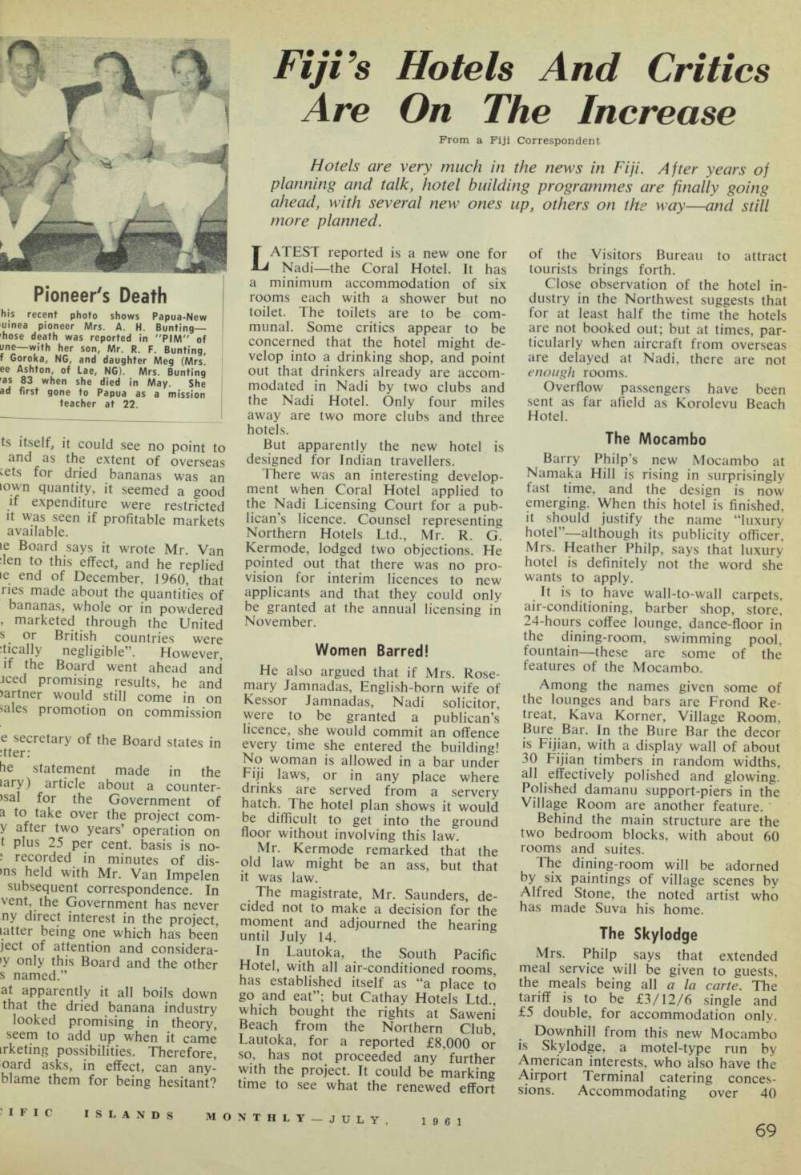
his recent photo shows Papua-New [?]uinea pioneer Mrs. A. H. Bunting— [?]hose death was reported in "PIM" of [?]une —with her son, Mr. R. F. Bunting, [?]f Goroka, NG, and daughter Meg (Mrs. [?]ee Ashton, of Lae, NG). Mrs. Bunting [?]as 83 when she died in May. She ad first gone to Papua as a mission teacher at 22.