Territories TALK-TALK
pp. 59-62 · Read in the full issue
With Tolala
Well, thank goodness , now we can expect something stable insofar as Administrator Cleland’s title is concerned.
And warmest congratulations on his knighthood announced in the Queen’s Birthday List.
IN the past, newspapers have never seemed to be quite sure whether to give him his old military title of Brigadier or just the plain “Mister”.
All that now is at an end.
And Sir Donald Cleland sounds quite euphonious and commensurate with the position, to say the very least. At no distant date I hope that Dr. John Gunther, the Assistant Ad ministrator, may also receive suitable recognition for the good job he is now doing. One wonders whether a Knight Bachelor now sets the norm for future Territory honours?
Honours for Administrators always remind me of an incident back in the ’Twenties when I was associated with Harry Hamilton, the printer, and who had the contract to print the Government Gazette in Rabaul.
An issue was about to come off the press when word was received from the Central Administration to hold the press for an important notice.
The press was held, accompanied by much bad language, impatience and speculation.
What was the notice of such signi-
ficance that the Gazette was delayed?
A day passed . . . two days. Then instructions issued to go ahead. There was no notice, no deletions, no changes.
Later we learned an Honours List had been released, but it did not affect the title of the Administrator of that particular period. Neither then nor at any later date! That was Evan Wisdom. Certainly he had his faults (who has not?), but he was not the least deserving of those to whom honours could have been given.
Sic transit. . .
Things About Trees I was reading somewhere, recently, where the big 300-year-old oak tree in New Jersey (USA) which inspired Joyce Kilmer to write that famous poem “Trees”, is showing signs of dying, and this reminded me of a couple of old-time personalities who, apparently, had a “thing” about trees and their own personal association with the life and death of certain trees.
Whether this old Celtic cult has any connection with the possible machinations of “witch doctors” malira or such Islands media, i would not venture. Be that as it may, but both these old-timers—brothers' —J. W. and Alan Campbell—had a premonition that when certain trees died they, too, would follow.
On the beach at Soraken (Bou gainville)—where Choiseul Planta tions Ltd. started their first plantings m 1913—there was a giant calliphil hum which J. W. admired when he first landed in 1912 and which, he said, when it died he would also go.
Later in the ’Thirties when he visited Soraken as an independent planter
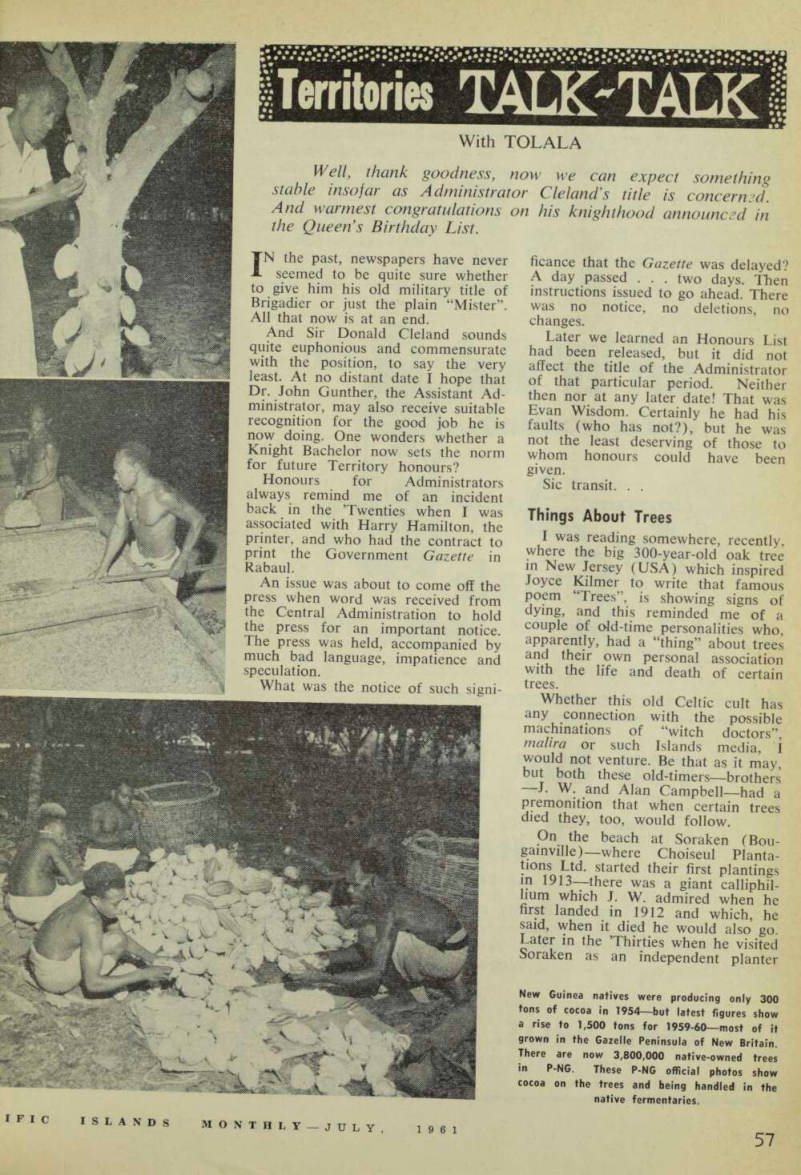
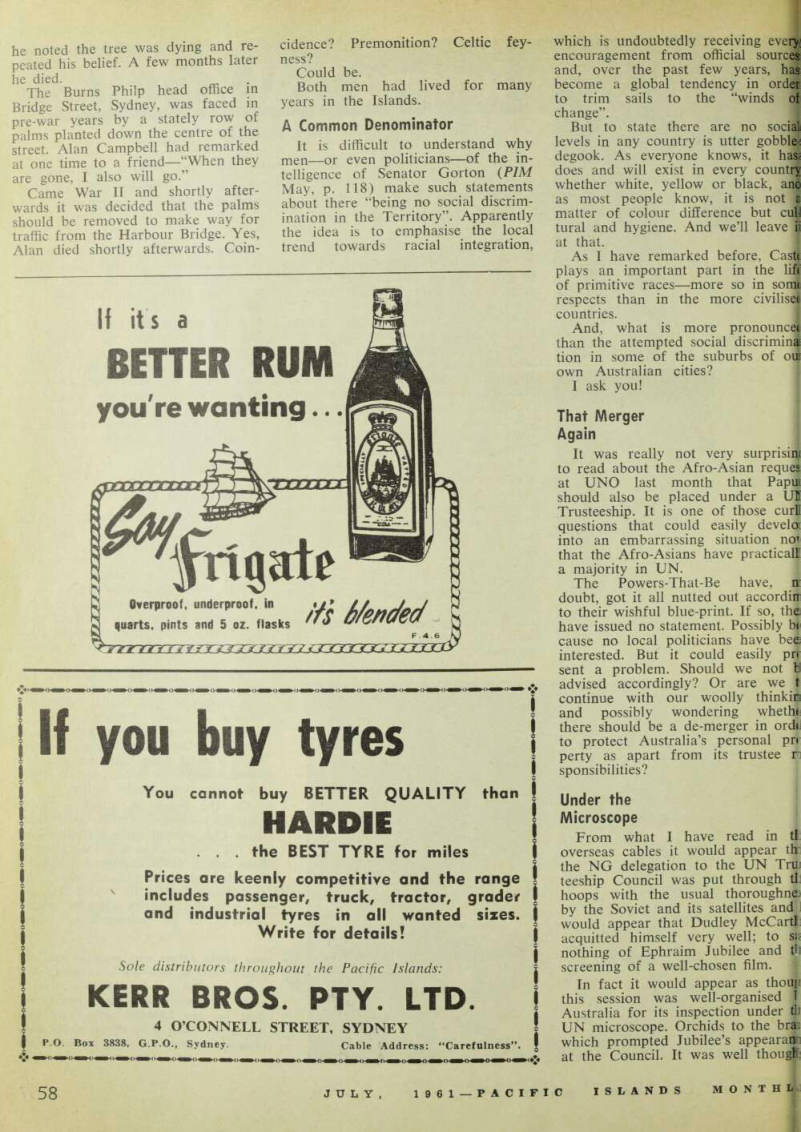
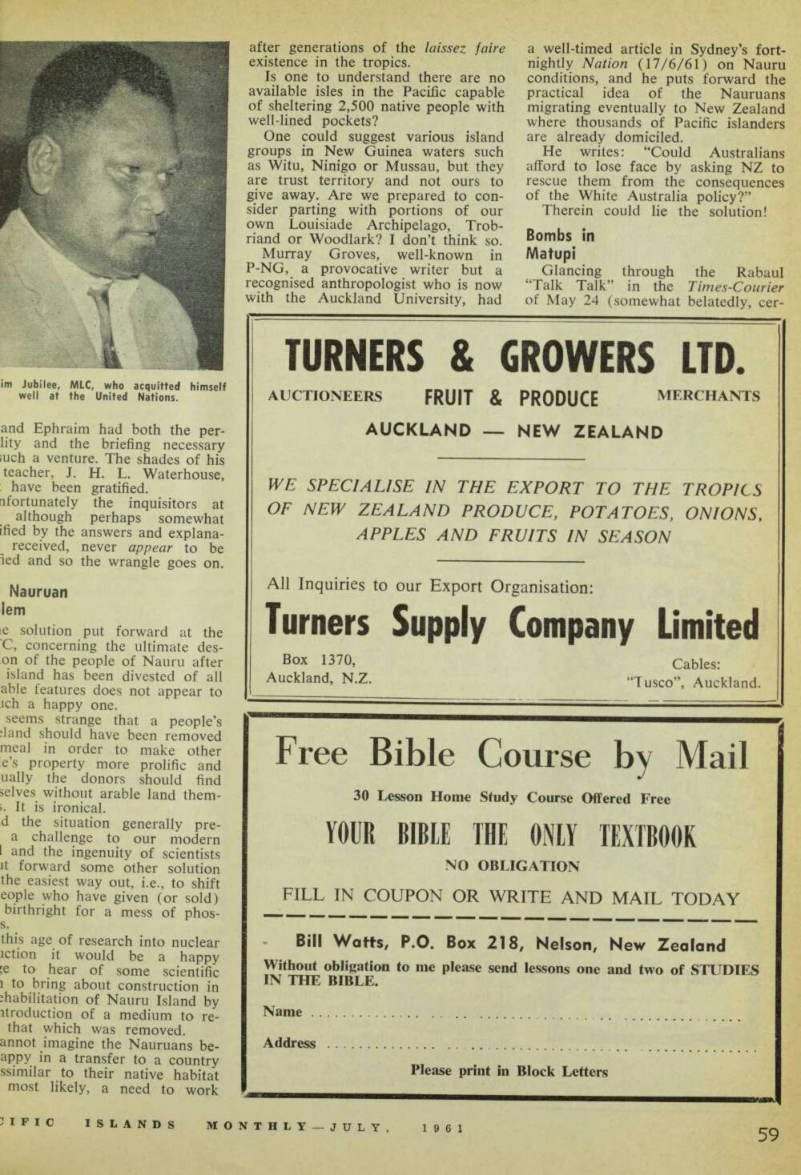
New Guinea natives were producing only 300 tons of cocoa in 1954—but latest figures show a rise to 1,500 tons for 1959-60—most of it grown in the Gazelle Peninsula of New Britain.
There are now 3,800,000 native-owned trees in P-NG. These P-NG official photos show cocoa on the trees and being handled in the native fermentaries.
he noted the tree was dying and repeated his belief. A few months later he died.
The Burns Philp head office in Bridge Street, Sydney, was faced in pre-war years by a stately row of palms planted down the centre of the street. Alan Campbell had remarked at one time to a friend—“ When they are gone, I also will go.”
Came War II and shortly afterwards it was decided that the palms should be removed to make way for traffic from the Harbour Bridge. Yes, Alan died shortly afterwards. Coin-
cidence? Premonition? Celtic fey ness?
Could be.
Both men had lived for many years in the Islands.
Common Denominator It is difficult to understand why men—or even politicians—of the in telligence of Senator Gorton (PIM May, p. 118) make such statements about there being no social discrim ination in the Territory . Apparently the idea is to emphasise the local trend towards racial integration,
which is undoubtedly receiving encouragement from official source! and, over the past few years, has become a global tendency in ordei; to trim sails to the “winds of change”.
But to state there are no sociai levels in any country is utter gobbler degook. As everyone knows, it has? does and will exist in every country whether white, yellow or black, and as most people know, it is not s matter of colour difference but cuM tural and hygiene. And we’ll leave ft at that.
As I have remarked before, Cast* plays an important part in the lifl of primitive races—more so in sorajj respects than in the more civilise* countries.
And, what is more pronounce* than the attempted social discrimina tion in some of the suburbs of oii own Australian cities?
I ask you!
That Merger
Again
It was really not very surprising to read about the Afro-Asian requea at UNO last month that Papm should also be placed under a UH Trusteeship. It is one of those curll questions that could easily devela into an embarrassing situation no* that the Afro-Asians have practical!! a majority in UN.
The Powers-That-Be have, nr doubt, got it all nutted out according to their wishful blue-print. If so, the have issued no statement. Possibly b* cause no local politicians have bee interested. But it could easily pre sent a problem. Should we not tt advised accordingly? Or are we t continue with our woolly thinkim and possibly wondering whethu there should be a de-merger in ord<j to protect Australia’s personal pro perty as apart from its trustee n sponsibilities?
Under the
Microscope
From what I have read in tl overseas cables it would appear thri the NG delegation to the UN Tnu teeship Council was put through tIJ hoops with the usual thoroughn© by the Soviet and its satellites and J would appear that Dudley McCartlJ acquitted himself very well; to si< nothing of Ephraim Jubilee and til screening of a well-chosen film.
In fact it would appear as thouji this session was well-organised 1 Australia for its inspection under tit UN microscope. Orchids to the bras which prompted Jubilee’s appearaiji at the Council. It was well thougfc
and Ephraim had both the per lity and the briefing necessary inch a venture. The shades of his teacher, J. H. L, Waterhouse, have been gratified, nfortunately the inquisitors at although perhaps somewhat ified by the answers and explana received, never appear to be ied and so the wrangle goes on.
Nauruan iem ie solution put forward at the 'C, concerning the ultimate des on of the people of Nauru after island has been divested of all able features does not appear to ich a happy one. seems strange that a people’s ;land should have been removed meal in order to make other e’s property more prolific and ually the donors should find selves without arable land them >. It is ironical. d the situation generally pre a challenge to our modern 1 and the ingenuity of scientists it forward some other solution the easiest way out, i.e., to shift eople who have given (or sold) birthright for a mess of phos s. this age of research into nuclear iction it would be a happy ;e to hear of some scientific i to bring about construction in diabilitation of Nauru Island by ■production of a medium to re that which was removed, annot imagine the Nauruans be appy in a transfer to a country ssimilar to their native habitat most likely, a need to work
after generations of the laissez faire existence in the tropics.
Is one to understand there are no available isles in the Pacific capable of sheltering 2,500 native people with well-lined pockets?
One could suggest various island groups in New Guinea waters such as Witu, Ninigo or Mussau, but they are trust territory and not ours to give away. Are we prepared to consider parting with portions of our own Louisiade Archipelago, Trobriand or Woodlark? I don’t think so.
Murray Groves, well-known in P-NG, a provocative writer but a recognised anthropologist who is now with the Auckland University, had
a well-timed article in Sydney’s fort nightly Nation (17/6/61) on Nauru conditions, and he puts forward the practical idea of the Nauruans migrating eventually to New Zealand where thousands of Pacific islanders are already domiciled, He writes: “Could Australians afford to lose face by asking NZ to rescue them from the consequences of the White Australia policy?”
Therein could lie the solution! , .
Bombs in
Matupi
Glancing through the Rabaul “Talk Talk” in the Times-Courier of May 24 (somewhat belatedly, cer
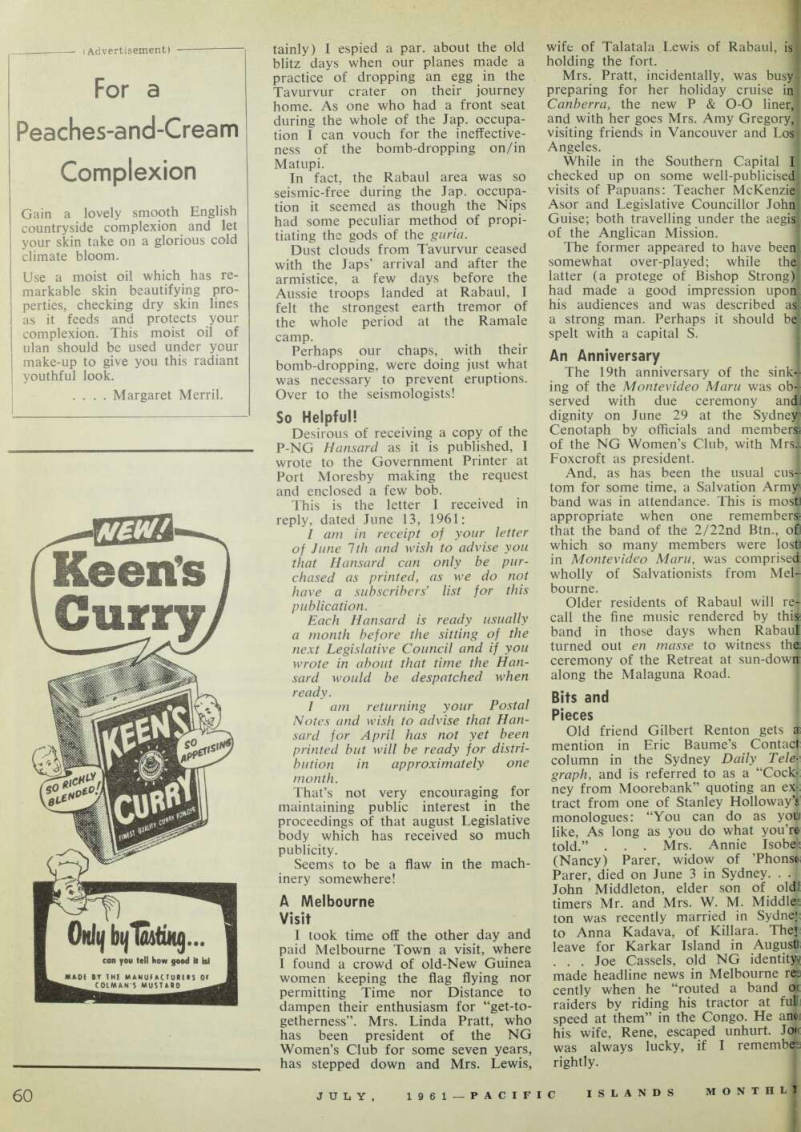
im Jubilee, MIC, who acquitted himself well at the United Nations.
tainly) I espied a par. about the old blitz days when our planes made a practice of dropping an egg in the Tavurvur crater on their journey home. As one who had a front seat during the whole of the Jap. occupa tion I can vouch for the ineffective ness of the bomb-dropping on/in Matupi.
In fact, the Rabaul area was so seismic-free during the Jap. occupa tion it seemed as though the Nips had some peculiar method of propi tiating the gods of the guria.
Dust clouds from Tavurvur ceased with the Japs’ arrival and after the armistice, a few days before the Aussie troops landed at Rabaul, I felt the strongest earth tremor of the whole period at the Ramale camp.
Perhaps our chaps, with their bomb-dropping, were doing just what was necessary to prevent eruptions.
Over to the seismologists!
So Helpful!
Desirous of receiving a copy of the P-NG Hansard as it is published, I wrote to the Government Printer at Port Moresby making the request and enclosed a few bob.
This is the letter I received in reply, dated June 13, 1961: I am in receipt of your letter of June Ith and wish to advise you that Hansard can only be pur chased as printed, as we do not have a subscribers’ list for this publication.
Each Hansard is ready usually a month before the sitting of the next Legislative Council and if you wrote in about that time the Han sard would be despatched when ready.
I am returning your Postal Notes and wish to advise that Han sard for April has not yet been printed but will be ready for distri bution in approximately one month.
That’s not very encouraging for maintaining public interest in the proceedings of that august Legislative body which has received so much publicity.
Seems to be a flaw in the mach inery somewhere!
A Melbourne Visit I took time off the other day and paid Melbourne Town a visit, where I found a crowd of old-New Guinea women keeping the flag flying nor permitting Time nor Distance to dampen their enthusiasm for “get-to getherness”. Mrs. Linda Pratt, who has been president of the NG Women’s Club for some seven years, has stepped down and Mrs. Lewis,
wife of Talatala Lewis of Rabaul, is I holding the fort.
Mrs. Pratt, incidentally, was busy! preparing for her holiday cruise in- Canberra, the new P & 0-0 liner# and with her goes Mrs. Amy Gregory,! visiting friends in Vancouver and Los| Angeles.
While in the Southern Capital I checked up on some well-publicised! visits of Papuans: Teacher McKenzie!
Asor and Legislative Councillor John] Guise; both travelling under the aegis! of the Anglican Mission.
The former appeared to have been! somewhat over-played; while the!: latter (a protege of Bishop Strong)] had made a good impression uponjj his audiences and was described as| a strong man. Perhaps it should bdi spelt with a capital S.
An Anniversary
The 19th anniversary of the sink! ing of the Montevideo Mara was ob 4 served with due ceremony andi dignity on June 29 at the Sydneyf Cenotaph by officials and members of the NG Women’s Club, with Mrs!
Foxcroft as president.
And, as has been the usual cusl tom for some time, a Salvation Armyi\ band was in attendance. This is most! appropriate when one remembers? that the band of the 2/22nd Btn.. ofl which so many members were lost! in Montevideo Maru, was comprised wholly of Salvationists from Mel bourne.
Older residents of Rabaul will rej call the fine music rendered by this band in those days when Rabaul! turned out en masse to witness thep ceremony of the Retreat at sun-down along the Malaguna Road.
Bits and Pieces Old friend Gilbert Renton gets as mention in Eric Baume’s Contact: column in the Sydney Daily Tele-' graph, and is referred to as a “Cockj: ney from Moorebank” quoting an ex-: tract from one of Stanley Holloway’s' monologues: “You can do as you like, As long as you do what you’re told.” . . . Mrs. Annie Isobefc (Nancy) Parer, widow of ’Phonse; Parer, died on June 3 in Sydney. . .
John Middleton, elder son of old! timers Mr. and Mrs. W. M. Middle:, ton was recently married in Sydney to Anna Kadava, of Killara. They; leave for Karkar Island in August!; . . , Joe Cassels, old NG made headline news in Melbourne res cently when he “routed a band or raiders by riding his tractor at full: speed at them” in the Congo. He ami his wife, Rene, escaped unhurt. Jcxr was always lucky, if I remembes rightly.