Potlight On
pp. 55-56 · Read in the full issue
Papua’S North
From a Special Correspondent in Popondetta fhe northern district of Papua pleased with itself over the dicity it has got through the
jondetta Agricultural Show—
-1 on June 10 after a lapse of je years.
IE show was so successful, in all kinds of ways, that it will now held every year, and plans are t for a permanent showground permanent buildings to be in ence by next year, bout 9,000 natives, and 300 ipeans, most of them visitors to area, turned up in June, and : the show had virtually started i scratch again this year, District missioner and Show Society dent Kevin Atkinson said that he more than satisfied with the d. Since the war, the northern ict has been one of the Terri s more neglected areas from the city point of view, itil the last year or so nobody seemed to travel through here, as far as anybody in Australia •ncerned, it is just a place that gave birth to a volcano. The show helped everyone see just kind of recovery has been made
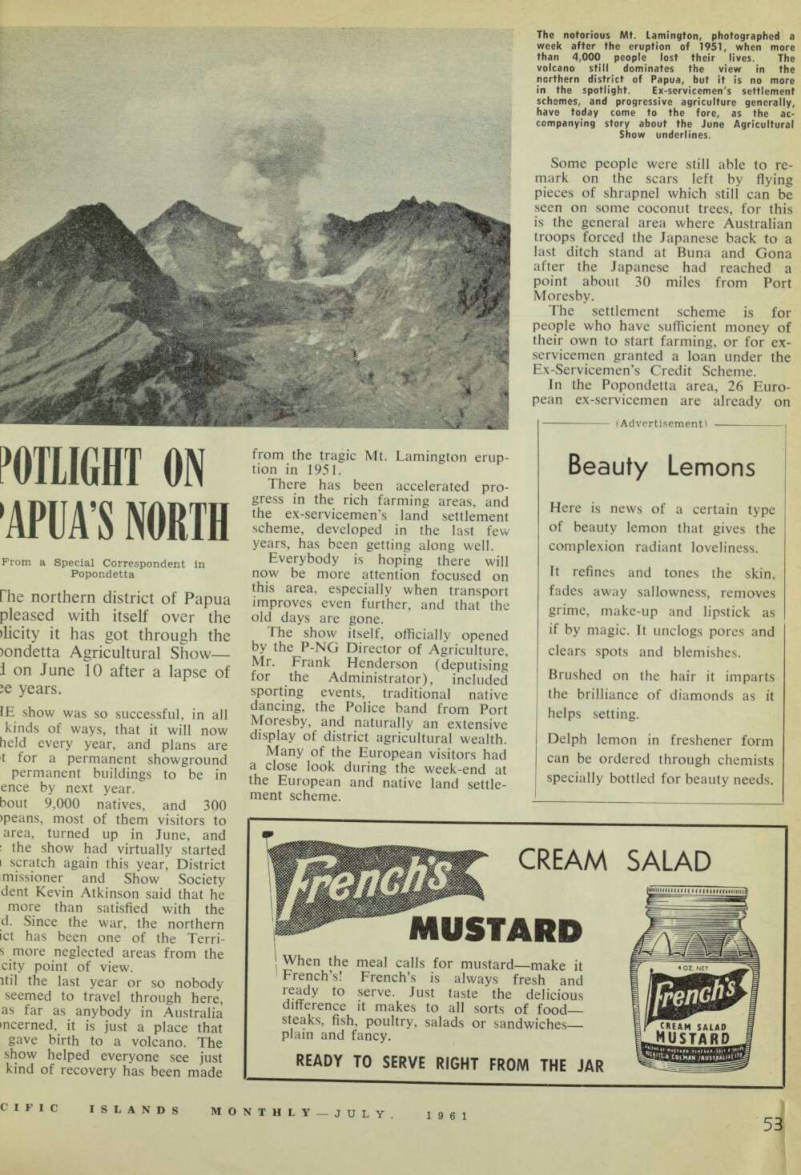
from the tragic Mt. Lamington erup tion in 1951.
There has been accelerated pro gress in the rich farming areas, and the ex-servicemen’s land settlement scheme, developed in the last few years, has been getting along well.
Everybody is hoping there will now be more attention focused on this area, especially when transport improves even further, and that the old days are gone.
The show itself, officially opened by the P-NG Director of Agriculture, Mr. Frank Henderson (deputising for the Administrator), included sporting events, traditional native dancing, the Police band from Port Moresby, and naturally an extensive display of district agricultural wealth.
Many of the European visitors had a close look during the week-end at the European and native land settle ment scheme.
Some people were still able to re mark on the scars left by flying pieces of shrapnel which still can be seen on some coconut trees, for this is the general area where Australian troops forced the Japanese back to a last ditch stand at Buna and Gona after the Japanese had reached a point about 30 miles from Port Moresby.
The settlement scheme is for people who have sufficient money of their own to start farming, or for ex servicemen granted a loan under the Ex-Servicemen’s Credit Scheme.
In the Popondetta area, 26 Euro pean ex-servicemen are already on
The notorious Mt. Lamington, photographed a week after the eruption of 1951, when more than 4,000 people lost their lives. The volcano still dominates the view in the northern district of Papua, but it is no more in the spotlight. Ex-servicemen's settlement schemes, and progressive agriculture generally, have today come to the fore, as the ac companying story about the June Agricultural Show underlines.
their blocks. Sixty natives are per manently settled on their blocks, and six natives are working part-time on their land, in preparation for moving permanently onto their properties.
A group of native ex-servicemen, settled on the land at Popondetta, through the president of the Natives’
Ex-Servicemen’s Association, Edric Eupu, said: “The government put us on the land. We each have a block and we stay here. We like having European settlers in this area. They help us, especially with transport when people are ill.”
Eupu said the native landholders liked the idea of having their own
title to the land. It meant that they could pass it on, instead of having to hand it back to the village under the old system.
President of the Popondetta sub branch of Australian Ex-Servicemen’s League, Mr. W. W. Casey, who is a soldier-settler at Popondetta, said: “Land is valuable to the natives, and giving them a clear title to it is the incentive they need.”
Another European soldier settler, John Langhorne, who has taken up 440 acres at Sangara, six miles from Popondetta, and since January, 1960, has cleared 200 acres of virgin jungle, and now has 150 acres under cocoa, said:
“It’s a sound project. There arn first class relations between the natm and European settlers.
“The native ex-servicemen are f fine body of men, with a good sens? of responsibility. There is only onr future in this country: a policy a partnership between Europeans am natives. With more bridges am roads, this will be the best coca growing area in the Territory.”
Within two years it is hoped ths there will be 1,000 acres of natiw cocoa and 1,000 acres of native coj< fee plantings, in addition to the native land settlement scheme.
But roads and bridges are stij wanted.