Sydney's Sin Finances
pp. 45-49 · Read in the full issue
Sydneysider At Home Base Sydney's Sin Finances An Opera House
Sydney isn’t all beer and skittles (two subjects we’ve dis cussed in this column during the year). It’s got culture, too.
By 1964 it will have at least £7 million worth of it, all in one piece of masonry and reinforced concrete, spreading its white sail-like roof in the place where once a tram shed stood on Bennelong Point.
rFHE building that will cost the vast -I amount of money is the Sydney Opera House, the most talked-about piece of civic architecture in a city where the skyline is continually changing.
The talk began in 1954 when the idea was first mooted (“Who wants an opera house, anyhow”), and rose to a howl when the winning, un orthodox design was published in 1957. But whether or not you are
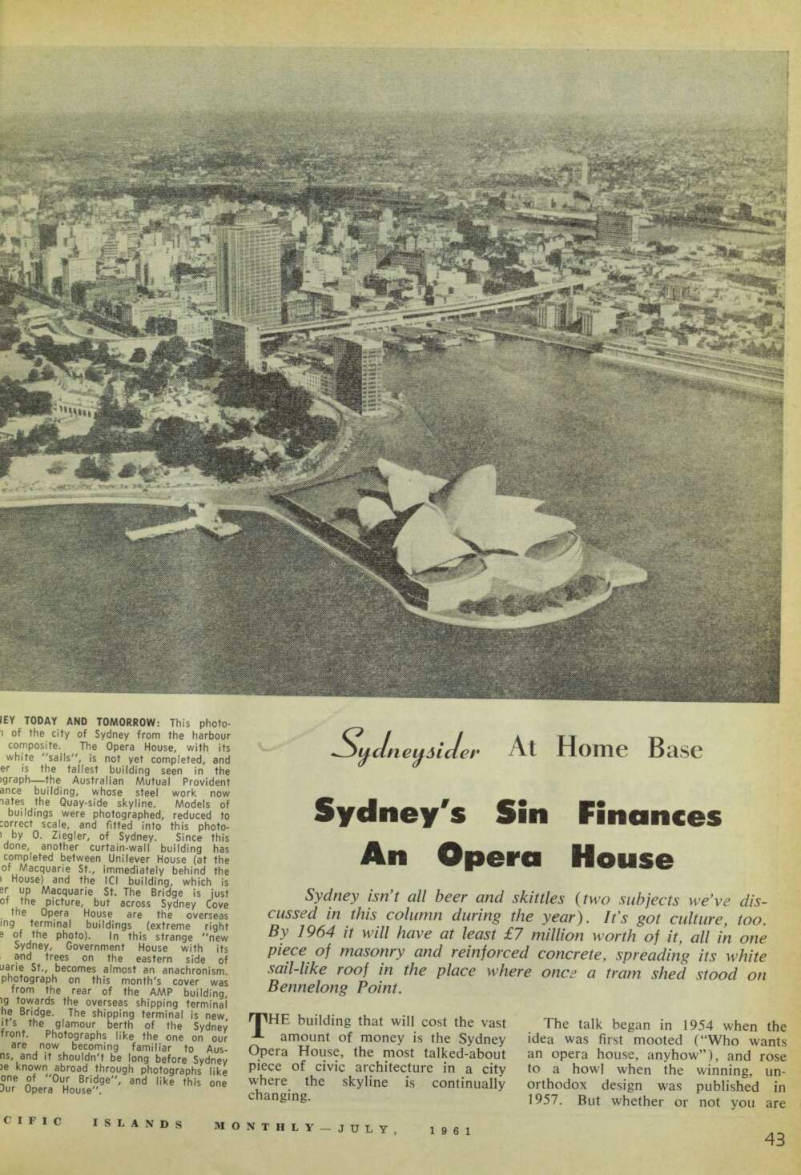
[?]Ey Today And Tomorrow: This Photo
[?]n of the city of Sydney from the harbour composite. The Opera House, with its white "sails", is not yet completed, and [?]er is the tallest building seen in the [?]graph—the Australian Mutual Provident [?]ance building, whose steel work now [?]ates the Quay-side skyline. Models of buildings were photographed, reduced to correct scale, and fitted into this photo [?] by O. Ziegler, of Sydney. Since this done, another curtain-wall building has completed between Unilever House (at the of Macquarie St., immediately behind the [?] House) and the ICI building, which is [?]er up Macquarie St. The Bridge is just of the picture, but across Sydney Cove the Opera House are the overseas [?]ing terminal buildings (extreme right [?]e of the photo). In this strange "new Sydney, Government House with its and trees on the eastern side of [?]uarie St., becomes almost an anachronism. photograph on this month's cover was from the rear of the AMP building, [?]g towards the overseas shipping terminal [?]he Bridge. The shipping terminal is new its the glamour berth of the Sydney front. Photographs like the one on our are now becoming familiar to Aus [?]ns, and it shouldn't be long before Sydney [?]e known abroad through photographs like o ne o f Our Bridge", and like this one [?]ur Opera House".
for this “cultural centre” (and no one pretends that opera will take upj more than a fraction of available letting time), as soon as those roof' shells go on, probably in 1963, no one who approaches Sydney by sea or by air, is going to overlook it. I It will be as dominant a feature of the landscape as the Harbour Bridge which has been a symbol of Sydney since 1932. The top of the highest shell at 230 feet will be 50 feet higher than the decking on the Bridge; higher, too, than Unilevei House, the first skyscraper imi mediately behind it, at the foot of Macquarie Street. The building will be over five acres in ground area* and the site over six.
Passengers on liners sailing up the harbour will see it once arouno Bradley’s Head and the arguments ox those who hate it on sight with those; who see it as the physical manifestat tion of soaring imagination will go down the years, ad infinitum .
The idea of a “cultural centre”— an Opera House—was conceived sometime in 1954; the site was chosen (the stubby peninsula that divide: Sydney Cove, where the First Flees anchored in 1788, from Farm Cove; and a world-wide competition for i design announced in 1956.
From 223 final entries from 3(J different countries, the entry oc Danish architect, Mr. Joern Utzom was chosen. Mr. Utzon got £S,OCX for this, and more later as supervisim architect, for an unusual design witJ the roof that has been likened if shells, ballooning spinnakers anr numerous other less complimentan objects.
Who’s Got
the Dough?
The cost, it was said, would “proH ably” be about £3i million, and thr mightily comforted those who wen opposed to it. Where, they asked; would this sort of dough come frorm Pay Mr. Utzon his 5,000 quid, and h 1 him go home. As an idea it was biji but as a reality—not for our time.
They were wrong. A Labour Citi Council and a Labour State Govern ment, usually concerned with homdi for the workers, jobs for the bhoy< and the unsewered wildernesses $ outer suburbia, were determined, fo: once, to strike a blow for cultuu and posterity. The show must go ok By then the estimated cost ha risen to £4,800,000. But £3i millio or £4i million—what did it matter.
Both were large sums, and at timj looked equally impossible of fulfill
ment. J
In August, 1957, the Opera Hour.
il Fund was launched. The er weighed in with £100,000 on of the State Government; the Mayor promised a similar sum a five year period; £35,000 in donations were promised at the iral meeting of the Fund. But now, almost four years later, und stands at no more than 100—a slow and painful busi a spite of devoted and even in work by an organising com of enthusiasts. ■500,000 is a drop in the or i pit of a £7,000,000 Opera , it was still a long way from .8 million that was thought to ded in 1957. But the financial n was a typically Australian might say a typical New Wales one: Lotteries.
V started State Lotteries in the originally to finance public ils, and the lottery habit (you’ve be in it to win it) has become rained one with a large slice of pulation. ies With J Benefits Opera House Lotteries were 1” in that they didn’t interfere -sser State lotteries, and that *st prize was a fortune of
£lOO,OOO for the price of a £5 ticket. The first one filled with moderate enthusiasm, subsequent ones did not, dragged on over four or five months and then ceased al together while the financial wizards regrouped their forces.
Cost of tickets was dropped to £3, first prize remained at £lOO,OOO and there were strange fringe benefits like £750 cash plus 250 £1 tickets in other State lotteries for being one off the winning number.
The new type Opera Lottery is filling at about three-weekly intervals, with number 26 currently coming up.
The opera house project nets £lOO,OOO from each—something like £1,700,000 in a year.
The aim is still that the Opera House should open free of debt, al though it is a simple mathematical calculation to see that the project that began life at a cost of an estimated £3i million, rose to an estimated £4.8 million in 1957 and to £7 million in mid-1961, could end up at opening date, sometime in 1964, having cost about as much as the Harbour Bridge and its approaches did when com pleted in 1932.
Work on the project was let in two stages, and stage one, which will com plete the job up to the podium at which point the shell roof goes on, should be finished by the end of this year or shortly after. Tenders for stage two will be called about the same time.
Civil and Civic Contractors Pty., Ltd., began work on stage one in
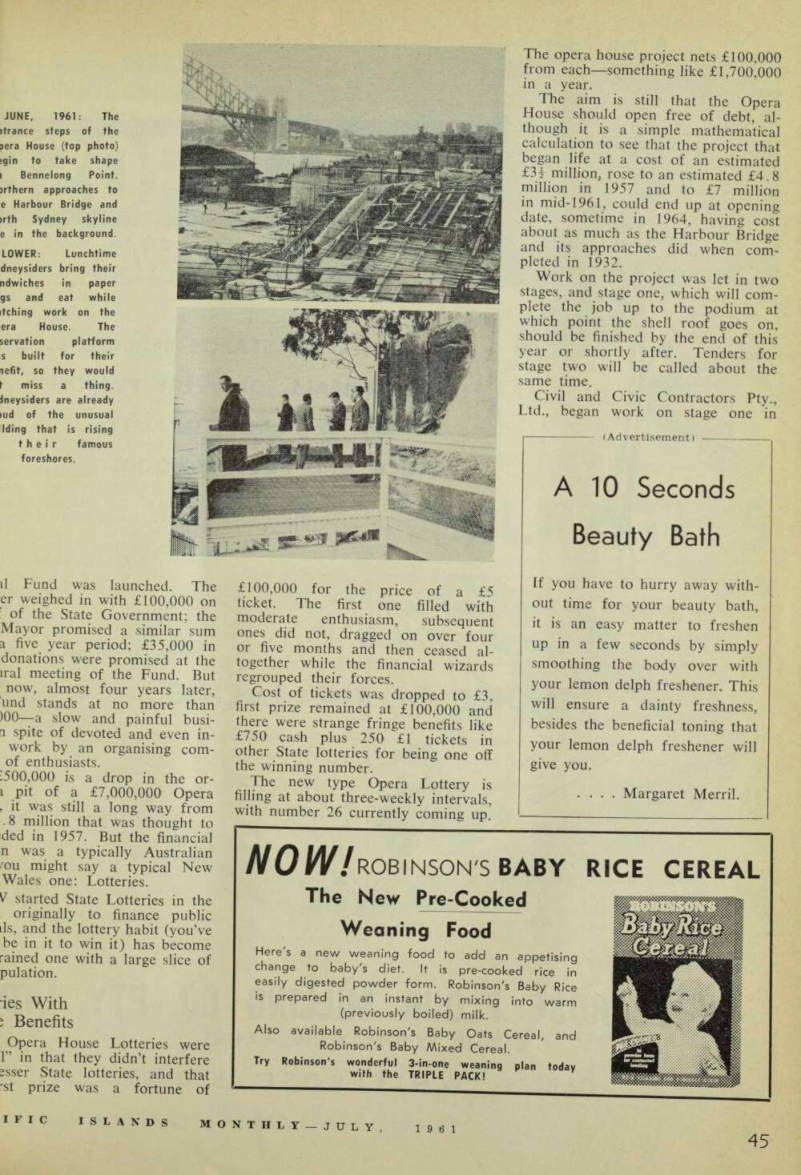
June, 1961: The
[?]trance steps of the [?]era House (top photo) [?]gin to take shape [?] Bennelong Point. [?]rthern approaches to [?]e Harbour Bridge and [?]rth Sydney skyline [?]e in the background.
LOWER: Lunchtime [?]dneysiders bring their [?]ndwiches in paper [?]gs and eat while [?]itching work on the [?]era House. The servation platform [?]s built for their [?]efit, so they would [?]t miss a thing. [?]neysiders are already [?]ud of the unusual [?]lding that is rising their famous foreshores.
i, 1959, and at one time were Dnths behind work schedule due expected troubles with the site At some time, Bennelong Point been a tidal island and in y’s first hundred years had been ned from the harbour mud and ip to take first, Fort Macquarie, hen a tram depot. A storm channel ran underground h the middle of it and this and : engineering difficulties were itered in providing for the innings of a building of such id weight, on 6i acres of land ould by right have belonged to i. the first year the Opera House ist a very large hole in the . Only in recent months has of the shape of things to come d from the tangle of reinforc ds and equipment that strews In June, the vast flight of hat will lead to the landward e was taking shape.
Dbservation platform has been n the rock wall at the bottom ernment House gardens and a ckle of people file on and off ay. At lunch time the younger ion comes along with paper >f sandwiches and munches t looks. By pressing a button n get a recorded description, University Professor, of just going on down below, i complete, the Opera House atain one auditorium capable ing 2,800; another to seat There will be a small theatre ipacity) in the basement; and meeting hall somewhere else, have bars, lounges, foyers, il rooms, storage rooms, work nd a restaurant to cope with ers. It will be wired for sound
and simultaneous translation, be air conditioned in summer and heated in winter. It will have, from its front windows, a magnificent view of the harbour; and it will have its own wharf.
But whatever the Opera House has inside it, that will always be dwarfed, as a talking-point, by the roof. Future generations of Sydneysiders may hate it or love it, according to their in dividual inclinations, but they’ll cer tainly never be able to ignore it.
Rev. Clarence Luxton, former Methodist missionary in Bougainville, has been appointed chairman of the Overseas Mission Board of the NZ Methodist Church.