One-Armed Bandit
pp. 23-143 · Read in the full issue
They've Outlawed The
From a Honiara Correspondent Never have there been so many long faces in this town. Thanks to a Legislative Council decision, the Solomons is to lose its poker machines.
I hat s probably bad enough in itself—for those who like to play poker machines—but what the decision is likely to mean in other ways makes it very unpopular, and all sorts of harsh words are being bandied about.
fpHE decision to ban them came unexpectedly during the June meeting of the Legislative Council.
The Council was inaugurated only at i® ° f last year > t 0 replace the 0 tL Advisory Council. • A he Council discussed the Gammg and Lotteries Bill, which sought to make poker machines legal for everyone—black and white—but only it installed in private clubs. They were to be taken out of the bars of Honiara’s two hotels, the hotel Menda ™ l !i e K T ng u Chow Hotel - Vd u three macl ] ines ' GnaSanli C A°h u' - WO ’ and , ,le M n?u m’ Homara, and the Auki Club, Malaita, have one each.
Only Europeans have been alm'de? ,h, OPera Vu eSe ™ achines . and under the new bill, natives were to
be able to use them if they were members of registered clubs which had them.
The idea behind the bill is that gambling laws of the Solomons should be the same for everyone, ir respective of race. The bill sought to allow Solomon Islanders to play some gambling games in the same way as Europeans without breaking the laws,
Bishop's Amendment
when the bill came up, Bishop A - T - H ‘ll. Bishop of Melanesia, presumably with the foreknowledge of the Government, proposed an amendment aimed at making poker machines illegal everywhere.
He said he did this to discourage gambling in general. He said people,
Queen's Birthday
Holiday
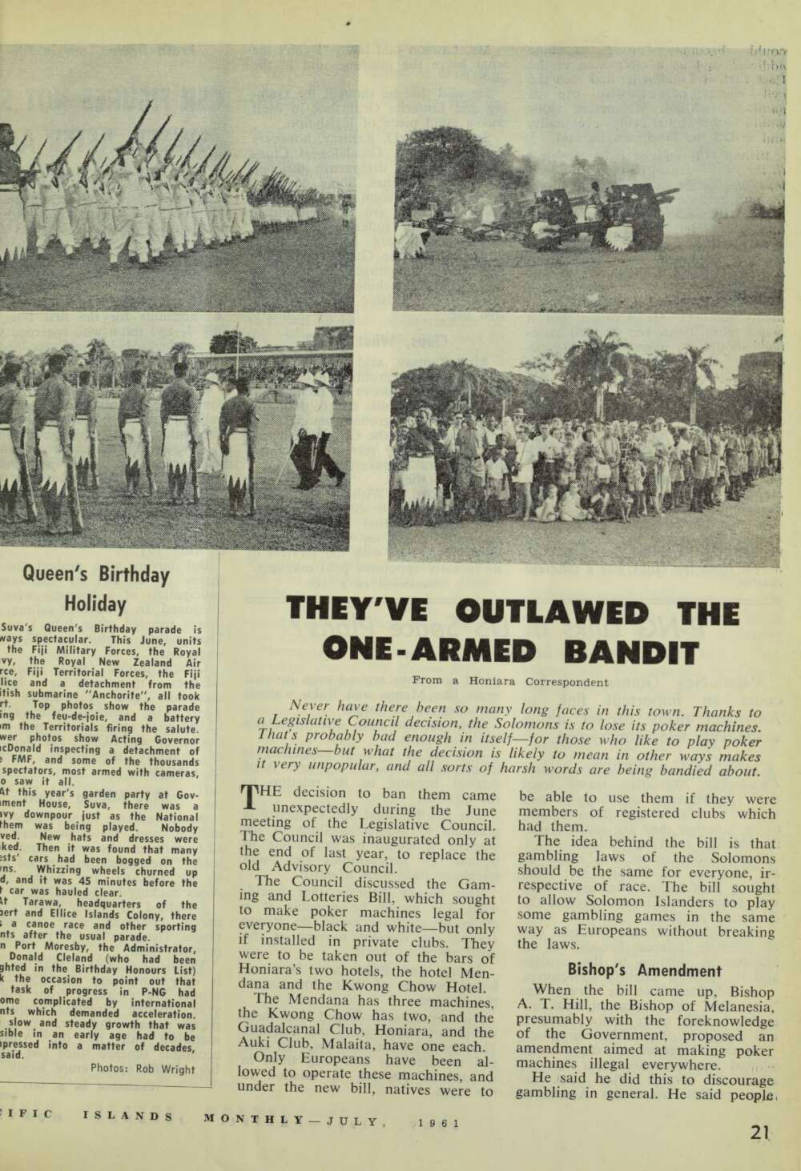
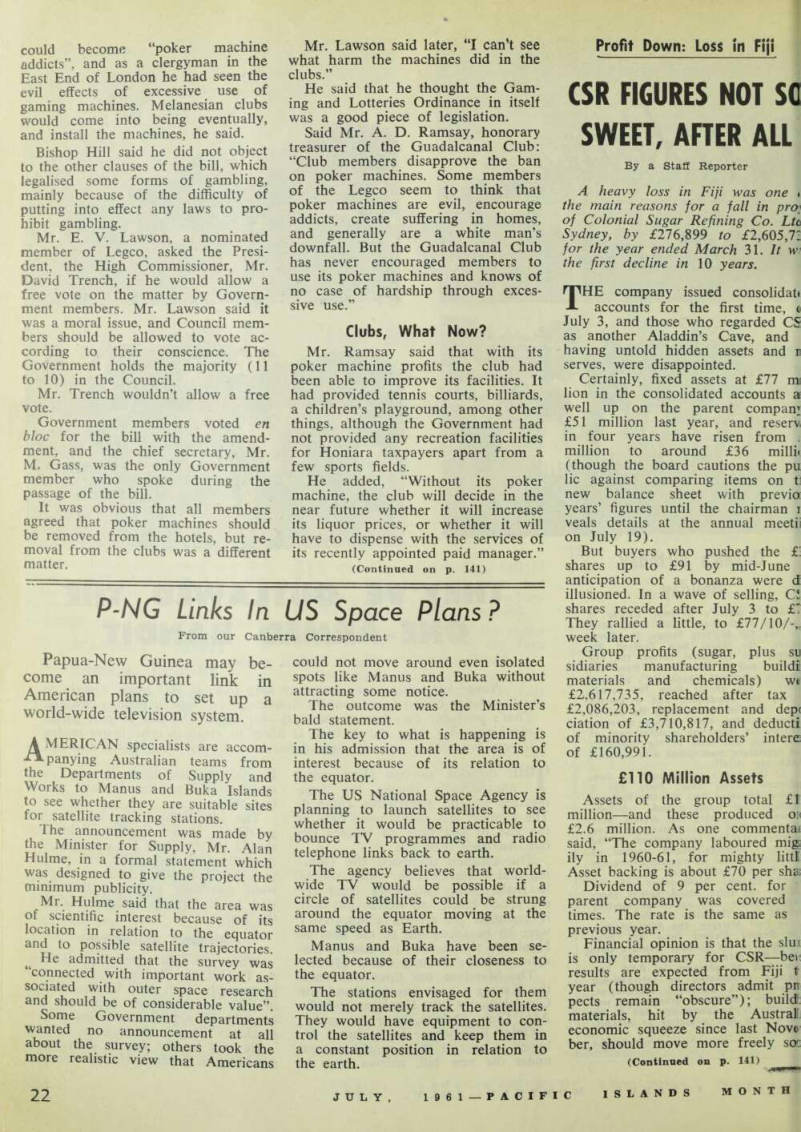
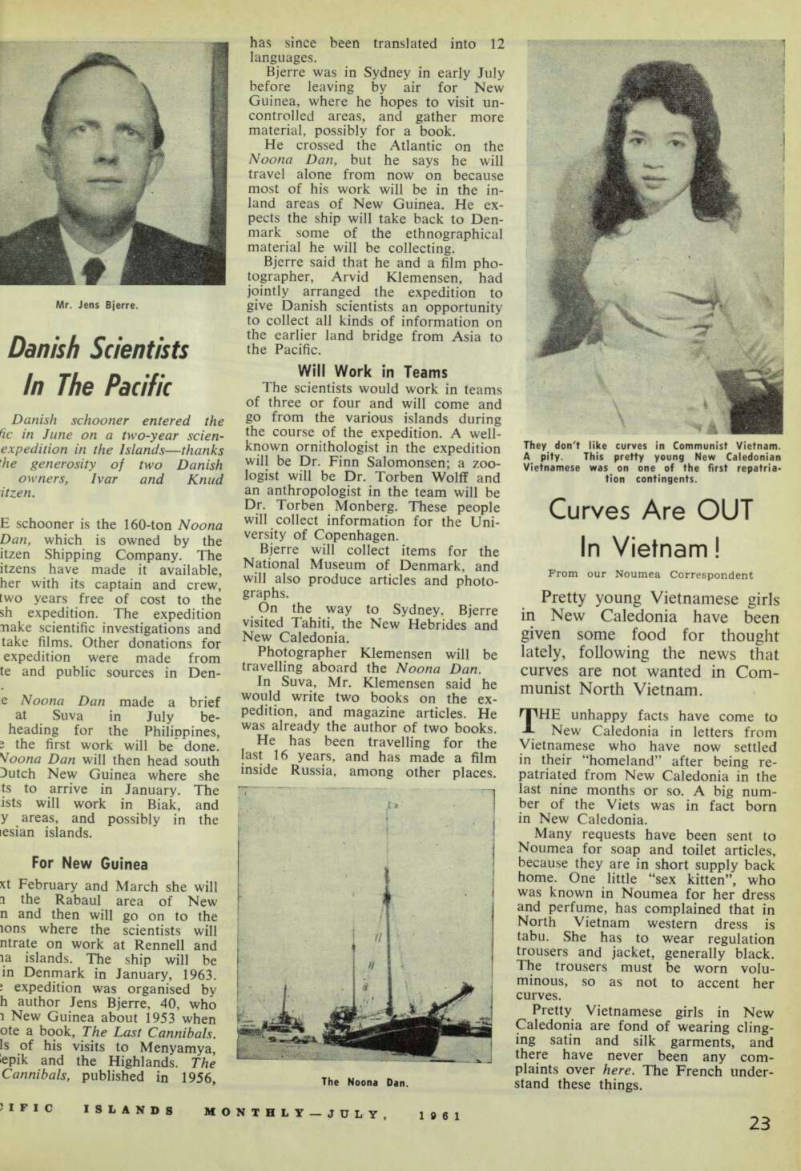
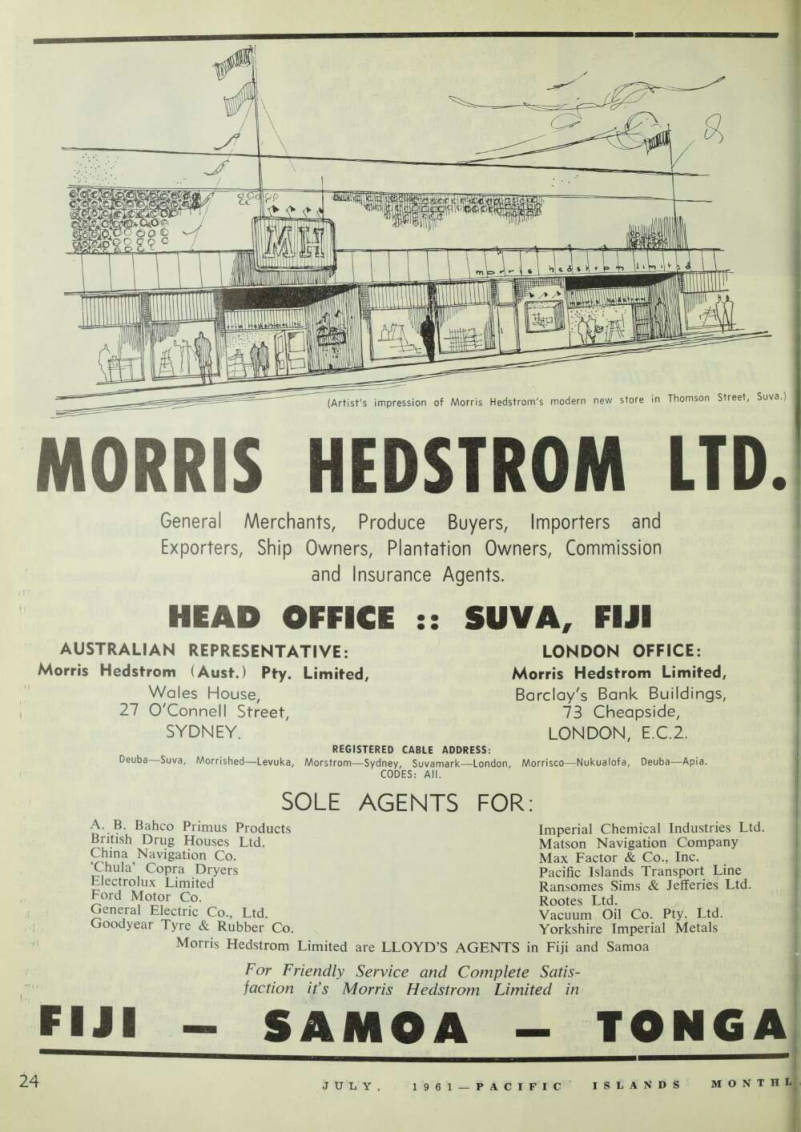
Suva's Queen's Birthday parade is ways spectacular. This June, units the Fiji Military Forces, the Royal [?]vy, the Royal New Zealand Air [?]rce, Fiji Territorial Forces, the Fiji [?]lice and a detachment from the [?]tish submarine “Anchorite", all took [?]t. Top photos show the parade [?]ing the feu-de-joie, and a battery [?]m the Territorials firing the salute. [?]wer photos show Acting Governor [?]cDonald inspecting a detachment of [?]e FMF, and some of the thousands spectators, most armed with cameras, [?]o saw it all.
At this year's garden party at Gov ernment House, Suva, there was a [?]vy downpour just as the National them was being played. Nobody [?]ved. New hats and dresses were ked. Then it was found that many ests' cars had been bogged on the [?]ns. Whizzing wheels churned up [?]d, and it was 45 minutes before the [?]t car was hauled clear.
At Tarawa, headquarters of the [?]ert and Ellice Islands Colony, there [?] a canoe race and other sporting [?]nts after the usual parade. [?]n Port Moresby, the Administrator, Donald Cleland (who had been [?]ghted in the Birthday Honours List) [?]k the occasion to point out that task of progress in P-NG had [?]ome complicated by international [?]nts which demanded acceleration. slow and steady growth that was [?]sible in an early age had to be [?]Pressed into a matter of decades, said.
Photos: Rob Wright
could become “poker machine addicts”, and as a clergyman in the East End of London he had seen the evil effects of excessive use of gaming machines. Melanesian clubs would come into being eventually, and install the machines, he said.
Bishop Hill said he did not object to the other clauses of the bill, which legalised some forms of gambling, mainly because of the difficulty of putting into effect any laws to pro hibit gambling.
Mr, E. V. Lawson, a nominated member of Legco, asked the Presi dent, the High Commissioner, Mr.
David Trench, if he would allow a free vote on the matter by Govern ment members. Mr. Lawson said it was a moral issue, and Council mem bers should be allowed to vote ac cording to their conscience. The Government holds the majority (11 to 10) in the Council.
Mr. Trench wouldn’t allow a free vote.
Government members voted en bloc for the bill with the amend ment, and the chief secretary, Mr.
M. Gass, was the only Government member who spoke during the passage of the bill.
It was obvious that all members agreed that poker machines should be removed from the hotels, but re moval from the clubs was a different matter.
Mr. Lawson said later, “I can’t see what harm the machines did in the clubs.”
He said that he thought the Gam ing and Lotteries Ordinance in itself was a good piece of legislation.
Said Mr. A. D. Ramsay, honorary treasurer of the Guadalcanal Club: “Club members disapprove the ban on poker machines. Some members of the Legco seem to think that poker machines are evil, encourage addicts, create suffering in homes, and generally are a white man’s downfall. But the Guadalcanal Club has never encouraged members to use its poker machines and knows of no case of hardship through exces sive use.”
Clubs, What Now?
Mr, Ramsay said that with its poker machine profits the club had been able to improve its facilities. It had provided tennis courts, billiards, a children’s playground, among other things, although the Government had not provided any recreation facilities for Honiara taxpayers apart from a few sports fields.
He added, “Without its poker machine, the club will decide in the near future whether it will increase its liquor prices, or whether it will have to dispense with the services of its recently appointed paid manager.” (Continued on p. 141)
lr. K. H. Dalrymple-Hay, gov ng director of Mendana Enter es Pty. Ltd., which owns the el Mendana, was a bit more to point. fe said the lightning speed with :h the prohibition on poker hines was enacted was “amazing, n one thinks of the more im ant matters of legislation which piled high on Government desks ich as the land legislation.” e described the Gaming and Lot 's Ordinance as legis ,n “designed by the Parkinson boys to take away the amenities :h the poker machines gave to hotel and club population of lara and to legalise gambling for natives. They were unable to
prevent the natives from gambling so they made it legal to save face. The same thing was done about natives being allowed to drink beer.
“In a bankrupt Protectorate, such as this, one would have thought that the Government would have placed a tax on the machines to endeavour to bolster up their income, instead of living on the crumbs handed out by the UK Government.”
Mr. Dalrymple-Hay said poker machine gambling was harmless, and the profits had supplied many hotel amenities, including a swimming pool which was shark proof, although the Government had made no at tempt to provide one.
Mr. Hay’s parting shot: “In Honiara, there are much grayer problems than poker machines which the Government should face up to, such as housebreaking and assault on Europeans in their own homes. Thieving by natives is so much, that people in business find it impossible to continue to employ natives. We do not blame the Police for this, the blame is with the over staffed Secretariat for not seeing that the Police force is adequately staffed with both Europeans and natives, and for not insisting on much more severe penalties for breaches of the law. The natives just laugh at the sentences being imposed at present and look upon a term in gaol as a holiday.
“All these things have happened in Honiara in the last few years since we have had this influx of Government servants from East, West and Darkest Africa in our midst. Think back on what has hap pened in Africa in the past few years and you will be able to get a picture of what could happen here unless these matters are dealt with severely and quickly. Perhaps, as quickly as the Gaming and Lotteries Ordinance was dealt with.”