—And What Of Others?
pp. 19-144 · Read in the full issue
Home For The Nauruans —And What Of Others?
From our Canberra Correspondent
Few issues with such a potential impact on Australian dicy have attracted so little attention as the invitation to auruans to become part of the Australian community.
vas a matter with a direct im ict on international relations, on ition policy, on the future of alia’s other island Territories, e “announcement” of Australia’s on to invite the 2,500 Nauruans ttle in Australia was made by Commonwealth’s Special Repre ;ive in the Trusteeship Council, Dudley McCarthy, was an “announcement” in the that there had been no general ledge of what was proposed.
Yet on Mr. McCarthy’s own state ment he discussed the proposal in a series of meetings and in talks with individuals in Nauru last December.
He told the Trusteeship Council that he had put the proposition to “every Nauruan on the island”.
This must be one of the few occasions in modern times in which 2,500 people shared a secret of some international consequence, yet no word leaked to the public prints.
It could happen only in a com munity like Nauru, where virtually every educated person is beholden either to the Administration or to the British Phosphate Commission.
Undoubtedly, those concerned were anxious to make a shock impact in the UN.
But the UN is only one of the parties concerned; the Australian people have a right to be told of a major change in national policies.
And since most Australians would approve of the plan to make Nauruans true Australians, there was no need for furtiveness.
The Plan Briefly, this is the plan which Mr, McCarthy put to the Trusteeship Council:— • The transfer of Nauruans to Australia will be spread over about 30 years. (The island’s phosphate de posits will last, at current consump tion rates, for about 40 years.) • Main emphasis will be on bring ing children to Australia for their education, at an average cost of £6OO a year for five years. These children will be eligible for a deposit on a house in Australia when they marry. And if they wish to marry a girl still on the island her passage money will be paid and she will be given a £6O clothing allowance. • Adult Nauruans coming to Aus tralia will be given a free passage, a house worth up to £4,000, cloth ing and maintenance allowance, furni ture, and will be eligible for all social services from the time of arrival. • Nauruans will be able to settle in the United Kingdom or New Zea
land, as well as Australia, if they wish.
There has been no formal state ment that Nauruans who elect to go to the UK or NZ will be entitled to the same generous treatment as those who come to Australia.
However, it is generally accepted that there has been informal agree ment among the three countries to give Nauruans very similar treatment, with Australian conditions perhaps a little out in front.
The island has its closest links with Australia, where many of its citizens have been educated, and which pro vides practically all of its imports.
Officials believe that Nauruans would find the UK too cold to want to emigrate there in any numbers.
The Nauruan people did not want the Australian plan.
They fear that it could only result in their disappearance as an inde pendent community, and instead they want to be moved to some other Pacific island. Raymond Gadabu, a member of the Nauru Local Gov ernment Council, who is the first Nauruan to visit the UN, made this clear in speaking at UN following the Australian announcement. Gadabu went as an adviser, and it was not expected by most people that he would speak.
The question still remains about what island the Nauruans could go to if they don’t go to the mainland.
And this, of course, has been the
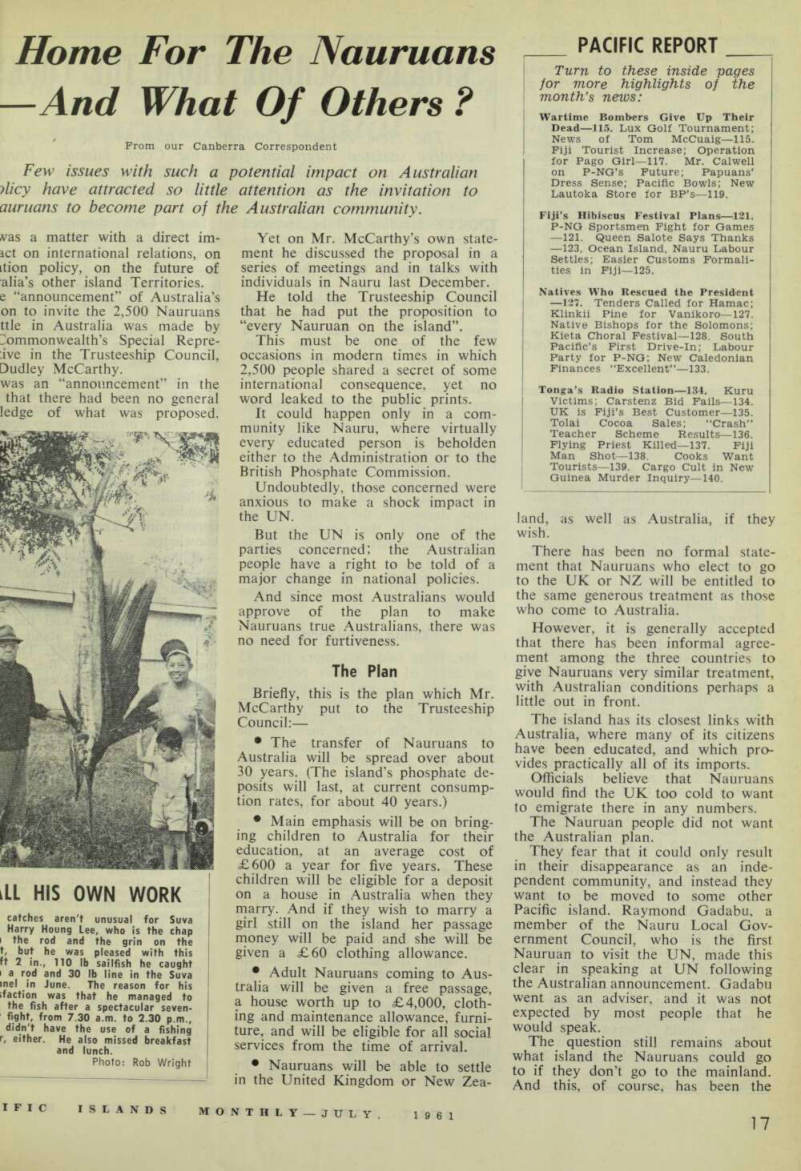
[?]Ll His Own Work
catches aren't unusual for Suva Harry Houng Lee, who is the chap the rod and the grin on the [?]t, but he was pleased with this [?]t 2 in., 110 lb sailfish he caught [?] a rod and 30 lb line in the Suva [?]nel in June. The reason for his sfaction was that he managed to the fish after a spectacular seven fight, from 7.30 a.m. to 2.30 p.m., didn't have the use of a fishing [?]r, either. He also missed breakfast and lunch.
Photo: Rob Wright
problem which has resulted m the mainland offer being made.
No island has been found, despite a long search {PIM, July, 1959, p. 145).
Islands in New Guinea, including Goodenough and Woodlark, have been looked at in the last few years, and the Markham Valley of New Guinea was also regarded a pos sibility. But the Nauruans didn’t want any of it, probably because the type of country was foreign to them.
The Nauruans themselves have been reported to be interested in Fraser Island, off the Queensland coast, about 100 miles north of Bris bane. Most of it is Crown land.
However, the real attitude of the Nauruans was probably summed up in a colourful sentence in late June by Mr. J. K. McCarthy, P-NG
(Continued on p. 142)
Director of Native Affairs, who in 1957 was Acting Administrator in Nauru. Mr. McCarthy said that when he was in Nauru the people had their own ideas about where they wanted to go—“ Australia or Hollywood!”
Mr, Gadabu’s rejection of the Australian proposal does not affect the long-term implications which arise from the fact that the offer was made.
Perhaps the most interesting aspect
of the offer to the Nauruans is its impact on the “White Australia” policy.
With the steady change in public opinion this policy has been watered down over the past decade, by, for example, the provision which enables distinguished Asians to settle in Aus tralia and the more recent change enabling Asian residents to become naturalised.
But these changes have dealt with individuals.
The Nauruan decision is something different. It invites the whole coloured population of a country—admittedly a small one—to become Australians.
Will it be regarded as a precedent?
If it is, then Australia will face a host of similar problems in future.
Will the people of P-NG accept a lower status in relation to Australia than that which has been freely and generously offered to the Nauruans?
And what of the people of Cocos Island and Christmas Island?
Those questions may be academic now, but with the advancement of native peoples in other territories they might become the liveliest of issues.
Sophisticated
Australia’s case for the re-settle ment of Nauruans rests heavily on the fact that Nauruans are a sophisti cated people, with urban skills, who* would not be easily settled on another Pacific island, even though most Nauruans have expressed a wish for this type of re-settlement.
It is true that in relation to other islanders, the Nauruans are an ad vanced people, but Australia’s latest report to the UN makes it clear that progress has not been as rapid as the Government would have wished.
For instance, the report says: “The three Administration cadetships granted at the beginning of 1959 for territory study in medicine, science and teacher training, were unfortun ately fruitless. One student returned home before the annual examinations, and the other two failed badly.
“Adjustment difficulties and in ability to develop proper study habits played a large part in failure.”
As increasing numbers of Papuans qualify for tertiary education there could easily develop a resentment at Nauruans being accorded most favoured-nation treatment.
And that could pose a major problem for Australia.
The Australian Prime Minister, Mr.
Menzies, said in June that neither Australia or New Zealand, nor the UK, was forcing a re-settlement solu tion on the Nauruans. It was their decision alone.