Pacific Report
pp. 115-143 · Read in the full issue

The month’s round-up of news and pictures of people and mts, from PIM correspondents in the South Pacific.
lon Trip'; Criticism
ji Sugar Leaders
B. D. Lakshman, MLC, in De ir continued his attacks on ■s’ of some Fiji cane-farmers’ s, alleging they were using in ition to raise funds for a trip ndon. word “intimidation” has been gd about freely in Fiji ever the December, 1959, rioting in and not without cause. /as common knowledge in Fiji r the 1960 cane-harvesting )ck that a big majority of ts wished to cut Uheir crops fbut afraid of reprisals. The police some arrests, but found it in court to sheet home guilt, messes retracted their original jng a largely illiterate popula a threat to burn a farmer’s or his home, or do physical ?e to him or members of his /, is very real indeed, and an ,ve deterrent against harvest- Lakshman (who lives at ka in the heart of the Viti cane country) kept in close with farmers throughout the ;e and knew what was going i his latest attack upon some ■s, he alleged they had said wanted to go to London (pre
sumably to the Colonial Office) to plead the case of the farmers.
He said he did not object to that, but he did object to the methods they used to raise money to pay their way. (He apparently did not mention that some of these leaders are fairly wealthy men and could easily afford to pay for the trip themselves if they really had the interests of the farmers at heart).
Mr. Lakshman said that if the farmers did not pay it was a case of “you’d better look out”. He challenged those leaders who wished to make the trip to make their appeal
and then stay at home and see just how many people would send them money.
However, since the Sugar Com mission of Inquiry was announced on December 22, any suggestion that information about cane-growers’ grievances should be specially carried to London has lost its force.
At least one Indian member of the Legislative Council has asked the Government to order payments from the Sugar Price Stabilisation Fund.
However, the Fund was set up originally for use if the price of sugar fell because of conditions out side the Colony, and it has been built up largely through a propped up price on the UK market.
In any case payments from that fund are guarded mainly by a series of ordinances, and are in the hands of a board which has strict control of the money, subject to the legis lation. The Government view is that the initiative for any payments must come from the board.
The official feeling also is that with the 1961 sugar output esti mated at 188,000 tons, complaints about the possible plight of farmers in 1961 may be over-emphasised. (Over)
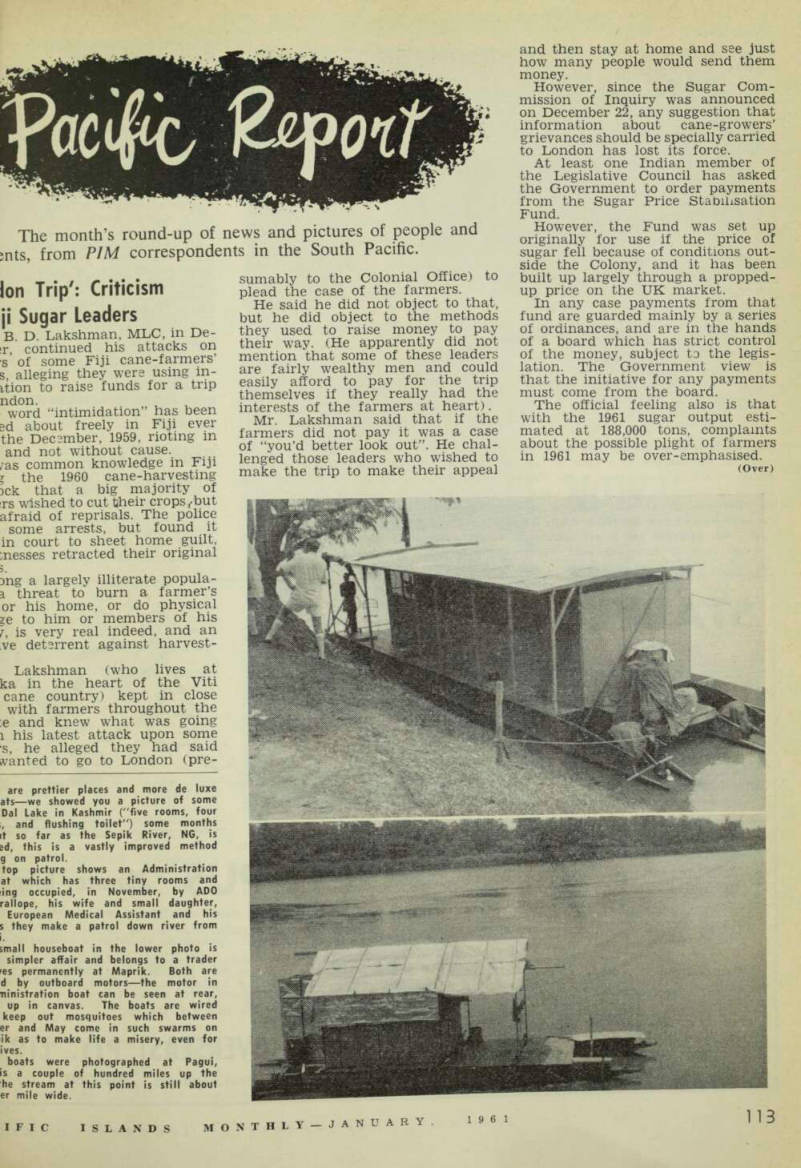
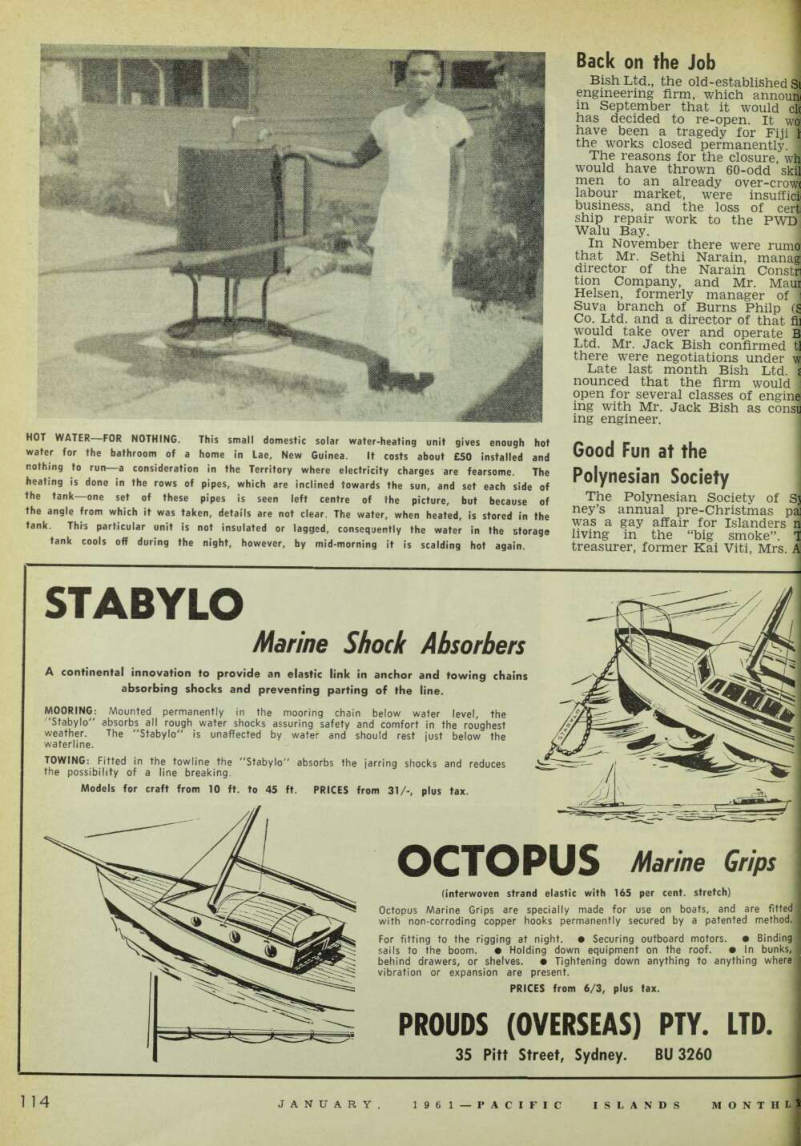
[?] are prettier places and more de luxe [?]ats —we showed you a picture of some Dal Lake in Kashmir ("five rooms, four [?], and flushing toilet") some months [?]t so far as the Sepik River, NG, is [?]ed, this is a vastly improved method [?]g on patrol. [?]top picture shows an Administration at which has three tiny rooms and [?]ing occupied, in November, by ADO [?]rallope, his wife and small daughter, European Medical Assistant and his [?]s they make a patrol down river from [?]. small houseboat in the lower photo is simpler affair and belongs to a trader [?]es permanently at Maprik. Both are [?]d by outboard motors —the motor in [?]inistration boat can be seen at rear, up in canvas. The boats are wired keep out mosquitoes which between [?]er and May come in such swarms on [?]ik as to make life a misery, even for [?]ives. boats were photographed at Pagui, [?]is a couple of hundred miles up the [?]he stream at this point is still about [?]er mile wide.
Back on the Job
Bish Ltd., the old-established 4 engineering firm, which announi m September that it would clc has decided to re-open. It wa have been a tragedy for Fiji 1 the works closed permanently. 1 The reasons for the closure, wh would have thrown 60-odd skil men to an already over-crow] labour market, were insufficii business, and the loss of certi ship repair work to the PWDj Walu Bay.
In November there were rumo that Mr. Sethi Narain, managi director of the Narain Constri tion Company, and Mr. Maur Helsen, formerly manager of j Suva branch of Burns Philp (g Co. Ltd. and a director of that fii would take over and operate B Ltd. Mr. Jack Bish confirmed tl there were negotiations under w Late last month Bish Ltd. 2 nounced that the firm would I ppen for several classes of engina ing with Mr. Jack Bish as consu ing engineer.
Good Fun at the
Polynesian Society
The Polynesian Society of Sj ney’s annual pre-Christmas paj was a gay affair for Islanders n living in the “big smoke”. T treasurer, former Kai Viti, Mrs. A:
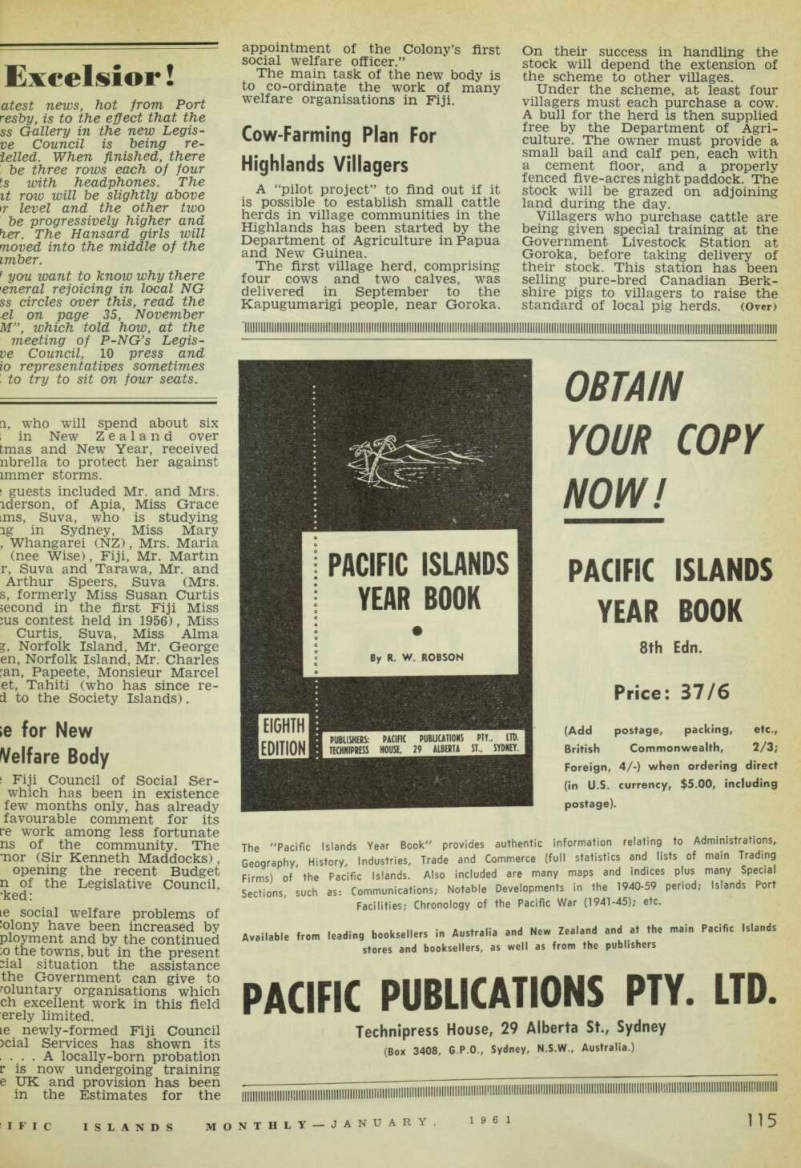
HOT WATER FOR NOTHING. This small domestic solar water-heating unit gives enough hot water for the bathroom of a home in Lae, New Guinea. It costs about £50 installed and nothing to run—a consideration in the Territory where electricity charges are fearsome. The heating is done in the rows of pipes, which are inclined towards the sun, and set each side of the tank—one set of these pipes is seen left centre of the picture, but because of the angle from which it was taken, details are not clear. The water, when heated, is stored in the tank. This particular unit is not insulated or lagged, consequently the water in the storage tank cools off during the night, however, by mid-morning it is scalding hot again.
a, who will spend about six in New Zealand over tmas and New Year, received nbrella to protect her against immer storms. i guests included Mr. and Mrs. iderson, of Apia, Miss Grace ims, Suva, who is studying ig in Sydney, Miss Mary , Whangarei (NZ), Mrs. Maria (nee Wise), Fiji, Mr. Martin r, Suva and Tarawa, Mr. and Arthur Speers, Suva (Mrs. s, formerly Miss Susan Curtis second in the first Fiji Miss jus contest held in 1956), Miss Curtis, Suva, Miss Alma Z, Norfolk Island, Mr. George en, Norfolk Island, Mr. Charles :an, Papeete, Monsieur Marcel et, Tahiti (who has since re el to the Society Islands).
;e for New
Welfare Body
i Fiji Council of Social Ser which has been in existence few months only, has already favourable comment for its re work among less fortunate ns of the community. The •nor (Sir Kenneth Maddocks), opening the recent Budget n of the Legislative Council, •ked: ie social welfare problems of iolony have been increased by ployment and by the continued ;o the towns, but in the present fial situation the assistance the Government can give to voluntary organisations which ch excellent work in this field erely limited. le newly-formed Fiji Council )cial Services has shown its ... A locally-born probation r is now undergoing training e UK and provision has been in the Estimates for the
appointment of the Colony’s first social welfare officer.”
The main task of the new body is to co-ordinate the work of many welfare organisations in Fiji.
Cow-Farming Plan For
Highlands Villagers
A “pilot project” to find out if it is possible to establish small cattle herds in village communities in the Highlands has been started by the Department of Agriculture in Papua and New Guinea.
The first village herd, comprising four cows and two calves, was delivered in September to the Kapugumarigi people, near Goroka.
On their success in handling the stock will depend the extension of the scheme to other villages.
Under the scheme, at least four villagers must each purchase a cow.
A bull for the herd is then supplied free by the Department of Agri culture. The owner must provide a small bail and calf pen, each with a cement floor, and a properly fenced five-acres night paddock. The stock will be grazed on adjoining land during the day.
Villagers who purchase cattle are being given special training at the Government Livestock Station at Goroka, before taking delivery of their stock. This station has been selling pure-bred Canadian Berk shire pigs to villagers to raise the standard of local pig herds. (Over)
' Dutch Are Training
r Papuans
b education programme for ans being carried out in erlands New Guinea, and their ing to take greater re iibility in administration, im ed the Secretary-General of South Pacific Commission (Mr.
Smith), during a visit in No er-December. inspected schools, training es, hospitals, and various pro for the development of agri ,ure, fisheries, ship-building, zr production and roads, highlight of Mr. Smith’s trip a visit to the remote Baliem y. This, accessible only by air, discovered when an American ift crashed there in 1945, and vors were rescued by glider. 10,000 inhabitants have a Stone culture, and their staple food e sweet potato. >sion posts were established in alley in 1954, and Government in 1956.
nd E. Colony Thanks
Lepers' Trust
;h ranking chiefs and repre tives from the Gilbert and ; Islands formally expressed gratitude to the people of New nd and the New Zealand rs’ Trust Board for their help e care and treatment of lepers, was carried with acclamation he Third Colony Conference, recently on Makin Island r the Chairmanship of the lent Commissioner (Mr. M. L. acchi).
jper Petrol for
]a and N. Hebrides
aga and the New Hebrides will r substantially reduced prices ietroleum products through the ruction of new, bulk oil in itions by the Shell Co. (PI)
The Tongan installation, at Nukualofa, has been finished. Work on the New Hebrides project will start in April and the target date for completion is December next.
The Nukualofa installation has a capacity of 160,000 gallons. Bulk supplies arrive from Suva by bulk lighter and a tug operated by the Tongan Government. Until recently, supplies arrived from Suva in more costly drums.
The products handled at Nukua lofa are motor spirit, which will fall by 8d a gallon; lighting kerosene, down 6id. a gallon; and dieseline, down 6d a gallon. The installation cost more than £25,000, and will dis tribute 500,000 gallons of fuel a year.
The New Hebrides installation will be built at Santo and will cost about £120,000. The storage capacity will be 1,000,000 gallons.
The Santo terminal, like that at Nukualofa, will handle motor spirit, kerosene and dieseline.
The New Hebrides at present re ceives fuel supplies from Suva in 44-gallon drums. When the Santo installation is operating, 18,000-ton ocean-going tankers from Singa pore will carry the bulk petroleum products to the New Hebrides.
The Nukualofa terminal was officially opened by Prince Tungi, Premier of Tonga, on December 3.
In an address he outlined the events
leading up to that day—the build ing of the tug Hifofua and the oil barge, Lolo Maana’ia in which oil for the bulk terminal is transported, and the negotiations with the Shell Company for building the installa tions.
He said that Queen Salote had consented to name the barge dis charge basin and the installation site and in future it would be known as Touliki which, in Tongan, means “constant supply” or “con tinuous flowing”.
The Shell Company later enter tained guests to a buffet dinner.
The first discharge of the oil barge Lolo Maana’ia went smoothly and 32,000 gallons of motor spirit, 16,000 gals, of dieseline and 15,000 gals, of kerosene were discharged into the Shell tanks in 10 hours.
Matson Finds Profit
In Rarotonga
While British shipping lines turned up their noses at the idea of making profitable calls at Rarotonga to uplift or set down passengers, the American Matson Line seems to be proving that it can be worthwhile, even at luxury Since the Matson liners Mariposa and Monterey started making southbound calls, on the run be tween Papeete and Auckland, the number of passengers uplifted at Rarotonga has steadily increased.
Early in December Mariposa picked up 50 passengers at Raro tonga. The fares vary with accom modation from about £NZSI to £NZ9O, so a handy sum was earned in a few hours’ stay off the island — with no port charges involved, and no interference with the ship’s schedule (the time is easily made up on the passage to Auckland).
Passenger loadings out of Raro tonga are seasonal, of course, and in mid-summer all who can will take their leave or arrange their business visits to New Zealand.
Returning to NZ from her first voyage to the Cooks early in De cember, Island Territories’ new Moana Roa had a full load of 40
Prince Tungi shown opening the new Shell Company bulk terminal near Nukualofa, Tonga (see this page).
passengers fare £NZ37 for adults. in A ml§ e fsS 1 p Il iJ ZAr Ha sDavi in ; inid-December was fully booked JJSSiaf? Is *? en £ ers heading South. This Sr? 3 *?* too J : school children from fummeTholXvs 116 C °° kS f ° r the summer holidays.
Dried Bananas — And The
Hesitant Tonnans
A " longans An offer to establish a £60,000 banana dehydrating factory in Tongatabu, made to the Tonga Governmjent in mid-1960 jointly by a Dutch and an American business promoter in New Zealand, was still being discussed early in December —according to Mr. Anton Van Impelen, the Dutch partner, who went to Tonga in May.
Messrs. Van Imnelpn and p tt dson offered to put up all the necessary capital—about £l5 000 in the first year—and operate the in dustry entirely at their own risk ask f d 0 “T tor ajurances that ample supplies of bananas would be organised by the Tonga Government, and that there be no time limit on the period of opera tion of the industry.
The Tonga Gove y mment had not been prepared to accept this nro position. It sought a controlling in terest in the industry, A counter-offer was made by the promoters that they be left in full control for a minimum of two years to get the industry established and that the Government then take it over completely on a cost-nlus -25 per cent, basis.
But the Tonga Government J asked for a controlling financial* terest, from the outset.
Mr. Van Impelen said that! oner had also been made to Government to set up the indus purely in a consultative capac This includes organising the mar outlets in Europe.
The partners say they have b ready for months to proceed, 1 were still ready; but the slow* of the negotiations with 1 Tongans highlighted their reas for seeking complete control pe: ing the establishment of the i dustry. . Mr. D. C. Brown, of m Auckland, in November, i cussed the possibility of a di banana industry for the C o Islands, with Mr. Van Impelen. ] he was told that while Rarotoi has a good banana would be unwise to plan such! industry before ample bupplies bananas were available. Tori conditions were ideal.
No Inter-Samoa
Plane at Present
Travellers between Apia (WestJ Samoa) and Pago Pago (Ameri< Samoa) are back again to sea tral port.
The American-o wn e d Sami Air Lines, meeting financial di: culties, ceased running some ti ago; but the Apia-owned Polynesi Airlines carried on with their sni “Prince” aircraft. However 1 Saturday, December 3, the ’lat plane, when coming in at Fale airport on a return flight fn Tafuna (American Samoa) tri to land on a deflated tyre. It v seriously damaged and is reporl to be a total loss.
Polynesian Airlines is at pres< negotiating for the purchase of t second-hand planes in Tanganyil and in December the operatic manager, Capt. R. R. Barnew] was expected to go to East Africa; arrange for the planes to coi from Tanganyika to Apia.
Encouraging NG Highlander
To Run Cattle
Out of a grant of £1,170, made the Australian Reserve Bank 1 assist agriculture development I Papua and New Guinea, £6OO w be devoted to encourage cattle-ral ing by natives in the New Guini Highlands.
The first “pilot project” in tc direction was established at Bel Bena last September, when AU tralian Illawarra Shorthorns fra the Government Livestock Static in the Highlands were sold I selected villagers at from £l5 to £! each.
The balance of the grant goes I provide prizes for native exhibits
ie various annual district shows le Territory.
Dm another fund, the Reserve : is donating £1,183 to the h Pacific Commission, to en ige research work on the gical control of coconut pests.
\ Fishing in
k Islands
L e return of flying fish (after years absence) to Atiu, Cl, for ning, has provided the islanders plenty of fish and risks, correspondent in the Cook ids Review writes: “Thirty es were kept busy, each catch- LOO to 150 fish. Shark incidents numerous. A large shark bit . Potoru’s canoe clean in half, only a paddle and a piece of ing were saved. Another shark Ded into Karo Opunga’s canoe upset it, all the fish being •ded to the shark. Joe Papa had icky escape when the shark d the net as he was removing fish, but he suffered only a ■ated thumb.”
V. Samoa, Just
Months to Go
dependence is now less than a away in Western samoa, and ew stamps, 10 postage and three 1, will be issued to commemorate Day—January 1, 1962.
‘nominations of the postage
ips will be from Id to 5/-, with , £1 and £5 for the fiscal issues.
Samoans have been invited to submit suggestions and designs for a pictorial series, which will replace the current issue, but a professional stamp artist in New Zealand will be commissioned if there are no suitable designs by local artists.
Although a cash prize is being offered by the Samoan Government for an acceptable design or sug gestion so far there have been few starters.
Children Christen Niuean
Fleet at £1 a Time
Niue’s merchant fleet of two gov ernment launches and eight lighters are now bearing names, and 10 local children are each £1 better
off following a successful “Name the Lighters” competition.
The Administration donated the cash.
The competition was suggested by the Works Officer on Niue, Mr. J.
Roughan, and school children were asked to choose 10 suitable names of historical and legendary import ance to the island.
Ordinance is "Full
Of Obscurities"
The Fiji Liquor Ordinance came in for sharp criticism in the Colony’s Supreme Court in Decem ber, during the hearing of an appeal against a Magistrate’s Court refusal to issue a certificate for a publican’s
licence for the South Pacific Hotel, Lautoka.
The exasperated presiding judge, Mr. Acting Justice Knox-Mawer, remarked when he allowed the appeal, This case necessitates the interpretation of a provision of an Ordinance that is so full of obscurities as to be a nightmare”.
Cathay Hotels (Fiji) Ltd. appealed to the Supreme Court after ® e , m ° r a g istra te at Lautoka (Mr. M. J. C. Saunders) refused to issue a certificate for a publican’s licence to Sir Percy McNiece, of Cathay Hotels.
Mr. Saunders said the matter had been brought before the Court without any of the provisions of the section relating to objections being complied with. No member
of the public could object to the licence because he did not know the matter was coming up Mr. R. G. Kermode who ap peared for Cathay Hotels, asked pointedly in the Supreme Court whether the public had a right to object after a provisional certificate which allowed the hotel to be built had been issued, If it were possible for someone to raise an objection after the hotel had been built no one would invest the large sums needed to build a hotel.
Mr. Justice Knox-Mawer once re marked to Mr. Kermode: “Your interpretation, with which I am inclined to agree, would render the last few words (of a section in the Liquor Ordinance) meaningless”.
Constable Pen! Got
His Man
Peni Seru became a fully-fledgt constable in the Fiji Police For in October at the age of 19. Le than two months later he won warm commendation from a Sin Magistrate for courage and devoti( to duty, when he chased a thi half a mile across country in tl dark, and suffered a heavy blow the fight with the thief.
Constable Peni did not get h man then but, like a good polici man, he was able to give g accurate description which led other police making the arrest. ] the subsequent court hearing it Wi revealed that Constable Peni, whf his man threatened him with pair of tin snips after the chas went in with a flying tackle.
During the scuffle the represents tive of law and order attempts to blow his whistle. The quan grabbed the policeman’s trunchec and struck Constable Peni on tt head, and got away.
When he was arrested these ti snips were found in his possessic and Constable Peni was able, j court, to identify them as the om with which he had been threaten© The court praised Constable Per and sentenced the thief to a tots of 27 months’ imprisonment on fh charges.
West Samoa Sells
Its 1961 Copra
The Copra Board of Wester Samoa has recently concluded sal contract for the major portion c the Territory’s 1961 copra pro duction (approximately 15,000 tons; Some 3,500-4,000 tons of the 196 copra were sold to the New Zealan buyers, Messrs. Abels Limite (exact quantity to depend on pro duction) and some 6,000 tons (1 per cent, more or less) were sol to the British firm of Unilevd (Raw Materials) Ltd.
The Copra Board also signed ii freight agreement with two Direc tors of the Bank Line Ltd., Hon. A C. R. Weir and Mr. J. C. Hawkes who visited Apia The Boan obtained a 10/- per ton reduction oi the 1960 freight rates.
The prices stipulated in the copn contracts were not disclosed bu were reported “satisfactory, con sidering the present market rate”.]
The "Crash" Did
Not Pay Off
Mr. Frank Andrew Brunt, whc had been a member of the stafi of Apia (Western Samoa) Broad casting Station for many years, was selected, early in 1960, under the “crash training” programme, to proceed to New Zealand to receive
training in broadcasting, nistration and supervision. It understood he would be oted to the post of Director of feasting in succession to Mr. . Turner, who was leaving. . Brunt managed the Broad ig Department, after the de ire of Mr. Turner, for several hs and was then appointed tor by the Public Service Com on. appeal against this appoint was lodsred with the Public ce Appeal Board by a radio lician of the Radio Depart , Mr. James William Moore. appeal was allowed by the 1. The Public Service Com on then cancelled Mr. Brunt’s intment and appointed Mr. e to the position, is incident has caused resent and protests by Samoan als, and particularly by the h” trainees, who were promised rence in promotion to senior ions of the Public Service, on letion of their special train looks like a muddle by bureau- The “crash training” pro me was subsidised by New md —an apparent waste of sy.
m For AAore Now
torolevu
rolevu Beach Hotel, pride of Ragg chain of hotels in Fiji, known throughout the world, reached its capacity for guest nmodation, according to Sir i Ragg, Managing Director. told guests at the opening of w block, just before Christmas: think we had better stop now •e the hotel gets too large for 3 give the best service to the c.” e Governor of Fiji, Sir Kenneth iocks, officially opened the new jons, which include bedrooms, !S, kitchen and reception rooms.
A few amenities remain to be added —one of them a swimming pool between an extended Adi Kuila Bure and the sea, and a few more trees have yet to be planted.
The new accommodation block has 19 rooms, all with shower and toilet, and some of the bedrooms have their own baths. Korolevu can now accommodate 125. (Over)
The Rev. Jabez Leslie Bryce (centre) who was ordained Deacon in the Holy Trinity Anglican Cathedral, Suva, on Sunday, December 18, photographed with his parents Mr. & Mrs.
William Henry Bryce.
Mr. Jabez Bryce is 25 and was born in Vava'u, Tonga. He went to Samoa while an infant and was educated at Leifiifi School and Samoa College and later at St. John's Theological College, Auckland, from 1957-60.
He will serve his title at Holy Trinity Cathedral, Suva, under the direction of the Rector, Rev.
H. W. Figgess. Mr. Bryce's parents are still living in Apia, W. Samoa.
Photo: Stinsons
ne of the new rooms, known as Function Room, will be avail- 3 for private parties, functions, options, etc. he new kitchen is equipped with ly modern devices all designed maintain an efficient service to dining room. A 12-ft square k-in freezer stores meat and er perishable foods for daily rerements. ruests may drive up to the retion desk in the new offices and oy an uninterrupted view of the ch, sea and reef while they com- :e booking-in formalities.
'here are nine Ragg hotels scatid throughout Viti Levu and y are capable of accommodating •ut 400 guests.
Shloboard Accident
JHipuu
i/j|| s Rarotonqa Woman
1 3 While en route from Atiu to Raro tonga, in the Cook Islands, on ino vember 22, an accident occurred on the auxiliary ketch "JJ? 1 resulted in the death of a ji-yea old woman passenger, Ngame Rua Enoka, of Rarotonga, Cargo, cabin and deck had been taken on the at Atiu to travel to Rarotonga, on this particular trl P’ passengers were allowed to »cc modate themselves on was hatch cover, and a ta p yide placed over the boom P shelter.
After clearing Atiu, deck pas sengers made use of the shelter pro vided. The mainsail was raised with the aid of a winch and suddenly the timber holding the pulley block on the masthead gave way, and the main pulley block with three double sheave blocks, weighing approxi mately 130 lbs, fell to the deck be low.
Mrs. Enoka was lying on the hatch when the pulley block crashed through the tarpaulin shelter onto her right side.
The ship immediately returned to Atiu to seek medical advice for the injured woman. The medical officer there treated her and the ship re turned to Rarotonga. But Mrs.
Enoka died at 2 a.m. the following morning before reaching hospital there.
The Taveuni, which is owned by Mr. Dick Brown, of Rarotonga, had recently completed a major over haul at Pago Pago, American Samoa.
New Powers Over
The Press in Fiji
The December, 1959, Fiji riots, and the “liveliness” attending the subsequent dispute in the sugar in dustry, revealed that the Colony’s laws were not adequate to deal effectively with matters adversely affecting the general wellbeing of the community.
The Government’s legal depart
Photographs show (TOP): The Governor, Sir Kenneth Maddocks, receiving yagona after he had opened the additions to the Korolevu Hotel in December. (See story page 121 and below).. Sir Hugh Ragg is shown right.
LOWER: Part of the new additions showing the new bedrooms, each with its own sun balcony, on the upper floor.—Photos by Stinsons.
:s found themselves hard at in 1960, looking into the old , and designing amendments new laws suitable to changed mstances. ie of the most important of the measures is an amendment to Press Correction Ordinance, it is not unexpected, ring the sugar dispute some □ns of the Press indulged in a of propaganda which was not false, but contributed to a ioration in racial relations, ere were many requests during currency of the dispute for idments to the ordinance, to r the Government to deal with sading reports and propaganda, words which, while not out out sedition, were mischievous leir effects, e amendment, which became in December, will allow the rnor to order correction of or distorted Press reports DUt running the risk of a law- The Governor-in-Council may act if in his opinion distorted false statements about in uals are likely to cause a public lief. amendment to the Penal Code gthens the law relating to rnient to violence and to dis ience of the law; and provides malty of up to two years’ isonment, or a fine up to £2OO, Dth, for breaches, e Criminal Procedure Code has amended to add to the class arsons who can be required to * into undertakings to be of behaviour, or to keep the 3. In future, the code will in : persons disseminating any er likely to be dangerous to 3 and good order, or likely to to the commission of an ce.
Building to Last
In Goroka (See photos below ) No matter how well you build in fibro-cement and timber the result does not have the substantial look of bricks and cement. The few — very few —buildings that are now appearing in Papua-New Guinea in the latter medium underline this fact.
Bricks and cement in the Terri tory are expensive, however, especi ally in the interior, which makes Goroka’s effort at producing per manent building materials even more remarkable.
At present, a small, simple machine called a Cinva-Ram (it’s imported from America) is turning out stabilised earth blocks there and causing a lot of local interest.
The Native Local Government Council in Goroka has secured the agency for these gadgets and has already sold about 40 of them. The stabilising medium, in this case, is
cement and the basis of the block is common earth. Ideally, the earth from the site of the building should be used; but experiments in Goroka have shown that the efficiency of the block varies greatly with the type of earth used and the soil for those shown being made in the picture on this page (taken behind the District Office, Goroka) was brought from some miles away, and looks something like river sand.
The cost of the blocks varies with the amount of cement that goes into the block, and naturally with the price of cement. According to the specifications, each block takes about li lbs of cement and this, based on the price of £55 per ton for cement sold “over the counter” at Goroka, works out at about lOd per block.
If cement is bought in ton lots and air-freighted from the coast as backloading, it costs about £32 per ton and the blocks are correspond ingly cheaper. Administration De partments get cement everywhere
[?]ft, the Highland [?]rs' and Settlers' [?]ation building at [?]a. It is made of [?] made fired of an attractive [?]lour. It contains [?]cious meeting hall office for the As [?]ion plus premises [?] to outside [?]sts. At right, a shows how the Ram works. The [?]e of earth and [?]t is mixed and [?]led into the [?]ke body of the [?]e, the lid is
and the long
pulled down to [?]ess the block high pressure, [?]andle is released [?]he block rises up [?]n easy position for
out and stacking.
in the Territory at the same flat rate—about £l5 per ton.
The blocks are suitable for all types of buildings, including native labour quarters. A wash-room block has been built from them at the District Office and part of this can be seen in the background of the picture on page 125.
A fired red brick is also being made by private interests in Goroka and the attractive new Farmers and Settlers’ Association building (shown also page 125) has been made from them. These bricks are sold at about £32/10/- per thousand, which makes the initial outlay on a brick building in this area pretty expensive. But from a
maintenance and depreciation point of view, it probably is still a worth while proposition.
'Bellowing' Manam—And
The DC's Nightmare
Sixty explosions an hour is real liveliness, in anyone’s vulcanology.
That record was achieved for one brief period in November by the double-cratered volcano Mount Manam, which lies almost under the equator, 10 miles off the coast of New Guinea, between Madang and Wewak.
Manam is New Guinea’s busiest volcano. During 1960, it practically
never ceased erupting and bellow mg. The official vulcanologist, Mi G. A. Taylor, calculated that, frod November 18 to 25, Manam wa exploding 45 times per hour Manam got into high gear las February, and in March the peopli of two villages were removed fron a danger zone. But they soon wen back.
Apart from its volcanic ferocity Manam is a fertile and pleasad island on which to live, and 4,00 natives stubbornly regard it a home.
The harassed District Corn] missioner at Madang has arrange! mass evacuations of the people oi occasion, and tried to induce then to settle elsewhere. But, for thed it’s Manam or nothing. The DC in occasional nightmares, probata; envisages a day when a couple o slow-moving villages will b( fricasseed, and headline-hunting Southern newspapers will howl fo: his blood. But what can he in New Guinea today Browi Brother is the Boss!
NG Tribute To
The "Foreign Doctors"
Migrant doctors who had noj been allowed to practise in Aus tralia had played a great part in th recent advancement and develop ment of New Guinea, said Mr. Cltf Ryan, manager of the Departmenl of Agriculture Experimental Farm at Bereima, Papua, when address] ing a meeting in Australia recently Foreign medical men and scientists who had come to Aus tralia, seeking a new life, had beeß barred from practice, and had beer forced to engage in labouring world These men readily accepted the chance to go to Papua and New Guinea, where they were allowed to practise.
“As a result, we got some of thd best brains in Europe up there and they have been the backbone of the advancement made,” Mr. Ryan said.
How Do You Index
These Taxpayers?
A Rabaul writer says that the Tolai system—matriarchal—of naml ing its citizens is giving headache! to the newly-established, coni scientious tax-gatherers of Rabaul.J The taxation documents follow the Western pattern, and demanJ the name of the taxpayer’s fathers so they may use it as a surname for indexing purposes. Whereas, in this particular society, the young citizenj ignores his daddy and takes the name of his mama.
The taxation officials (says the; correspondent) must either change Tolai social practices, or face tha hideous alternative of changing their indices.
sonal Parties
large gathering of members of Pacific Island Society and their ids met at the Feminist Club ns, King Street, Sydney, for the lal cocktail party on December le Society, which seemed to be ily heading for an early grave w years ago, has taken a new ; of life under the Presidency Ir. N. H. Foxcroft, who is sup -3d ably by his wife and an en iastic executive committee. iends and well-wishers donated £9O to the New Guinea len’s Club of Sydney for their of year children’s Christmas y. The party was held on mber 12 at the Feminist Club ns, 77 King Street, Sydney, i each young guest received a from Santa, a lot of good ?s to eat and drink, and hed a ventriloquist do his stuff. ie adult Christmas cocktail y for members and their friends held on December 15, and was usual great success.
Tense Christmas Eve
In Western Samoa
With Christmas only one week away, the people of Western Samoa on December 17 were anxiously scanning the horizon for a glimpse of the motorship Ratanui, carrying a large quantity of bottled beer.
Beer supplies ran out In No vember, and Apia’s clubs had been without this favourite refreshment for many weeks.
Beer supplies ordered from Eng land and Germany were delayed by waterside strikes in England; and the Customs Department failed to get substitute supplies from Aus
New Guinea Club 10 10 0 Mr. B. G. Edgell 3 0 0 Mrs. G. Sturgeon 10 0 Mrs. B. Perriman . . 10 0 0 Mrs. A. Wheeler J 1 0 Mrs. W. C. Carpenter . . 3 3 0 Burns Philp & Co 3 3 0 Mr. B. G. Roberts 5 0 0 Mrs. P. Muller 10 0 Miss J. Ewen 10 0 Mrs. V. B. Pennefather 6 0 0 Pacific Islands Monthly 2 2 0 Mrs. L. Mansfield 3 3 0 Burns Philp, Port Moresby 2 2 0 Robert Gillespie 5 5 0 Mrs. E. Wauchope 2 o 0 Mr. T. Prince 2 2 0 Mrs. J. Dunbar-Reid 2 ■> 0 Mrs. C. Normoyle 0 0 Mrs. H. Baldwin 18 0
Total
. . 91 11 0
Ations For Children’S
Party
Cleland l £ 1 0
R. Cambridge
3 3 0 C. Perichon 2 2 0 N. Laws 2 2 0 E. Gray 1 0 0 G. Thomas 5 5 0 R. Haviland 1 0 0 R. Pye 1 0 0
Guinea Trading Co
5 5 0 O. Neile 10 0 G. Green 2 2 0 J. Duncan 2 2 0 J. Keenan 10 0
i and New Zealand. Finally, Union SS Co. chartered the nui to bring transhipment 3, which arrived in Suva, Fiji, le Port Lyttleton on December l to Apia. ;oholic liquor is imported to 3a under bond, and is not for ral sale. Privileged persons are r ed to purchase liquor at the I Store, usually because they a medical certificate that tol is necessary to their health.
:oe False
ences Case
red Vercoe, well known as a Dgrapher in both Western and *ican Samoa, has not yet been need in Australia on false nces charges rising out of the ipping of eight-years-old ey boy, Graeme Thome r , Sept., p. 133 and Dec., p. rcoe pleaded guilty in the lower ; to a charge of having ipted to obtain, by false nces, about £25,000 from the father. The boy was later i dead, but it was not alleged Vercoe had taken any part in kidnapping or subsequent ler, or knew anything about :rime, other than what he read le Press. rcoe was to have appeared for nee in the Sydney Quarter ons in December, but his case not called. The earliest he can
now appear is February, as the Quarter Sessions are closed for the end-of-year vacation.
Those Submarines
Are Around Again
The sudden departure from Suva on December 23, 24 hours earlier than planned, of a Russian research ship, the Shokalsky, caused a stir throughout the South Pacific. The RNZAF, based on Laucala Bay, sent Sunderland flying-boats into the air, and gave rise to a spate of rumours that the ship had disappeared.
RNZAF spokesmen were cagey about the movements of the aircraft and equally cagey about uncon firmed, but persistent reports, of an unidentified submarine, or sub marines, near Tarawa, in the Gilbert Islands.
The theory was that it was a Red nuclear submarine testing a Polaris-type missile. And the general opinion was that it should not be there, although how the Russians are to be prevented from using the open sea is hard to say.
Finally the RNZAF at Welling ton confirmed that one of the flying-boats had sighted a sub marine in the Pacific “north of Fiji” about December 26. One of the spokesmen at Wellington added that the Shokalsky had been seen regularly by Sunderlands.
The “silent” service Chief of Naval Staff (Rear-Admiral P.
Phipps) broke silence at Wellington, when asked to comment, and said, “We have heard nothing about it.”
Rear-Admiral Phipps said the RNZN was not concerning itself with the Shokalsky and added that he would be surprised if the RNZAF was either looking for or shadowing the ship.
“I know they are doing some flying from Laucala Bay, but I would be very surprised if it had anything to do with the Russian ship”, he said.
The Shokalsky arrived at Suva on December 20 for bunkering and minor repairs. The Russian officers, sailors and scientists welcomed visitors to the ship.
Tass, the official Soviet news agency, reported at Moscow a week earlier, that the Shokalsky had launched the first Soviet mete orological rocket in the tropical at mospheric belt before calling at Suva.
Danny Weil Yells
For Help Again
The English radio “Ham”, Danny Weil, who has been in trouble so often now and has raised so many radio yelps for assistance that it now seems routine, was hollering for help again in December.
This time his third yacht, Yasme 111, was foundering almost —65
off Cape Corrientes, Mexico, brother Ham, Mr. J. W. White IX) of Gisborne, NZ, was in ental in bringing aid.
White —who happens to hold world’s record for greatest er of overseas amateur stations cted —was tuning the 20band on the evening of De )r 19 when at 5.13 p.m. Danny’s for help came drifting across acific. lio conditions were such that gnals were inaudible in nearby :o or the United States —a not lal situation —and it was not five hours later that those y stations could receive station B aboard the 60-ft Yasme my, who is accompanied by ife on the present voyage, re -1 that the yacht was taking in fast, that he was working rately on the pumps, and that 'gently required assistance in orm of a tow to the nearest ite could not make contact Weil, so he immediately made ct with a California Ham, who
connected the Gisborne man through to the US Coastguard head quarters by telephone landline con nection.
White then explained the situa tion to the Coastguard. Shortly afterwards he made contact with a Ham in Mexico City who in turn contacted Mexican Navy Head quarters.
It happened that there was a ship inbound for Manzanillo, just south of Cape Corrientes, from Socorro Island, which the Mexican naval authorities immediately diverted by radio.
But when this ship arrived along side the yacht its master was apparently not able or willing to undertake any salvage work. He was prepared only to take off Weil and his wife and abandon the yacht.
Weil would not agree to this so the ship departed.
As Yasme 111 was later reported at Manzanillo it is assumed that the leak was kept under control; perhaps with the aid of a pump or other equipment supplied by the ship. , On December 22 the Gisborne station was again in contact with Weil who then reported that the leak had been repaired at Man zanillo and the yacht was again at sea and bound for San Diego, Cali fornia. „ J This, of course, is all good clean fun for the radio Hams of the world, and especially of America, who have financed the various Weil expeditions to foreign parts, but it does nothing towards the sport of yacht cruising, and provides added grist to the mills of those who would have all yachting ventures completely surrounded by red tape in the hope of preventing expensive search and rescue operations at the taxpayer’s expense.
There is more than a feeling that Mr. Weil and Yasme 111 will not
be much welcomed in South Pacific waters by maritime authorities un less he is prepared to engineer his own salvage operations.
It will be remembered that a Qantas Catalina pilot plucked Danny off a Papuan reef some years ago and the P-NG Administration subsequently sent in a bill for the cost of the charter. As far as we know Danny never paid up.
Presumably P-NG will not be on the itinerary during the present Pacific cruise.
Soft Words at Bridge Opening
The native people of Papua and New Guinea were aware of “grave mistakes” made by countries which granted self-government to de pendent territories “at the wrong time and to the wrong people.”
A Papuan leader, Mr. Phillip Taunakekei, vice -president of the Rigo local government council, made this statement on December 8.
He added: “We do not want this to happen here, and we are working towards unity with Australia.
“We look towards Australia as Australia looks towards Britain as the Mother Country.”
These sentiments, regarded as most admirable by the Papua and New Guinea Administration, were expressed by Mr. Taunakekei, when speaking at the official opening of the Territory’s longest single-span bridge, 60 miles south-east of Port Moresby.
The Administrator, Brigadier D. M. Cleland, performed the open ing ceremony of the 280-ft bridge, which crosses the Kemp Welch River. , . , Mr. Taunakekei said the bridge meant much to native farmers in the Kemp Welch River district. It would provide an economic way of getting their produce to market in Port Moresby. (Over)
The biggest single span [?]dge in the Territory was [?]ened by the Administrator Papua-New Guinea, [?]gadier D. M. Cleland, on [?]cember 8. It is over the [?]mp Welsh River in the [?]go Sub-District in Papua, [?]otographs show, left, the [?]nnon Bridge itself (it was [?]med after a former Admin [?]ration officer); and right, [?]igadier Cleland cutting the [?]bon. Holding the ribbon, [?]t, is the ADO of Kwikila [?]ation (which replaces the [?] Rigo staaion) Mr. E. S. [?]arp.
ae bridge is further evidence le excellent work being done Australia in Papua and New ea,” he said. e are grateful for these things : am expressing the opinions of ouncil when I say we feel that though we must govern our i one day, we shall always i for complete harmony with Australian Government.”
Papuan member of the official , Mr. Rarua, MLC, said Mr. akekei’s words expressed the of many native people, gadier Cleland, in his formal h, said the bridge would do . to assist in the development
e area.
Reuter report.
I Words from
lael J. Leahy
seems probable that Mr. akekei (unless he is a very un- Papuan) was assisted in the ruction of that speech (above) European official, vever, the same day (De er 8) Reuter also distributed to Lustralian Press the text of an e in the New Guinea news written by NG veteran, ael J. Leahy.
Leahy savagely challenged Hasluck’s assurances that a tory friendly to Australia I be ready for self-government le generation. Here are a few 3 points. rhe view that democracy—rule ,e majority—is the divine right y majority, irrespective of cul background, is the view of a lary.
• Why should we be grateful for a generation’s grace before the un armed and politically immature in digenes, and their betrayed, white fellow-countrymen are handed over to a Lumumba-type rabble led by visionary Canberra politicians? • Either Australia must have control of the destiny of this country, or we (the settlers who have invested our all here) must agitate for a watertight guarantee
of compensation, to enable us to move out and leave the country to be run by the visionaries. • Dedicated missionary-educators have not been able, in three quarters of a century of effort, to produce one native University graduate. • Canberra visionaries say they are going to produce a whole native governing body, complete with Gov ernor and Administrator, in a gen eration. In 10 years of dairying, here at Zenag, we have never been able to train a native to run a farm. • And that goes for almost any occupation calling for some brain power and attention to detail.
No End Yet To
A Seven Year Fight
One of the queerest tax cases ever—with some prominent Cook Islands residents the victims —is getting somewhere towards finality.
Back in 1953 when residents of the Cooks Islands were required to—but rarely did —pay taxation to the New Zealand Government, Mr.
D. C. Brown, a leading trader, de cided to go to Italy to look over a ship which was for sale.
But before the shipping line in New Zealand could issue a passenger ticket, it was necessary for Mr.
Brown to get a NZ taxation clear ance, like all other travellers.
That was where the fun started.
Up to then, the NZ Government had never made any determined legal effort to collect taxes in the Cooks. This perhaps was mainly be cause the number of persons with taxable incomes was very few.
But Mr. Brown apparently was
[?]EL ON THE WAY. This is how the new Mocambo Hotel, on Namaka Hill, near Nadi [?]rt, looked in late December. This building will be the hotel's power station. The [?] is being supervised by the proprietor, Mr. Barry Philp, and the foundations have already [?] poured for the first 30-room wing of the new hotel. Mr. Philp expects the hotel to [?]ompleted within the next six months. photo: Stinsons
NEW HOTEL. This is the lounge of Cathay's new South Pacific Hotel, which opened for business at Lautoka, Fiji, in December. It has 25 bedrooms, including two suites, all with their own bathrooms and all air-conditioned. Photo: Stinsons
too good to miss. He got his clear ance and went to Italy—after the Taxation Department had exercised its powers and laid hands on £lO,OOO, pending a proper accounting of his earnings over a period of years.
Later, they assessed the tax due at £12,500 —and decided to investi gate a few other residents of the Cook Islands.
Among the Big Fish eventually included were William H. Watson, and Napa Tauri Napa—who jointly decided to “resist”.
Argument proceeded over a lengthy period.
During this time the taxation laws were altered, and Cook
Islanders became liable to pay their taxes to the Cook Islands Govern ment instead of to the NZ Govern ment. Cook Islanders in general objected to paying taxes while hav ing no vote in New Zealand.
With this change in the taxation laws the Big Fish sought to have their impounded bank accounts re leased, and to be allowed to make a fresh start by paying taxes to the Cook Islands Government in future.
But the Cook Islands Government was adamant about that back money, so it took Messrs. Brown, Napa and Watson to court in Raro tonga, in 1959.
There, Judge Kay held that the
High Court of Rarotonga had : jurisdiction as the taxes were pa able to New Zeaiand under t former taxation scheme. He referr the case to Auckland.
When the case came before Jud McCarthy, in February, 1960, 1 said he had no jurisdiction and se it back to Rarotonga.
In November, 1960, the Coi missioner of Taxes in the Coo applied to the Supreme Court] NZ for a writ of mandamus requi ing Judge McCarthy to hear t cases in Auckland. Judgment in tl matter was reserved.
The case could be wound up-i Auckland or Rarotonga—some tii in 1961.
In the intervening years, one] the Big Fish has become a mei ber of the Legislative Council, ai all three now are Members of t Rarotonga Island Council.
Conscription For
N. Caledonian Natives?
During the recent session of tl New Caledonian Assembly, the ti major political parties—UNß ai Deputy Lenormand’s Union Cal donienne both presented motid (which were passed asking that New Caledonia natiV be called for military training of] months, on reaching the legal ag The only NC natives now doii military services are recruits] volunteers recruited by the Armj Mr. Lenormand asked that tl natives be called up under the saq conditions as their “white brothers All that remains now is for tl Metropolitan French Government] give assent. This could be a b thing for the native. Military dii cipline, catching him at a critic] age, could teach him the self coi trol that so many of the natiw lack.
It is assumed that military servij would automatically mean fu citizenship rights, including tl right to drink all types of alcohj At present (theoretically) he ma only consume light beer. He wouj learn to drink like a civilised persd and not, as sometimes happed “like a guzzler”. The Army als would watch over the young cot script’s health.
Possibily the French Governmei had some idea like this in mid when a decision was made to buil a permanent military training card in the environs of Bourail, half-wa up the island. A good deal of mone is being spent on this camp.
Some Straight Talking
On P-NG Apprentices
In December the Guinea Native Apprentices!!!
Scheme ended its first five yean but for the Port Moresby men hind the scheme there was stil a big question mark on the horizoa The horizon, to be exact, was S(M
away at Rabaul where em *s were presenting a solid of indifference towards the ic. the Chairman of the Native mticeship Board, Mr. F. D. C. son, decided to bring all guns ar on Rabaul in an attempt iak down the resistance. result was that three mem )f the board and the board’s official made a rush trip to il and lined up a public con e, a series of interviews with yers, and a general publicity dgn about the scheme. board members who made ip were two private enterprise ees, Mr. H. H. Stubbs and . Maloy, and an Admini&ra ominee, Mr. G. Newton. With was the Executive Officer, Mr iton. flowing terms they told how prenticeship scheme had been shed to bring trade training Kive people, and how it was ig with success in all parts ipua-New Guinea—e xce p t 7 told how the first small group irentices had already gradu nd how a bigger group would te in a few months time.
Maloy, in particular spoke t from the shoulder. He that the scheme was a piece
•vernment window-dressing,
itubbs and I don’t work for /eminent and we believe the is a wonderful one, so that ;nt won’t wash with us,” he ilso made no pretence that tradesmen could replace
Ss-Sssrsfcs
for the teade^man® need creasingly apparent that there was only one major objection to the scheme in Rabaul.
This was the fact that accommodation legally required for apprentices was of a much higher standard than that required for th5 or fl»sS!i Ve wo ? ker f; A Part from JJj® .J.^ nce . angle, there was the possibility of dissension from existof g iack ko o S f J ge f neral P ro .blem oi lack of space for providing aC, TI^^ C indic^ , pd h thp^ Plo 'm^ S said ‘ tn 4 2 willingness to pay board and lodging for native hnF r u»v» e U t ?PP roved hostel— *e, f e reluctant to provide the capital for building a hostel. , Aj d matter would have deadlocked but for the timely intervention of the Methodist Overseas Mission. The Rev. lan Fardon. of Rabaul, and the Chairman of the mission in New Guinea the Rev Wesley Lutton, announced’that the church was prepared to build a ?? d ope r ate it. They were SSSSELf for a P pren tices and transient native people—but they would need a low-interest Government loan to complete the building programme, * s now holding talks with the Papua-New Guinea Adm^ s^ra^lon °. n the subject.
The present position is that a group of employers has agreed to sign on 15 apprentices as mechanics, carpenters, joiners, plumbers,
Sr Wi “
„„ Neither the Methodist Overseas
ssrass
lie n J- l
rapeete-Ub Radiophone
■ • ■ . r LinK—Later Papeete nearly made it hut rmt quite y ' bUt not After a published announcempnt by the local Director of Telecom munications and of the Radio electric General System that radio telephonic communications between Papeete and the United statpc ™ ould be started on Decembers, there came a statement that the date was postponed Delay was due to international administrative reasons “beyond their control”.
All long distance calls, at the time of writing, were being sent via Paris. 8 tL- c* ■ * ie btateleSS StOWawaVS u awo I J .
nave Landed at Last
Joseph Vae and Samuel Abdullah (see PIM Sept, and Dec., 1960) have finally found themselves a country thanks to the humanity of a re sponsible official in the British Home office.
These were the young men of Indian continental origin—t he v said they were from East Punjab who visited Suva in the artificially lit, locked cabin of the P & O liner Strathnaver when that vessel made an Islands cruise last August (Sep-
[?]EAR'S HONOUR. Mr. James Knight, New State secretary of the Returned Service- League, was made an Officer of the Empire in the Queen's New Year Honour Mr. Knight served in both World Wars [?]s been a member of the RSL since 1920. [?]ved in Port Moresby in 1946, and apart [?]SL interests, he is co-founder and presi [?] the Lae Chamber of Commerce and a [?]ion member of the Morobe District Agricultural Society.
THEY'RE MARCHING. Marching in formation has rapidly become a popular pastime and competitive sport in Fiji. There is a Fiji Marching Association now, and the president (Mr.
Vic Hugo) says there are five teams in Suva, six in Lautoka, and one in Nausori. There was a Colony-wide competition in Suva on December 10 and, despite heavy rain, four teams competed. Lady Maddocks presented trophies to the prize-winners. Here is the winning team —Millie Chang (leader), Ida Smith, Angeline Kamali, Mabel Chambers, Kitty Cadigan, Maira Curtis, Marie Curtis, Asinaca Petersen, Olive McComber, Doreen Petersen.
Photo: Stinsons
tember PIM, p. 51). The paying passengers were unaware of the existence of the stateless prisoners aboard their ship and it was only by accident that a Fiji Times re porter heard of them.
An Indian crew member took re porters to the barred port-hole of the locked cabin to hear their story.
Later in the day, as the ship lay at the Suva wharf, a request was made to the Staff Captain for per mission to photograph the men.
This was at first refused, but when it was realised that the Press already had their story, this per mission was given and the men were brought out on deck. They had then been on the ship since the previous June.
Near land or in port they were
either kept under lock and key or held in prisons ashore.
This was their second period in Strathnaver. They had first stowed away in this ship a year earlier and with no papers of identity they were unacceptable in any country.
They had no known relatives and were believed to have been victims of the violence associated with the partition of India which left many children homeless or stateless.
They were shuffled from one P & O ship to another in the hope that some country somewhere would accept them. That was how they came to make their trip to Fiji with its partly Indian community —but the Fiji immigration author ities turned thumbs down on a landing permit.
They were again back in th Pacific in Strathnaver in Novembe It took the United Kingdom, wit its long tradition of hospitality 1 political exiles, to finally accei them on January 2.
Free Hot Jazz and
French Movies
Not since the days when a ere of Tahitians played guitars and shipload of Frenchmen provided picture show have the natives Rabaul received as much harbou side entertainment as they did r cently from a jazz-happy group Japanese sailors.
The jazz-happy Japs in their rus streaked fishing ship came in Rabaul soon after Christmas on t] ignominious end of a tow rope,] They had been three months coi tinuously at sea, they didn’t ha a lifeboat or a dinghy—but neith did they have a care in the worl When they were anchored in st water where they could use thj record player, out came a stack] records. But they didn’t use a poi able gramophone or even a rata gram. They had a public addri system which would have do: credit to a parade ground (22 wal audio output, for the technical! minded).
Two big speakers mounted on t mast-head beefed out a program! of hot jazz with a Japanese vod and in no time at all a big croj of natives gathered on the bed to hear the fun.
At one stage there were 200 To, toe-tappers on the waterfront, soi of them waving to the Japan fishermen, I The disabled ship was the 200-fl Toya Maru No. 18, which brd down in fishing grounds more th 200 miles north of Rabaul. She vi towed to Rabaul for repairs I another fishing vessel, Hyujin Md No. 3.
The free harbourside entertaj ment recalled the time nearly fi years ago when an un-nam French naval landing craft spe three weeks at Rabaul undergo] engine repairs.
At that time a movie projecl was set up on the wharf and t slab side of the ship was used] the screen. The word soon J around the Tolai community thai picture show was available simj for the looking.
On the third night that the p tures were screened, the wharf a the Customs sheds were lined w; natives. Some even climbed on 1 roof of the main Customs shed] get a better look.
Because the native people are r supposed to look at uncensoi films, and because French films I what they are, the AdministraJ was forced to politely suggest tl the captain of the ship should I discretion in the films he chose!
He co-operated admirably witi
es of humorous features. No one Id follow the language, but the ves —and a fair sprinkling of Dpeans —continued to enjoy the vs. tie other occasion when harbour entertainment came to Rabaul four years ago when the old mship Oliver Mac passed •ugh Rabaul on her way to in for breaking up. le had a crew of Tahitians, and me memorable night the skipper j them some spending money sent them ashore, tiey took their guitars and other ruments with them and gave a ormance from the waterfront is of the Cosmopolitan Hotel, ch was one of the best im nptu entertainments Rabaul has wn.
in Hohnen Leaves
n Guinea
r. John H. Hohnen, MLC, who been a leading public figure in ua and New Guinea since the , resigned the managing ctorship of New Guinea Gold- Is unexpectedly in December, in ;r to take up the managing ctorship in Australia of the Rio x) Corporation, a world-wide misation which has moved into tralia lately in a big way. It is rested in all kinds of metals, i blue metal to uranium, i a public statement in Port esby in December, the Admin itor (Brigadier Cleland) paid a tn tribute to the valuable ser s given to the Territory over ly years by Mr. Hohnen, not only lead of NGG Ltd., but also as a slative Councillor and as chair i of the Native Apprenticeship rd since 1954. le Rio Tinto Corporation wanted Hohnen in a hurry; Mr. Hohnen been contemplating retirement i New Guinea for some time; so the NGG Board gave evid ; of its goodwill towards the i who has carried its heavy lens for some years by releasing at short notice. e departed immediately for Dpe and Canada on Rio Tinto ness.
jy Have Them
Rarotonga, Too
f. Jim Little, of Rarotonga, Ad istration employee, must have dered just how hard a coconut is when he surveyed the 3kage of his three-weeks-old imph Herald motor car on Sun morning, December 4. When got up that morning the car missing from the garage which a few yards away from the se. Later the car was found roximately nine miles away. It collided head-on with a coconut and was extensively damaged, he 20-odd miles of major road
on the island of Rarotonga leave little chance of success to a pro spective car thief, and the crime of car stealing is little known in the Cook Islands. The person, or persons, who took the car, apparently pushed it out of hearing distance and then drove off. The crime appears to have been more premeditated than the average local criminal offence.
The Police were still investigating in December but no person had been charged. Meantime local re sidents are a little more car-key conscious, and locked garage doors are more in fashion.
The coconut tree was undamaged.
Unlucky at Sea
Of all the men who spent Christmas at sea in the Pacific, Able Seaman John Boone was the unluckiest.
Boone, 42, celebrated Christmas by falling 40 feet into a hold of the 7,000-ton British freighter Fresno City mid-way between Japan and Australia.
But not content with flinging him into the depths of the ship, the Fates had more in store for him. As he struggled to rise, a plank from the hatch cover crashed on top of him.
He was unconscious and described
as critically ill when the ship made an emergency diversion to Rabaul the nearest major port.
A launch met the ship in Rabaul Harbour on Boxing Day night and took the injured man to hospital.
Doctors operated on him for con cussion and treated him for a broken arm.
Latest reports indicate that he is recovering quickly from his in juries.
Polynesians Were
Natural Policemen
Two young Pacific Islanders, one from Rarotonga and one from Western Samoa, who attended an advanced course of training for police detectives in New Zealand, gave the GIB head, Superintendent F. N. Aplin, something of a sur prise.
Although almost inexperienced, the two men not only kept up with the course—about the toughest and most comprehensive of its kind in the world—but went on to take the examination, and scored more than 50 per cent, in each of the two parts. They failed by less than 10 marks.
“The course covered fully every category of crime, from murder to Calcutta sweeps, procedures for in vestigation, arrests, interrogation, presentation of evidence, and police law,” said Mr. Alpin. “All the other candidates had had at least 2i years on GIB work, with regular in-service training each week. Had these two boys got 25 per cent. I should have said they’d done ex tremely well.”
The two who astonished the GIB instructors at the NZ Police Train ing School are Tangatanekeaere, of Rarotonga, and Temporary Con stable Nikoloa Masoe, of Apia, Western Samoa.
Tangatanekeaere, 19, went to New Zealand as an inexperienced cadet for basic training.
Temporary constable Nikoloa
This is what happened to Mr. Little's new car in December. Now Cook Islanders are a little more car-key conscious.
Photo: R. D. Moore
Vila Scene
The new store of French firm Maison Barrau, now being built in Vila, New Hebrides, looked liked this in December. The building seen here is already occupied, and the retail store is rising at the front of it.
Photo: Reece Discombe
Masoe had been five years in th police. He originally went to Zealand as a carpenter, but wa accepted for the Samoan Police i: 1955. After two years in th criminal inquiry branch at Apia, h was invited to spend four years i the fingerprint section of the CII in Wellington.
Working from Wellington, Nikolo has already formed the nucleus of fingerprint branch in Wester: Samoa Police Headquarters, and wi finish his job when he returns t Apia.
According to Mr. Aplin, his per formance in cases involving finger print identification is as outstand ing as his achievement in th detective qualification course. “He 1 worked on several cases recent! and come up with the right answer practically every time,” he said. 1
The Gendarmes Pounced
In Tahiti
There are always those who wil try for easy money with the leas effort, reports Papeete’s daily news; paper, Les Nouvelles, in a stori entitled “Pipe Dreams in Paradise’!
Two seamen, Philippe Rossi, 29 born' in Corsica, and Miche Cavagna, 24, from Nimes, France employed aboard the SS Caledonia (en route from Marseilles t( Sydney) dreamed up an easy waj to fill their pockets—selling opimt to the highest bidder.
On docking, Cavagna checked into Hotel Pacifique. There he was met by Rossi, who had successful!j smuggled off the ship the well-1 wrapped packets of opium. These were hidden in the clothes closet. I After dark, the seamen—noj suspecting that their movements had been followed by members of the local gendarmerie ever since their arrival—set off for a rendezvous with their prospective purchaser in front of the Cathedral.
It was a long wait and a fruitless one—so the gendarmes pounced] Rossi vainly tried to hide the incriminating packages in a bush of flowering bougainvillia, but the opium was spotted and taken as evidence, and the men arrested They refused to disclose theii source of supply or their ac-t complices.
New Telephone System
For Norfolk Island
Norfolk Island has a brand new 30-subscriber teleohone exchange and all things being equal, a new era of telephone communication is about to dawn. The system came into operation on December 19.
A large proportion of new poles and all new wire replaces the old system which had got to the stagd where the wires held up the poles: in several places. “Earth return!
the order of the day and the i induced in this type of re lation in proximity to power ; caused subscribers’ tempers to . Often it was quicker to visit wanted party. r arrangement with the De ment of Civil Aviation, a line he new Airport to Anson Bay ;rground control cable has been e available to the NI Adminis on, and will be connected to exchange giving first-class tele le circuits from the Post Office, Kingston, to the Cable Station be North of the Island, though a manual-type of unit, exchange will operate for seven s daily, 9 a.m. to 1 pan. and 2 until 5 p.m. Many of the sub •ers will be on party lines and be able to converse even after exchange is closed and during week-ends, when the exchange be unattended. ben suitable control equipment ) hand, the 10 a.m. broadcast II residents (news of shipping aircraft movements) will be i e from the Administration ;es at Kingston. This has been ed out, in the past, from the telephone exchange at the air
y're Drinking
e Orange Juice
lericans are consuming a lily increasing amount of citrus s, mainly in juice, msumption of oranges per person trended sharply upwards over past two decades. Grapefruit increased moderately until the 1940’5, then declined. Lemons, >, tangerines and tangelos ually increased. anges have risen from two s of the total citrus consumed, bout two-thirds, with a steady ? from fresh fruit to juice in essed forms. Per capita con )tion of oranges, fresh and pro d, is now about 61 lbs per im, compared with a total citrus imption of about 83 lbs. About s of the orange consumption is rocessed form—canned sections juice, frozen concentrates, and, •asingly, chilled juice, ange juice today is even trans ;d coastwise, and from the Indies, in an ocean-going er. the Cook Islands have got to low is to persuade the New mders to follow the same trend.
th Problems
• •• in magistrate, a former policeman, ministers, two scoutmasters and •rimer rugby international are ded in a committee which will itigate youlh problems in Fiji, committee’s terms of reference
“To consider the problems of guidance and employment of boys and girls of all races between 14 and 18, especially in urban areas, and to make recommendations.”
The committee members are Mr.
Q. V. L. Weston (chairman), Miss Saira Azam, Adi Losalini (wife of Ratu Dr. J. A. R. Dovi), the Rev.
Father J. Dutton, the Rev. L. D.
Fullerton, Mr. A. E. Muir, Mr. A.
Seeto, Eliki Seru (scoutmaster), Mr.
Deodatt Singh (scoutmaster), Mr.
Moti Tikaram (magistrate), Joiji Suguturaga (former police Assistant Superintendent), Emo s i Vuaka tagane (former Fijian rugby repre sentative) .
Mr. R. C. G. Strick, who was secretary for the Burns Commission, is secretary of the committee.
US Banded Bird
At Aitutaki
A white bird with grey head and tail was found floating dead on Aitutaki lagoon near Ureia (Cook Islands) at the end of November.
The bird was found to be wear ing an aluminium band issued by the United States Fish and Wild life Service, Washington, DC, which means that it could have been banded in Hawaii or the US main land.
The scanty information given in the Cook Islands News is insufficent to identify the bird—assumed to be a land bird like most varieties that migrate from Alaska and North
America to Hawaii each year, bi inquiries are being made.
At the end of 1949, a bande pin-tail duck, one of six in a grou] was shot on a brackish lake £ Penrhyn atoll, Northern Cook Inquiries revealed that it had bee banded in California a few montt previously and this was the longei recorded migration route of th: variety.
Actually these ducks had bee known by the Penrhyn people t call at the island for a shoi period each year though this fa( was unknown to ornithologists.
Until the identity of the bir found at Aitutaki is establish a there can be no indication o whether this particular finding ha special interest, as certain bird migrate from the US to Tahiti, th Cooks, and even to New Zealan regularly.
The boy who found it had th good sense to remove the ring wit its stamped registration numbe before disposing of the bird, so i will be easy to determine wher this particular bird was banded.
Big Backing for
Pastoral Industry
One day, a few weeks ago, a shr left the port of Gladstone, Nort Queensland, for Lae, in New GuineJ carrying 100 pure-bred Poll Short horn heifers and four Drought master bulls.
One wonders if the ghost o Cecil J. Levien was hovering some where near, to witness this furthe significant development of the plai which (probably unconsciously) h initiated nearly 40 years ago, whei he guessed that in the Bulolo flats below the Bulolo Gorge and Edi Creek, there was that vast deposl of alluvial gold.
DEPARTURE: Popular Sister Mary Brister, w[?] has been nursing at the Presbyterian hospita[?] Vila, for a number of years, recently left t[?] New Hebrides to return to Tasmania, becau[?] of illness. She is missed by all.
Photo: Reece Discom[?]
ut of his guess came Guinea d NL, a modest Adelaide con i. Out of Guinea Gold came Dio Gold Dredging Limited, nea Airways Limited, Placer ited and Commonwealth-New nea Timbers Limited —about the est group of money makers ever l in the Pacific Islands, de gold is nearly all worked out . In its place is the huge veneer timber industry which it made ible. But the restless, dear king Board of Bulolo Gold iging Limited is not content to and watch the timber business 7. ist year, it acquired from the linistration a lease over 18,000 s in the upper Markham Valley; now, in co-operation with the •itory’s Department of Agricul , and the Commonwealth’s RO, it has embarked on an ex mental programme of pasture rovement and beef production. shipload of highly-bred cattle ;h left Gladstone was consigned IGD’s new cattle-station, is a very good example of what ch gold industry can do in the ilopment of a country—always ided that the people behind the industry have vision and en rise.
v Years Honours
South Pacific
le award of a KB to Mr. Justice Tt Lowe, Chief Justice of Fiji. ?s the number of knights in Fiji Dur, if Sir Percy McNiece, chair . of Cathay Hotels (Fiji) Ltd., is ided. The other two are the ernor, Sir Kenneth Maddocks, Sir Hugh Ragg, who is the only in-born knight among the four, lief Justice Lowe received his hthood in the New Year ours’ list, which included the wing awards in Fiji and other s of the British South Pacific: 3E: Mr. G. R. Powles, High imissioner for NZ in India but ierly NZ High Commissioner in tern Samoa.
JG: Rt. Rev. Alfred Hill, Bishop Melanesia. 3E: Mr. C. S. de C. Reay, chair of the Fiji Public Service Corn ion. 3E; Mr. G. H. Goodacre, Min of Finance, Tonga; Ratu £. T. Mara, Deputy Secretary Fijian Affairs; Mr. James >ht, secretary of the New Guinea irned Servicemen’s League; Lucy Hawkes, now sister-in ge of the Bush Nursing home, linlay, Q’ld., and formerly r-in-charge, Rarotonga Hospital, : Islands.
BE: Mr. A. C. Blair, Honiara nessman; Mr. P. J. Bull, Fiji ter and timber miller; and itary division) Warrant Officer viliame Cava, bandmaster of Fiji Military Forces,
Jeen’S Police Medal: Mr.
Beaumont, Fiji Commissioner dice.