Pacific Shipping And Cruising Yachts
pp. 103-113 · Read in the full issue
New Zealand has given the all-clear for some ships to replace rigid, nventional life-boats with inflatable life rafts.
E main disadvantage of the •aft has been that the former xmld not be launched with its sngers aboard —but that is now y overcome by various means. iere is also the problem—which tins—that the inflatable rafts to be unpacked, inspected, and eked in chalk once a year by ained person. Some manufac 's have therefore not attempted ill in areas where they have no cing organisation—such as in ; Islands areas where these
; have great potentiality,
w Zealand shipping regulations ng into force at the beginning -961 will permit rigid lifeboats e replaced by these much more jact and convenient rafts in * cases, and will require certain 1 vessels to carry rafts. iese regulations will apply to Zealand-registered vessels ating in the Islands—if any. r rafts will have to be sent to dand for servicing—if the ships not going there. They will be ect to Marine Department sur isman Empire Airways Ltd. have irtaken to handle this work for ping, at a fee. They now carry similar work on aircraft rafts, fact that this service is now lable in Auckland should en age the use of inflatable rafts ;slands vessels in Fiji, Samoa.
Cooks, and other areas with I connections with Auckland.
Sydney the raft manufac rs have their own organisation. :e are at least four makes of
rafts now on the market in Aus tralia.
• Safely Delivered: Cap
taintain Ron Barnett and Chief En gineer Bob Fluker arrived back at Auckland by air on December 9 after completing delivery of the former Australian coaster Kooraka —now to be named Aldebaran —to Vila for Mr. G. Seagoe, who joined his ship at Auckland as Mate. It was a fine-weather passage.
Also safely delivered by Captain R. Boulton, of Auckland, in De cember was the New Zealand coaster Sumatra towing the vehicular ferry Ewen W. Allison from Auckland to Hobart via Eden, NSW. Despite a good deal of bad weather en route, the passage to Eden averaged 4.9 knots. Both Captain Boulton and the ferry are ex-Islanders.
• Banno Ship’S Named; The
Banno Company of Osaka, which has been operating chartered vessels of various nationalities to South Pacific ports, announced in De cember the new names for three second-hand vessels which it has now purchased for this trade. They will be registered in Hongkong— perhaps to permit operating to ports of Communist China when required.
The first of these ships, Daisen, has already entered service. She was the Dutch vessel Larenberg, built in 1941 at Krimpen and owned by Vinke & Co. of Amsterdam. Her tonnages are 3,764 gross, 2,195 nett, and 7,700 dead-weight. She is a single-screw motor vessel and has a service speed of 9i knots.
With five hatches and holds, Daisen will be a very handy cargo handler. She has 402,120 cu. ft of bale space. , .. The other two vessels are identical
to the company’s present chartered Korean ship Inchon —a well known type of US-built World War II vessel. Recently under the Vene zuelan flag and owned by Compania Anonima Venezolana de Navegacion they were named Republica de Venezuela and Rio Orinoco. They were launched as Magnus Hitch and Mainsheet Eve in 1945, and will now take the names Daiko and Daisei respectively. Their tonnages are 3,805 gross, 2,123 nett, and 6,007 deadweight. They each have three holds and hatches served by 12 winches. They originally each had 8,840 cu. ft of refrigerated cargo space as well as their 225,460 cu. ft of bale space for general cargo, but the refrigerated space may be converted to general cdrgo use. Both ships are single-screw vessels with Busch-Sulzer diesels, giving a 10J knot service speed.
•No Mutiny Expected:
Outward bound for Tahiti, the latest movie version of HMS Bounty cleared Lunenburg, Nova Scotia, at the end of November, sailing via Panama. (See elsewhere for later details).
The little ship is certain to cause a lot of interest at ports of call en route and at Papeete. Her radio signals have been heard in New Zealand —call-sign VYMF : —in the morse shipping bands.
As recently reported, this vessel is not an exact replica of Captain Bligh’s ship. The latter had a deck line length of 85 ft, the present ship is 118-ft, and has a pair of 300-hp diesels and a lot of other modern refinements.
• Coming In 1962: The 22,000-
ton Shaw Savill liner Northern Star will make her first voyage around the world in July-August, 1962.
The Japanese trade promotion ship "Aki Maru" which drew many thousands of visitors in New Zealand and Australian ports in November- December. The ship has been chartered from NYK Line by the Japan Industry Floating Fair Commission and is the third such ship to be sent overseas from Japan in post-war years.
l she comes into service she nake four eastbound voyages year, while the present .ern Cross will then make four ound voyages. the second half of 1962, Suva Papeete will have a fast and ent sea connection with the le world with the appearance s new big liners on the Pacific )tain L. H. Edmeades, at pre n command of Southern Cross, take command of the new lern Star. The older ship will jmmanded by Captain L. J. ins.
German Ships May Call
200 KS: It seems likely that time to time one or other of ist refrigerated German vessels e company owned by Rudolph etker, may call at Rarotonga ionally to uplift tomatoes for land when required. The com has now entered the frozen trade from New Zealand to iii and the US, the first vessel, ,879-ton, 18-knot Cap Domingo, ig at New Zealand ports in nber. iolph Oetker, a baking powder pudding-mix magnate, entered shipping business in 1951 and has a considerable fleet of very some ships on the high seas, r a variety of subsidiary com ;s, they range from tankers lassenger ships, and other alised vessels. The Cap-ships be new run have accommoda for a few passengers. t
Coming South Later:
e Winds, the Auckland-owned :a-registered trading ketch
cum-yacht, which has lately found some cargo work in the New Hebrides-New Caledonia area, will be lingering there a little longer than previously planned. According to a Vila report she will now probably head for refit in Auckland about February. The original maleand-female crew that left Auckland in March still mans the little ship, with the exception of Ted Copsey who is back at his Auckland business.
• What’S New In Equip-
MENT: From a nautical point of view, one of the more interesting of the thousands of exhibits aboard the 7,733-ton Japanese Trade Fair
ship Aki Maru, which called at Aus tralian and New Zealand ports in November-December, was a trans istorised “fish camera”—a portable echo-sounder no larger than a medium-sized pocket transistor radio receiver, for use in small fish ing vessels. It would be equally applicable for yacht use.
Not only capable of giving bottom depths, it also had sufficient defini tion to indicate shoals of fish—its primary use.
Also on display were several very compact transistorised direction finding receivers and other receivers for ship use. Not on display, but now available, is a compact radio facsimile receiver for fishing boat
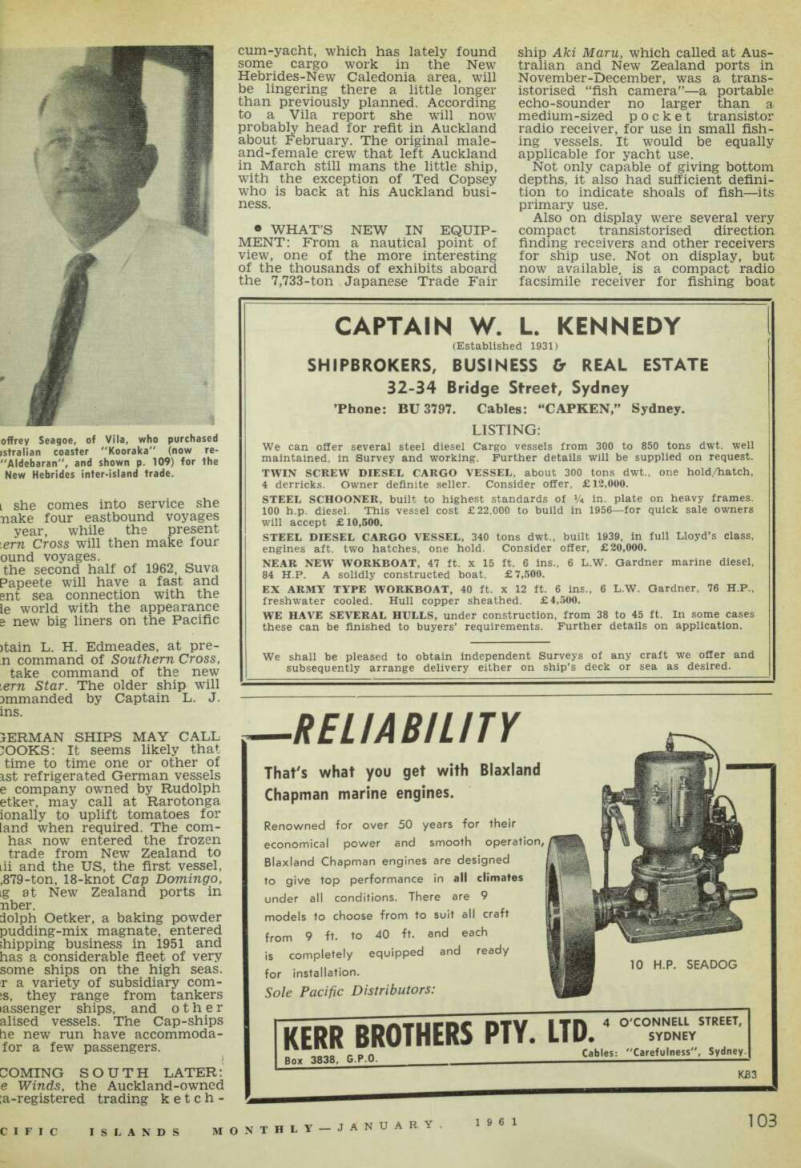
[?]offrey Seagoe, of Vila, who purchased [?]stralian coaster "Kooraka" (now [?]re "Aldebaran", and shown p. 109) for the New Hebrides inter-island trade.
use. It will receive and print weather maps and maps showing best fishing areas soon to be broad cast from Tokio to aid fishermen in their work. It is expected that the equipment will operate satis factorily as far away as the Indian Ocean. • TO BUILD IN JAPAN: A rep resentative of one of Japan’s largest shipbuilding companies said aboard Aki Maru in November that a modern, steel, general-cargo vessel of the type that might trade in the Islands, of 320 tons dead weight cargo capacity and the smallest vessel for which he was able to supply information on the spot, would cost approximately the equivalent of $U5123,000 built in
Japan. Costs are thus not par ticularly low, but delivery is usually fast. • NEW CHART: Resulting from RNZN survey work in Tongan waters in recent years, a new chart of the approaches to Nukualofa is now on sale in New Zealand from the Marine Department and chart agencies. •IN TROUBLE: Attempts to establish locally-owned boats in American Samoa’s tuna fishing in dustry have so far failed. The ex sub-chaser Isabel Rose, converted from a cargo carrier to a tuna long liner last year, is now laid up and the subject of litigation, according to reports from Pago Pago. There
was a financially unsuccessful] tempt to operate the Toni registered Trade Winds, on chai to Pago Pago interests last y also. A lot of capital is invol in a well-equipped and properly signed tuna longliner—and a lot hard work, too.
• New Zealand Base Ne2
Two Japanese tuna fishing co pames—probably Taiyo and Nipt] Suizan—have indicated to a la New Zealand food processing co party J. Wattie Canneries, that th would be ready to supply tuna m fishing vessels based at the No] East Coast port of Gisbor The Labour Government turn down the project—but the Natioi Government, which came to pota m December, may have other ide There is no doubt that the tu are available nearby. Longliners i tached to the mothership fleets these two companies operate as ] south as New Zealand in the win months each year. In additie trawlers - net-fishing for both feeding fish—are now operati continuously on the New Zealai continental shelf outside territor waters.
Recent reports from Japan i dicate that five major fishing cor pames are expanding their plans i trawling—as opposed to deep-s longlming—near New Zealand, Au -raha, and both coasts of Africa • of 1960 it was expect that 12 large trawlers would I available for these three fisheri and that they will fish appro imately 12,000 tons in 1961—main red snapper which the Japanese ca Kai. About 4,000 tons of this w be sold overseas, and the remain! consumed in Japan.
• Matson Cargo Plan*
The Matson Company will soon re place its war-time built C2-typ freighters Alameda, Sierra, Sonant, and Ventura with larger and fasti vessels, and resume calls at Auck land—which port was dropped on
ie trans-Pacific route in 1954 recently. With the entry of the r ships—their exact details not yet been given—the fre cy of the service will be slightly :ed.
THAT N O N-M AGNE T I C DONER AGAIN; Zarja, the ish-built, Russian-owned, 8- ■old, three-masted, wooden, magnetic research schooner is mother circuit of the Pacific, sailed from Sydney December ir New Zealand, South America, ah, Japan, and Vladivostok. 3 she called at Port Moresby April, Captain Taras Mazhara apparently been replaced by ain Alexander Udovich, aged ad five years junior to his pre ssor. rfa —her name means “dawn” :ries about 7,850 sq. ft of canvas i all set. She is gaff rigged with lils and has a 300-hp diesel ir made mainly of gunmetal. ess reports have given the age as 205, 250, 300, 330, and PlM’s information from Moscow \ 580 but does not indicate ;her this is gross, displacement.
or deadweight. Similarly, there is no indication whether the length given—1101 ft —is waterline or over all. Beam is 27 ft 4 in. and depth of hull 11 ft. Non-magnetic schooners are a rare commodity and those interested in ships like to have the facts.
® Under New Management:
A year or two ago the Rarotonga Island Council took over the man agement of the Avarua smallship wharf from the Union Company which had leased it for many years.
Now they are taking over control of the wharf at nearby Avatiu, which has been used in the past almost entirely by A. B. Donald & Com pany’s vessels. Cargo charges will
be levied as from January 1, 1961, to go to the Rarotonga Harbour Improvement Fund. • FIRST VISIT: An unusual caller to Rarotonga and Mauke in November was the Mormon Mission schooner Paraita from Papeete, under command of Captain Tehina Tapu. Of 128 tons gross and 85 ft waterline length, this schooner was formerly the American yacht Fan dango, built in 1930. She was donated to the Mission a good many years ago and renamed with the Tahitian version of the surname of Addison Pratt, first Mormon Missionary to Tahiti.
In fair winds Paraita, with her 110-hp motor and her 4,300 sq. ft
nvas, makes 10 knots. She has been fitted with a new engine, carries a little cargo, but has accommodation for 30 Mission tigers. The occasion of the Islands visit was to bring staff ewly established Morman m stations. ) aboard was Mrs. McCauley, of the Resident Agent at lyn, who had journeyed to ii in Wild Goose II and on ; US with her daughter earlier e year. The child died there ing a heart operation.
Till Under Fiji Flag:
in R. D. Matheson, who 3d the command of the Suva- Kurimarau in October, is in command of the Suva ered Bahinda which, with a :rew, plies the Tasman and visits the Islands.
Till Giving It A Go: The
of Royal Interocean Line s which ply down from the last to Fiji and NZ have had il brushes with the Customs rities through attempted ?ling. Confiscation of goods— y transistor radios and ,es—and heavy fines may dis ge the men caught, but there nvariably other members of Chinese crews who will “give ?o”. yever the Chinese did not have l their own. The Auckland ms made a haul of over £l,OOO of goods in the Union Com -3 Islands vessel Tofua on De jr 14 when the ship arrived Suva. The goods, transistor >, liquor, and cigarettes, were aled in a foodhoist to the eroom.
’Or Tahiti Fleet: Mr. S.
3tt, Secretary of A. B. Donald npany of Auckland, confirmed icember that his company had making inquiries recently for 3 of 300 or 400 tons gross with cabin passenger accommoda for use in French Polynesian
waters, but no purchase had been made to mid-December.
The Tahiti subsidiary, Etablisse ments Donald Tahiti, operates the Australian-built, wooden, 300-tonner Charlotte Donald and the hand some 181-ton schooner Vaitere in that trade at present. In the Cook Islands trade they have the 173ton, 47-year-old schooner Tiare Taporo, which in December was bound for Papeete via the Cooks Northern Group to undergo her annual hurricane season refit, with Captain Andy Thomson in com mand.
Recent purchases of ships for the French Polynesia trade seem to in dicate that business is prospering in that territory at the present time.
• Lamb Liner Again: For
more than two months, Delfino, formerly Australian coastal pas senger vessel Westralia, and in 1959 a sheep transport between Australia and America, has been moored to a buoy in Sydney harbour. Rumours that she was to be sold East for scrapping following a collapse in the lamb trade have been circulat ing freely.
Just before Christmas, a spokes man for the owners, International Shipping and Export Co., said the rumours were unfounded and that Delfino would sail again in the New Year with 25,000 sheep for America.
High price of sheep, and engine spares that had to come from Scot land were blamed for the delay.
Delfino was in the news for months in 1959 when she started carrying sheep to America. There were the usual labour troubles as sociated with doing anything new in Australia; protests from people who felt the sheep were badly accommodated or treated cruelly; and wails from other experts who insisted that some Merino sheep (a prohibited export from Australia) had slipped through the screening processes.
Losses on the first Pacific cross ing were higher than expected but
these were later cut through better ventilation and feeding techniques.
• Auxiliary Cutters Of A
Special Design: Three 25 Ft
auxiliary cutters are being built at the SPC boatbuilding school at Auki, in the Solomon Islands, from a special design developed by the Commission’s fisheries officer, Mr.
H. van Pel.
The cutters, which were designed primarily for use in Pacific waters as a live-well fishing boat, may equally well be used for trochus fishing, carrying copra; or as a general workboat.
The cutters are being built for the BSI Government by the 24 Islands trainees attending the school from Papua and New Guinea, Solomons Islands, Netherlands New Guinea, Gilbert and Ellice Islands, New Hebrides and Micronesia. They are being supervised by Mr. Cecil Fisher, director of the school, who has had many years of boatbuild ing experience in Port Moresby,
• The End Of The Line:
With 30 years of hard work behind her, one of the best-known ships in recent years in the South Pacific will make her final voyage this month (January).
She is the 3,000-ton Japanese steamship Chitose Maru, which has been ice-breaker, tug, salvage vessel and freighter.
Chitose Maru will call at New Guinea ports in January with gen eral cargo from Japan. Then she will go back home —and to the breaking-up yard.
The ship has been the mother ship for four years of extensive salvage operations in the Solomon Islands, New Britain, Bougainville
[?] Roa “ the new New Zealand Government vessel, back in Auckland with the stains of her first voyage to the Cooks upon her.
he Carolines. She has kept go i fleet of smaller ships and s and a team of 200 men, and carried away the bulk of the *ed material. i has also towed to Japan for ing up the stripped hulks of alian destroyers which were iballed” in Sydney Harbour the war. On one occasion she two ships in single tow from alia to Japan. i towed a floating crane from i to New Guinea, battling st storms near the Philippines, ■ee years ago she salvaged the ipanese freighter Eifuku Maru i went aground on the Great er Reef off the Australian East iy in 1960, she figured in a atic but unsuccessful attempt ive the grounded freighter ?aki Maru from Helen Reef the Caroline Islands. She took rew to safety in seas which so high that they crashed into ngine room. tose Maru was built at Yoko in 1921, and was originally an eaker with Japanese expedi te the Antarctic. Her present : is the Okadagumi Salvage iany.
Jnder Repair: A Union
iany announcement in De er said that repairs to the n plating of the trans-Pacific iter Waitomo, which went onto ■eef at the entrance to Apia )ur in October, were expected ivolve about six weeks in a Duver dock. The damage was ibed as “not serious”.
w of Cruising Yachts
ED WITCH, 35-ft American ketch sought assistance 750 miles east vaii in mid-November, was towed to ilu by a Coastguard vessel and was held there under writ in December g settlement of an alleged debt of to a Los Angeles firm. Bound for lia via Islands ports Victor and :s Westfall and their children Vicki, id Clyde, 11, and two other crew ;rs, had cleared San Diego early tiber. Their sails had blown out ;heir engine was not functioning they sought assistance. Time San Honolulu—7o days.
E RAPUNGA, George Dibbern’s n ketch which was dismasted in a while bound from Whangaroa, NZ,
to Brisbane in March, 1959, and was towed back to Auckland by the Japanese freighter TOKUWA MARU in battered condition, is again in the water. The yacht was left in the hands of an Auckland yachtsman-boatbuilder and Captain Dibbern returned to his Hobart farm, but he is back in New Zealand now and the ketch was re-launched late November.
• Forerunner Ex Springbok, 26-Ft
yawl which crossed the Pacific from Canada to New Zealand soon after War 11, and which, under other ownership made an Islands cruise in 1952, is reported to be for sale again at Whangarei, NZ.
Owned by Andre Guerin who sailed from Auckland for the Islands last Winter, the cruise ended at Whangarei when Guerin became ill. Now recovered, he is think ing of obtaining a larger yacht. Guerin left Tahiti some years ago in the motor yacht PHILANTE-11. • TANGANUI, 32-ft x OVz-ft x 5Vz-ft sloop with a 10-hp diesel, was being prepared at Okahu Bay, Auckland, in December for a cruise to Tahiti about April. With owner Nigel Watson will be crewmen Terry Burling and "Lofty”
Goebel. This yacht was built about 1948 by Peter Edmunds who cruised the Pacific in another yacht a few years ago. • WANDERER 111 of Southampton, SI YE PAMBILI and BEN GUNN, were all hauled out at Okahu Bay, Auckland, in December. The Hiscocks put their little sloop back in the water on December 15 in readiness for some Christmas cruising in the Hauraki Gulf, and on that same day the BEN GUNN team launched a small sailing skiff which they had just purchased. • PATSY JEAN of Auckland, which has been based at Rarotonga for many months —and which made an excursion from there to Mitiaro and return in Novem ber with Don Silk, Bob Boyd, and Dave
Saunders aboard, was reported heading back for home base in December. • MARGUERITE, a 25-footer with a man-and-wife crew, which sailed from Cooktown, Queensland, on November 7, for Port Moresby, NG, was the cause of an unsuccessful air search in December when the yacht failed to reach its destination.
Two days after sailing the yacht reported by radio that it was 150 miles south west of Port Moresby. (See elsewhere for more details). • SHIRALEE and the Burkes who sailed from Sydney to Honolulu via Rarotonga late in 1958—after having lost their yacht VENTURER on the Queensland coast in June of that year—are still in Honolulu.
The Burkes live aboard the 40-ft double ender ketch and dream of some more cruising some day. • TAMARE, a 14-ton Dutch-built double ender cutter, is at present being prepared at Ostend by Belgian photographer Robert Robelus for a world cruise, to commence about mid-1961. • WAIHAPE, twin screw 42-ft motor sailer of Waiheke Island, near Auckland, owned and skippered by veteran cruising yachtsman Johnny Wray, which left New Zealand in mid-March arrived back at Auckland on November 28 at the end of a 31 day passage from Gladstone, Queens land. Also aboard, A. Lake, of Wellington.
The yacht had cruised to Barrier Reef- New Guinea waters. • MAKOA, 32-ft Atkins cutter arrived Hilo, Hawaii, some time back, 19 days out of Los Angeles. Don and Dorothy Gillum plan on cruising the Marquesas. Tuamotus and Tahiti about April. • SONCY, 38-ft ketch of San Diego, arrived Honolulu, November 22, skipper owner Rockne and Ruby Johnson and son Dane Aukai, 1 year old. Trip took 20 days out of Bora Bora. SONCY departed San Diego for French Oceania. June 1, 1900. • BABBOON, 52-foot schooner, departed Honolulu for mainland US in early Dec. • REVEL, 30-ft sloop from Auckland, arrived Honolulu, December 6, 29 days out of Tahiti. Skipper-owner John Smith and wife Marlene sailed directly from Auck land to Tahiti and plan on sailing for Vancouver, BC, in April, 1961. • TAHITI. 30-ft ketch, owner Lorin Smith, arrived Honolulu in mid-November from Tahiti. • SEPTEMBER SONG, 33-ft sloop sailed by American couple Dr. W. M.- and Gretchen Lee, is currently in Port Moresby,
This photograph shows an increasingly common sight at the Honiara anchorage - more than one vessel.
From left to right: The Dutch vessel "Mataram", French naval ship "Francis Gamier" and China Navigation's "Chung king" all anchored off Point Cruz.
"Aldebaran", ex "Kooraka" which has recently been purchased by Mr. G. Seagoe, of the New Hebrides. Photograph was taken in Auckland.
from which point Mrs. Lee writes to si that C/- Papua Yacht Club will be the address for the next 12 months. T 1 sloop was twice reported overdue in Ne Guinea-BSIP waters in June-July last ye« and so much rough weather was er countered thereabouts that lengthy an costly repairs were necessary when the finally reached Madang, NG, in AugUtf The long stay over in Port Moresby I designed for financial recuperation—ni physical.
In her letter Mrs. Lee comments on th experiences of D’VARA in Indonesia: waters (Dec. "PIM”, p. 113). She say that in one respect she can agree will the Bradfields—lndonesian hospitality I very unpredictable! The Lees had botl visas and a clearance for those waters sen them by the Indonesian Navy, yet ii March, 1960, when they were within th three-mile limit off the coast of Morotai they were fired on by mortars, machine guns and rifles. “It didn’t take us lonj to decide which way to head”, she says • TASMAN RACE; When entries fo? the 1961 Tasman Yacht Race closed witl the Royal Akarana Yacht Club of Auck land on November 30, 18 entries had beer received—six from Australia and the re mainder from New Zealand. Some oi these yachts and yachtsmen have mad* Islands cruises in the past.
The cruising yacht, "September Song' photographed close up against the Dutch ves[?] "Snellius" some months ago when between [?] equator and the north coast of Dutch N[?] Guinea. It was a chance encounter but very welcome one for Dr. and Mrs. Lee they were out of sugar and cigarettes a[?] low on water. The Dutch captain and his cr[?] filled "September Song's" water-tanks w[?] water; her ice box with ice and a ease Heinekens beer; gave the Lees sugar a[?] cigarettes, fresh bread and "even a stack paper-backs". While they were being ent[?] tained at dinner on board by the capta[?] someone took this photograph, developed and presented it to them. Even after mont[?] the Lees (now in Port Moresby) are still talki[?] about it. "We'll never forget their kindne[?] hospitality and generosity", they say. (S[?] page 109 and below).
Australian entries are: ASTOR: schooner; ARCHINA, 52-ft ketch; IIL, 40-ft cutter; NORLA, 38-ft SOLO, 57-ft cutter; and lERLY, 35-ft sloop.
New Zealand entries are: BOUNTY, ketch; CARA MIA, 32-ft ketch; INE, 29-ft ketch; FANDANGO, 38-ft FITHEACH BAN, 83V2-ft schooner; ITTE, 34-ft cutter; KESTREL, 40-ft MARORO; ROSANNA, 30-ft ketch;
SHIRALEE, 28-ft ketch; VECTIS, 32-ft sloop; and WAIRANGI, 30 ft. ketch.
The Australian entry NORLA is owned by the well known Halvorsen family, who have not only cruised in the Islands in other yachts but also have close and long commercial connections with the Islands.
Of the New Zealand yachts, BOUNTY and FITHEACH BAN have both been in Islands ports, though they are now under different ownership.
While it is possible that all these yachts may not line up for departure from Auckland on January 28 for the race to Sydney, it seems certain that this will be by far the largest number to enter a Tasman Race. Largest previous field was of nine yachts in 1951.
• Sydney-Hobart Race: A Number
of the Australian yachts entered for the Trans-Tasman event sailed in the 1960 Sydney-Hobart Race, which left Sydney on Boxing Day.
The 1960 version of this classic was a real piece of cake. The whole of eastern Australia lay in the grip of a heatwave and the race was sailed throughout in light nor’east winds.
First to reach the finishing line in Hobart was the big yacht KURREWA IV, but the 35-ft sloop SIANDRA was declared the official winner on handicap.
SIANDRA also won the race in 1958.
Second in the 1960 event (the 16th Sydney to Hobart Race) was KALEENA; and third, MALOHI.
NORLA, the Halvorsens’ 38-ft cutter, won Division One of the Race (for smaller handicaps).
[?]—there will be more lambs for her [?] —or so they say. (See page 107). [?]r her future is still something of a [?]. Advertisements appearing in the [?]imes" recently have been to the effect W. R. Carpenter & Co. Ltd. will no be responsible for debts in connection [?]Delfino". There have also been stories [?]he will be chartered to take Pilgrims from Indonesia to Jedda.