North For Action
p. 89 · Read in the full issue
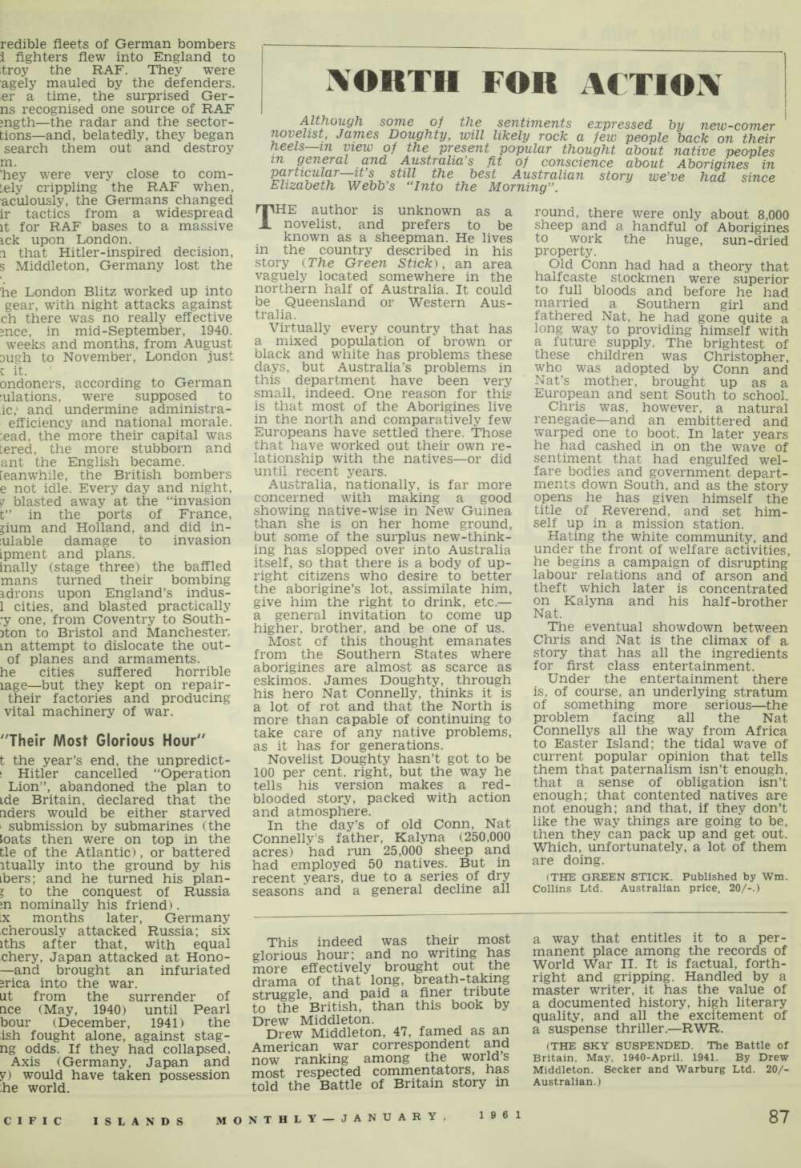
Although some of the sentiments expressed by new-comer novelist, James Doughty, will likely rock a few people back on their heels—in view of the present popular thought about native peoples in general and Australia’s fit of conscience about Aborigines in particular — it’s still the best Australian story we’ve had since Elizabeth Webb’s “Into the Morning”.
THE author is unknown as a novelist, and prefers to be known as a sheepman. He lives in the country described in his story ( The Green Stick) , an area vaguely located somewhere in the northern half of Australia. It could be Queensland or Western Australia.
Virtually every country that has a mixed population of brown or black and white has problems these days, but Australia’s problems in this department have been very small, indeed. One reason for this is that most of the Aborigines live in the north and comparatively few Europeans have settled there. Those that have worked out their own relationship with the natives—or did untii recent years.
Australia, nationally, is far more concerned with making a good showing native-wise in New Guinea than she is on her home ground, but some of the surplus new-thinking has slopped over into Australia itself, so that there is a body of upright citizens who desire to better the aborigine’s lot, assimilate him, give him the right to drink, etc. — a general invitation to come up higher, brother, and be one of us.
Most of this thought emanates from the Southern States where aborigines are almost as scarce as eskimos. James Doughty, through his hero Nat Connelly, thinks it is a lot of rot and that the North is more than capable of continuing to take care of any native problems, as it has for generations.
Novelist Doughty hasn’t got to be 100 per cent, right, but the way he tells his version makes a redblooded story, packed with action and atmosphere.
In the day’s of old Conn, Nat Connelly’s father, Kalyna (250,000 acres) had run 25,000 sheep and had employed 50 natives. But in recent years, due to a series of dry seasons and a general decline all
round, there were only about 8,000 sheep and a handful of Aborigines to work the huge, sun-dried property.
Old Conn had had a theory that halfcaste stockmen were superior to full bloods and before he had married a Southern girl and fathered Nat, he had gone quite a long way to providing himself with a future supply. The brightest of these children was Christopher, who was adopted by Conn and Nat’s mother,* brought up as a European and sent South to school, Chris was, however, a natural renegade—and an embittered and warped one to boot. In later years he had cashed in on the wave of sentiment that had engulfed wel fare bodies and government depart ments down South, and as the story opens he has given himself the title of Reverend, and set him self up in a mission station, Hating the white community, and under the front of welfare activities,, he begins a campaign of disrupting labour relations and of arson and theft which later is concentrated on Kalyna and his half-brother Nat.
The eventual showdown between Chris and Nat is the climax of a story that has all the ingredients for first class entertainment, Under the entertainment there is, of course, an underlying stratum of something more serious—the problem facing all the Nat Connellys all the way from Africa to Easter Island; the tidal wave of current popular opinion that tells them that paternalism isn’t enough, that a sense of obligation isn’t enough; that contented natives are not enough; and that, if they don’t like the way things are going to be, then they can pack up and get out.
Which, unfortunately, a lot of them are doing. ithe green stick. Published by wm.
Collins Ltd. Australian price, 20/-.)