Watching The Weather For
p. 79 · Read in the full issue
The Jets
though you may still curse your local weather office on occasion recasting is getting better all the time. Or so the experts tell us!
should be better. Vast sums of ;y are spent on it; and the safe economic operation of giant jet ?s, travelling near the speed of i, depend on it. w Zealand is responsible for ‘weather” in the area north of her right to the equator, maintains a string of stations e Pacific Islands to feed in in ition for forecasting along the of the jet aircraft operating he Australasia-North America . Securing data on upper wind is only part of the daily re ig that goes on the year round •ovide basic material for use recasters. i most recent installation is a wind station at Funafuti atoll s Ellice Group, lying 300 miles e westward of the main Fiji ii trunk air route and 600 from Fiji, -re has been a weather observ ation on Funafuti for the last ars but upper wind observing t more complicated processes, elaborate equipment and more 7 skilled staff. There were ; to be thought of like elec generators, hydrogen mann ing plant and new buildings use equipment and the staff, imeone began to think of them back in 1953 when the jet age still a long way over the n. anising airways facilities in Jquth Pacific area is the re bihty of the South Pacific Air port Council, a body repre ss the governments of Fiji, New
id, Australia, Britain and
la But the actual task of set p the weather installations on uti, as on other islands in this passed to New Zealand and it e a combined operation for Meteorological Service, Civil on Administration and Min )f Works.
Meteorological Service and Administration indicated the ements, and the Ministry of designed and erected the igs. In between came the business of ordering, as ng and delivering a multitude ms, large and small, to a ' atoll in the knowledge that mssion could not be rectified any weeks without a special ;ither by surface ship or air e months ago the task was - ted, and two New Zealand es moved in—Mr. N. A. Rap- New Zealand Meteorological
Service observer, with his wife and two small children; and Mr. M L Leonard, a Civil Aviation Adminis tration technician, with his wife and three children.
There they are to remain for a year. Their home is on an island six miles long and half a mile wide, bordering a lagoon 12 miles by 9.
They share it with 600 Ellice Islanders and no other Europeans.
The climate of Funafuti is wet and warm—average rainfall 146 inches annually, with the record at 250 inches one year—but on an average one-half of the daylight hours are sunny.
Funafuti has its own native magistrate, a native “scribe”, an assistant medical practitioner, dressers and a nurse. Motor trans port comprises one truck. All goods are ordered a long time in advance and come by sea.
But if you like a quiet life, Funafuti offers an ideal existence, a new house to live in, competent Ellice Islanders as observers to as sist in the regular collection and transmission of meteorological data, communication by radio with New Zealand if necessary, and a safe lagoon for flying-boats at the front door, in an emergency.
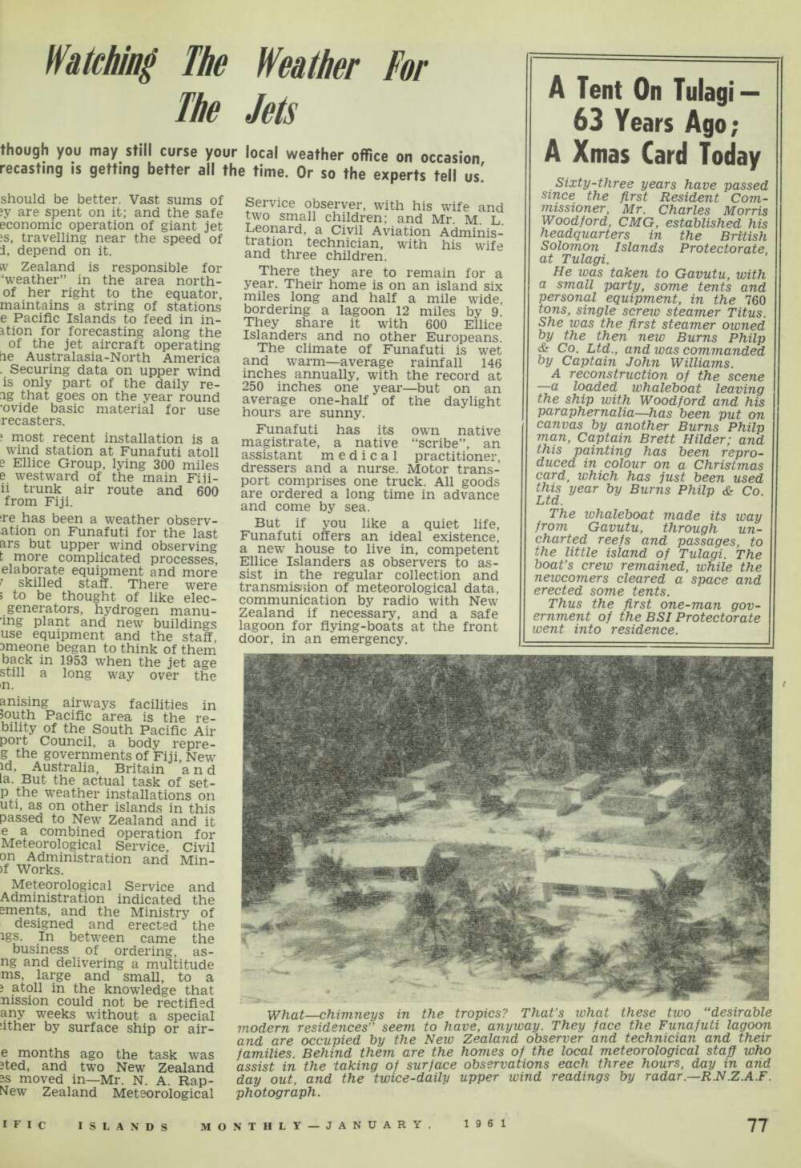
What—chimneys in the tropics? That’s what these two “desirable modern residences” seem to have, anyway. They face the Funafuti lagoon and are occupied by the New Zealand observer and technician and their families Behind them are the homes of the local meteorological staff who assist in the taking of surface observations each three hours, day in and day out, and the twice-daily upper wind readings by radar.—R.N.Z.A.F.
photograph.