When Lucas And Twelve Apostles
pp. 67-71 · Read in the full issue

Ruled New Guinea
don Thomas—PlA/Ts Tolala—who was on the NG Expropriation Board f from 1920 to 1924, turns back the clock and gives us the y of the Board's formation and some of its work in the Early Twenties.
To most of the white residents of New Guinea today, the name of the Expro priation Board just doesn’t mean a thing, and they couldn’t care less. And yet, nearly 40 years ago, it was an administering body in T.N.G. as important as the Adminis tration itself; in fact, in some respects, its powers were greater and its influence wider.
[E Board was created in 1920, following the Treaty of Ver sailles, which gave the Allied ers the right to take over all ts of German nationals in the nan Colonial Empire, while the dies themselves were placed it Mandate. was Billy Hughes who suc ed in having Deutsch Neu lea and Bismarck Archipelago led over to Australia as a “C” > Mandate by the newly-created ;ue of Nations. Japan obtained mandate over the German pos ons north of the Equator; New and was given Western Samoa; e Nauru and its valuable phos ;es went jointly to Britain, New and and Australia, adminis i by the latter. le job of taking over the Ger assets in New Guinea in 1920 a matter for the Prime Minis- Department, and a Custodian Ex-Enemy Property was ap ted and the Expropriation 'd formed to carry out the of liquidating all German as in the Mandated Territory of Guinea. was a gigantic undertaking for ralia. There was no precedent the Public Servants in the > Dept, to follow; the number xperienced personnel in tropi affairs was negligible and the e business appeared nothing t of one big headache it the job had to be done: “Huns” had to be got rid of, their assets maintained for disposal so that the proceeds 3 go to swell the Reparations
Selecting Personnel
ie man selected to form the ■d and set the wheels in motion Walter Henry Lucas who, ag the War years had filled the ;ion of Technical Adviser to Australian Government on fic Affairs, - was a well-known identity ughout the Pacific in pre-war s, with an encyclopaedic know j of islands trading and plan n administration. For years
he had been right-hand islands man for Burns Philp & Co., and knew the Solomon Islands and New Guinea like the back of his hand.
His first task was to get together a staff, and in this regard the Government insisted that selection should be restricted to Returned Servicemen. There was no difficulty there—there were many foot-loose, adventurous Diggers feeling around for some post-war job, although few of them knew the difference between a coconut and a cacao tree; and their knowledge of natives had, for the most part, been confined to Gyppos around Cairo or Abos in the Outback.
To add to his worries, Lucas found himself assailed from all quarters by VlP’s anxious to foist friends and relatives upon him, all looking for cushy jobs. But Lucas, who had himself come up the hard
way, took a dim view of nursing favourites,
The T e( Apostles
„ ' e 1 eve A P os,les But he succeeded m gathering together a nucleus of a staff and landed in Rabaul in September. 1920 - Hls arrival was described locally as the landing of “Lucas and his Twelve Apostles”, and it was much to the irritation of the Military Administration and to the trepidation of the German popula
tion -
The former, which had been operating since the beginning of 1915, was not anxious to forego any of its authority to the Board or to any change in the comfortable routine. The latter, the Germans, on the other hand, had become ner vous wrecks waiting to see just how well, or badly, they were to be
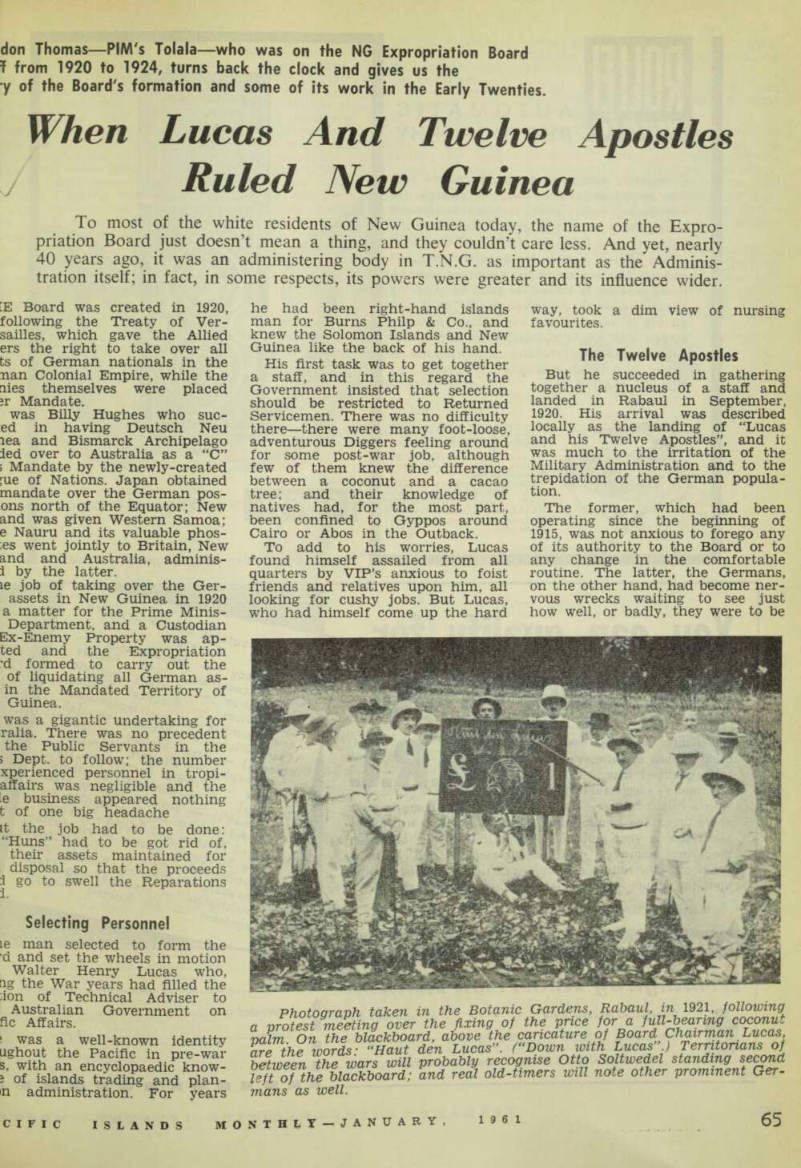
Photograph taken in the Botanic Gardens, Rabaul in 1921, following a protest meeting over the fixing of the price for a fall-hearing coconut palm On the blackboard, above the caricature of Board Chairman Lucas are the words: “Haut den Lucas”. (“Down with Lucas”.) Territonans of between the wars will probably recognise Otto Soltwedel standing second left of the blackboard; and real old-timers will note other prominent Ger mans as well.
ed both as nationals of a try which had lost the war as a horde of “savage slave rs amongst the poor, defence natives of New Guinea”, st-war hate was then at its and Lucas, like others who never soldiered-on in a front (he had only one lung and was ), was amongst the most vocal tiis Hate the Hun campaign, igely, perhaps, it was the -bitten Diggers, who had been -line soldiers who were the to nurse a peace-time hatred, war was over —so forget the 5 business, was their general ide. e result was that old enmities Bd far less amongst the Diggers arrived to replace the old mn NG residents than with the at-homes (including many of members of the Military Oc :ion in Rabaul). The delicate of taking over from the ex •iated Germans was made r by the tolerant attitude of najority. e “Twelve Apostles” included al plantation men whom Lucas known in the Solomons. Jim Dbell and Phil Shelley were of these and there were key from other commercial acti ; stores, accounts, engineer- I recall such names as F. V. ders, Bielby Evans, Jack ore, Bill Garnett and, amongst first arrivals —if not actually ig the Twelve —were Bill Wat “Herk” Braddon, “Tony” 11, “Blue” Allan, Hugh and Ben atta, and Colin McKellar who, tie most part proceeded to the mg district to take over the ations on the East Coast.
A Man-Sized Job sre were, in all, between 250 300 plantations to be brought : Board control. Most of them on New Britain and New Ire although there were proper in every area from the orltes in the north to Iwi and re down in Bougainville in auth; from Tadji in the Aitape ct to the isolated Tasmans in east. There were no inland irties: Wau, Bulolo and the lands country had not yet into being insofar as Euro > were concerned. Salamaua Lae were not even thought of: lua was an isolated property on luon Gulf. ntations were not the only ex y assets by any means. There the big trading companies New Guinea Kompagnie. j, Hernsheim & Co., D. H. & . and H. R Wahlen; and the (Nord Deutscher Lloyd) which ically owned all the Rabaul ship allotments. There were > and shipping to be added antations and thus the neces to obtain suitable Australian
Diggers to replace the old German employees.
The policy of the Board was Ste L tS te iver the a t date, which was in January, 1920, when the Peace Treaty was ratified.
This meant that no development work could take place; no planting of coconuts, no erection of new buildings. The result was that from 1921 to 1926 (when the first properties were sold by tender) the planting industry throughout the Territory “marked time” except on those few estates which had not been expropriated.
This position was off-set, to a certain extent, by the increased activity of many of the small German planters who, anticipating expropriation, had during 1919-1920 con-
centrated on adding to their planted areas to increase the value of their assets The procedure following the °thls^ e B ° ard W6nt llk e this.
The Board executive consisted of W. H. Lucas as chairman; a Finance Member (a Public Service accountant) ; a Business Manager, Capt. F. R. Jolley (who was also acting at the time as Military Sec retary to the Administrator, Brig.- General T. Griffiths) and a Secre tary The first task was the compila tion of a list of all German nationals and companies who could be declared “prescribed persons” under Article 297 of the Peace Treaty. Prescribed persons were
notified and such notification vested all their assets in the Custodian of Expropriated Property and emmntr r ol d a nri e m?n ard to * take over control and management.
It was, naturally, impractical to relieve the staffs of the big commercial firms or individual property owners until the Board had a sufficient staff to carry out these duties.
Consequently the existing German personnel were “required” to carry on in the meantime.
Under the circumstances, the cooperation from the Big Firms and
planters during this transitory period was extremely good I arrived in Rabaul to" takp nn a position as Plantation Insplcto? with the Board in October 1920 The headquarters at that time were located on Namanula Street in the residence of the HSAG manager in later years was known as the Pat Holmes Bungalow (Pat was Secre tary for Lands),
The Machine Starts Working
Capt. Jolley was holding the fort in the absence of Lucas, whom
I had met at Moresby on my wj up from Sydney. Lucas on that o( casion came aboard the old Ma\ sina, stepping aboard from 1 snappy Navy launch from HMA Melbourne, which was anchored the harbour after having made! tour of German New Guinea wit Judge Murray, Lucas and Atl« Hunt. They were enquiring into tl advisability of merging Papua ar New Guinea. Lucas and Hunt sai No”, and it took a quarter of i century for the Murray recommei dation to be put into effect.
The Board headquarters i Rabaul was a hive of industry dm mg mornings. It was here that a the managers of the old Germa firms converged to submit the daily reports to the Board, hai their cheques counter-signed a i\ correspondence vetted.
Here, too, queued up a horde I private German planters anxioi to know the Why and Wherefoi of the This and That. None rc ceived much satisfaction; mostly be cause the Board itself didn’t kna the answers. “You will be advise later”, or “in due course . . .” “Th Board has not yet determined th merits of the case . . .” “The Boar will consider the matter . . .”
I remember my first job in th Board Office was checking claim of German planters against th Military Occupation for the com mandeering of goods and properb dating back to 1914.
The claims covered many a n varied items from charterid schooners to serving meals for th itinerant troops on patrol. Many c the vouchers submitted for pay ment by the innocent German were signed by such famous peopl as “Ned Kelly”, “Billy Hughes” am some of less known but more vulga nomenclature.
I don’t know what eventual!; happened to the register of “Ger man Claims Against the Militar; Occupation”, because I was taken of the job in January, 1921, and de tailed for the task of taking ove: some plantations in Buka and Bou gainville.
The Gentle Art of "Taking Over"
It was a job, I was told, requirini some tact as several of the pro perties in that area were beinj planted under contract and th( contractors had the right to cance all native labour working on th< estates if they so desired. Thif would have left the Board with large areas of newly-planted land without labour.
The Business Manager (Jolley)) from whom I took my instructions, patted me on the back and, in his usual diplomatic manner, said: “Now, Tommy, it’s up to you I have no doubt but that you can avoid an embarrassing situation.’!
And so, after certain quarantine formalities had been observed (there was an epidemic of measlel
Rabaul) off I went to Kokopo to k up the good ship Wunatali i the newly-arrived plantation irseers from Australia who were replace the old, experienced Ger n planters. r or the most part these new ird employees were a goodly wd; all old Diggers and accus ed to adapting themselves to r conditions. There were Briga rs to Privates: jackeroos to mger sons of British peers—all to rehabilitate themselves after War. There were ex-planters m Malaya and boundary-riders ai Northern Queensland, keen as stard and rarin’ to go. >f the men selected for this par ilar job in Bougainville two of m, at least, have not yet been “ to overcome the “lure of the pics” and are now well-known erts in the coconut industry in !G. I refer to Mr. A. Richards, Rabaul and Mr. Alan Willis, of t Moresby. No doubt their nories go back at times to their t trip on an island hooker when old Wunatali took them from mpo to Bougainville, he “taking over” of a property y sound a very simple job. But yas no light task for a stranger )e sent off to a distant plantation some hundreds of hectares srything was reckoned in hec js, and to convert to acres think Eau de Cologne—l hectare als 2.4711 acres) with 50 or so ive labourers, and instructions “take over” from the German ler. I supervised many such isfers and the procedure went Lething like this: irstly; Amicable relations were iblished as a first step by the ouncement that a case of beer being put ashore;
Secondly: The technical details of the Expropriation Board and its far reaching powers were explained to the owner and his co-operation sought; Thirdly: Arrangements were made for the Board’s overseer to remain with the owner for an un stipulated period to get the hang of things while (a) counting the palms, (b) making an inventory of all assets, including native labour: and (c), compiling the final stock sheets.
Invariably the Germans were not anxious to speed up the “take over”; the longer it lasted, the longer they would remain on their estates; and so far as the Board was concerned, the more time the incoming man ager would have to make himself acquainted with native labour and local conditions generally, the better.
The Germans, when finally re
lieved of their management, were concentrated first in the main sea port of the district and eventually in Rabaul where, in the later days, there arose an accommodation problem for the men, their wives and children, who were awaiting final transport back to Germany.
Both Ah Chee’s and Chin King’s hotels in Chinatown were filled with them as time went on, and the overflow was accommodated at Kokopo and in many private homes.
During this period a sustenance allowance was made of £1 a day, which even in those days before inflation was barely adequate, for the German was a stickler for ap pearance and always required his clean white suits, to say nothing of the very necessary beer to allay the possible ravages of malaria! (The second and concluding part of this article will be published in February .)