U.S. Sub “Sturgeon” Sank “Montevideo Maru”
p. 63 · Read in the full issue
What Official Records Show U.S. Sub “Sturgeon” Sank “Montevideo Maru”
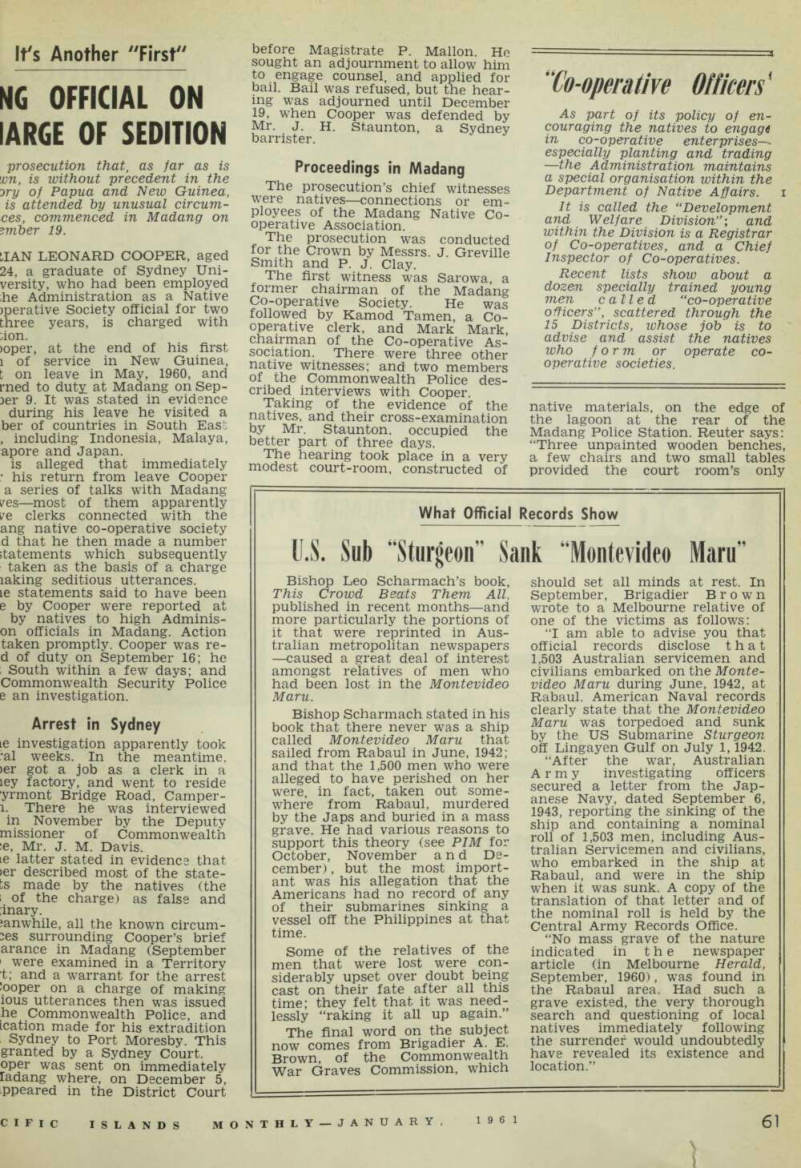
Bishop Leo Scharmach’s book, This Crowd Beats Them All , published in recent months—and more particularly the portions of it that were reprinted in Aus tralian metropolitan newspapers —caused a great deal of interest amongst relatives of men who had been lost in the Montevideo Maru.
Bishop Scharmach stated in his book that there never was a ship called Montevideo Maru that sailed from Rabaul in June, 1942; and that the 1,500 men who were alleged to have perished on her were, in fact, taken out some where from Rabaul, murdered by the Japs and buried in a mass grave. He had various reasons to support this theory (see PIM for October, November and De cember) , but the most import ant was his allegation that the Americans had no record of any of their submarines sinking a vessel off the Philippines at that time.
Some of the relatives of the men that were lost were con siderably upset over doubt being cast on their fate after all this time; they felt that it was need lessly “raking it all up again.”
The final word on the subject now comes from Brigadier A. E.
Brown, of the Commonwealth War Graves Commission, which
should set all minds at rest. In September, Brigadier Brown wrote to a Melbourne relative of one of the victims as follows: “I am able to advise you that official records disclose that 1,503 Australian servicemen and civilians embarked on the Monte video Maru during June, 1942, at Rabaul. American Naval records clearly state that the Montevideo Maru was torpedoed and sunk by the US Submarine Sturgeon off Lingayen Gulf on July 1,1942.
“After the war, Australian Army investigating officers secured a letter from the Jap anese Navy, dated September 6, 1943, reporting the sinking of the ship and containing a nominal roll of 1,503 men, including Aus tralian Servicemen and civilians, who embarked in the ship at Rabaul, and were in the ship when it was sunk. A copy of the translation of that letter and of the nominal roll is held by the Central Army Records Office.
“No mass grave of the nature indicated in the newspaper article (in Melbourne Herald, September, 1960), was found in the Rabaul area. Had such a grave existed, the very thorough search and questioning of local natives immediately following the surrender would undoubtedly have revealed its existence and location.”