New Hebridean Cake
p. 61 · Read in the full issue
They're looking at it Again [?]at Australian Slice Of The New Hebridean Cake
What does Australia do with the many acres of valuable New ides land that the late Sir James Burns gave her? For long ds of time, the answer is—exactly nothing. Then someone questions and wakes officialdom up and there is sporadic ity. One of the active periods occurred recently—but what ens now is anyone's guess. It is a bad time for adventures that I even remotely be considered "colonial".
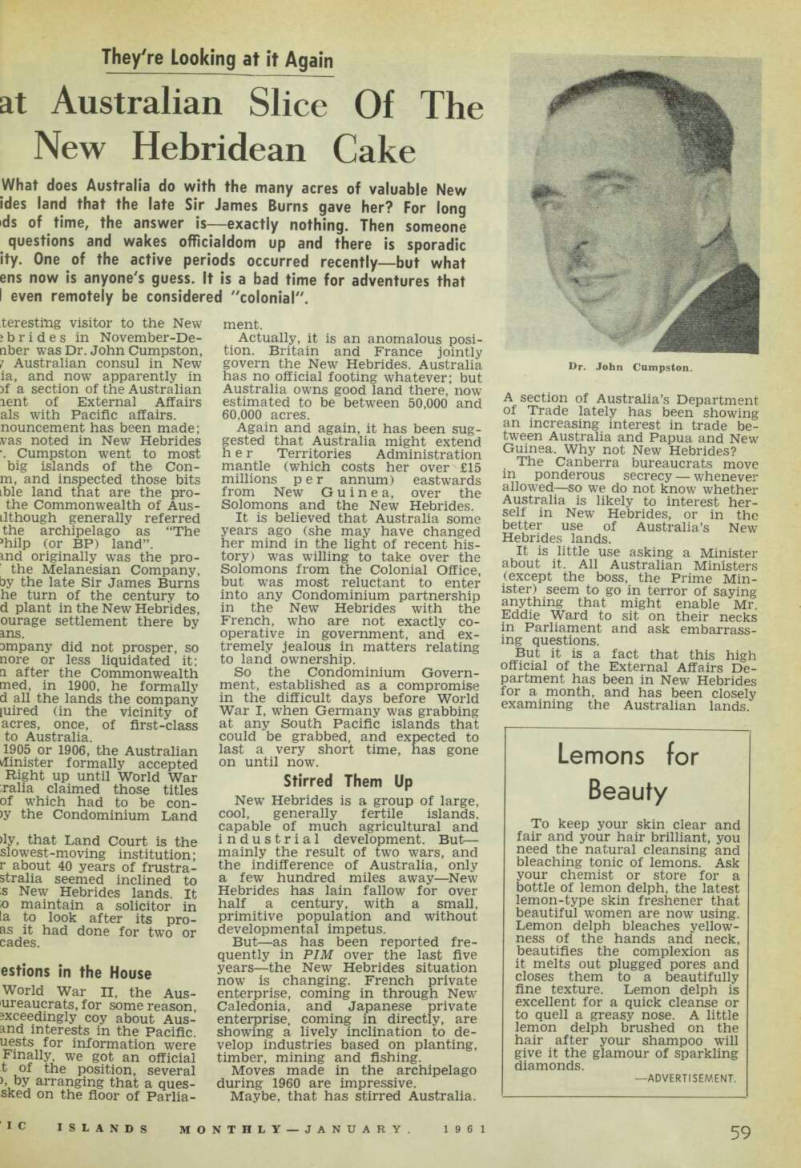
tcresting visitor to the New ibri d e s in November-De nber was Dr. John Cumpston, / Australian consul in New ia, and now apparently in ff a section of the Australian lent of External Affairs als with Pacific affairs, nouncement has been made; vas noted in New Hebrides •. Cumpston went to most big islands of the Con m, and inspected those bits ible land that are the pro the Commonwealth of Aus ilthough generally referred the archipelago as “The >hilp (or BP) land”, ind originally was the pro the Melanesian Company, by the late Sir James Burns he turn of the century to d plant in the New Hebrides, ourage settlement there by ms. impany did not prosper, so nore or less liquidated it; a after the Commonwealth med, in 1900, he formally d all the lands the company luired (in the vicinity of acres, once, of first-class to Australia. 1905 or 1906, the Australian Minister formally accepted Right up until World War ;ralia claimed those titles of which had to be con >y the Condominium Land )ly, that Land Court is the
slowest-moving institution;
r ab(put 40 years of frustra stralia seemed inclined to ;s New Hebrides lands. It £> maintain a solicitor in la to look after its pro as it had done for two or cades.
estions in the House
World War 11, the Aus ureaucrats, for some reason, exceedingly coy about Aus and interests in the Pacific, uests for information were Finally, we got an official t of the position, several \ by arranging that a ques sked on the floor of Parlia
merit.
Actually, it is an anomalous posi tion. Britain and France jointly govern the New Hebrides. Australia has no official footing whatever; but Australia owns good land there, now estimated to be between 50,000 and 60,000 acres.
Again and again, it has been sug gested that Australia might extend her Territories Administration mantle (which costs her over £l5 millions per annum) eastwards from New Guinea, over the Solomons and the New Hebrides.
It is believed that Australia some years ago (she may have changed her mind in the light of recent his tory) was willing to take over the Solomons from the Colonial Office, but was most reluctant to enter into any Condominium partnership in the New Hebrides with the French, who are not exactly co operative in government, and ex tremely jealous in matters relating to land ownership.
So the Condominium Govern ment, established as a compromise in the difficult days before World War I, when Germany was grabbing at any South Pacific islands that could be grabbed, and expected to last a very short time, has gone on until now.
Stirred Them Up
New Hebrides is a group of large, cool, generally fertile islands, capable of much agricultural and industrial development. But— mainly the result of two wars, and the indifference of Australia, only a few hundred miles away—New Hebrides has lain fallow for over half a century, with a small, primitive population and without developmental impetus.
But —as has been reported fre quently in PIM over the last five years—the New Hebrides situation now is changing. French private enterprise, coming in through New Caledonia, and Japanese private enterprise, coming in directly, are showing a lively inclination to de velop industries based on planting, timber, mining and fishing.
Moves made in the archipelago during 1960 are impressive.
Maybe, that has stirred Australia.
A section of Australia’s Department of Trade lately has been showing an increasing interest in trade be tween Australia and Papua and New Guinea. Why not New Hebrides?
The Canberra bureaucrats move in ponderous secrecy whenever allowed—so we do not know whether Australia is likely to interest her self in New Hebrides, or in the better use of Australia’s New Hebrides lands.
It is little use asking a Minister about it. All Australian Ministers (except the boss, the Prime Min ister) seem to go in terror of saying anything that might enable Mr.
Eddie Ward to sit on their necks in Parliament and ask embarrass ing questions.
But it is a fact that this high official of the External Affairs De partment has been in New Hebrides for a month, and has been closely examining the Australian lands.
Dr. John Cumpston.