[?]'s 35th President - by
pp. 51-53 · Read in the full issue

Courtesy of "Ferdinand”
The fact that Coastwatcher Reg Evans, away back in ugust, 1943, was instrumental in plucking a young American lied Lieutenant John Kennedy off a small island near Gizo the Western Solomons, might be regarded as an unfriendly t by American Republicans 17 years later in 1960. But it ould make that Coastwacher persona grata with the Demo ats. The young Navy Lieutenant has now, of course, become S President-elect Kennedy.
El Pacific career of Reg Evans les right back to 1930 when he as in the New Hebrides. By 1936 as with Burns Philp and Com in the Solomons, and when broke out in 1939 he was at headquarters at Makambo in ?i harbour. 1940 he went to Australia to : in the Navy, but the Navy, Evans, was fussy in those early lays and didn’t want him. He d the AIF instead and sailed he Middle East, len the Japs came into the war the Middle East battalions of AJF returned to Australia in he got permission to transfer e Navy and was actually train it Flinders Naval Base when Brass called him up for an in jw. They said they had an in :ing job for him, back on his tamping ground, at’s how Sub-Lieutenant Reg s arrived in Guadalcanal in mber, 1942, as a Coastwatcher in .tion Ferdinand. (After Walt ;y’s bull, a word chosen by nander Eric Feldt to remind ;watchers that they were not to fight and draw attention icmselves, but to “sit circum ly and unobtrusively gathering nation”).
February, 1943, he went out irt a station on Kolombangara. ew as far as Segi in a Catalina after a couple of weeks there ing Major D. G. Kennedy, a native scout with him and ff for his new base by canoe, ombangara is just a big e-covered cone rising out le sea; the one flat piece he island is Vila Plantation i the Japs, in 1943, were busy ng a small air strip; keeping m Jap activity there was to be I’ main job. al natives had already picked i site for Evans’ observation high on the mountain-side, landing excellent views of the ip and of the strait between ibangara and Arundel Island, explained to Evans that in the before all the natives lived on oast, this vantage point was for exactly the same purpose le mountain people in their with the coastal villages.
The story of how Lieutenant John Kennedy had his PT boat cut in half by a Jap destroyer in the Solomons in 1943 and how he and 10 other survivors reached a small island near Gizo and were subsequently rescued, has been cropping up in issues of “PIM” since October.
At first the call was out for a New Zealander called Wincote, who was alleged to have rescued Kennedy—an idea that can be traced right back to a “Reader’s Digest” article of August, 1944.
But we were soon put right on that score : “Find Reg Evans,” wrote Coastwatcher Eric Feldt in November, “There never was a New Zealander.” And just before Christmas, Mr. Reg Evans, now an accountant, came into “PlM’s” Sydney office to tell us the real story.
Evans was joined here later by Sergeant B. F. Nash, probably the only American Coastwatcher to operate behind Jap lines; and after Kolombangara observation station had been in operation about six months Evans shifted over to a small island in Blackett Strait, whose name, if he ever knew it, he does not now remember. (The US official war history calls this Wana Wana Island, but that is the largish island lying parallel to Arundel).
Back by Canoe
It was while Evans was actually in process of organising his move from Kolombangara that Lieutenant Kennedy had his brush with the Japanese destroyer, and Evans had scarcely become settled at his new post before he was informed that there was a party of US Navy men stranded on a small islet on the other side of Gizo.
He sent a canoe over with three or four natives and a note, and a young man came back, lying in the bottom of the canoe, prudently covered over with coconut fronds — it was a journey of about four miles, over open water in broad daylight, with constant risk of a too in
quisitive Jap plane appearing at any moment. The young man said he was Lieutenant John Kennedy.
Evans said he was impressed by the youngster whom he took to be about 20 or 21—although figuring back now, it is obvious that Lieu tenant Kennedy was 26 at the time.
Evans told him that he could send him to US headquarters by canoe— a comparatively safe journey from that point—and that another PT boat would be sent to pick up his crew.
But Kennedy “wouldn’t buy that”; apart from anything else, he said, it would be difficult for anyone who didn’t know it to pick the right island. It would be much better if he went back and piloted them in.
Evans told him he thought he’d made the right decision and sent a signal arranging Kennedy’s rendezvous with a PT craft and sent the young Lieutenant off in a canoe to keep it. The subsequent operation was carried through suc cessfully, the 10 men rescued and returned to the US base.
Enter a New Zealander Evans remembered Kennedy only as another incident in his Coast watching activities but about a year later someone sent him the August, 1944, issue of Reader’s Digest in which American writer John Hersey told the story of the sinking of PT boat 109 and the subsequent rescue of 11 men.
Evans was interested in learning from the article that Lieutenant Kennedy was the son of the US Ambassador to the UK and came from a wealthy family; and he was even more interested in finding that the man who had organised his rescue was a “Lieutenant Wincote”, and a New Zealander, to boot.
However, he didn’t feel that there
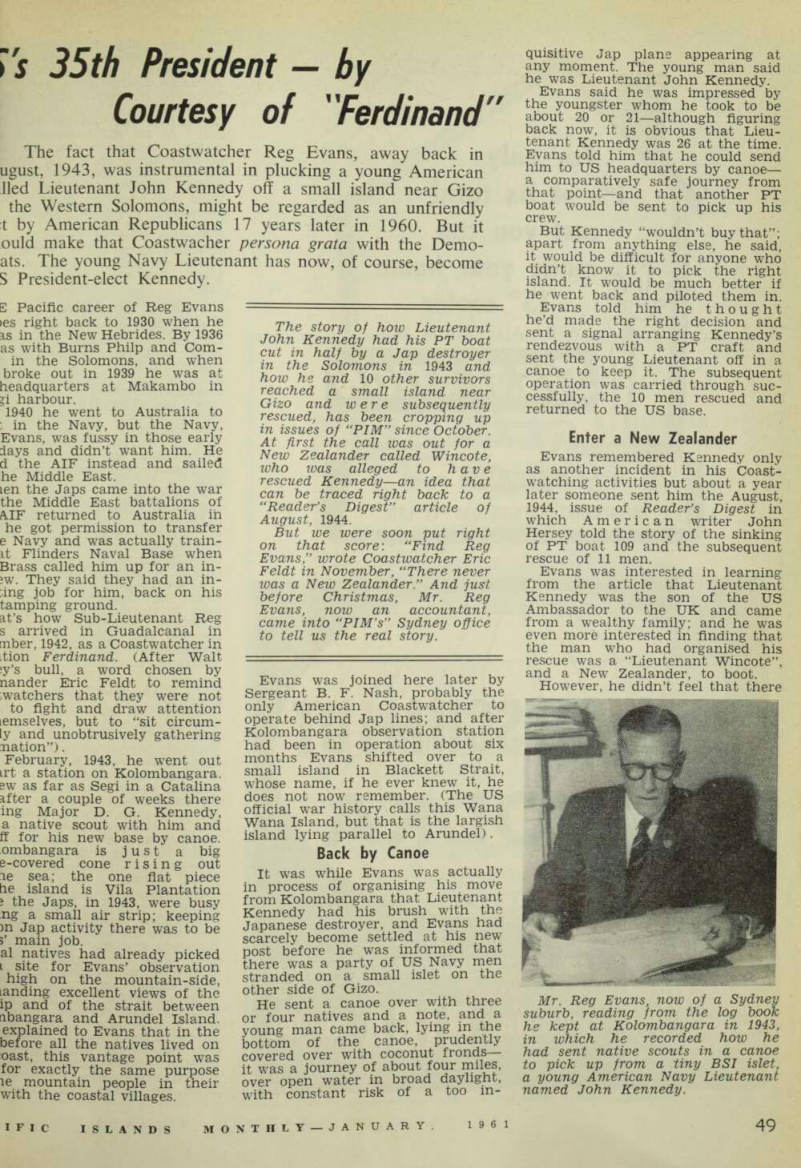
Mr. Reg Evans, now of a Sydney suburb, reading from the log book he kept at Kolombangara in 1943, in which he recorded how he had sent native scouts in a canoe to pick up from a tiny BSI islet, a young American Navy Lieutenant named John Kennedy.
was any point in correcting tl error. It seemed likely that I the stress of the circumstance Kennedy might quite easily ha' forgotten his name and there w; no telling why he or the author! the article had settled for “Wi] cote.” As for the business of beii a New Zealander—few America! at that time, knew the differed between New Zealand and Au tralia, anyhow, and New Zealaj units did begin to operate in tl Solomons about a month aft Kennedy was rescued.
For his work at Lunga, Segi ai Kolombangara—quite outside ti efforts on behalf of an Americ?
Lieut.—Evans was awarded the Dg (Br.)
To Africa
After the war, Burns Philp ai Co. did not resume operations : BSIP and Reg Evans’ job the folded up. Rather than try to hr another niche for himself in E service, he answered an advertisl ment for Colonial Service recrui that then was appearing in Se vice magazines. He hoped to get i Fiji or Malaya, but when somi thing was at last offered him it wi in Ghana—or Gold Coast, as it wi then.
Feeling that it would make a interesting change and that oi part of the tropics is much lil another, Evans accepted tl appointment and during Gol Coast’s interesting transition ini Ghana, he served there for 12 yeai About 18 months ago he retiri from the Colonial Service, cad back to Sydney, bought some lah at Avalon Beach, built a house an became the accountant for tl organisation that runs the Ws Veterans’ lottery.
The Silent Service
About the same time he bega hearing again of Kennedy—but til time of Kennedy the politiciaj Kennedy the racket buster, Kennefl the Senator and finally Kennefl the US President-elect.
Evans became more and more in terested but it wasn’t until PIl began to shop around some montl ago for this mysterious Lieutenai Wincote who was alleged to ha\i saved Kennedy from the Japs, tha it occurred to him to break that I years’ silence.
One day around the end of N(i vember, a mysterious voice ova PI M’s office phone said: “That stui you have in October issue aboii Kennedy and the Lieutenant Wiß cote who is supposed to hav rescued him —I can give you son! more details about that.”
We asked the Voice if it had see the additional details supplied b Mr. Eric Feldt in November, an as the answer was no, we readl out. Feldt had said that, in hi opinion, the Coastwatcher con cerned would have been a Sub.
Lieut. Reg Evans. The Voice on th
ne then interrupted to say, at’s me. I’m Reg Evans.” He nised to tell us the real story it he still wasn’t in any great •y about it. He’d come in, in e or four weeks, he said. b kept his promise just before istmas. le late Admiral Halsey once that the Coastwatchers saved dalcanal and Guadalcanal saved Pacific. We can now perhaps that theme a little: The stwatchers saved Guadalcanal the 35th President of the ed States.