Territories TALK-TALK
pp. 35-36 · Read in the full issue
With Tolala
People are saying that 1961 is going to be a topsy-turvy jar, and foresee tragic happenings because the figures read 261 whether upside-down or not.
like to take the optimistic view nd say it’s going to be a very able (or even stabilising) year ase it still remains the same if you do turn it upside-down, yway, it’s only right to be listic at the threshold of a no matter how mucked-up mal and world affairs may be ie old year’s end. : have certainly had a King’s plateful of problems as 1960 led its way out: Trouble spots ted from Laos to the Congo, um to West New Guinea, t then, down through the years, have always been “trouble ” somewhere. Floods and ie are often beyond our con but international tensions and >mic crises are human problems can be controlled by ourselves logical, realistic thinking, if exercise sufficient determina and not be swept away by the mce of modern social or cal propaganda, st of present-day economic are due to our own efforts in Ing up with the Joneses”. In words: adopting a standard ing beyond our particular in group, which is a result of a 7 to keep production up and ployment down, international situations are due y to fear. Fear of aggression; Df political infiltration and the nination of ideologies differ om our own; fear of economic, and cultural instability. Most r fears are based on the con ■al “if”. In short, ignorance e Other Fellow’s mind—be it dividual or a nation, lowledge will cure Fear” is a i we should not disregard. Let ncentrate more on cultivating )wledge of those who are the of our fears. Top-level nans, please note!
Mr. Kubary
July PIM I sent out a SOS as e identity of a “chap called ry”, as the original enquirer, Tiday, put it. Hans Mannsfeld, me manager of Arawa plant in Bougainville and student w Guineana, writing from Ger , says: din Kubary was a scientist he employ of the Hamburg i, Johan Cesar Godeffroy, a most successful one. He overed pre-historic ruins at
Nanmatal on the island of Pon ape and published studies about the culture in Micronesia. This must have been in the years 1871-75, Kubary was of Polish origin.
I think it must have been the widow of Kubary who was con nected in one way or another with the Ponape rising early in this century. Unfortunately, I cannot give any exact dates ”
Thanks, Hans. This is not the first time you have answered a Quiz in “Talk Talk”. And I hope it will not be the last.
For anyone interested in the unique Ponape ruins there is an in teresting article by Professor Mac millan Brown quoted in Stewart’s Hand Book of the Pacific Islands, 1918 edition.
That Word Kambiu
In “Sydneysider’s” Walkabout (Dec., PIM, p. 65) she gives a most interesting picture of the Kambiu community in Rabaul. She appears, however, to be somewhat mystified as to the reason and origin of the name Kambiu. (See also Editors’
Mailbag, this issue).
Actually the name is Kombiu and is the native name for the Mount Mother which towers above this particular section of the town. For some reason, and since War 11, it has become Kambiu, although on a post-war government Plan of Rabaul is spelt Kombiu in designat ing the avenue of that name.
An old German plan, which is spread out before me now, show's
the area in question as “Malay Quarter”, as “Sydneysider” men tions. She must take full marks for her plug for the naturalisation of the Mixed Races.
They, together with the Ambonese and a few Caroline Islanders, per formed a gigantic task in the colony during the German period and for years afterwards, especially in office-work and as technicians.
It was these people who did the hard yakker, the routine filing and keeping of records while the Euro pean confined himself more or less to the executive. Not sitting back and smoking a fat cigar and push ing buttons, but smoking a Simon Artz cigarette and calling out “Boy!” There were few Europeans in those earlier days on what we now call the lower income levels.
The time will come (and not too far distant) when the “winds of change” will force the naturalisa tion issue to a successful conclusion.
We could not do better than follow the German method of accepting those Mixed Race people who live as Europeans and have served their conscript term in the Services— Army or Navy—as being of Euro pean status.
Bill Stower's
Egg Trick
The reference to “Bill Stower and the egg trick on L. Bennett’s mary’s
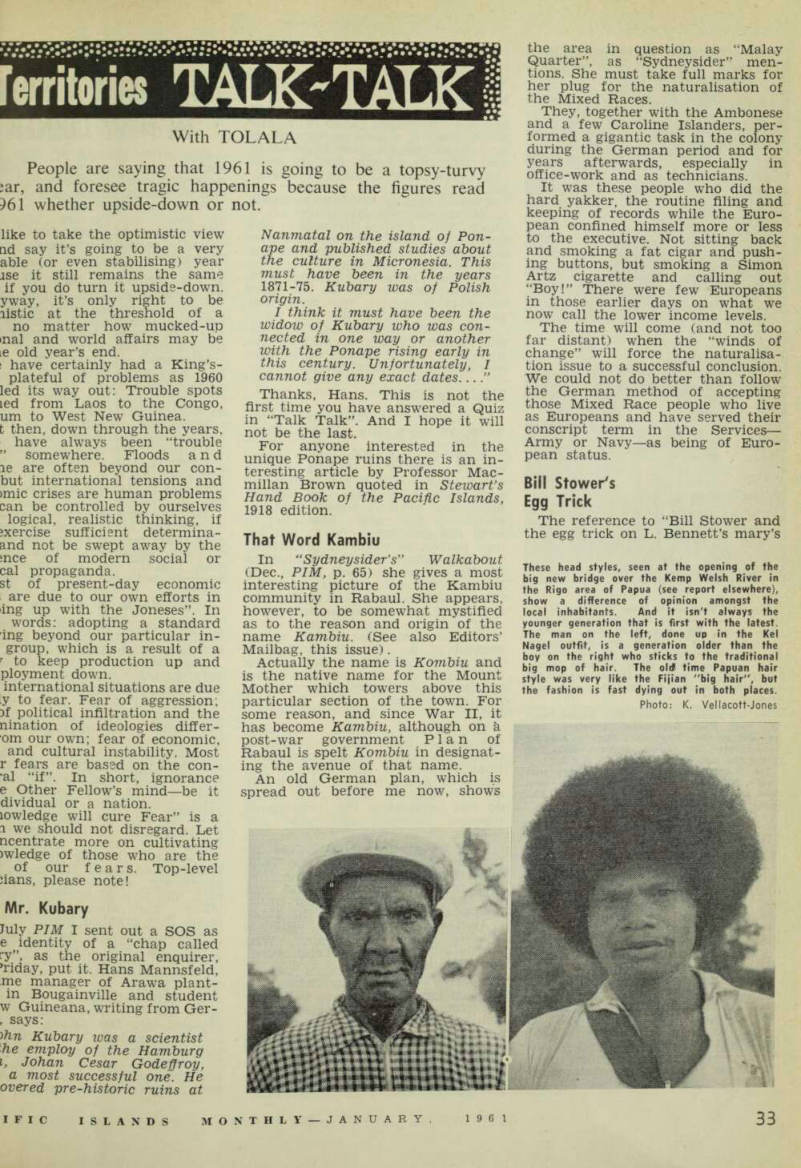
These head styles, seen at the opening of the big new bridge over the Kemp Welsh River in the Rigo area of Papua (see report elsewhere), show a difference of opinion amongst the local inhabitants. And it isn't always the younger generation that is first with the latest.
The man on the left, done up in the Kel Nagel outfit, is a generation older than the boy on the right who sticks to the traditional big mop of hair. The old time Papuan hair style was very like the Fijian "big hair", but the fashion is fast dying out in both places.
Photo: K. Vellacott-Jones
head” (PIM, November, p. 81) in Flynn’s diary story was not such a mysterious incident to old-timers.
Bill was a recruite r-miner schooner master of no little fame in the ’2o’s and ’3o’s, and amongst his many accomplishments were sleight-of-hand tricks which he put to good account on recruiting trips by entertaining prospective em ployees and their respective chiefs in the native villages.
One such was juggling with an egg and at times the grand finale was the smashing of the egg on the native’s head.
I have seen him perform the trick several times at formal dinner parties when he was called upon for some form of entertainment.
I first struck Bill when he was
schooner-master of Choiseul Plant ations’ Actaea in pre-War I days.
Bill went to his Long Rest in the ’3o’s. And a happy, jovial soul he was.
Another exponent of legerdemain on the recruiting field was one Bluey Ireland, a hard case red-head who recruited for the Exproboard and was one of the first to work the Sepik River area on a large scale.
I forget exactly what his main at tractions were for his native audi ences, but scent, fire-works and ignited kerosene were amongst the ingredients he used to bewilder the very primitive populace.
He must have had a way with him; he would follow in the wake of other recruiters who could not get a “boy” and fill his ship up.
Officialdom used to cast suspici ous eyes on “Bluey” but his activ ities were always on the up-and-up —or nearly always, anyway.
Pidgin Spelling
It is somewhat intriguing to me when perusing the “Pidgin News Supplement of the Times Courier” to follow the rules adopted to trans pose English into Pidgin, and I often wonder who is responsible for such rules. Is there an official dictionary, or is it left to the dis cretion of the native journalist to twist the spelling round to suit his own particular value of phonetics?
I have before me the Supplement of November 30, 1960, with the heading “I Laitim Paia. ... I go Long Kalabus Long Fopela Yia.” In that there seems to be an inconsist ency difficult to understand.
Why is “Paia” spelt with a “p” instead of an “f” when “Fopela” uses the “f” for Four (and not for “pela”) ? If he can pronounce the “f” in “Fopela” surely he can use it for “Paia” and “pela”. Or can’t he?
The answer, I think, rests with the district from which the native comes. Different tribes have dif ferent values for the letters of our alphabet. Some natives cannot (or do not) use the “f’ or “h”. Many do not pronounce two consonants together (except “nd”, “mb” and “ng”.) The Buka invariably mixes up his “d’s” with his “r’s”; the Tolai often gets confused with his “t’s” and “s’s”. The New Ireland folk use the “f” and “h”; letters which do not come naturally to the Tolai.
Another heading reads: “Bikpela Kibung Long Vunadadir.” Why mutilate “Kiyung”, a Tolai word, for “Kibung”?
I often wonder now, when the English language appears to be the government’s target, correct Eng lish spelling is not adopted for those natives capable of solving the intricacies of wielding a pen. Why not; “He Light ’im Fire. . . He go along Kalabus along four fellow year”?
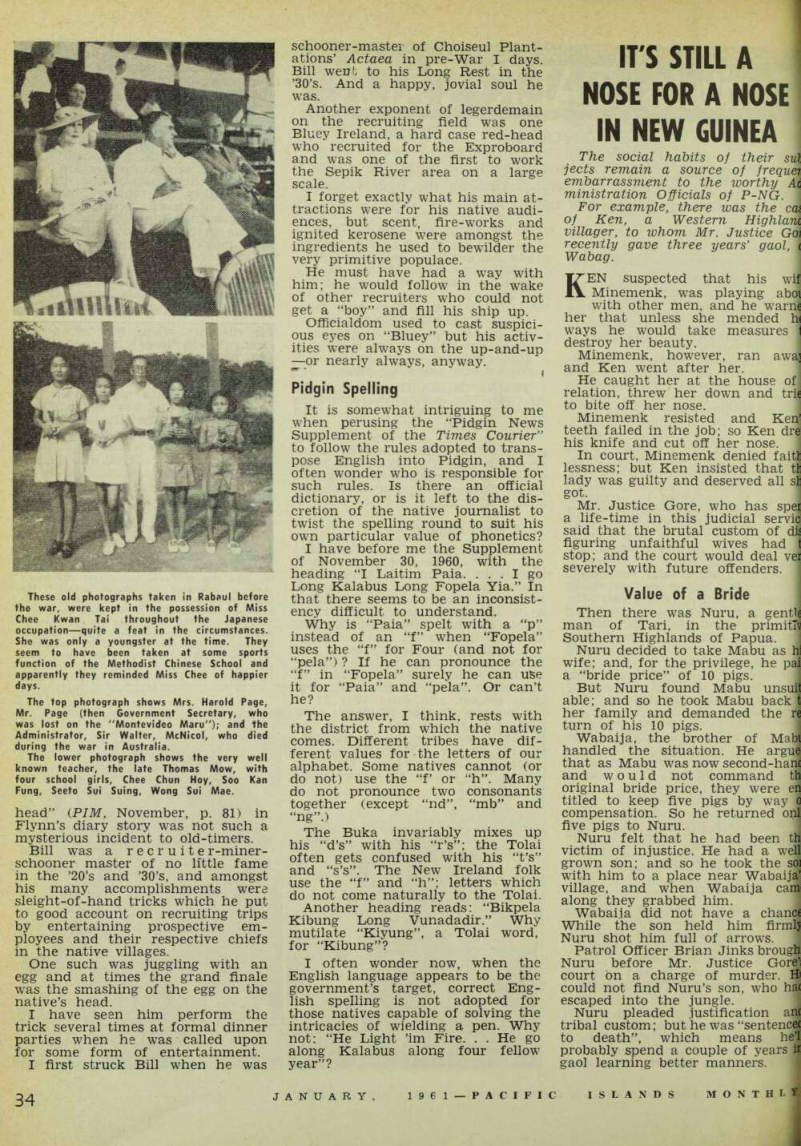
These old photographs taken in Rabaul before the war, were kept in the possession of Miss Chee Kwan Tai throughout the Japanese occupation—quite a feat in the circumstances.
She was only a youngster at the time. They seem to have been taken at some sports function of the Methodist Chinese School and apparently they reminded Miss Chee of happier days.
The top photograph shows Mrs. Harold Page, Mr. Page (then Government Secretary, who was lost on the "Montevideo Maru"); and the Administrator, Sir Walter, McNicol, who died during the war in Australia.
The lower photograph shows the very well known teacher, the late Thomas Mow, with four school girls, Chee Chun Hoy, Soo Kan Fung, Seeto Sui Suing, Wong Sui Mae.