School Principal's
p. 27 · Read in the full issue
Urgent Plea For Fijian Girls
The progress of young Fijian women, the wives and mothers of the coming Fijian nation, is being grievously retarded by ancient Fijian social customs says the principal of the famous Adi Cakobau School .
Miss F. L. Charlton, in a very out spoken letter to the “Fiji Times” of January 5.
THE Fijian social law of kerekere has been denounced many times in the past half century. Under it, a Fijian has no property rights— a relation or a close friend may demand from him anything that he fancies. A Fijian labourer, return ing to his village after a year’s toil, with special clothing, or a watch, or tools, can lose all his possessions within a couple of weeks.
This practice naturally kills pri vate enterprise and thrift. It is a two-ways practice, of course. The Fijian who is thus despoiled may himself despoil his relations. Net consequences: no Fijian villager goes hungry while the rest of the community has food.
But the effect upon young Fijians who are trying to live in European style is often tragic.
Miss Charlton has described the fate of many girls from the Fijian villages.
They are taken from the villages into the Adi Cakabau School; educated and taught the habits of dainty living; trained so that they
may support themselves as sales women, clerks, office workers, teachers: and then, so that they may not drift into squalid homes, they are provided with hostels—the Nawela Hostel, in Suva, is a good example.
The Fijian Administration has co operated fully with the boarding school authorities in providing the girls with facilities for good living conditions, and encouraging them to hold their heads high.
"Despair, Disaster"
“Then (says Miss Charlton) the ex-pupil, emerging into the always difficult life of self-dependence, settling into Nawela and the exacti tudes of business and professional life, is descended upon by an endless chain of relatives, who ultimately force her to leave the comforts of an organised life to live in the back streets of Suva and to plunge into the chaos of hand-to-mouth exist ence, in descending order of magni tude, towards the end of the month. . . . Then comes disillusionment, frustration, despair and disaster.”
Miss Charlton says that the girls, especially when commencing work, need every penny they can earn for clothes, fares, all the little things so necessary for decent living and daintiness.
But before they can draw their first month’s pay, they are “beset by a multitude of clamouring hands —hands they hardly knew existed during their years of school life”.
The principal makes a very urgent plea to the Fijian communities generally to help these young Fijian girls by keeping them free from the cruel and crippling demands of kerekere.
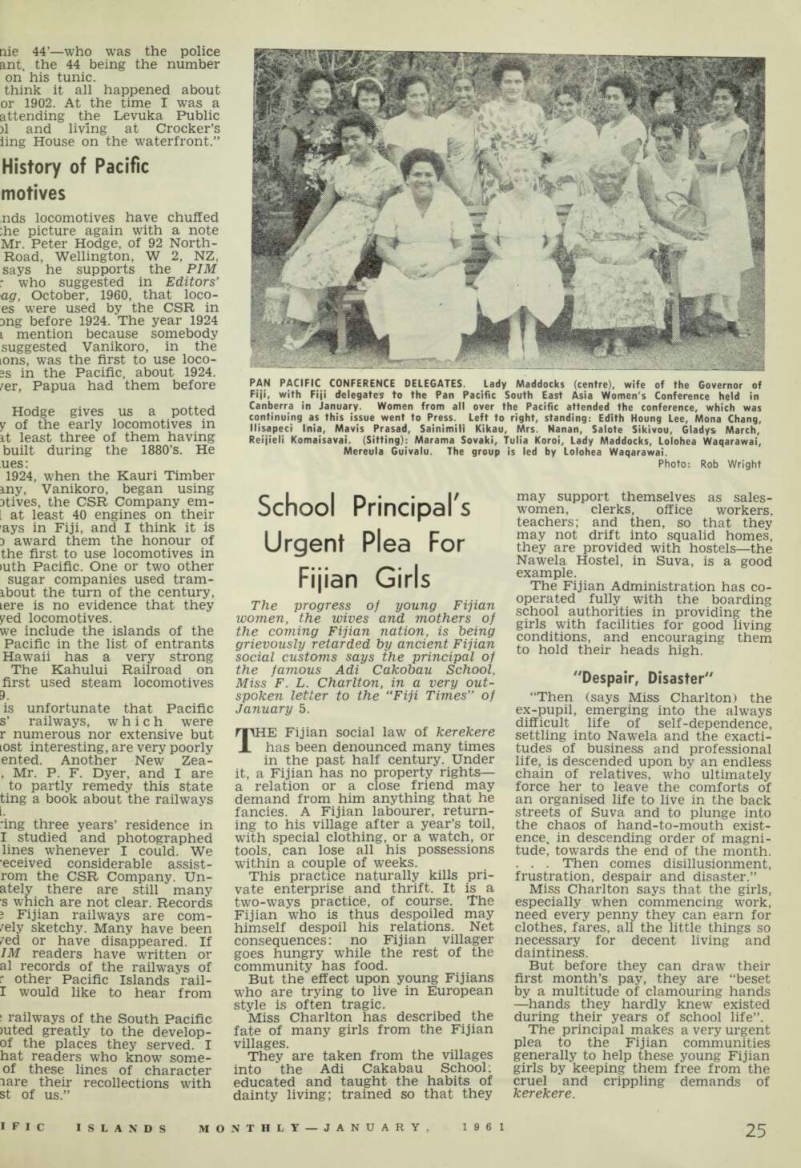
PAN PACIFIC CONFERENCE DELEGATES. Lady Maddocks (centre), wife of the Governor of Fiji, with Fiji delegates to the Pan Pacific South East Asia Women's Conference held in Canberra in January. Women from all over the Pacific attended the conference, which was continuing as this issue went to Press. Left to right, standing: Edith Houng Lee, Mona Chang, Ilisapeci Inia, Mavis Prasad, Sainimili Kikau, Mrs. Nanan, Salote Sikivou, Gladys March, Reijieli Komaisavai. (Sitting): Marama Sovaki, Julia Koroi, Lady Maddocks, Lolohea Waqarawai, Mereula Guivalu. The group is led by Lolohea Waqarawai.
Photo: Rob Wright