Its Wings Wider
pp. 21-144 · Read in the full issue
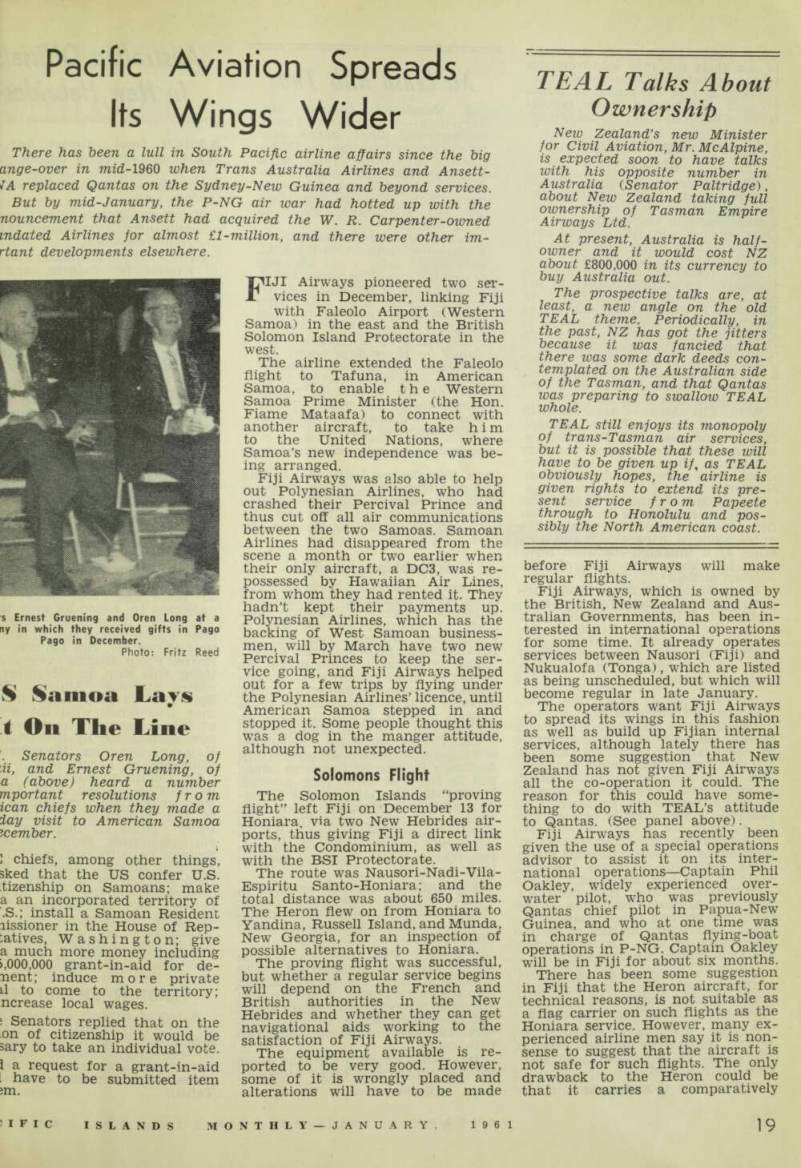
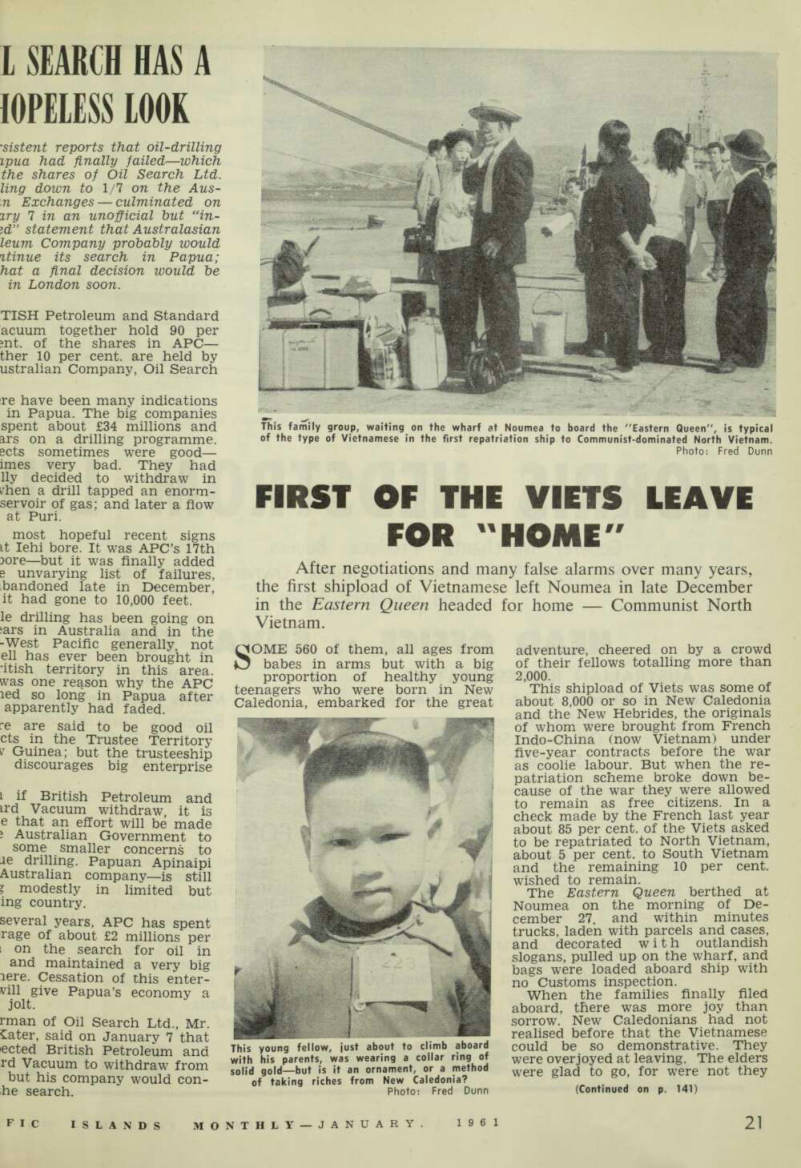
Pacific Aviation Spreads Its Wings Wider
There has been a lull in South Pacific airline affairs since the big ange-over in mid- 1960 when Trans Australia Airlines and Ansett- IA replaced Qantas on the Sydney-New Guinea and beyond services.
But by mid-January, the P-NG air war had hotted up with the nouncement that Ansett had acquired the W. R. Carpenter-owned indated Airlines for almost £l-million, and there were other im rtant developments elsewhere.
FIJI Airways pioneered two ser vices in December, linking Fiji with Faleolo Airport (Western Samoa) in the east and the British Solomon Island Protectorate in the west.
The airline extended the Faleolo flight to Tafuna, in American Samoa, to enable the Western Samoa Prime Minister (the Hon.
Fiame Mataafa) to connect with another aircraft, to take hi m to the United Nations, where Samoa’s new independence was be ing arranged.
Fiji Airways was also able to help out Polynesian Airlines, who had crashed their Percival Prince and thus cut off all air communications between the two Samoas. Samoan Airlines had disappeared from the scene a month or two earlier when their only aircraft, a DC3, was re possessed by Hawaiian Air Lines, from whom they had rented it. They hadn’t kept their payments up.
Polynesian Airlines, which has the backing of West Samoan business men, will by March have two new Percival Princes to keep the ser vice going, and Fiji Airways helped out for a few trips by flying under the Polynesian Airlines’ licence, until American Samoa stepped in and stopped it. Some people thought this was a dog in the manger attitude, although not unexpected.
Solomons Flight
The Solomon Islands “proving flight” left Fiji on December 13 for Honiara, via two New Hebrides air ports, thus giving Fiji a direct link with the Condominium, as well as with the BSI Protectorate.
The route was Nausori-Nadi-Vila- Espiritu Santo-Honiara; and the total distance was about 650 miles.
The Heron flew on from Honiara to Yandina, Russell Island, and Munda, New Georgia, for an inspection of possible alternatives to Honiara.
The proving flight was successful, but whether a regular service begins will depend on the French and British authorities in the New Hebrides and whether they can get navigational aids working to the satisfaction of Fiji Airways.
The equipment available is re ported to be very good. However, some of it is wrongly placed and alterations will have to be made
before Fiji Airways will make regular flights.
Fiji Airways, which is owned by the British, New Zealand and Aus tralian Governments, has been in terested in international operations for some time. It already operates services between Nausori (Fiji) and Nukualofa (Tonga), which are listed as being unscheduled, but which will become regular in late January.
The operators want Fiji Airways to spread its wings in this fashion as well as build up Fijian internal services, although lately there has been some suggestion that New Zealand has not given Fiji Airways all the co-operation it could. The reason for this could have some thing to do with TEAL’S attitude to Qantas. (See panel above).
Fiji Airways has recently been given the use of a special operations advisor to assist it on its inter national operations—Captain Phil Oakley, widely experienced over water pilot, who was previously Qantas chief pilot in Papua-New Guinea, and who at one time was in charge of Qantas flying-boat operations in P-NG. Captain Oakley will be in Fiji for about six months.
There has been some suggestion in Fiji that the Heron aircraft, for technical reasons, is not suitable as a flag carrier on such flights as the Honiara service. However, many ex perienced airline men say it is non sense to suggest that the aircraft is not safe for such flights. The only drawback to the Heron could be that it carries a comparatively
small payload. But this drawback is one likely to cause inconvenience to the operators not to passengers.
There is also likelihood of larger aircraft being used once regular services begin to other island groups.
Suva May Get Airport
At Last Establishment of a regional airport at Suva Point, Fiji, to replace the existing airfield at Nausori moved a step nearer in December when the Government and the Suva City Council agreed to provide £2,000 for a soil, site and noise survey.
Most residents of Fiji are in favour of an airfield alongside the city. The haul from Suva to Nausori (14 miles) takes almost as long as it does for Fiji Airways to fly to the most distant point on its inter-island network of services.
Fiji Airways spend about £7,000 a year transporting passengers, air crew and maintenance staff be tween Suva and Nausori.
With Fiji Airways interested in other areas, such as Tonga, Western Samoa and the BSI Protectorate, via the New Hebrides, it is more important than ever that there should be a more suitable strip than Nausori.
The proposed site at Suva Point is only five minutes by car from the centre of the city, against 14 miles along a congested road—two miles of it unsealed—between Suva and Luvuluvu (the site of the Nausori airfield).
The cost of the Suva Point air port, including buildings, is esti mated at £375,000, a sizeable sum when the Colony’s financial re sources are sorely strained. But against that the Government will soon be up for big maintenance costs at Nausori.
Costs Go Higher The Marsden matting runway will have to be replaced within a couple of years, and the cost will depend on the work which must be done.
The cost of a main bitumenised runway, with a subsidiary gravel runway, has been estimated at £225,000, if the work is carried out by contract.
The construction of an airport at Suva Point has been discussed many times. 7inch time, of course, the esti mate of cost has increased.
Fortunately, the Suva Point Regional Airport Committee, made up of private and Governmental in terests, has shown realism in its de liberations to date. It has asked the Government to consider: • The setting up of an airport authority with power to raise loans, receive money, impose charges and operate and administer the airport; • That any money intended for use at Nausori be handed over to the authority to enable it to start construction; and • That the Government and the
Suva City Council be invited to find annual repayments for a 15-years loan on a sum to the difference in cost between building the new air port and reconstructing Nausori air port.
Friendships for TAA
Trans Australia Airlines an nounced in December that they will introduce Fokker Friendship air craft to internal air services in Papua-New Guinea, and for the Lae-Honiara (BSIP) service also.
The Friendship will make its debut in the Territory with the Honiara service on January 17, but as there will be only one of these aircraft initially, it will alternate on that service with the existing DCS.
The Friendship, now one of the most popular passenger aircraft in Australia for short to medium hauls, will be the first turbo prop aircraft to operate internally in the Terri tory, and if the company retains the normal passenger aircraft fittings used on Australian services, it cer tainly will provide the most luxuri ous travel P-NG local passengers have yet had.
A lot of the internal services in P-NG now have forward facing seats of a sort, but many flights still have the old tin benches down the side.
With the Friendship, a hostess service will be introduced on P-NG internal airlines. The larger aircraft in the Territory usually carry a sort of flying supercargo, who hands out the lunch boxes where neces sary, but who is mainly concerned with cargo.
In smaller aircraft, the pilot copes with passenger and cargo problems.
(Continued on p. 141)
Australian airline operators are watching, with lively curiosity, the rapid growth and development of Mandated Airlines, a Carpenter owned corporation based in New Guinea.
In January, P-NG echoed with rumours of an imminent “merger” between Ansett-ANA and Mandated Airlines Limited.
On January 16, PIM was officially informed that, up to that date, no merger had been arranged.
When we asked whether any dis cussions were in progress PIM was told, “Possibly”.
Mandated Airlines was formed 25 years ago, after the tireless Walter Carpenter decided to do his own air freighting in New Guinea mainland, instead of paying a large monthly bill to Guinea Airways and one or two small operators.
Carpenters started very modestly, with a couple of Moths, in January, 1933; became competitive in 1934; bought Pacific Aerial Transport Co. (started by Ray Parer); and in 1936 were registered as Mandated Air lines Ltd.
In 1938, Carpenters beat Guinea Airways in successfully tendering for the Sydney-Rabaul airmail ser vice which they inaugurated on May 30 1938, with three De Havil land 86B’s. This service folded up when the Japs invaded in January, 1942.
MAL, when war came, were hold ing five DHB4 Dragons; three DHB3 Fox Moths; one DH6O Moth; one Avro; and two Lockheed 14 10passenger planes for the Sydney- Rabaul service.
Competition With Qantas
Carpenters were prepared to re sume the Sydney-New Guinea ser vice after the war; but it was officially ear-marked for Qantas.
Carpenters sold out amiably to Qantas and, in the ensuing 14 years, while Qantas operated so success fully in New Guinea and between New Guinea and Sydney, there was
a good relationship between Qantas and Carpenters.
Qantas and MAL operated side by side. There was competition—but no ill-feeling.
Changes in New Guinea
MAL grew with the country. A couple of years ago, it bought out the Gibbes airline—a couple of Norsemans and Junkers, and a good big workshop at Goroka.
Then came the Canberra decision which forced the Commonwealth owned Qantas out of New Guinea, and introduced the strong Aus tralian airlines, Ansett-ANA and
Taa.
Qantas did not like it—New Guinea, over the years, had been a
splendid training-ground for the pilots and technicians needed for its rapidly-growing international services.
Among the New Guineans who, also, did not like the new set-up was MAL. Nothing was said; but the in dications were that if there now was to be internal air development in Papua and New Guinea, the Car penter-owned airline would be in it.
Early in December, Mandated Airlines bought out Madang Air Services. The latter, in a few years, had grown from one Dragon to a Dragon and five Cessnas, About the same time, Mr. J. B.
Sedgers, head of the Carpenter in terests in New Guinea, arrived in Tamworth to discuss with East- West Airlines a contract for engine
maintenance and overhauls c Mandated Airlines’ DCS aircral MAL now own nine DOS’s—in add tion to many smaller planes—and was arranged that, about once evei six weeks, a MAL DCS should f from Lae to Tamworth for overhau In January it was announced th{ Mandated Airlines was purchasir two Italian Piaggio twin-engine pusher-type aircraft.
The first Piaggio was being de livered immediately from Italy an the other was due in April.
And then, right on the heels c these moves including the earlie official statement, Ansett Transpoi Industries Ltd. announced on Jan uary 18 that it had acquired Man dated Airlines for £A950,000, com prised of two million Ansett 5/ shares and a cash payment (thu making W. R. Carpenter the larges single shareholder in Ansett).
Mandated will continue to operat under its own name, and Mr. f Ansett, chairman of Ansett, say services will possibly be extendej and more aircraft added to Mail dated’s fleet.