Pacific Commerce and Produce
pp. 159-160 · Read in the full issue
at is Future of
Goldfields
ith the 31st annual report the year ended June 30, l) before us, and the history
tiis particular enterprise in
, we wonder what is to be uture of New Guinea Gold ;, Ltd. Manifestly, it does eem to lie in gold-mining.
S year, the company distributes 856.000 to its shareholders (about 7 per cent.). An analysis e accounts shows this has not from the profits of gold-mining, >e. It comes out of a Gold ig Profit Reserve, which has built up—as far as recent times concerned —from subsidies. A lete analysis suggests that the any now keeps going from s on trading, and not from lining. the year under review, the any’s receipts from goldmining iding a subsidy of £25,000) £271,395; while its costs in the field were £277,322. But its >ts from trading were £307,000 its costs were £252,000. first glance, one might ask why >oard does not cease mining ;ther, and concentrate on trad ed planting and timber-get where it is enjoying moderate ss. There may be an answer c probability that the £277,000 lining costs carries a large nt of overhead which, while ebitcd to trading, would have by trading if mining : history of NGG Ltd., as a nining enterprise is one of the depressing in the Territory. ;orporation was created out of mglomeration of Urquhart res —some highly speculative— i took form in the early, hectic of the Koranga-Edie Creek (from about 1924 to 1930). The sts which formed NGG e d out greedily and grabbed bit of likely gold-bearing land could lay hands on, and kept : of the possession of smaller vho might have done well with
Staggered Along
in, as NGG Ltd., the organisa staggered along through ten ,s of mismanagement and ling, suffering all the dis itages of remote control, tnight have recovered as the of a decade of hard experi
ence; but before anything really could be done, there came World War 11, and the paralysis of the Jap invasion. By the time New Guinea got back to normal function ing, in the late ’Forties, the com pany had lost its great chance: Costs had gone towards the skies, and the price of gold had not risen correspondingly. And that still is the position—if not more so.
The successors to the management of the 1930’s have done their best, with a swollen, top-heavy structure.
On the one side, they have wiped out a very large proportion of the original “issued” capital—the orig inal optimistic four or five millions being now down to three-quarters of a million (which the stock market values at half a million); while the company has moved gradually and steadily away from mining to timber getting, trading and coffee-growing.
The shareholders are entitled to ask, Is there now any future in gold-mining in this area? If not, why maintain the large organisa tion in its present costly form?
Is there any real future for the company in timber-getting? (It is understood that, while the Bulolo enterprise has rights to large areas of good forest, the rights of NGG Ltd. in that respect are limited and precarious. Yet there is a great and growing market for New Guinea timbers. Could not the big NGG Co., with Administration help, use its resources and know-how to develop timber-getting in districts other than Bulolo?) In a social as well as an economic sense, NGG Ltd. has had a good record under Mr. John Hohnen. It has co-operated with the Adminis tration where possible in develop ment, and certainly has helped in giving to masses of native workers some practical tuition in the affairs of industry and in better standards of living. In return, it deserves all the help the Government can give it, in a transition from the declining industry of gold-mining to the in dustries which can be of so much value to the New Guinea of the f u t u r e—planting, timber-getting, trading.—RWß
Loloki Copper Again
A Japanese company was in November showing a lively interest in the Loloki copper deposits near Port Moresby. Papua.
These deposits were worked in the 1920’s but little or nothing has been done there since, although there was some sporadic activity just after World War 11.
The interested company is the Nippon Mining Co. of Tokio. and a couple of their geologists were looking the deposits over in November. The Japanese company is already getting a great deal of copper from Queensland’s Mt. Isa but they “need a lot more”. A spokesman for the com pany stressed that the November visit to Papua was a “preliminary survey only”.
At present the Consolidated Zinc
Corporation of Australia has an option over the Laloki deposits.
The £1.6 Million
Question of lehi
Up to the time this issue went to press, there had been no results from the drilling of the Australasian Petroleum Company’s £1,600,000 well at lehi, 250 miles north-west of Port Moresby, in Papua. Many people see this as probably being APC’s last throw of the dice in Papua, and if no oil in commercial quantities results the major partners are likely to pull out.
The well had been drilled to 10,000 feet by end of November, and seven inch casing was then to be inserted and testing commence. This testing, it was thought, might run into January.
Oil Search Ltd., the Australian company that is the junior partner in APC. has no forward plans after lehi, and the major partners—British Petroleum and Vacuum Oil—are understandably restive about the whole business of oil search in Papua.
The search is costing a vast amount of money, and it is not vital for the two big companies themselves to find oil in Papua. It is well known that all major oil companies have an excess of crude oil on their hands and that the world supply situation is good.
It is a different matter for Oil Search and Australia, however. A reliable source of oil in Papua at the present time would go a long way toward straightening up Australia’s adverse balance-of-trade situa tion.
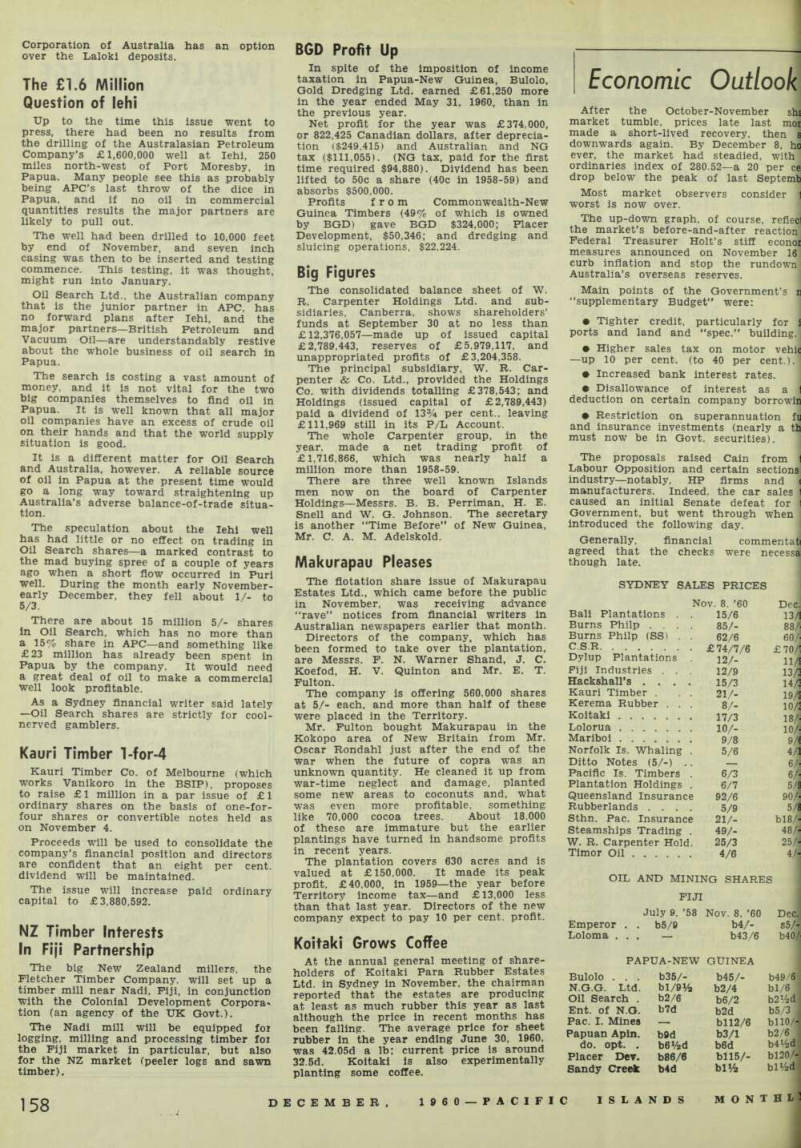
The speculation about the lehi well has had little or no effect on trading in Oil Search shares—a marked contrast to the mad buying spree of a couple of years ago when a short flow occurred in Puri well. During the month early November early December, they fell about 1/- to 5/3.
There are about 15 million 5/- shares In Oil Search, which has no more than a 15% share in APC—and something like £23 million has already been spent in Papua by the company. It would need a great deal of oil to make a commercial well look profitable.
As a Sydney financial writer said lately —Oil Search shares are strictly for cool nerved gamblers.
Kauri Timber l-for-4
Kauri Timber Co. of Melbourne (which works Vanikoro in the BSIP), proposes to raise £1 million in a par issue of £1 ordinary shares on the basis of one-for four shares or convertible notes held as on November 4.
Proceeds will be used to consolidate the company’s financial position and directors are confident that an eight per cent, dividend will be maintained.
The issue will increase paid ordinary capital to £3,880,592.
NZ Timber Interests
In Fiji Partnership
The big New Zealand millers, the Fletcher Timber Company, will set up a timber mill near Nadi, Fiji, in conjunction with the Colonial Development Corpora' tion (an agency of the UK Govt.).
The Nadi mill will be equipped for logging, milling and processing timber for the Fiji market in particular, but also for the NZ market (peeler logs and sawn timber).
BCD Profit Up
In spite of the imposition of income taxation in Papua-New Guinea, Bulolo, Gold Dredging Ltd. earned £61,250 more in the year ended May 31, 1960, than in the previous year.
Net profit for the year was £374,000, or 822,425 Canadian dollars, after deprecia tion ($249,415) and Australian and NG tax ($111,055). (NG tax, paid for the first time required $94,880). Dividend has been lifted to 50c a share (40c in 1958-59) and absorbs $500,000.
Profits from Commonwealth-New Guinea Timbers (49% of which is owned by BGD) gave BGD $324,000; Placer Development, $50,346; and dredging and sluicing operations, $22,224.
Big Figures
The consolidated balance sheet of W.
R. Carpenter Holdings Ltd. and sub sidiaries, Canberra, shows shareholders’ funds at September 30 at no less than £12,376,057 —made up of issued capital £2,789,443, reserves of £5,979,117, and unappropriated profits of £3,204,358.
The principal subsidiary, W. R. Car penter & Co. Ltd., provided the Holdings Co. with dividends totalling £378,543; and Holdings (issued capital of £2,789,443) paid a dividend of 13% per cent., leaving £111,969 still in its P/L Account.
The whole Carpenter group, in the year, made a net trading profit of £1,716,866, which was nearly half a million more than 1958-59.
There are three well known Islands men now on the board of Carpenter Holdings—Messrs. B. B. Perriman, H. E.
Snell and W. G. Johnson. The secretary is another “Time Before” of New Guinea, Mr. C. A. M. Adelskold.
Makurapau Pleases
The flotation share issue of Makurapau Estates Ltd., which came before the public in November, was receiving advance “rave” notices from financial writers in Australian newspapers earlier that month.
Directors of the company, which has been formed to take over the plantation, are Messrs. P. N. Warner Shand, J. C, Koefod, H. V. Quinton and Mr. E. T.
Fulton.
The company is offering 560,000 shares at 5/- each, and more than half of these were placed in the Territory.
Mr. Pulton bought Makurapau in the Kokopo area of New Britain from Mr.
Oscar Rondahl just after the end of the war when the future of copra was an unknown quantity. He cleaned it up from war-time neglect and damage, planted some new areas to coconuts and, what was even more profitable, something like 70,000 cocoa trees. About 18,000 of these are immature but the earlier plantings have turned in handsome profits in recent years.
The plantation covers 630 acres and is valued at £150,000. It made its peak profit, £40,000, in 1959—the year before Territory income tax —and £13,000 less than that last year. Directors of the new company expect to pay 10 per cent, profit.
Koitaki Grows Coffee
At the annual general meeting of share holders of Koitaki Para Rubber Estates Ltd. in Sydney in November, the chairman reported that the estates are producing at least as much rubber this year as last although the price in recent months has been falling. The average price for sheet rubber in the year ending June 30, 1960, was 42.05 d a lb; current price is around 32.5 d. Koitaki is also experimentally planting some coffee.