Pacific Report
pp. 119-145 · Read in the full issue
The month’s round-up of news and pictures of people and /ents, from PIM correspondents in the South Pacific.
5 Council 'Won't Be Asked
Discuss Target Date'
therlands Minister for the In r, Mr. E. H. Toxopeus, said at end of his November tour of r that it was not true that he told the chairman of NNG’s >nal political party, Parna, that subject of a target date for government would be one of the questions submitted to the itory’s new Council when it is ilished next year.
New Guinea newspaper re id in November that this was of the subjects discussed with a (PIM, Nov. p. 135). Mr. peus said he “regretted” that Is of the talks with the party man, Mr. H. Wajoi, had been shed, because he had con ed the talks confidential. How he said he had definitely not d that the question of a target would be put before the Coun- Decause the matter concerned Council only, and it would be ie Council’s authority to make vision. . Toxopeus also denied having Mr. Wajoi that NNG would be elled to grant independence e 1970. Such a period would be hort.
If-determination without a 1 economic basis is a farce,”
Foxopeus added. /■ertheless, later, back at The e, a source quoted a Govern snokesman as saying the NNG cil would be asked about fix target date. 3 announcement started some running in some places, senior Administration officer many years’ experience in r native affairs said in Port sby: “The implications of the •sal are far-reaching, I can’t ipw it can fail to affect Aus ’s position in Papua-New sa” would cause major discontent ipua-New Guinea. ie Administration will be 3 to push development at -neck speed,” he said. “It will to face grave consequences of itmg restlessness among the 3 people.”
' officer said the announce
ment indicated the Dutch wanted to pull out of West New Guinea as soon as possible.
“It costs them plenty and gives them nothing in return,” he said.
“Apparently they have only stayed this long to save face with In donesia.”
The announcement also was criticised by native MLC, Reuben Taureka, president of the Papua New Guinea Workers’ Association.
He called it a dangerous move which could lead to a native dictatorship in West New Guinea.
Old Echo Of The
'Joyita' Mystery
The ill-fated Joyita, which caused a world-wide sensation late in 1955 when she disappeared while on a voyage from Apia to the Tokelaus is still in the news. The motor vessel, now owned by a group of Vanua Levu planters and lying on the beach at Nasova, near Levuka, was mentioned in a recent case in Cardiff (Wales) before a divorce court commissioner.
The wife (or widow) of the cap tain, Mrs. Ismay Beatrice Miller, aged 48, asked the court for a decree on two grounds—presumption of death or, alternatively, desertion.
Her husband, Captain Thomas Henry Miller, was master of the Joyita when the crew and passengers disappeared. The Joyita was dis covered later, derelict, about 90 miles north of Vanua Levu, with no sign of the crew or passengers. Nothing has been heard of them since.
According to court evidence, Miller went to New Zealand and his wife and family were to follow. In May, 1951, he stopped sending money or writing to his wife, who had not seen him since. The court granted Mrs. Miller her decree.
After a court of inquiry at Apia, which never really settled what had happened to the Joyita, the ship was offered for sale at Suva, and was sold to a group of Vanua Levu planters in July, 1956.
At sea again early in 1957 trading between Vanua Levu and Suva, the Joyita grounded on the notorious Horseshoe Reef in the Koro Sea.
After she floated off she was towed to Nasova and laid there for some
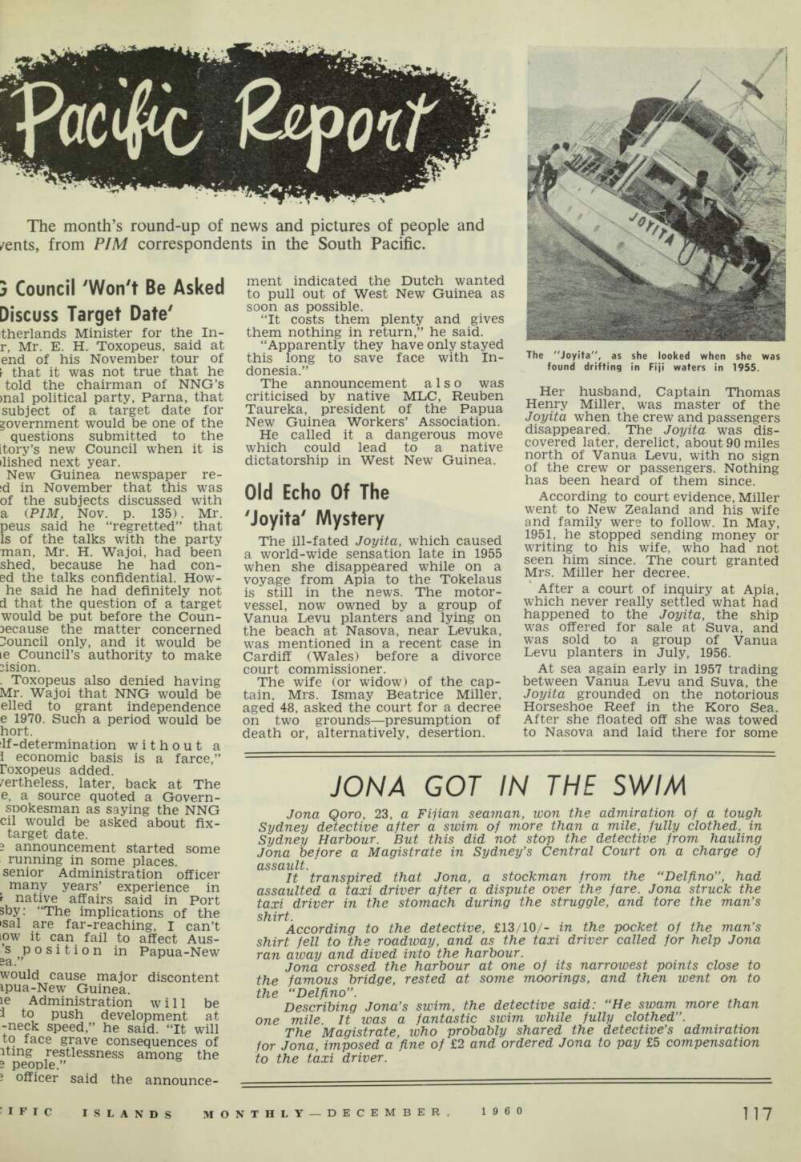
The "Joyita", as she looked when she was found drifting in Fiji waters in 1955.
mths while temporary repairs re carried out.
Anally recommissioned in October, 8, she resumed trading and little jpened to her for 12 months, sn, in November, 1959 she unded on a reef at Vatuvula, .r Makogai. This time she was e to make Levuka under her own im, but the attempted trip to ra was a nightmare. Off Kaba nt, after taking in much water, turned back, and after staying the main Levuka wharf for a rt period she was towed to >ova, where she now lies beached. : has cost her owners a small ;une.
. A. E. Waddingham
II Be a Farmer Now
rom storekeeping to cane, bee 1 poultry farming is a big step, one which Mr. A. E. Wadding i plans now that he has retired n Burns Philp (SS) Co. Ltd. ;r 31 years’ service with the firm, member of a well-known Fiji lily, Mr. Waddingham and his 5 will spend their retirement at la Point, which overlooks Nadi r , the Yasawas and the cane is of Sabeto. [r. Waddingham, who is now 59, r ed with BP’s in many parts of Colony in accounting, merchan ng and managerial capacities, en he went on 12 months’ retir leave on November 30 he was lager of the Lautoka branch of firm. He had filled that post :e 1947. e leaves at a time when the firm under way an extensive mod sation programme of the Lau i store. The contract, worth at £150,000, is one of the biggest ding contracts ever undertaken
fiji. .
is wife is the daughter of Mr.
W. Garnett, of Suva, a member mother well known Fiji family, ee of their four chillren now live 'few Zealand, and the fourth is •loyed by the CSR Company at toka, maintaining a family lition, for his father, for a short ?, and his grandfather also, ked for that company. r. Les Pearson has succeeded Waddingham as manager of the toka branch of BP’s.
ect Service Soon
don-New Guinea
ipua and New Guinea and the ish Solomon Islands are shortly have a direct shipping service i the United Kingdom and the tinent. Andrew Weir and Co. Ltd. an oced recently (PIM, Oct., p. 54), Bank Line will begin the service l regular monthly sailings from ipe, commencing in January, le first vessel in the direct ser
vice will be Ashbank, which will load Amsterdam, Bremen a £ d ?^ rg o betw S en . D T sce T ber . 27 and January 2, and at London between January 3 and 5. She is expected to reach Port Moresby about February 9 and thereafter will call at Samarai, Lae, Madang, Rabaul, Kavieng (if inducement) and Honlara. Ashbank will be followed, on the same route, about a month later by Avonbank (See Shipping Timea ~" section).
The vessels will carry general cargo southbound and probably load Australian 1 ports° rthbounc * cargo at ?3 r 8 ok Sde B nhalfst°e7 n London, EC3;’
or the owners, Andrew Weir & Co Ltd., 21 Bury Street, London, EC3.
Pa P ua and New Guinea agents are Burns Philp (NG) Ltd.- and BSIP agents are BSI Trading Cor poration.
Two London directors of the Bank Line, the Hon. A. C. R Weir and Mr. J. C. Hawkes, have recently been visiting Australasia and some of the Pacific Islands. Mr Hawkes with Captain W. M. Reade, of the Bank Line’s Sydney office were in Papua-New Guinea in November,
Th « Bride Price Is
CaUsi "9 Them WolT y
ofX*
dn are using their daughters as •iage bait to get money from y visiting natives according to :ent report in Rabaul. e report came from New Guinea iland natives who were attend a meeting in Rabaul of the iul Foreign Natives Council.
Council looks after the hi ts of natives in Rabaul who not locally born, eakers told the meeting that times a man from the more itive New Guinea districts d come to Rabaul to work and d find that he had attracted interest of a young Tolai girl, t realising that he had been 3d into a trap he would save noney and pay the bride price le girl’s mother. As soon as the 3y was paid, girl and mother d disappear. t Tolai natives who heard the 't were faintlv contemptuous ;he business. It was rare, said, and in any case a man Id be sufficiently alert to see a ere was little comfort in the s of one of the Tolais. “If you to save your money keep away families who want to take it,” lid. e story focuses attention on bride price custom which still s in many districts but which ndoubtedly dying out in the progressive districts.
Port Moresby a survey is being ed out by native communities i attempt to solve problems as ted with the custom, ints being determined are her the bride price should be shed, the general popularity of custom among modern native le, the advantages of the custom iy, the possibility of placing an r hmit on the price, and the bility of sharing the money over
mly group.
unger men in Hanuabada
Village, Port Moresby, have ad vocated complete abolition of the bride price but the women still favour it.
The custom is still very prevalent in New Ireland and fairly prevalent in New Britain.
Split in NNG s
Parna Party
A report from The Hague in No vember said that there had been a split in NNG’s multi-racial political party, Parna.
This had resulted in Nicolaas Jouwe being ousted from the party by the chairman, Herman Wajoi.
According to the report, Wajoi had supported the idea of a tri partite conference between the Netherlands, Indonesia and the Papuans on the future of NNG, but Jouwe was opposed to the proposal.
Wajoi, reportedly, had sent a letter to the United Nations containing a proposal for a conference between the three Governments and Jouwe had wanted it withdrawn.
Wajoi wrote to Jouwe rejecting him on behalf of the party and ad vised Jouwe to set up his own party.
Nuclear Power Has "Little
Effect on Aust. Defence"
Papua-New Guinea was still “very important” to the defence of Aus tralia, the General Officer Com manding Northern Command, Major General T. J. Daly, said there in November.
He rebuffed suggestions that nuclear weapons made the Territory obsolete as a front line of defence.
He said: “I would not like to make comparisons between now and 20 years ago as to just how important the Territory is to Australia. But let me say it would be very uncom
fortable for us if an unfriendly power lived here.”
General Daly was making a fare well tour of the Territory before taking over as Adjutant-General at Army Headquarters, Canberra, next January.
He was accompanied by the Secre tary for Army, Mr. B. White, and the Director-General of Medical Services, Major-General A. J. Clyne.
General Daly told a Press confer ence in Port Moresby that the pos sibility of nuclear warfare made little difference to Australia’s de
fence policy.
“Australia is not a major political power or a huge war machine,” he said. “What benefit or advantage
could be obtained by her total de struction by nuclear weapons?
“I believe that if Australia does become involved in a major conflict it will be of the Korean War type.
“That is why Papua-New Guinea is undoubtedly very important to Australia’s defence,” he said.
General Daly was then asked to comment on a report by the Executive Council of the Returned Servicemen’s League to the League’s National Congress in Melbourne last month.
The report claimed that the de fence forces in Papua-New Guinea were “quite inadequate”.
He said: “It is so easy to say that a country is wide open.
“I suppose you could say th about many countries.
“The Governments assess the ri and threat involved and then co centrate their defences at stratef points,” he said.
General Daly said who was to s what were Papua-New Guinei strategic points?
“Australia cannot afford to spre garrisons all over the country. \ therefore rely on defence treat] and a strong, hard-hitting mob army force.”
New Airstrip For Savaii,
West Samoa
An area has been surveyed ne the village of Safotu, on the isla] of Savaii, for the construction of i airstrip in preparation for esta lishment of a regular air connect! between Faleolo airport on Upc and Safotu on Savaii.
A 5,000 feet runway on level ai smooth volcanic grounds will pr vide a satisfactory landing grou] for the Prince aircraft of the Pol nesian Airline. The village of Safe is providing voluntary labour f the construction of the airsti under the supervision of the ai line’s operation manager.
Some "Out of Pocket"
Expenses For Councillors
The Fiji Government plans to r vise the system of allowances pa to members of the Executive ai Legislative Councils, and the Stan ing and Select Finance Committei The present allowance, which h been in force for some years, w be replaced by a subsistence alloi ance, and an allowance for each d: that members attend a meeting.
Those who live at home and a tend meetings from there (in effe members who live in Suva I nearby) will receive a daily ance of £4/4/- a day. Others will r ceive £B/8/- for each period of j hours, and £4/4/- for less than S but more than six, hours.
All members, except those fro the Eastern Division will receive] expenses and travelling allowan of £lOO a year (£l5O in the Eastei
sion). Travelling expenses to tings will also be paid, ilegraph and telephone facilities urgent public business will be lable at the public expense.
icult Industrial
Filled in Fiji
sturbed by industrial rumblings le last 12 months or so the Fiji eminent has appointed an in rial relations adviser, who has idy taken up his duties. The which carries a salary of £2,400 ar, plus a £3OO post allowance, gone to Mr. L. H. Nicklin, of lingham (UK) who was en d on similar work in Uganda .2 years. *. Nicklin’s appointment follows commendation by Mr. E. Parry, ity Labour Adviser to the Secre of State for the Colonies, who ed Fiji this year. 3 main task in Fiji, where the strial know-how (by New Zea and Australian standards) of employers and employees, is low standard, is to strengthen Labour Department, and assist le transformation of its role in strial relations so that it may a more active part in the de unent of amicable relations be ta both sides of the industry. . Nicklin will have a hard job, tie must succeed in his work if ; unionism is to develop in Fiji T , lines which will be of benefit growing Colony.
ids Man To Come
For Sentence
’red Vercoe, well known as a Dgrapher in both Western and rican Samoa, was expected to ! up for sentence in Sydney ter Sessions in December on arge relating to the kidnapping ight-years-old Sydney boy, me Thorne. ( PIM, Sept., p. rcoe pleaded guilty in the lower ' at Sydney to a charge of hav attempted to obtain, by false mces, about £25,000 from the father. The boy was later
found dead but it was not alleged that Vercoe had taken any part in the kidnapping or the murder, or knew anything about the crime other than what he had read in the Press.
When he pleaded guilty, Vercoe was committed for sentence in the Quarter Sessions at Sydney due to start in October and to finish in December.
Big Scrap Clean-Up
To Begin in NNG Soon
The Dutch Administration is negotiating with a Japanese firm for the salvage of a minimum 120,000 tons of scrap from Nether lands New Guinea territorial waters.
The Administration’s Sub-director of Finance, Mr. L. G. Hoornweg, said in Port Moresby in November that the estimated worth of the scrap was £3,000,000.
Mr. Hoornwee was in Port Moresby from Hollandia for talks
with senior Australian Administra tion officers. He was accompanied by Mr. J. R. Hommes, a financial adviser to the Dutch Administration.
Mr. Hoornweg said there were “certain details” of the contract which had to be discussed with the Australian authorities.
He said the Japanese firm in volved was the Japan Netherlands Salvage Company of Tokyo.
It already had been sold the sole rights to investigate all sunken shipping in Western New Guinea waters.
The Dutch Administration hoped work would begin in the first six months of 1961, he said.
Mr. Hoornweg said about 80 ships
REMEMBRANCE. Remembrance Day services of November 11—Australia's commemoration of the Armistice of World War I, were held in Papua-New Guinea this year as usual. Here is the scene at the Memorial Gates, Ela Beach, Port Moresby. In front is the P-NG Administrator, Brigadier D. M. Cleland, and behind him, on the right, is the Commissioner of Police, Mr. C. Normoyle.
been sunk in the Territory’s *rs during World War 11. le bulk of it was Japanese. Only of this —about 120,000 tons— i be salvaged. le rest was in water far too deep jo treacherous. r. Hoornweg said about 60,000 of shipping had been sunk in andia Harbour. Most of the was near Biak, Sorong, and okwari. ; added: “We will have a better just how much shipping can ilvaged when the Japanese firm es out an extensive survey next 99
"Spy Planes"
South Pacific Visit
aerican U 2 aircraft, virtually :ard of before Francis Gary jrs was shot down over Russia before the scheduled Summit erencs in May, have made their arance in the South Pacific, ree of the U2’s passed through Airport recently on their way le RAAF base at East Sale, in >ria, Australia, where they were for upper air sampling. The >les the aircraft took were sent ae US for testing for radio ity and fallout in the atmos a one recent flight a U 2 got to n 100 miles of the Antarctic nent. The U2’s created great ?re s t at East Sale, and the rican pilots found themselves >arded with questions from us members of the RAAF.
; Will Get a
nanent Council Building
e idea is catching on. Papua- Guinea has a brand-new air itioned chamber for meetings e Legislative Council. Now The e has approved a plan for per mit accommodation for the New ea Council, which will be in rated next year, in Hollandia, s NNG Council in about two will be accommodated in a new building in the centre of ndia, alongside Humboldt Bay. 3 heart of the new two-storey ing will be the council chamber, uring 98 ft by 75 ft to seat 48 hi members, plus the public of course, the Press. An added itage as far as the public and are concerned will be the pro i of an electric translation de ivith headphones. Port Moresby headphone translation service, a its case, the facilities for the were inadequate right at the ning. 3 NNG architects have given attention to the surroundings, iutiful garden with a pond has designed for one side of the ing. On the other side there 3e a large parking space, while
a fountain will ornament the inner court.
Until the plan becomes a reality the New Guinea Council will use a hall in the centre of the city. This hall, now in the process of construction, will have to be completed by March 15, 1961. It will provide room for 28 representatives, plus the audience of 150. It will be equipped with a translation device. a * . ■ ■ i
Apia bets a modern
~i D ;ij;
New Library DUlldin9
West Samoa’s modern new Nelson Memorial Library was officially opened on November 5.
The Nelson family donated the land near the Apia clock tower on which the library is built and contributed £5,000 towards the cost of the building. The NZ Government gave another £5,000. The library perpetuates the memory of the late Mr. O. F. Nelson, an outstanding cjnmnnn ritizen The modern stvle of the new building is an attractive addition to growing Apia. The interior is spacious and airy, and the library contains a wide selection of general literature.
Speakers at the opening ceremony were the High Commissioner, Mr.
J B Wright- the Minister for
Education, The Hon. Tuatagaloa, and Mr. E. Annandale, general man ager of O. F. Nelson & Co., repre sentmg the Nelson family,
COOKS TomatOGS MaV
Take WinQS
3 If the Rarotonga airstrip could be brought up to standard to handle modern aircraft, it might well be an economic proposition to air freight tomatoes and possibly other produce to New Zealand, Mr. D. C.
Brown, MLC, said in Auckland in November.
Mr. Brown said that Tasman Air ways had expressed interest m these possibilities and had indicated a possible freight rate that would easily permit the landing of tomatoes in NZ at an economic price at certain times of the year, But a reasonable freight rate would depend on the use of large aircraft, and at present the Civil Aviation authorities would not allow such aircraft—even freighter aircraft to operate into Rarotonga, An an indication that aerial freight rates can be competitive, the New Zealand meat industry an nounced in November that it has made arrangements for trial ship ments of meat to be sent to the United States soon in American
Designed by an Australian architect, Mr. A. Deller, Apia's new 0. F. Nelson Memorial Library, is the most handsome building along the town's famous seafront. The library also includes rooms for meetings. The building cost £15,000 —provided by the NZ Government, the Nelson family and the West Samoa Trust Estates Corporation. Lower photograph shows the NZ High Commissioner, Mr. J. B. Wright, speaking at the official opening. See story below. Photos: Samoana
freighter aircraft at a rate of 7d per lb, by arranging that the aircraft obtain a full loading of Hawaiian pineapples on the southbound flight.
Tongans 'A Bit Free
With the Knife'
On holidays in Sydney, where he was once a barrister, and also at one time Mayor of North Sydney, Tonga’s Chief Justice, Mr. Justice Hunter, took time off to give a Press interview in which he talked about Tongan crime. The Tongan islands had a fairly high crime rate, he said.
“It’s true that Tongans are among
the friendliest, happiest people in the world. It is also true they are very passionate people, easily aroused and fiercely proud”, he said.
“It needs only a heavy kava drink ing session or an agrument over land to make a Tongan violent.
Tonga is virtually free of what you would call full-time or professional criminals. Premeditated crime is also unknown to Tongans for example, I have never had to deal with a case of poisoning. But when ever I see the words “causing grievous bodily harm” on a court list, I know that behind the charge is a story of a sudden flare-up.
“Some Tongans are a bit free with the use of knives, but they never
seem to try to kill a victin merely mark him for life.”
P NG Will Have a
Child Welfare Ordinance
Legislation giving Papua-N Guinea a child welfare ordinal has been introduced to the Ter tory’s Legislative Council.
The Assistant Administrator, : J. T. Gunther, said what little leg lation already existed was “obsole and could not cope with the “ creasing perplexities of Territi life”.
The bill will be debated at 1 next sitting of the Council in 19f
US "Brain" Helps
Process NG Reports
An electronic brain in Washii ton, USA, is now regularly p cessing information which IS Guinea observatories are collect] on earth tremors.
Mr. G. A. Taylor, vulcanologist charge of the central observab at Rabaul, said in November tl this scheme was part of the mutual assistance research p: gramme in New Guinea.
America was processing in 1 electronic brain the informati from New Guinea together with : formation from other parts of \ world.
In return, America sent back New Guinea the results of the search.
Mr. Taylor said research work in New Guinea and America w using the information to study earth tremor effect known as lo anomaly. This existed when ea: tremors travelled between t points at speeds from those ( pected.
One example occurred wh i America held nuclear explosion te in the Pacific, the shocks react Rabaul ten seconds “b e h i ] schedule”.
Papuan Desiccated Coconut
Gets a Clean Health Bill
Australian imports of desiccal coconut were in trouble again j November—but this time the Papu coconut had a clean bill of heal Around 1953, the young Papu industry was almost wiped c when disease was traced to soi desiccated coconut which had be exported to Australia. The Ceyl coconut virtually took over.
In November, the Australij National Health and Medical B search Council in Canberra recoi mended that import of desiccat coconut into Australia should J permitted only when there w satisfactory evidence that it h
manufactured under hygienic itions. e Council was told dysentery been discovered in a number of ties, and many consignments been destroyed. There was no inty that harmful organisms not escaped notice in other gnments. e consignments were not from J. e meeting was told that fully :ive means of manufacturing r hygienic conditions had been oped in P-NG with steam isation.
Moresby Playground
a Kick In It
Army Bomb Disposal unit in mber unearthed 18 live mortar > in the playground of a Port sby primary school. The shells fused and rusted and described ‘extremely dangerous”. The ren apparently had been using of the shells as playthings for hs. e shells were found at Kila primary school, two miles from 10-year-old reported them to r officers during a “bomb” ition” lecture. icers have been touring all Moresby schools in a drive ist caches of old war-time am tion. s Army’s Bomb Disposal unit notified and in nine hours ag 18 shells were found, ey were later dumped in Port sby Harbour.
An Army spokesman said that many old ammunition dumps still existed around Port Moresby. The big problem was to find them.
They're Making Way
For The New "Oriana"
The imminent arrival at Suva of the great new P & O liner, Oriana, stirred the port authorities into action. Earlier there had been some doubts about the ability of the Oriana to get alongside King’s Wharf.
Dredges have now increased the depth along the frontage at low water to a minimum of 34 feet, which will allow any liner now operating in the Pacific to get along side the wharf. The Oriana is due at Suva on January 24 on her maiden Pacific voyage.
Further dredging may be neces sary within the next 12 months to allow Suva to handle an even bigger liner than the 40,000-ton Oriana.
This will be P & O’s Canberra which will be in the Pacific in about a year’s time.
Will Attempt Climb
Of NNG Mountains
A Wau geologist, Mr. D. B. Dow —originally of Auckland —will be one of six mountaineers to attempt to climb the 16,500-ft Carstensz Range of Netherlands New Guinea next June.
The attempt is being organised by the New Zealand Alpine Club and the party will be led by Mr. C. K Putt, of Sydney, chairman of the Australian section of the clu b.
Others in the group will be Messrs.
T. Barfoot and D. E, Cooper, of Auckland, and Messrs. P. Temple and D. J. Macdonald, of Christ church.
The five Carstensz peaks are part of the Nassau Mountains overlook ing the Arafura Sea, and are said to be the only glaciated peaks in the whole of New Guinea.
The advance guard of the ex pedition will leave New Zealand in April and the remainder of the party will assemble in New Guinea in June.
Mr. Monk Saw Some
Discrimination
One of the most striking con t r a s t s between Australian and Netherlands New Guinea was that in NNG there was no racial dis crimination, as operated in the Australian territory.
The president of the Australian Council of Trade Unions, Mr. Albert Monk, said this in Melbourne in November after returning from a visit to both Territories as member of a delegation (PIM, Oct., p. 18).
Mr. Monk said that Papuans on the NNG side attended the same schools as Dutch children without the segregation operating in the Australian territory.
NNG natives could also be sup plied with liquor but in the Aus tralian territory this was forbidden.
“I saw no evidence of drunken ness by Papuans in Dutch New Guinea and the Papuans in Aus
tralian territory bitterly resent the discrimination there,” added Mr.
Monk.
Problems of a
Suva Hotelier
Mr. W. H. Rafton probably did not bank on flooding when he built a new hotel at Suva on high ground this year. Apparently he was un aware of an area next to the hotel from which water cascades freely after heavy rain.
A recent unusually heavy fall of rain soon disillusioned him and his wife when muddy water seeped through a side door of the hotel and flooded the foyer to a depth of two inches, before spreading to the dining room, a store room and one of the bars, Mr. Rafton made a public com plaint which brought some action, but along with the other owners, who spent £130,000 to convert the
building into a hotel, he did i know who would pay for the da: age.
The owners have also had trou from nearby blasting which is i signed to remove a soapstone fa The walls and ceiling of an upsta room have been cracked by vibi tions from the blasting. But 1 owner of this land will look af any damage caused by the blast!
Mr. Rafton probably knows now that running a hotel in Fiji not always a bed of roses.
Radio Noumea "Might
Suffer Interference"
An Auckland report says ra< listeners in the more distant pa of the territory of New Caledonii such as Wallis and Futuna and p haps other areas—may find so: interference to their reception Radio Noumea later in 1961 —thou this is by no means certain.
The New Zealand Broadcast] Service plans to establish a 2 ki watt transmitter at Kaitaia in 1 far north of New Zealand, ce sign IXA, on the same frequei as the Radio Noumea broadca band outlet—l4oo kc/s. At ab( the same time a similar station, ca sign IXE, is to come into operati at nearby Kaikohe, on 1220 kc although this frequency is not use by any Islands station.
Fortunately, Noumea has alternative shortwave outlet 6035 kc/s, which serves more dista listeners, but this is subject to so] interference at night at present
What of the Future,
Ask P-NG Officers
The Public Service Association Papua-New Guinea, in Novemb was seeking talks with the Minis for Territories, Mr. Paul Haslu on the future of the Territor expatriate officers.
It wants assurances that t Territory’s 2,200 white pu b 1 servants will be protected when t country becomes self-governing.
In a statement, the Associati said it would press for talks as so as possible.
It was time, the statement add( that the Australian Governmen policy on compensation for loss career was determined.
President of the Association, A W. A. Lalor, said a number j officers now being recruited in Ai tralia could expect to be replac by native officers before reachi] their retirement age.
He said the Association’s rece annual congress had voted for t introduction of safeguards simil to those introduced by Britain protect her officers in colonial ten tories.
These were when the Territo became self-governing, pensions ai conditions of service for office would be safeguarded and comp©
iion paid to those suffering retirement.
Jnder recent British proposals iucements to continue to serve ;er self-determination had also ;n offered Public Servants. ‘Congress considers the British proach a realistic one,” Mr. Lalor d.
'lt wants the Australian Govern nt to provide similar assurances.” the same time the P-NG iresentations were made, the therlands Minister for the In ior, Mr. E. H. Toxopeus, an mced in Hollandia that all vernment officers of Dutch uonality, whether sent from the therlands or engaged locally, uld be given status equal to that Government officials in the therlands. A bill would be brought o Parliament as soon as possible, ich would include a guaranteed nsfer for the officials to the Jierlands upon termination of ir duties.
wai Told a
hy Story
tewai, the Papuan, looked down ough the clear water of the New tain North Coast and he saw a mge sight.
'wo feet below the surface a plate ; floating, and on the plate was empting meal. Happily enjoying meal was a big, fat, lazy fish. 0 lazy, in fact, was the fish that flowed Rewai to reach down and ry it away. History doesn’t say it happened to the plate with food on it, but Rewai waded ore happily with his slippery iggling prize. e lit a fire and cooked the fish, m the flames from the fire leapt —and soon afterwards the copra t belonging to New Massawa itation was a heap of ashes, hat was the story which Rewai d to tell when he appeared in :t at Rabaul charged with hav burnt down the drier. But the 7 part of the story which the jecution was prepared to accept that the drier, in truth, was a p of ashes. iter Rewai admitted having it down the drier deliberately, said he had piled copra husks ;nst one wall, lit the husks, and 1 waited to make sure that the spread to the walls of the drier, ewai said he had done this be >e the manager of the planta , Mr. E. Taylor, had hit him. lor admitted hitting Rewai, who continually run away from the itation and refused to work, r. Justice A. Mann said he could erstand how Rewai had felt, and jelieved Taylor would have been er advised to send Rewai home y in the piece. \ the same time he found it im ible to condone Rewai’s action ;h had destroyed property and mgered life. He sentenced Rewai 3ur years’ hard labour.
A Busy Time For
Islands Cruising
The Islands Cruise business appears to be booming as never be fore, with no one taking any more notice of hurricane seasons or wrong times of the year.
Another newcomer to the field this summer will be the New Zea land Shipping Company’s 21,867 ton Rangitane, normally on the UK- Panama-NZ run, and which in 1959 has been making some calls at Papeete.
Rangitane was scheduled to clear
Auckland on December 23 and cruise to Nukualofa and Suva, returning to Wellington on January 2.
The Orient Line’s Orsova, will make another Island cruise in Feb ruary, sailing from Wellington on the 7th, calling at Auckland, Nukua lofa, Suva, Sydney (4 days) and re turning to Auckland by March 1.
As earlier reported, the German liner Seven Seas, 12,575 tons, will leave Wellington on January 7 for Auckland, Papeete, Pago Pago, and Suva, returning to Wellington on January 29.
All in all, with the other regular liner traffic—including the new
riana —these will be busy months r the port of Suva and perhaps ■osperous ones for the Suva busi es community.
aputin Gets His Name
i The Paper
John Kaputin, 22, a native trainee terpreter with the P-NG Depart snt of Extension Services, won him [f some publicity in the Australian ess in November by announcing at he was in love with a married istralian woman and wanted to irry her.
He said the woman was 23; she d been a teacher in Port Moresby len he met her, she was now in 3Stern Australia but would return Port Moresby after her divorce d been completed.
“Caputin, a Tolai from Rabaul, d he had lost his job as a trainee icher with the Port Moresby achers’ College because of his nance with the white girl. He said ministration officials had brought assure to bear asking him to andon his marriage plans, lowever, a P-NG Administration icial replied that Kaputin had not m sacked because of the romance. ‘The simple truth is you can’t rry somebody else’s wife,” said ; official. “There is no law to pre it the marriage and no objection likely to be raised, provided the man is eligible for marriage.” kaputin was educated at a Rock mpton (Queensland) school. n , Pe L th ’ West Australia, the nday Times sent a reporter out interview the schoolteacher The •orter described her as a sautiful dark haired girl”. She 3 said it was not correct to say some newspaper reports had said, it she would be refused entry to Gl L mea ' She said s he had enter bo6n granted the ri^ht to he Sunday Times also reported ‘. as saying she had left New mea of her own free will. She d it was true that at first putin s parents had been opposed his marrying her, but they no ger opposed it. She had no com nt to make when asked would she rry Kaputin.
Was Good While
Lasted
’wo big Suva stores which showed isual initiative for Fiji in 1959, en they decided to keep open for iness during the lunch-hour, reverted to type. Lunch hour ;mg, not only in Fiji, has always n a feature of Islands life.
Vith a flourish of trumpets, Burns Ip (SS) Co. Ltd. and W. R. ■penter and Co. (Fiji) Ltd. an inced last year that they would 3 the public continuous trading m 8 a.m. to 4.30 p.m.
Morris Hedstrom Ltd. and their subsidiary, Millers Ltd., refused to have anything to do with the newfangled idea and kept their premises closed between 1 and 2 p.m. The Suva public looked on, wondering whether these two would eventually crack and come into line with their C °TO P e r°elulls as far as BP’s apparSrtlv e S t d I not lusMfvthpmtf? 1 pirlse, fo? y in d November l they would again close between 1 and 2 p.m.
It was good for the buying public while it lasted.
Now, apart from a few Indian stores and eating houses, the casual shopper will find Suva a dead city while everybody goes home for lunch.
n . /%
Karotonqa Orange
... , JUICC in March The big New Zealand food pro cessing firm of W. Gregg & Co of Dunedin, who have been working in nounce:i early in December’ that they exp ® ct t 0 f°,'? me ?' ce canning oran ge juice next March, The £20,000 factory will employ 20 people in the early stages, & It 18 intended eventually to pro cess other foods, but the cannery meanwhile should give a valuable boost to the Cooks citrus industry by greatly reducing waste.
IP Electricity
arges Bring Protest
'he BSIP, in December, increased electricity charges—and thereby led a howl of protest. [ost people thought the old rges were quite high enough. The charges were fixed at 6d. a unit domestic uses and 4d for com cial, but the new rates will be a sliding scale and will mean increase of about 32 per cent, on average domestic electricity )unt. he Civil Servants Association ikly protested that commercial ■s were more favourably treated er the new scale.
G's and BSKs 1961 Copra
itracts Complete
was announced in late No ber by Mr. lan McDonald, rman of the Papua and New aea Copra Marketing Board, copra contracts covering 1961 3 been concluded and are sub tially the same as in 1960. ley are: ) Unilever (Raw Materials) , London—3o,ooo (10 per cent. 3 or less). > Australian crushers—3o,ooo i Coconut Products Ltd., Rabaul übsidiary of W. R. Carpenter & which operates the Rabaul a crushing mill) including pro ion from their own estates— -0 tons. 1 Japan. 300 tons per month, or further quantities as may be iable. us will account for virtually all ie 1961 production. Papua-New iea production for 1960 is ex -3d to be about 102,000 tons, ie P-NG Board is paying the ; tentative price for December, -that is, £A6S, £A63/10/- and 10/- per ton for the three es, but these rates will be re ed as from January 1, 1961, and likely then to be lower, e British Solomon Islands Copra d has announced that 14,000 of the Protectorate’s 1961 copra action will go to Unilevers in [JK. proximately 4,000 tons annually ipped by Lever’s Pacific Planta (under licence to the Board) the Protectorate to Australia, the balance of production illy in the vicinity of 2,000-3,000 is either accepted by Unilevers Id on the open market, pra handled by the Board over last three years to September but exclusive of the amount >ed by Lever’s to Australia) has : 1958, 15.988 tons; 1959, 18,149 1960, 16,763 tons, gently the chairman and man of the BSI Copra Board flew *prt Moresby to meet repre itives of the Bank Line Ltd. to
negotiate the contract for the delivery of Protectorate copra to Unilevers.
With a freight reduction of 10/- Stg. per ton the Bank Line’s freight rate of 165/- Stg. was accepted and their ships will call at about sixweekly intervals.
Fan fnnra May Poroivo
N|l LOpra may Keceive
ACU n * m fhp Arm JilOT in ine Him The Fiji copra industry, which is the second biggest earner of overseas revenue for the Colony (sugar is No. 1), is likely to receive a shot in the arm through a scheme of subsidies to encourage the planting of coconuts.
Development programmes in the industry have been spasmodic for years, and many palms planted by the pioneer settleis of southern Vanua Levu and Taveuni. are now near the end of a life, 'pie industry earns about £3,000,000 a y ear - The Fiji Government has accepted Horn 5 in C Sinfe°" hatTt m takes a a lead in restoring confidence in the industry. The final scheme of subsidies has not yet been announced, but the target will be to plant or replant 4,000 trees a year for five years.
The scheme envisages a fund to which both the Government and growers will contribute equal shares, and that payments will be made
from this fund to cover the plant ing and replanting costs, plus the cost of maintenance for a specified period.
The Fijian Development Fund Board has agreed that contributions to the fund from Fijian producers should be offset against the cess of £lO a ton, which is paid to their accounts in the Fijian Development Fund. The Director of Agriculture, Mr - J - M - Watson, guided by the Agricultural Advisory Council, will administer the scheme, The industry meantime still faces the rhinoceros beetle threat. So far the pest has been kept out of the main copra-producing areas of southern Vanua Levu, Taveuni and Lau, but has reached some parts of Lomaiviti.
The Q oConu t Pests and Diseases Board confined the beetle to Viti Lovu for mEinv vears but last vpar “o that y the beetle had reached Moturiki, just o ff Ovalau. Last month, markings similar to those made by the beetle were found at Viro, on Ovalau.
At tha ‘ time the board’s Inspectors )Y ere un abie to establish whether the markings had been made by the beetle or by rats, and a check of all rotten palms and logs re vealed no trace of the beetle. The board proposed to extend the check to other areas of Ovalau and to keep a special watch on ships which anchored at Viro on their way from Viti Levu to Vanua Levu.
At The
Big Ball
These lovely lebs were among those presented at the Show Ball at Lae, NG, in October.
They are (in top photo) from left, Miss Jenny Morgan, Miss Judy Davenport and Miss Fay Seeto. Bottom photo shows sisters Francis and Judy Chan with their escorts Ron Partridge (left) and Colin Clement. The Aus tralian Governor-General, Lord Dunrossil, was at the Ball and the debs were presented to him by Mrs. H. Niall, wife of the Morobe District Commissioner.
Photos: 0. Brabant
P Sees Itself In
Airways Boom
M’s Honiara correspondent, in smber, reported local feeling that the BSIP was on the shold of an airways boom, lis followed the announcement in December, Fiji Airways d at last make a proving flight a Heron from Suva to the New 'ides, Honiara and return, as a mnner to a fortnightly service, le Heron was due to leave >ori for BSI on December 12. addition, Trans Australia Air , on November 30, started an tional service from New Guinea oniara, to operate every second . This means that the Protec e will have six planes a month, mderson airfield, now equipped navigational aids, will also tly be reopened now that the Dlesome Lunga River has been ?ed once more. BSIP people s that the new traffic plans will ut to full use.
To Have New
np Designs
ie designs of seven Fiji stamps be changed, and a stamp (10/-) ped in 1959, will be reintroduced a new design. The change will iade to brirvg about a uniformity ze. e designs to be changed are 3 for the Id, 2d, 6d, Bd, 1/-, 2/6 £1 stamps. The Government ex > the new stamps will be issued i time in 1961. :anwhile, the British Solomons in January, issue three new ps—twopence, threepence and pence —to commemorate the )lishment of the BSIP Consti n this year.
rch for Rhinoceros
fie Predator
ice April, 1959, the South ic Commission’s entomologist, 3. P. Hoyt, has been in West ;a, searching for parasites and itors of the rhinoceros beetle, pest that attacks the coconut s in the Pacific. Under his tion, consignments of selected ts have been transferred by air ifested islands of the Pacific, e Commission has warmly corn led his work, and requested to carry out further field work ist Africa in 1961. the request of the Commission, official entomologist, Mr. B. A. nnor, who is part-time con nt for the Commission’s rhino beetle project, will prepare a n-wide plan of co-ordinated against the beetle, e search for a means of getting gical control over the rhinoceros e has been going on for the 30 or more years.
Fiji Sugar Position:
Meeting in Early 1961
The CSR Company wants to mill sufficient cane in Fiji in 1961 to produce not less than 200,000 tons of sugar, according to a recent an nouncement by the company’s chief manager in Fiji, Mr. J. C. Potts.
But because of the difficulties the industry has faced this year he has warned that the objective is not likely to be achieved unless the ratoon cane is cultivated and fertil ised properly, and more cane is planted for 1961.
In previous years failure to plant cane for the following year’s crop
by August 31 would have been dis astrous, but new varieties, which may be planted much later, will mature in time for the succeeding year’s crop.
The company, late in November, undertook to buy in 1961 all the ratoon cane available, all stand over cane not harvested during the current crushing season, and 150,000 tons of cane from plantings made before the end of December, 1960.
The company, in giving the undertaking, added the usual pro viso that the cane be fit for manu facture. It would also be necessary to reach an agreement relating to price and other conditions. [The company planned late in November
ne e t canegrowers’ represent s to discuss the 1961 price, etc. e were to be meetings with two :ate organisations on different ]
r Fishing Methods
Small Crews
overcome the problem of the 7 manpower involved in Jap ; methods of longline tuna fish about 22 men are required to ige equipment used by a 100r essel —the US Bureau of Com ial Fisheries has been experi ing with other methods more i to management by a smaller e latest of these methods is the f a huge nylon gill-net extend lownwards from the surface to eet below. lerimental fishing for skipjack off the leeward coast of Oahu, di, in September did not pro very good results but netting been very effective in some along the Californian coast, is now believed that the best ; for such netting is in an area 3 at a certain depth there is iparatively sudden fall in water mature. la will remain in the warmer • level and are very reluctant snetrate into the cold level, if the net is suspended across path from the surface to below inversion level the fish will to try to go through the net or low it into the cold zone. They r to “have a go” at the net. ny Californian tuna fishermen ow reported to be abandoning ole and live-bait surface-fish
ing methods which they have always used, in favour of the new gill netting technique which is less strenuous, calls for no live bait, and has certain other technical ad vantages.
Another recent development in Japan is the appearance of a pre paration called Marinezol, which is packed in containers of various sizes. The container is sent down on the baited line and its contents are slowly forced out by sea
pressure. The odour—or flavour— can be detected by fish over a con siderable distance and is said to be irresistible to such fish as tuna and salmon, which are brought into the baited-hook area and are much more apt to fall to its temptation.
Commercial tuna fishermen are now using this preparation with good results, according to the report from Japan.
Samoan Airlines
Loses Its Aircraft
Samoan Airlines, the American airline company which has had a rough and tumble career operating between American and Western Samoa since mid-1959, in No vember found itself without its only aircraft.
The DCS, which had been hired from Hawaiian Air Lines since the service was inaugurated between the two Samoas, was seized by HAL representatives and ferried back to Honolulu. Reason was the non-payment of rental. Amount due was reported in Pago to be about $50,000.
Thus the air link between the two territories is being carried on by Polynesian Airlines, a West Samoa company operating from Apia, which is now said to be planning to acquire an additional aircraft.
President of Samoan Airlines is Mr. Lawrence Coleman, who is a brother of Mr. Peter Coleman, the Governor of American Samoa.
The company early in its career developed a great deal of staffing troubles, and Coleman was involved in court cases over alleged non-pay ment of wages to some staff mem bers. On another occasion the air craft was seriously damged in a
NDS EDUCATIONISTS. Mr. H. F. S. Hammond, well known as a teacher in Fiji and NZ, joined the Islands Education Office of the NZ Department of Education, to help supervise help Islands' scholarship students in NZ. There are usually about 400 in NZ at any time —200 of them fully maintained by the NZ Government, and the number will be ased next year, particularly from West Samoa. Mr. Hammond, left, is photographed with other members of the Department, Miss G. Tate, Mr. F. R. J. Davies (Officer for Islands Education) and Mr. C. M. Sealy.
Mr. Lawrence Coleman, president of Samoan Airlines, which had its only aircraft taken from it in November for non-payment of rental, with his sister, Mrs. Mabel Reed, who is also an executive of the airline, and their brother, the Hon. Peter Coleman, Governor of American Samoa.
d storm. i November, however, Lawrence eman was still full of plans and med he would have a new plane •peration and would even expand >ent flying operations, olynesian Airlines’ Perc i v a 1 ice aircraft suffered a mishap in y December, and a Fiji Airways on flew on charter on December 'om Nausori to Faleolo to take Hon. Fiame Mataafu by air to srican-Samoa to join a US bound iner. The Samoan Prime Min : was to attend a UN debate on Samoa’s independence. The on went on to Tonga with Bank ; and BP officials.
)es Fading
Lost Launch
ipes of finding the 36 ft launch guerite, with three people aboard, in the Coral Sea, dwindled in y December as an air-sea search d to uncover any information, le launch, carrying a Manus id plantation owner, Mr. R. E. son, his wife and an un tified crew member, left Cairns November 4 for Manus and was in Port Moresby on November mt failed to appear. a Press conference in Port ssby on December 2, the P-NG inistrator, Brigadier Cleland, it was “most regrettable” that 3 had been a delay of almost 5 weeks before search had been ed. lother official said no blame 1 be attached to Port Moresby ne authorities as they had not told that the launch was com
ular US Missionary
s Back Home
Back to the United States p e r m a nently went Father Michael Bod nar in late No vember. Father Mike has been a popular in stitution around Goroka, New Guinea, for
past dozen years and several :ions were held before his de ire so that friends of all de nations could say good-bye and him well. has developed a spinal com t and will have a spell in the > Clinic before taking up duty i as a parish priest somewhere le States. Father Mike is an it baseball fan and he feels one of the few good things can be chalked up on the t side of having to leave New ea is that he will be right back e they really play the game.
) Halves Make a
jer Whole
nen Pat Roberts, of Rabaul, led that one of his ships should bigger than it was, local leering initiative came to the and solved the problem, r some time Roberts has been iting the 45-ft landing craft as a dumb barge, but recently tad it engined and decided to nto business carrying timber logs on the New Britain coast, t he worked out that the hull d need to be 10 ft longer to it a really useful capacity. He d over the problem with Harry nail, of Rabaul—better known diver of considerable experi —and they came up with the er. ey slipped the ship at Rabaul Brutnall went to work with a ng torch on the steel hull. In than two days he cut it in two ships, working right through louble sides, double bottom and gers. e two halves were then pulled ; apart on the slip, and 10 ft ;w ship welded into position in :entre. fly in December the work was not quite complete, but was ng along fast and successfully, e new 55-ft Korn was expected ) into service in January.
:h Have More
ible with Infiltrators
e Dutch authorities in NNG arrested armed Indonesian in ters who landed on the south coast of the Territory about middle of November. Accord
ing to a report which emanated from The Hague, about 20 Indo nesians, armed with rifles, auto matic weapons and hand grenades had made the landing The captured prisoners said, when interrogated, that other groups would follow. However, the Director of Internal Affairs, Mr. A. Boender maker, said that Dutch forces were ready to meet the infiltrators, and because of this further attempts to land such forces were improbable.
The Dutch Navy detained an In donesian ship which carried sup plies for the invaders.
Shortly before the landing, the Dutch authorities arrested a num ber of Indonesian residents of the Territory for alleged subversion.
According to a newspaper in NNG, 25 Indonesians were arrested. Of that number a group of 12 had planned to attack Merauke on the west coast. Other groups were picked up in Biak, Serioe and Hollandia.
According to the newspaper, In donesian residents were forming clubs and inviting natives to join.
The newspaper reported that the residents were convinced that an Indonesian invasion would take
place and that they would have to answer for their attitude in recent years. Thus, they had been active in gathering proof they had been active in trying to overthrow the Dutch Administration, using the clubs as a starting point.
NZ Snatches Alumina
Prize from Papua
An announcement in November that the alumina substance, pro duced in primary first process from the bauxite ore at Weipa, on the Gulf of Carpentaria side of North Queensland, will go to New Zealand for final treatment, instead of to the Purari area of Papua, was a sharp disappointment to Papua.
Consolidated Zinc Corporation Ltd. and Kaiser Aluminium and Chemical Corporation made a joint announcement in Melbourne that a 360,000-ton alumina plant would be established at Weipa, the bauxite processed in Australia from the raw form and smelted at Invercargill.
It was thought that the massive electrical power, in the shape of heat, required for the conversion of alumina to aluminium, could have
For Curios
Increasing quantities of the valuable rain tree logs leave Suva each month by the Matson ships for Hawaii to supply the carved wood curio trade. The tree is there known as "monkey-pod”. Here is a consignment on the Suva wharf.
Photo: J. P. Shortall
n provided by harnessing Papua’s •ari River, and establishing huge •ks on Hall Sound, behind Yule md. It would have been only a rt carry from Weipa to the coast Papua. hen the Purari scheme was chal ked by another —the development nassive power on the Blair Athol Ifield, in North Queensland. bwever, the prize goes to In ;argill, NZ. The huge, constant fall from those snow-fed lakes southwest New Zealand is to be nessed, and the electric po wel ded on landlines to the South i town. - is a long pull, from Weipa, in th Queensland, to Invercargill, outhern NZ;. but no longer than carry from the bauxite deposits the West Indies to the great Iting works in remote Western ada, which similarly get their er from interior mountain lakes rivers.
sett Brings Back
Famous Name
nsett Transport Industries, in ember, announced it had formed lew airline company in New nea with a nominal capital of ,000. But the new company has old and famous name—Guinea vays. nsett’s managing director, Mr.
VI. Ansett, said Guinea Airways ined to operate to major areas P-NG, linking up with Ansett ices between Sydney, Port esby and Lae. l Federal Parliament, the Min ’ for Civil Aviation, Senator ridge, said Ansett’s had applied Dperate services on the Lae aul and Lae-Goroka-Madang es, and this application would ? to go for decision to the malisation committee.