Pacific Shipping And Cruising Yachis
pp. 103-117 · Read in the full issue
Perhaps in the not-too-distant future cargo and passenger sels will be plying up and down the great rivers of New nea from their very headwaters to the Sea at speeds of 60 >ts and more. It could be done today, if the trade were ring.
great English banana im rting company of Elders & ffes has lately ordered a incraft for trial purposes from i-Norman Ltd., for use in the ;rn Cameroons. ■ a midget, 19 ft in diameter. not carry much, but it will »ly be the fore-runner of bigger craft which the com lopes to use for transporting is from the plantations to the Dading points some miles designers say that this first should lift its own empty in cargo and travel at about )ts at a height of 12 inches inches above level ground or or at half that height with the cargo loading. Cost is ted at about £2 per pound ht of unladen Cushioncraft, he same time Saunders Roe have just completed a much model under their trade of Hovercraft. Weighing 25 it is designed to carry 68 gers at 60 knots. This one is ;d with four Blackburn gas ?s, two of which drive the rhich elevate the craft above or land, and the other two aircraft-type propellers to s the forward motion. The 3S have a combined horse of 3,000. ;her type of craft suitable or sheltered waterways is oming to the fore overseas, illy in the USSR and Norway, s the hydrofoil, the hull of
which rides clear of the water on a pair of fins as it gains speed.
Vessels of this type of up to 500 tons and carrying hundreds of
passengers are already in operation.
Once cruising speed of about 50 knots or more is achieved only very shallow draught is involved, but the rivers of New Guinea with their huge quantities of driftwood would seem to present hazards for this type of craft.
Neither the hydrofoil, nor the Cushioncraft-Hovercraft types can be operated in rough seas, but both would seem to have future applica tions in certain Islands’ areas. • A BIG ONE: Now plying the waters of the extreme western Pacific is the world’s largest non passenger ship, the American-owned tanker Universe Daphne , of 107,030 tons deadweight cargo capacity and about 75,000 tons gross (Queen Elizabeth is 83,673 tons gross).
The keel was laid on October 14, 1959, in the former Japanese naval dockyard at Kure, which is now leased by the American-Greek, Daniel K. Ludwig, head of National Bulk Carriers Ltd. The giant tankei was launched less than nine months after commencement, and was de livered on time charter to a Jap anese company, Idemitsu Kosan, on November IT, Now running oil to Japan, the ship is believed to be registered in Liberia, and carrying a Japanese crew and American officers. She is one of a series of approximately similar tankers. Universe Apollo of 104,520 tons deadweight and 72,132 tons gross was put into service last year. They are single-screw vessels driven each by 25,000 hp steam tur
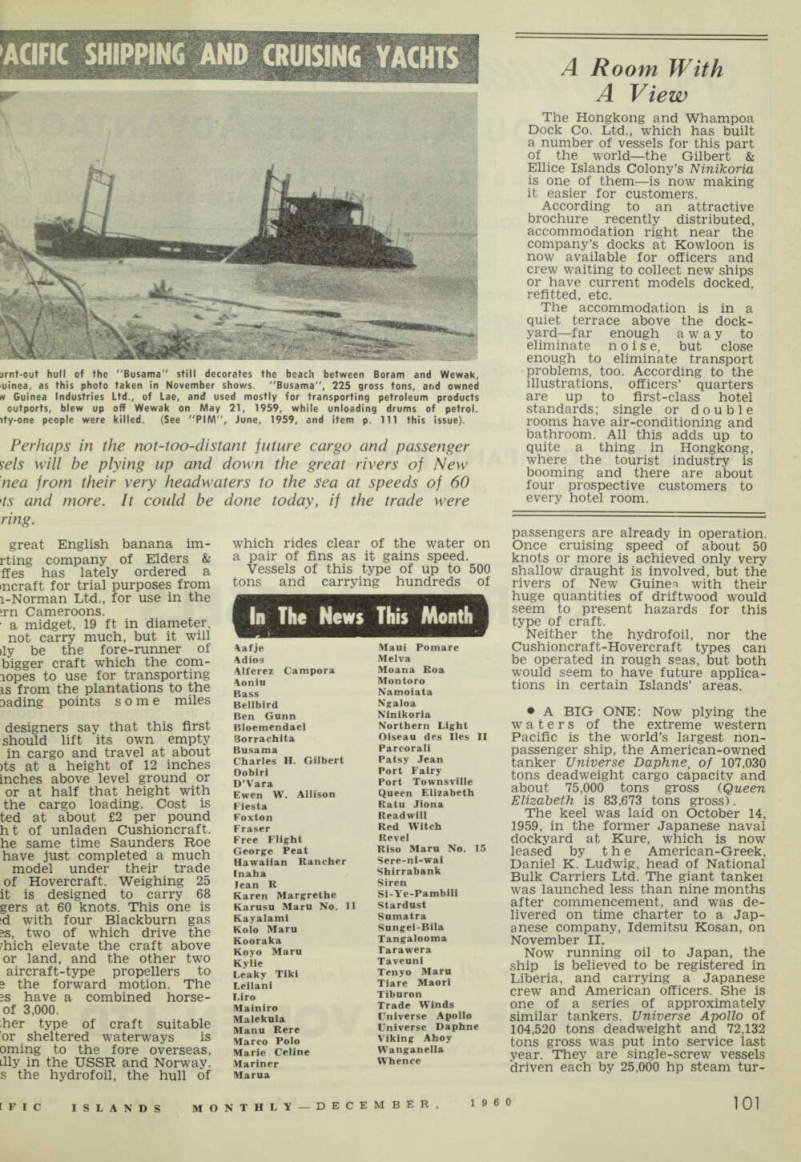
urnt-out hull of the "Busama" still decorates the beach between Boram and Wewak, uinea, as this photo taken in November shows. "Busama", 225 gross tons, and owned W Guinea Industries Ltd., of Lae, and used mostly for transporting petroleum products outports, blew up off Wewak on May 21, 1959, while unloading drums of petrol, ity-one people were killed. (See "PIM", June, 1959, and item p. 11l this issue).
at a service speed of 15 h knots are costing £A5,750,000 each, i verse Daphne is 9491 ft long, t in beam, and draws 48i ft loaded.
Jetting Around: In Auck
in November, as chief officer a Bank Line vessel Shirrahank, i arrived from Makatea with I cargo of phosphate, was Mr.
Johnson, who for a number of was harbour master and pilot ikualofa, and jointly master of Fonga Copra Board’s former Aoniu (now named Trade s). er leaving Tonga, Mr. Johnson I for a time in Australian il shipping. He joined the Line in June, 1958, and joined resent ship at Durban in May, Johnson is one of that select holding a foreign- go in g t’s ticket in square-rigged sail II as in powered vessels. There : much opportunity to acquire ailing qualification today. He led the necessary time in Cape ?rs before World War 11, h he is still only in his early s. ;il some years after the war, ihate loading at Makatea was ghterage, but now ships are f by single cantilever tube — lold at a time —at the rate of 500 tons per hour. Under good fcions lighterage used to be at e of not much more than 200 per hour working all hatches.
Juying Their Own; The
o Company of Osaka, which ranches and representatives in il Islands ports and whose ered vessels are well known is reported to be purchasing essels of its own. They are be to be second-hand ships, recent years the company has vessels of Japanese, Finnish, ?gian, Hongkong, South Koreali Liberian registry on time er. > ships now being prepared are stood to be comparatively and capable of uplifting es of coal from New Zealand’s Coast across river bars, as well wing Islands ports.
Lone Flying: Mr. Ken
sor, who for some years has radio officer-purser in Maui re on the New Zealand-Cooks has moved ashore to become ng instructor with the Auck- Aero Club at Mangere Airport, ng to the future, Mr. Windsor een building up his flying time ever his ship came to port, by the time that the “Pom made her last voyage he was to step into a flying job.
Dan McMahon, who came ”om the UK as radio officer in iew Moana Roa, has returned e Union Company’s Tarawera Wally Clutterbuck, formerly lior signals officer with the
RNZAF find very well known in Fiji, has taken over the new ship.
He had made relieving voyages in Maui Pomare last year,
• Changing The Guard:
The big Taiyo tuna mothership Koyo Maru, which left Japan August 16 and has been operating in the Fiji area since September 1, handed over her fleet to the com pany’s Tenyo Maru No. 3 north west of Viti Levu on November 23 and headed back home to prepare for her next job with the Antarctic whalers. Tenyo Maru No. 3 was on her second 1960 tuna mothership stint which will continue through into next February.
The Japanese university team, which was to have returned to Japan in the Banno ship Parcorali, departed instead in the much roomier Koyo Maru to see something of mothership operations en route.
• More Koreans For Pago
PAGO: According to a Japanese fishery newspaper, the number of South Korean tuna longliners de livering fish to the Pago Pago cannery was to be increased to ten vessels by the end of 1960 “as a re sult of difficulties with Japanese crews while ashore in American Samoa”.
The number of Japanese long liners would be decreased accord-
There had never been more three South Korean craft led at Pago Pago since they rrived there in 1958, until re- Japanese newspaper report lat the American Samoa Gov nt had received an under ng from the Korean boat -3 that two Samoan fishermen be placed aboard each vessel •ained in fishing techniques.
AVING FUN: As predicted tenth, Captain Leslie Boulton 26 years master of the Islands laui Pomare, and his crew of I were having their troubles ivering two ships to the Tas n Government from Auckland /ember. 354-ton Sumatra, towing the ined 385-ton vehicular ferry W. Allison —which served in ew Guinea area during the ider the name of George Peat to put back to Auckland with large to repair leaks in the bow. ships left Auckland on No r 5 and got as far as North The ferry was noticed to be by the head. porary repairs were carried heavy weather, and the tow i back at Auckland on No r 10. Sumatra sailed again No r 18 —but with the long tow t prevailing winds across the in, first to Eden, more could
well be heard of this operation be fore the job was completed.
• For New Hebrides: The
35-year-old steel motor vessel Kooraka, temporarily under Suva registry but soon to be transferred to Vila, New Hebrides, left Auck land on November 28 en route to the New Hebrides under the ownership of Mr. Geoffrey Seagoe, of Vila.
An ideal type of Islands craft, with shallow draught and ample cabin passenger accommodation, the ship had been purchased from Coast Steamships Ltd. of Adelaide.
Built in Scotland, Kooraka was em ployed by American Forces during the war so probably served some where in the Islands at that time.
She will now trade within the New Hebrides.
Mr. Seagoe said that he had made application for a new name for the vessel. The three names submitted, in order of preference, were Alde baran, Undine, and Efate. Lloyds Register does not show any other British vessel bearing the name Aldebaran at present, and this is the name that was approved for the ship.
• Unsatisfied Customer:
Also in Auckland in November was Cook Islands shipowner and Legis lative Councillor D. C. Brown look ing for a second-hand vessel. He later returned to Rarotonga per Voyage No. 1 of Moana Roa with out a ship, and disappointed that he had missed Kooraka, which was particularly suited to the Cook Islands trade on the score of draught and passenger accommoda tion.
He said that he had found the second-hand supply of vessels of this size and type in New Zealand and Australia was very restricted.
The Kooraka transaction was com pleted by Sydney shipbroker Cap tain Kennedy. The delivery was by Captain Ron Barnett and Chief Engineer Bob Fluker. Captain Barnett delivered Foxton and Aranui from Auckland to Papeete earlier this year.
® Calling Her Names: Mr.
Anthony Bambridge’s Foxton, men tioned above, now bears the name Namoiata —not Namiota as was earlier forecast. Mr. Bambridge is understood to be negotiating for the purchase of another vessel to add to his small Papeete-based fleet. Among his various interests Mr. Bambridge holds the lease of the British Caroline and Flint atolls north of Tahiti which he operates as copra plantations. • BACK IN SERVICE: Mr. D. C.
Brown’s 128-ton ketch Taveuni was back in service in November after undergoing a major refastening and redecking job at Pago Pago. Heading back for her home base at Raro tonga the vessel called at Puka puka, Rakahanga, Manihiki, and Suwarrow. She was to uplift a team
When three year old Liza Anne Lopez is not at the local kindergarten she plays on the pier at the Cruising Yacht Club, Sydney—but always with her life jacket.
Although she's sailed the Pacific in a small yacht, she can't swim. Liza is the daughter of Gordon and Roberta Lopez, of the WHENCE, seen above in Sydney after a leisurely trip across the Pacific from California.
Photos: Alan Fitzgerald
tanihiki divers from the latter and return them home for the tion of the hurricane season a successful 62 months of shell g there. 10 returning to the Cooks ser in November was the 169-ton,
-masted yacht-cum-trading
1 Tiare Maori, which has been up in Papeete for some time ving an engine breakdown. 1 Pacific Trading Company re y advertised their Penrhyn d property as for sale, and are reports that the schooner, back in service, is also on offer, ncident with reports that Cap- Hugh Williams’ Rarotonga 1, Noumea-built, 135-ton Dohin t be sold to Tahiti, there was news that Captain Williams’ ous vessel, Melva, now lies idle arwin.
SOLD AGAIN: Liro, ex Maria War ex Kokoda, has changed s again. As Kokoda, this 220wooden vessel was purchased BP’s in New Guinea in August, by Captain Emile Savoie and iates of Noumea. Two months she was resold to Mr. A. edous, of Vila, and the name 1 del Mar so recently given, •eplaced by Liro. n the vessel has been pur d by M. Janin, of Noumea, but is her present name and re g in the New Hebrides inter - 1 trade. i name Maria del Mar was ferred to the New Zealand lased vessel Marua, by Captain e, and it is now reported that vessel is again for sale. If sold would relinquish her present , which Captain Savoie retains is own ships.
Leported Purchasing:
agnie Francaise des Phos s de I’Oceanie, the company ting the phosphate workings akatea Island, French Poly and which is now establish -1 new township and major anese project at Forari, isa Bay, west coast of Efate 5 New Hebrides, is reported to iking a vessel for use in con n with that project. A wharf Iready been established, s company—generally known : FPO—owns perhaps the est looking vessel in the South c Islands trade today, the alined, 500 ton, French-built, rear-old Oiseau des lies 11. ally operating as a supply between Papeete and Makatea ar labour recruiting duties, this has made one or two voyages ' New Hebrides in connection the new mining project. Her tive predecessor, Oiseau des l three-masted, steel schooner aid to Mexico in late 1957.
Rouble Down Below:
;y-four hours out of Lautoka, for Dunedin, the nine-year sin g 1 e-s crew Port Line
motor vessel Port Townsville suffered a broken crankshaft on Octpber 29. Following some improvisati°n, the 8,070-ton ship, with ten passengers aboard, was able to limp slowly south to a point about 160 miles north of Auckland, where the company’s Port Fairy took her in tow. The big shaft could not conyeniently be replaced in New Zeath ree of the engine’s six cylinders have been blanked off for the voyage back to the UK. As a three-cylmder motor, the engine should still drive the ship at nine knots instead of the usual 15 knots.
• Still On The Move: The
US Fish and Wildlife Service research vessel Charles H. Gilbert, based on Honolulu since 1952, was
out on her 50th cruise in October- November, heading for Christmas Island, the Marquesas, Tuamotus, and Tahiti on a biological study of yellowfin and skipjack tuna. On similar research cruises the 105-ft, 188-ton vessel has logged 175 000 miles since she took up the Ho’no lulu station.
She was lengthened by 28 ft in 1953, a year after she was built at Tacoma, and more recently has been fitted with a special observa tion chamber below her bow, and windows in her bottom plates near the stern, from which a close study of tuna can be made under the stimulus of different kinds of bait fish and equipment. She has also been fitted with experimental long line fishing gear, and with gill nets
nidwater trawling nets, i of her recent cruises was as 3f a joint US-Japan study of )re tuna spawning grounds en the Hawaiian Islands and .. Results of this cruise are leing evaluated. rles H. Gilbert is commanded aptain William Tanaka and . Paris as chief engineer. She 3 a crew of 11.
RUISE PLANNED: Huddart r’s 9,876-ton Tasman service iger vessel Wanganella is ilsd to make an Islands cruise year, leaving Auckland June I returning there July 17 after f at Suva, Apia, Vavau, Nukua ind the Bay of Islands north ckland. In 1958 and 1959 the inella Islands’ Winter Cruises ited at Wellington.
Saving It All Behind;
tnd laundry king, Frank , was reported to have pur l the well known 35 ft, twin passenger launch Sere-ni- October. The craft will cen to operate a service from to Levuka as well as other charter work.
Topical Whaling
NED: According to a Tokyo report in November the Nitto ig Company has been unsuc .s^ekmg a licence from the Fishery Agency to allow it
Ji?-’ 725 ,-?f on Dl i tch 7 7ji all gS D ® hip Bloemendael 1 L-it 71 • Barendsz, ex Pan i n ? w .^ den ln 1931) Si whaling operations Central Pacific. The exact area of operations was not stated.
Ja ß? n en< ?£ whaling i lons Pacific, and also engages in sperm whalmg in the tropics for a month or so prior to the opening of the Antarctic whaling season oa mvi O J u v . , i rv e Antarctic whaling fleets have lateiy been moving south through areas. The Nitto operations, if licensed, would apparently be connned to the Central Pacific area, but as the whales migrate from the
Arctic and Antarctic to the tropics any operations in the latter area would effect the polar operations and add to the present admitted problem of over-exploitation of the world’s whaling resources. That is, as regards baleen or non-toothed whales with their edible oil (as opposed to the toothed sperm whales, which are less sought after).
• Trade Winds Moving
SOUTH; The Tonga-registered, 120ton ketch Trade Winds, with Athol Rusden in command, which has lately been in the New Hebrides- New Caledonia area, was expected to return to Auckland in mid-De cember for dry-docking. The ketch left there last March 21 and has
visited Tonga, Fiji, Samoa, Sllice, as well as the New les and New Caledonia. The jar-old Suva-built trading is said to be still for sale.
R Ew Ship For Ran Sur-
The Royal Australian Navy’s t ship officially joined the sur ieet in November. The ship, 3 Bass is the Royal Australian 5 fourth survey vessel and ; to seventeen the total number vy ships at present in com n, ? is a 90-ft general purpose , completed at Walkers Ship- Maryborough, Queensland, • this year. In Sydney she had equipped for survey duties, /ill begin her new career by ing in Victorian waters early mary. survey ship has a comple of two officers and 14 ratings, japtain is Lieutenant F. T. ;dy, assuming his first corn after experience in several ships.
:Edal For Courage: A
nurageous thing was done in .959, when the coaster Busama
blew up in Wewak harbour, New Guinea, while unloading drums of oil. There was a big death roll.
Cadet John Edwards was in charge of a Malekula launch, a quarter-mile away, when the ship exploded and fire spread everywhere.
Edwards took his launch to within 20 yards of the Busama, through a barrier of blazing oil. While suc cessive explosions occurred, Edwards rescued one European and several natives; and, later, he returned to seek survivors.
Little was said about this act at the time. On November 25, in Syd ney, Third Officer Edwards, aged 20, now of the Montoro, was form ally presented with the Bronze Medal of the Royal Humane Society. • MO AN A ROA IN SERVICE: NZ Islands Territories Department’s new Moana Roa left Auckland on her first commercial voyage to the Cooks on November 10. She had made a special run to Tauranga to load timber for the big housing pro ject at Niue before taking aboard her general cargo and passengers at Auckland. Another timber loading for Niue was planned for Voyage No. 2, scheduled to leave Auckland
He Show
cently at the District show, nea, this 60-ft [?]ed sailing was specially the Bipi Island nd is owned by e co-operative It can carry tons of cargo, enerally takes nd copra to market.
Cruise Craft
The 60-Ft Tangalooma,
built in Brisbane in 1938 and owned by Mr.
Eric Snook, of Madang, New Guinea, is avail able for tourist charters to local islands, lagoons and reefs. It usually does a 3½ hour cruise morning and afternoon when the BULOLO is in Madang. TANGALOOMA was used by Lowell Thomas, the American radio commentator, when he was in P-NG filming the Sepik River for TV.
t December 13. Mangaia was * another port of call on the two voyages. e her predecessor, Maui Pomare, lew ship will not operate to itrict schedule. In the Islands sspatch is governed by weather tions at open anchorages, and b New Zealand end if a delay lay or so means the difference en a poor or a good cargo ig, the ship will wait. This cement is never very satisfac for passengers, but it is a ion that cannot very well be d. east passengers will now know here is a roomy and comfort ship on the run, which can i the ocean gap between Auck and Rarotonga in five days. [URDER CHARGES: Islands were involved in murder ?s in November. In Wewak, Guinea, Domingus Kedabak, ;eaman from Netherlands New a, was remanded at the ne Court at Madang on a ; of having murdered Petrus Metekong—chief officer of the i-Bila. Kedabak is a member ; crew of the 600-ton Dutch and it was alleged that fol an argument over a pair of rs, Kedabak had swung an axe i, which had hit the chief on the head.
Pago Pago, American Samoa, Nobuyuki, 24, from the Jap tuna longliner Riso Maru No. s returned to Japan to stand or the knife murder of a sea iboard the longliner Karusu No. 11.
ARBOUR NEARER: Another owards the development of a ctory smallship harbour at >nga was made in November the Rarotonga Island Council r ed the expenditure of £6OO on ond-hand steel barge sections Die from the Ministry of in New Zealand, sd together, these separate dll form a 3 ft x 12 ft barge drilling rig.
s of Cruising Yachts
lonesia looks after visiting yachts [t is, in fact, a pretty good nlace That’s according to Mr. & Mrs. field of the yacht D’VARA, writing Singapore after a trip through ia from New Guinea. What they may or may not be typical, but rtainly interesting. Here it is: • leaving Sorong in Dutch New we intended sailing straight to ese Timor, and thence across the Dcean. However, we could make no against the mocsoon once out of Iter of the New Guinea coast, so run west to the passage between md Buru Islands. Off the passage squall struck and we took shelter icly beach. rtunately, some Indonesians came nd suggested that we go to their g with them. They were very , but in the morning insisted that
we see the chief of the village. He in his turn called in the military, and we were ®TSS to Ceran \ and interviewed by thrpf TJ° n , c ° mmander - and others. After i I k SCnt " S t 0 Area Head ‘ 9 “Although Amb °K - h i Although we had no visas or papers for Indonesia, and notwithstanding the fact that the Moluccas are a closed area, under military control, we were cleared and given th “ °! th S . .
We spent two delightful weeks in the Moluccas, then sailed for Dili in Timor.
Spent nine days there and attended the
celebration of the 500th anniversary of Prince Henry the Navigator.
“From Dili we passed up through Alor Strait and along the north coast of Flores to Reo Baai. Couldn’t get up the river to Reo, as it is too shallow, so went on to Bima in Soembawa. From there to Buleleng in Bali for 10 days, then Surabaia for nine days, and Djakarta for 30 days.
“In all these places we were welcomed with open arms and everybody went out of their way to help us. It was imoossible to have a meal on board and anythin?
equired doing to D’VARA was itely taken in hand, act, we have very fond memories iesia and would like to revisit there ie in the future. Naturally, there >t of petty restrictions, but if you ling to go along in the ways of utry and just take it easy, every nooths itself out. nyone else who is interested, it is y to have a visa, one for either ;ks or three months. Permission ; them comes from Djakarta, so >f time is needed when apnlying. ;a can be further extended once ;he country. Coming from the probably the best place to get a lili, which is quite a pleasant spot i to spend a few days. Also needed ling Permit for Indonesian waters, re issued by the Indonesian Navy, • must be obtained from Djakarta. , Sinapore we will cruise up the coast to Penang thence via the Islands to Ceylon.” > WITCH, 40-ft American yacht, orted with sails blown out and assistance 700 miles ENE of i on November 15. With owner fall, his wife and children Clyde ki, and Messrs. J. Smith and W. aboard, the yacht had cleared go 65 days previously. She was bted by the freighter HAWAIIAN R which reported the yacht’s i to the US Coastguard. The i frigate FRASER also stood by it for a time. A tow was being at that time. The yacht was originally heading for Tahiti.
URON of Santa Barbara with Ed ita Vessey aboard, which had left October 19, reached Auckland, r 4, after a rough passage. Future definite, but the 40-ft by as likely to remain in Auckland least a month—perhaps much f Mrs. Vessey, a Samoan, could permit to remain longer.
YE PAMBILI, the South African tch owned by ex policemen W. nd R. Gowan, reached Auckland smber 11 from Suva, and BEN llVz-ft ketch from Mystic, USA, r. and Mrs. H. M. Horn and d daughter Carlile and A. aboard, arrived from the same November 10. These two have ing the same route since Panama, ilund, who joined at Rarotonga, er of the Sydney converted 29-ft pacht READWILL which suffered
serious damage while entering Avarua last June.
BEN GUNN and SI YE PAMBILI will remain in New Zealand waters for some months. • MARCO POLO with Axel Pedersen lonehanding arrived at Gronigen, Holland, on November 3, on the next stage of his voyage to Denmark. He purchased the yacht in Auckland and left there in July, 1958. He has had companions on some stages of the cruise. • PATSY JEAN, 28-ft ketch of Auck land, at present based at Rarotonga where owner Don Silk and family and com panions are fitting out the Suva-built ketch SIREN (which has been up on the beach since October 4. 1951), made a week-end cruise with friends to Manuae Island in October. The 120-mlle return run to Rarotonga with a fair and fresh trade wind, was made in 23 hours. • VIKING AHOY, the sturdy motor sailer which has been in Fiji waters for some years, and preparing to voyage south to Invercargill. NZ, where her owner now lives, for a long time past, is now reported to be remaining at her Suva berth at least until the end of the current hurricane season. • MANU RERE, 34-ft schooner of New port Beach. Cal., with owners Wesley and Louise Herr, Henry Lucas of Tahiti, Helen and Phil DeVita. and Jim Bell aboard, sailed for the Marquesas, Tahiti, and westward in September. • ADIOS with Tom and Janet Steel of Newport, Cal., was reported still at Darwin in mid-October. They left Noumea last April and called at Port Moresby—with which port they were favourably impressed —and Thursday Island. They plan to continue the voyage towards Cape Town next April, with probable calls at Christ mas Island, Cocos, and the Seychelles.
Ideas of heading north to Southeast Asia ports have been abandoned due to the political situation in some of these terri tories. Friends should address mail to 840, 34th Street, San Francisco.
O KYLIE, 39-ft steel yawl of Sydney, which left that port April 23, was in New Caledonian waters in September and planning to head for Fiji. Calls were made at Port Stephens. Port Macquarie, Ballina, and Brisbane—where a month was spent, and Harry and Patsy Fink have been enjoying their stay at Noumea which they consider an ideal cruising area, though food prices ashore are very high.
Also in that port recently has been the yacht NGALOA manned by French Canadians Matty and Clare Luhtanen.
This yacht commenced its voyage from Sydney on August 29, 1958, and was re ported overdue bound Wellington, NZ, but arrived off Onehunga, September 29.
Exactly three months later NGALOA left that port to sail round to Auckland and was again reported overdue. A course was apparently laid directly for Noumea.
The Finks report that Noumea now has an excellent yacht jetty in the Baie des Pecheurs. The yacht club will build a clubhouse adjoining this pier when funds are available. Mr. “Bibi” Hubbard has been the driving force behind the pier construction. It has fresh water and bowser facilities. • MARIE CELINE of Nantucket; SKAAL of Norway; AAFJE of Sausulito; FREE FLIGHT of Honolulu; MARINER of San Diego; KAYALAMI of Honolulu; KAREN MARGRETHE of San Diego; FIESTA of Panama; BORRACHITA of Santa Cruz (West Indies); REVEL of Auckland; STARDUST of Sydney; and ALFEREZ CAMPORA of Montevideo, were all lying in Papeete in the last week of October. • NORTHERN LIGHT, 45-ft Norwegian built ketch with Australian journalist Eric Jessup lonehanding, left London last August for Spain, Cape Verde Islands, Panama, and Sydney via Island ports. • WILD GOOSE 11, 136-ft. converted VMS returned to Honolulu, November 14, after owner Max Wyman attempted to return the boat to Seattle but met with rough seas. WILD GOOSE II was the vessel which brought four-year-old Cecelia MacCauley from the Cooks to Honolulu recently, where she flew on to Minnesota for an operation on her heart. She died the day after the operation (“PIM”, Nov. r p. 13). • AWAHNEE, cutter, left Honolulu, November 11, for NZ via the Islands with owner-skipper R. L. Griffith. • FLYING FISH, 60-ft. staysail schooner (previously listed as a ketch) arrived Honolulu. November 14, after a pleasant cruise in French Oceania.
River Boat
With the removal of the sugar-mill from Nausori, Fiji, the old, wood burning, steamboats which were used to carry loads of sugar cane along the Rewa River have gone into disuse. In this photo graph the steam-barge RATU JIONA is tied up to the bank not far from Nausori, a highly satisfactory playground for a group of Fijian and Indian boys.