Sorting-Up Of Islands History
pp. 87-99 · Read in the full issue
The Month's New Reading
With Judy Tudor
By 1500 AD, most of the world—except the Pacific Ocean -had been seen and charted in rough outline by European filors.
ANIARDS and Portuguese had some down around Africa, and across the Indian Ocean, and itrated the archipelagoes of the Indies, and looked out east is over the great ocean. 1513, the famous Spaniard, ez de Balboa, crossed the ima Isthmus at Darien, and id “amazed” at the Pacific in, stretching endlessly west l. it none could even guess at ; lay between the East Indies the Isthmus of Panama. 1519-20, the Portuguese navi r, Ferdinand Magellan, led 5 ships around Cape Horn, ted Magellan Straits, crossed Pacific Ocean from east to , and recorded the first cir navigation of the world. He d a new world of Islands, cording to a new book, The overy of the Pacific Islands, ;en by Andrew Sharp, over 100 gators and explorers from pe entered the Pacific Ocean een 1500 and 1850 AD, and dis red, charted and described the sands of islands which com the countless archipelagoes of and South Pacific Ocean, arp has done a remarkable job. has examined hundreds of ished books, manuscripts and ry references relating to Pacific )ration; collated and compared checked the recorded facts; thus has produced a book which ; us, in handy, accessible form, full list of the explorers who wered the Pacific Islands, de of their ships and particulars leir voyages. is a book which every man who js about the islands in the :e, or makes plans for them, have available for reference, the first couple of centuries acific Ocean exploration, these ■ds were quite haphazard. 3 did find early publication a place in libraries; but most to have been buried deep in archives of a dozen countries. :he following centuries, some searched for, examined, com i, and used for the correction inumerable errors in material dy published. But the printed ds bristled with inaccuracies inconsistencies.
Sharp apparently has de i years to research, and now
gives us a complete history of this 350 years of exploration, accurate as far as seems humanly possible.
His footnotes, indexes, biblio graphies make the way easy for other researchers. If they doubt the conclusions of Mr. Sharp, they now can easily go over the same track for themselves.
(Discovery Of The Pacific
ISLANDS. Published by Oxford University Press. Australian price, 73/-.)
The Unofficial Historians of
The South Pacific
AND on this subject of Pacific history, latter day historians will probably never be able to repay the debt they owe to the old missionaries of the London Mis sionary Society who were prodigious writers as well as being stern realists and enthusiastic savers of souls. Modern missionaries are not nearly such dedicated scribblers.
However, two current LMS workers in the field have done something to repair the neglect in the last month, and each has produced a small book from widely different parts of the Pacific.
One of them by a comparative newcomer to the Pacific, Bernard Thorogood, concerns the Cook
Islands; the other is about Papua and is written by a veteran of almost 30 years in that field, Miss Constance Fairhall.
Mr. Thorogood sets the theme of his book with the title —Not Quite Paradise. The idea of the South Seas being Paradise has been the war-cry of second rate novelists too long, he says; often with no know ledge at all of Pacific conditions they have written tales that stir the wanderlust of city workers who think of the far flung island, so serene in the Pacific, as a place of music and dancing “where life is easier and the girls, always seduc tive in grass skirts, are easier”.
There are the other type of paradise seekers also —the seeker
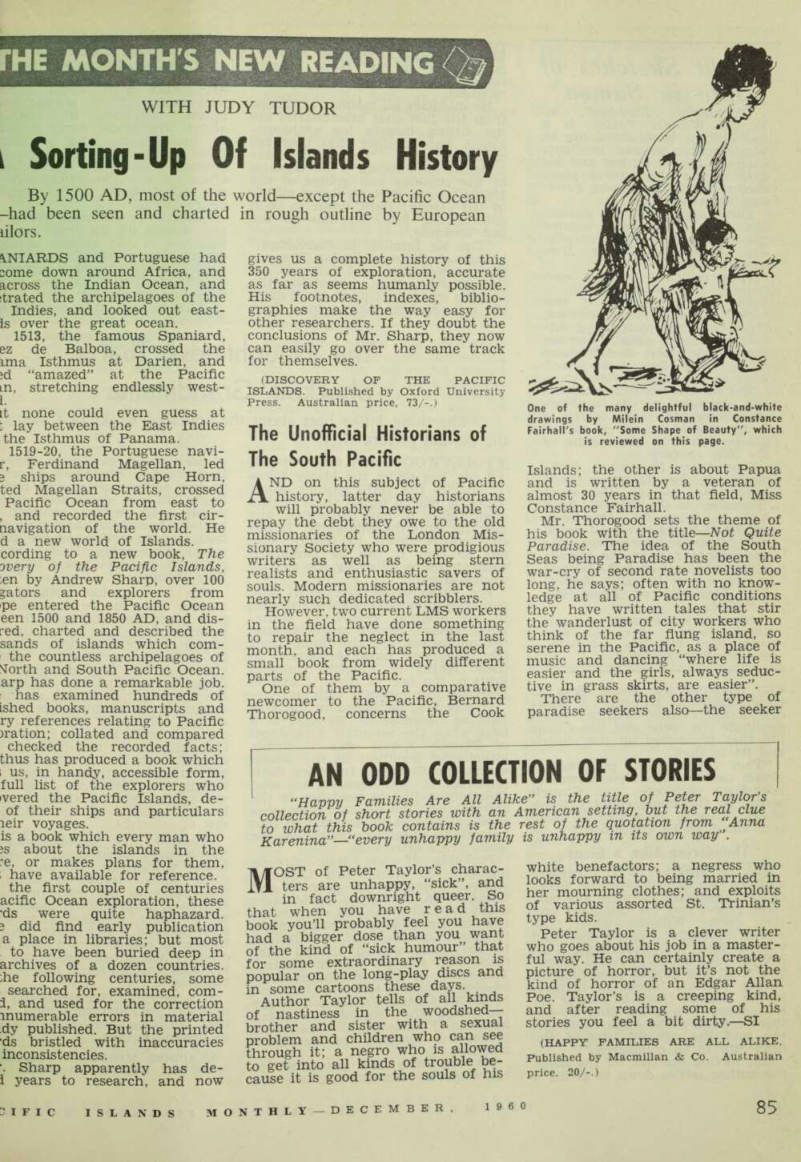
One of the many delightful black-and-white drawings by Milein Cosman in Constance Fairhall's book, "Some Shape of Beauty", which is reviewed on this page.
who imagines the South Seas as an ecclesiastical paradise. A para dise of fine church buildings which dominate the scene and the village life that is centred on the church and its services.
“They have seen pictures of plump pastors with their crowds of adorable children. . . . Church people in the home country think of the mission as a success story just about to be concluded.”
Thundering Like a Giant But the situation is far otherwise and one can almost hear the voices of the missionary giants of the past —the Lawes and the Chalmers and the John Williams —when the author thunders: “Young men and women find the sophistication of Hollywood a more powerful incen tive than the simple preaching of village pastors. There is holiness in the islands, there is honour for God, there is a living church; but there are self-satisfaction, material ism and the age-old sins of the flesh still to be conquered.”
But having got this off his chest, the author settles down to giving a
very human, entertaining and some times amusing account of contem porary life in the Cook Islands, setting out its problems, secular and religious.
He discusses all manner of things, from the fact that missionaries are the sitting targets for anthropo logists who consider that they are meddling with “delightfully in teresting old customs”; the vagaries of the comings and goings of the Maui Pomare, that regulated all life in the Group; right down to such entertaining local customs as the Big Wedding.
“The big families in Rarotonga,” he says, “rejoice in display. You see this at weddings and funerals. At the church before a wedding the groom’s party rolls up in hired cars; the rolling often takes a long time,
for it is not just a best man, but retinue. Depending on the bigne of the affair, there may be up a dozen groomsmen, all in nav blue suits with white garden buttonholes. They stand aroui looking awkward till the gii arrive. The bridal party may ha 12 bridesmaids, with a pair little flower-girls, all handsome gowned. Some of the local belles a often asked to be bridesmaids ai so collect quite a wardrobe dance frocks.
“This large group of young m and women fill the front pews a] the rest of the church is almc empty, for guests do not usual bother to attend such a minor pa of the festivities as the servic they line up for the feast.
“This is held in a packing she
pen area filled with tables rest m orange boxes. Boxes are also seats and provide the basic ort for the 400 or 500 guests, le door as they go in, gifts for couple are put in a large box. he families keep a good eye ;his, hastily supplying a new 3ting box when one is filled. this impersonal atmosphere cs the voice of the orator as he les back into memory, pro cing the family origins, its ss and lineage and proving the and groom to be an excellently d couple.”
That's Papua
3S Fairhall, a missionary nurse apua since 1932, is much more i to seeing her natives through coloured spectacles than Mr. ogood. Her small book — Some e of Beauty —consists of a col »n of pieces about people and ents in almost every district ipua. Most of the stories have iigious motif and reading the Docks, and taking them at face i, one might assume that there a great deal more religious -sliding in the Cooks than in a. netheless, Miss Fairhall has descriptive ability and a talent reducing authentic atmosphere this introduction to a story s: >day is a typical Delta day.
Coleman lamp failed last night; refrigerator went out because ?irls forgot the kerosene; the us won’t work and the type r has twisted its ribbon. I seem 3 always dirty just wrestling these things. Oh for a man : the place! When I came up hospital for morning tea at past six, I found only hot ' in the teapot and when I d it out looking for the tea (Over)
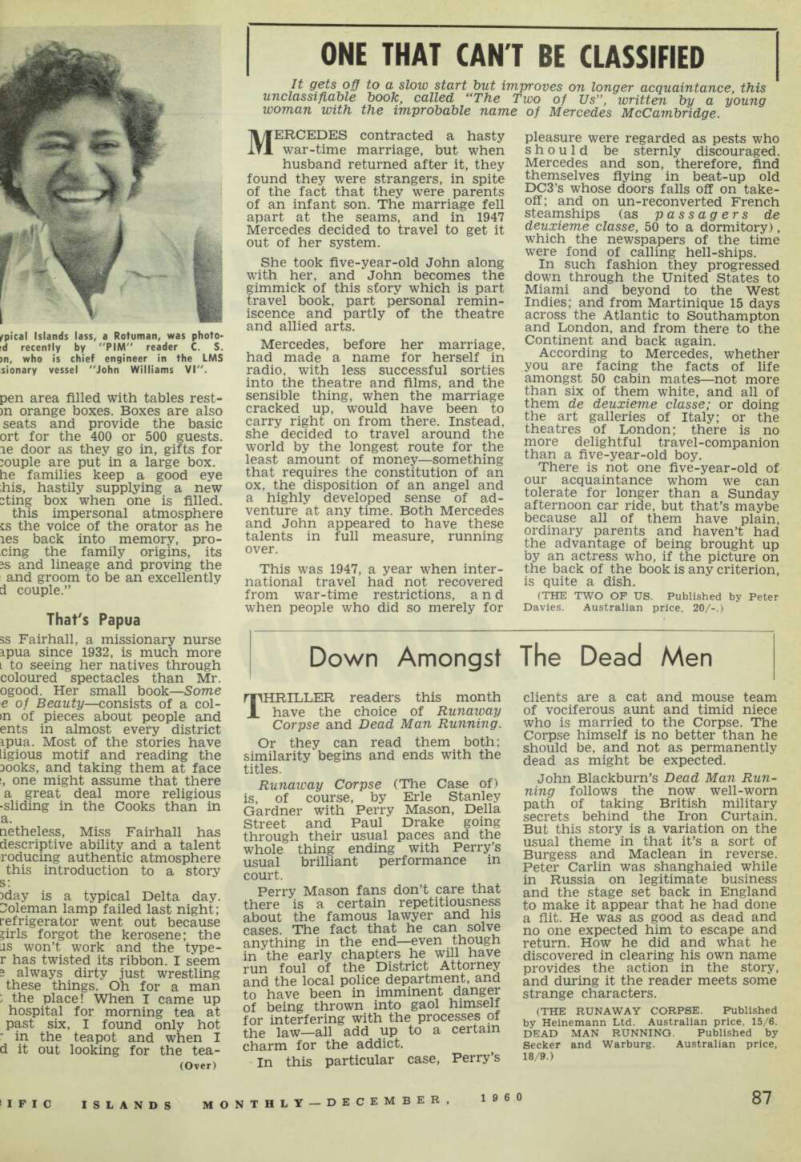
ypical Islands lass, a Rotuman, was photo ed recently by "RIM" reader C. S. on, who is chief engineer in the IMS sionary vessel "John Williams VI".
a dead cockroach lay in the l of the pot and waved its ; me.” •e is, of course, the other side ledger: “All the same, the s astonishingly lovely in the ig, and there is a poinciana n full bloom outside my v.” ips fail and house servants hot water instead of tea 2r Papua—but probably the al thing, whether you are lary, patrol officer, or some- Lst earning a living, is that ,s still a poinciana to bloom, river to look astonishingly unts of life in the Pacific in 'th century written by old nissionaries are amongst the referred-to books in PlM’s . It seems a good thing to t the present generation of leld workers is keeping up ssion’s subsidiary role of re of contemporary life in the Fairhall’s book is illustrated re amusing black-and-white gs by Milein Cosman.
Quite Paradise, 5/- Stg. Some
OF BEAUTY, 3/6 Stg. Both books lished by the Livingstone Press, ;ret Street, London, SWI.)
fears Before
lumbus
3 long been a possibility that Vikings discovered America uries before Christopher >us who is usually credited le feat. The late Nevil Shute one of his novels on this and now another English Henry Treece, uses the same for the third of his trilogy Vikings.
Norsemen were still pagans 30 years after the birth of by when the rest of Europe ng been christianised; and he French and English burnt . in their churches and asked o be preserved from these the devils themselves were incredible adventures on lorthern seas, visiting their Hebridean neighbours, and >• further on to Iceland and md. Of such stuff were their nade at a time when the rest rthern Europe cared little he Vikings were at so long t saw nothing of them, aeologists have discovered ley take to be Viking symbols ‘d on a stone in Minnesota prow of a longship has been in one of the great lakes of America. Treece has taken ncidents on which to build al novel of the two friends, Sigurdson and Gaint Grum who pushed out into un seas mostly because they nknown. whatever the Norse Sagas have told, the novelists seem convinced that it was a one
way traffic and that although the Norsemen saw America they did not return home to tell about it.
Sigurdson and his Vikings joined forces with the fierce red men they discovered on the seaboard of the new land, and with them journeyed along rivers and huge lakes to the Sacred Quarries, west of what we Superior. It is here Sigurdson finds his own Valhalla.
Mr. Treece is a schoolmaster and has a string of historical novels, adult and for children, to his credit.
His particular interest is Celtic Tv, or iu , , , ... In the present book, which would be suitable for adult or youngster, he has adopted quite successfully something of the style of the Norse Sagas. (viking’s sunset. Published by Bodley Head Ltd. Australian price, 13/6.)
If You Arp Tirpfl Whv?
IT lOU Are urea, vvny.
WOMEN who spend a lot of their time being unaccountably tired might find it a good investment to outlay a modest sum on a small
book recently published that tells them why they are.
The book has the unromantic title of Women and Fatigue and was written by Dr. Marion Hilliard, a specialist in gynaecology and obstetrics in Toronto, Canada. She died in 1958—but from a rare type of cancer, not tiredness.
Like surprises that are wrapped up in unexpected packages, there is a lot of good common sense in this little book quite apart from its main subject matte r—that of fatigue. Considering the amount of time that most females spend in con sidering their own femaleness and swopping notes with members of their own sex on the same topic, there are probably more miscon ceptions about female psychology and physiology than about anything else. A good Straightening out is called for on several occasions in a woman’s life and Dr. Hilliard with her brash way of writing, her sense 9* humour and long experience is 3 us t the one to do it.
Not that she suggests that women should play up to the role of frail
creatures; to the contrary. But I ing recognised the fact tl although fatigue is not peculiaj women, women do have par tic fatigues born of their own biol she advised on how best to < with the problem.
A woman’s store of energy I rise and fall capriciously during] monthly cycles but particularly c ing the three great crises of life. These should be handled, i the doctor, with understand humour and intelligence.
In addition, modern women more than biology to contend y —especially if she takes additional roles such as that of sistant breadwinner or car woman. It probably isn’t for notl that in primitive society the nat division of labour leaves the ti that require a constant low ou of energy to the women, while men deal with the short high em jobs and the emergencies.
The male is more adept at k( ing six ideas going at once; female, like the camel, much n susceptible to having a straw the ultimate damage. How rn times have we seen a woman wh successfully managing a ho: children and a job go complete! pieces over a simple dom< tragedy like a burst hot-w; cistern?
Dr. Hilliard isn’t against ca women, even when they try to o bine it with being a wife mother. She merely tells how i to accomplish it without cracl off at the pockets or without cn ing general mayhem in the resi society.
(Women And Fatigue. Publl
by Macmillan & Co. Australian p 13/3.)
Some Christmas Books
For The Small Fry
FIRST-CLASS quality books the young continue to come the Australian presses. we’d recommend for Christmas the small and the smaller fry' Patricia Wrightson’s The Rocks Honey and Judith Wright’s The j the Mountains Played.
Patricia Wrightson’s book is adventure story about Barney W and Eustace the aboriginal boy \ go looking for a mysterious st axe, guarded by the Rocks of Hoi of aboriginal legend. It’s an in ligent book, this, and one that advanced school child would enj( The Day the Mountains Playei of the younger picture-book vari< with some big appealing illust tions, many of them in col( by Annette Wright. Austral aborigines are the theme here,!
In the long-forgotten days bef the white men came, two little b lived with their tribe near J long yellow beaches of the noi and when enemies came to force] tribe from their hunting ground!
Dys enlisted the aid of the ains. It’s an attractive pro i.
ROCKS OP HONEY. Published by ind Robertson. Australian price,
The Day The Mountains
>. Published by the Jacaranda Australian price, 13/6.)
slovel With A
lating Plot
' SENTINEL, Bene Hardy’s el translated from the French, a fascinating plot which iw gets lost in the telling. It’s her 7, 1943, and the crippled submarine Moro, escaping , puts into the free port of :s for emergency repairs, crew are faced with the of being interned if they ex e 24 hours amnesty to which isels are entitled, or leave the ad face destruction at the of a British naval cordon for them outside. To corn matters, Moro has on board ian naval frogman with the sk, yet unperformed, of slip to Gibraltar. book tells of the 24 hours which the decision has to be md although there is much est, the reader feels that the e could have been a little aut, the atmosphere a little realistic than the author s it. A love story which rs through the tale never s to be taken seriously.
SENTINEL. Published by The :ead Ltd. Australian price, 17/-.)
fo Be An
ustralian
' John O’Grady scooped the I as Nino Culotta in They’re T eird Moh and Cop This Lot, icult for anyone to write a istralian novel and not be of imitation; or not to be by comparisons.
Vizzers came to Australia unatra in 1929 and therefore
SS, 1 ?. ®? id ,. to be a, very ancient New Australian. His life, after he S? wvSES wo d ?-P the out b re^ k n » f°Jlows so closely Sf a Qis77 h n/* h S2’
Sir HoHl,lts a pretty
fair deduction that the appearance of the novel now and not 20 years ago was influenced in part by the overwhelming success of Nino ; , The thing that set a different tempo in the cases of Nino and Peter was the economic climate in which each found himself on arrival Vizzers makes it a point that the best migrant is not the one that acquires wealth soon after arrival, but the one who, after years of adversity, can look afifec-
tionately at Australia and say, “She’ll do me”. , Peter’s story covers the period be tween the Depression year in which he landed up to the time he sailed away again on a troopship from Fremantle at the beginning of the War as a member of the 2nd AIF.
Apart from that, his experiences with wild Australians and his reac tions to their peculiar language, in grained customs, their hobbies and their sacred institutions are much as Nino’s.
He got himself a room in the boarding house of Mum Mullins— “bloody old nympho”—at 15/- a week for bed and breakfast; learned about SP bookmaking; the ways of pubs and barmaids who presided
ver, and the virtues of beer >osed to those of plonk which leaper, quicker but inferior, earned what it was like to be »n to an over-gorged labour t and what it was like to odd id cut scrub or sweep floors living. Finally, of course, the ; of a European education and ; personal talents won out, he novel closes with silver is a story with a lot of and it’s aided and abetted s department by New Cale l born Emile Mercier’s ig black and white drawings.
LL DO ME. Published by Jacaranda ,td. Australian price, 19/6.)
Wrinkled Up
ace world is composed of two ids of people, (a), salesmen; d (b), people who don’t want r anything but can be per 1. By following the rules, and all, by being sincere, (a) has ge on (b) all along the line, s made abundantly clear in book called How Top Sales men in Australia, by W. R. im. Mr. Gresham is the ing-director of International pondence Schools, le first part of the book, Mr. im tells you in 10 chapters 0 be a good salesman—the es you should have, how to e your sales talk and even ;o wear. The last section con f a number of case histories 1 by top salesmen who have y sold things like travel and ivertising and motor spares, is a book whose distribution
should be restricted to those who practise or aspire to practise the craft of selling. Let loose amongst the general public—who are pre sented as a lot of wet hens with no minds of their own—it would be more likely to build up acute sales resistance. For example, such trade secrets as “Methods of Closing the Deal” make fascinating reading if you happen to be permanently amongst the (b)s.
There are, we are told, at least seven approved methods of asking for the order including The As sumption, The Last Chance, The Surprise—and so on. In the first method, when the salesman reckons he has softened up his victim suf ficiently and the fellow is ready to buy, he picks up his order book and says: “What are your initials Mr.
Blank?” Or: “I’ll telephone this order immediately, Mr. Blank.”
If Mr. Blank doesn’t protest, the sales is “automatically made”.
Apart from the constant exhorta tion to be sincere, the book is full of bits of potted wisdom like: “The only place ‘success’ comes before ‘work’ is in the dictionary.”
And there are bits of verse that are positively overwhelming: A smile is quite a funny thing, It wrinkles up your face, And when it’s gone you never find Its secret hiding place. (First verse ) V And since a smile can do great good By cheering hearts of care, Let’s smile and smile and not forget That smiles go everywhere. (Third verse ) I’ve always suspected that sales men were a tribe apart, and this book proves it.
(How Top Salesmen Sell In
AUSTRALIA. Published by Angus and Robertson Ltd. Australian price, 25/-.)
This Month's
Weird Lot
Kathleen sully has about eight novels to her credit and is described as a writer of “originality and power”; a “prim itive amongst novelists”: and numerous other praiseworthy things by famous reviewers on the Sunday Times, Observer, Tatler, etc. By this you can conclude —if you know the signs—that Miss Sully is strictly not for the bourgeois.
And your conclusions would be correct as far as Skrine, the latest of her masterpieces, is concerned.
Skrine is a long-haired vagabond who wanders around England murdering people for small morsels.
Mind you, it isn’t the kind of Eng land that it once was. It’s been hit by “Something”, and although what is never said in plain words, one supposes that it was some kind of H bomb. The leafy lanes and the green grass and the trees are gone, and what remains bears a close re
mce to the country around
era Rocket Range, As protec
igainst the Skrines, people
nore regular habits have got
er in sort of walled towns illages, which in turn makes cult for Skrine. ;he book opens, he has just red an old woman for one ,te and is sitting there amid solation quite cast-down and to make up his mind to bury Ithough why he should bother clear.
l later stage, her spirit and
)f the other people he’s killed 0 follow him and out of his it he is reborn and finds God.
nothing.
is all a bit above our head
would be right down the alley
>ple who like the “culture”
American TV series called oilight Zone and the products
Robert Herridge Theatre, also
mrrently shown on ABC Tele ;NE. Published by Peter Davies, an price, 17/-.)
's New in Paper Backs
GRAND SOPHY, by Georgette Like all of this author’s period it is full of the blue blooded •acy—and Sophy, who having been up as part of an army of on in Europe (after the Peninsula ;uts everyone down to near-enough roday’s world of trade unionism ack is more often right than his seems an unlikely one in which gallants and their ladies could But the Heyer novels seems more then ever, (PAN GIANT).
G LOVE, by Johannes Allen. As s are considered such interesting 10 doubt many readers will like how a 17-year-old meets up with how “three men entered her life”, aager is Danish which may make le thing more tolerable for those ‘1 such goings-on can’t happen
Great Pan).
Mo Man Write My Epitaph,
ard Motley. This is the sequel ck on Any Door” which told the Nick Romano who went to the chair for murder. The new novel the child of that murderer and in the Chicago slums with a drug mother and his efforts to break his environment. Of it is has been said that it is “ . . . rough, meaty ... an undeniable chunk n life”; and that the author “pins rs back with the brute force of
Ing”. (Pan Giant).
1 Years Solitary, By Dr.
lone. The author spent seven s a prisoner of the Communist hrown into prison as an “English patently for no other reason than e had had an English governess lild in Budapest and spoke the :. Because careers for women aited when she had to make the it the beginning of this century, se medicine, but only because she was to be preferred to the only ive —teaching. Being a doctor helped her survive her ordeal,
however, that and a particular type of courage and tenacity that had the Reds baffled. (GREAT PAN).
The Promise Of Nigeria, By Sam
Epelle. Britain’s largest African colony became independent only in October this year, but the Nigerian author of this book jumped the gun a few months beforehand and compiled this assessment of the country that could give Ghana a run for African national leadership. The book is an original—specially written for Pan Books. The author is active in public re lations work, is a writer and poet of some note in his own country, and a broad caster. He has travelled widely in Western Europe. His book gives something of the history of Nigeria and its build-up towards independence; he outlines the problems of the present and the progress the new
country hopes to make in the years ahead.
(Pan Giant).
THE BOWMAN TOUCH, by Hartley Howard. Featuring the “dynamic private eye, Glenn Bowman”. It says so on the cover. Strictly for those who like their crime stories mixed up with females who go in and out in the right places even if they do pack a gun. (FONTANA).
THE SURE HAND OF GOD, by Erskine Caldwell. Any connection between God and the behaviour of this writer’s old Southern style females is strictly fortuitous. And in this particular number where a plump, warm-hearted widow and an eager-to-learn teenage daughter go man-hunting together, it’s the men who need the help from On High. (GREAT PAN). (Over)
BEGINNER’S LUCK, by Paul Somers.
Hugh Curtis was a brand new newspaperman and when he was told to go down into the country and try to find out what has happened to the cannon ball stolen from Lodden Castle, he thought it was some sort of joke. What happened next was a first-class murder mystery. The way Somers tells it, being a newspaper reporter is easy, interesting and very rewarding. Maybe we’ve been working for the wrong paper. (FONTANA).
Memoirs Of A Tattooist. Like A
dragon on your back or a couple of anchors on your wrists? Terribly conventional desires, according to George Burchett who practised in London for 55 years and in his time tattooed such exotic items as pints of beer, plates of roast duck, wills, and copies of famous paintings
on gentlemen’s fronts and backs. For the fair sex he performed all-over lacy patterns of butterflies and flowers from neck to knee and even beyond. Hundreds of stories go to make up the reminiscences of the greatest tattooist of our time; but even George doesn’t explain successfully why civilised man (and woman) goes for this kind of primitive self-adornment,
(Great Pan),
A Case For Inspector West, By
John Creasey. Over 20 million Creasey who-dunnits have now been bought by satisfied fans—a fact that speaks for itself without any embroidery from mere re viewers. (GREAT PAN).
Miss Bungle Married, By D. E.
Stevenson. This may, as we are informed, be a sparkling comedy of life and love,
but the fact is that things have n on a bit since this was first publish* 1936 with the result that it seems j as far out of this world as one of i Quaint Olde Movies circa 1933, that Australian Broadcasting Commission t] are suitable for Channel 2 vie
(Fontana).
The Talented Mr. Ripley]
Patricia Highsmith. This is a Jekyli Hyde up to date, but now they ca schizophrenia. Mr. Tom Ripley take talents with him to Europe and thet a romp all over Italy and France,] plenty of scope. A dissection of criminal minds with a European I thrown in. (GREAT PAN).
The Case Of The Velvet Claw
Erie Stanley Gardner. When trouble up for Eve in the small hours of the : —someone had shot her husband—it natural that she should ring Perry M A bit too natural, thought Della S (who, as everyone should know by no Perry’s confidential secretary). (G 1
Pan).
The Millionth Chance, By J
Leasor. The late Nevil Shute ‘ tol something of the tragedy of the RlOl giant dirigible which ended its life those of the 48 who had travelled in on a French hilltop on October 4, Leasor goes into the whole episode the blunders that led up to it in siderable detail. Within seconds of hi the hill, the RlOl was a raging holo from which only six escaped with lives. It was the end of Britain’s att to enter this field of air travel. (GI
Pan).
CALAMITY TOWN bv Ellery Q Perry Mason’s big rival. He went quiet town looking for a place to wr book. But it was not to be. He ste right into someone else’s murder
(Great Pan).
They Fought For The Sky
Quentin Reynolds. This is the story ol fighter pilots of World War I—the who first wore wings, and usually no very long in the frail contraptions of and wood that passed for fighter pi in 1914-18. With a collection of ilia tions of the first air fighters—human otherwise. (PAN GIANT).
This Is The Schoolroom,
Nicholas Monsarrat. This is the first lished novel of a man who waited ( some time to become a best seller— “ The Cruel Sea” after War 11. This novel is the story of a young man wi social conscience who matured with Depression of the ’Thirties and who he must go off and tilt at windmills in Spanish Civil War. First published in 1
(Pan Giant).
DYNASTY OF DEATH, by Taylor C well. A long (832 pp) complex novel, vigorous and dramatic as it follows fortunes of two families. Bouchards Barbours, who control a firm of armai manufacturers. From a small concer mushrooms until it influences the fat nations and becomes responsible for mi and death on an enormous scale. (F
Tana Monarch).
The Trojan Horse, By Hamn
Innes. Refugee Paul Severin, an Aust Jew, finds himself wanted by Scot!
Yard for a murder he did not con and wanted also by Nazi agents for new diesel engine which could transl war in the air. Suspense builds up hero-lawyer Andrew Kilmartin, chew Severin’s story, discovers that promil
le in wartime England are working he Nazis. (FONTANA, Yellow).
VNY, by Ada Lewis. Love, reckless etc., in eighteenth century London, the women were really women.
I Giant, 5/-).
E MANDARINS. French writer ne de Veauvoir has rightly been ac ted for this thick novel of literary political life among the intellectuals ustwar France. (FONTANA, Monarch ). ir copies from Wm. Collins (Over- Ltd. Australian prices all 3/9 with exception of Let No Man Write My ph, The Promise of Nigeria and Grand Sophy, which are all 5/- each.) iNTAS STORY : The current
5 of Qantas’ always-interesting
azine, Airways, is devoted en y to the airlines’ 14 years of eering history in Papua-New lea. Qantas bowed out in Sep )er. TAA and Ansett-ANA took the Sydney-NG service and . took over internal operations The Airways story includes some nificent colour and black and e pictures that show what es P-NG flying unique in this d. We’ve always thought that tas didn’t get full credit for the it did for the Territory. After ig this issue of Airways, others be inclinded to agree with us.