The Wild, Wild Women Of The Marquesas
pp. 80-81 · Read in the full issue
Didn’t Break The Spirit Of Mr. Crook
By R. A. Langdon, Author of “Island of Love”
William Pascoe Crook, the first missionary to be left in the Marquesas Islands, was a pioneer in more ways than one. Besides being the first European to live in the Marquesas, he was the first person to establish a boarding school in Australia, the founder of the Congregational Church in Australia, and he helped to print the first books ever printed on an island in the South Seas.
R. W. Robson, in his article in October “RIM”, left Mr.
Crook somewhat uncertainly among the wild, wild women of the Marquesas. He said that, after the mission ship “Duff” sailed back to Tahiti in 1797, Crook appeared “to have gained approbation as a hard-working, conscientious missionary”.
rHS was not quite the case.
Crook was a conscientious, hard working missionary all right, but he did not gain the approbation of the natives.
After the Duff sailed, the Mar quesas gave Crook a pretty rugged time. They would have nothing to do with his attempts to Christianise them, and they soon stole all his clothes.
Nothing was heard of poor Mr.
Crook until the end of his first year in the Marquesas when an American sailing ship put into the island of Tahuata in search of an anchorage.
Not finding one, the captain de cided to go on to Nukuhiva. But just as he was leaving, he saw a naked “native” paddling out to his ship in an outrigger canoe.
He paid no attention to him until the “native” called out to him in English.
Surprise turned to astonishment when the “native” clambered aboard and introduced himself as William Crook, sole representative in the Marquesas of the London Missionary Society.
Crook Was Stubborn The captain, after listening to a tale of woe, tried to persuade Crook to leave the islands in his ship. But Crook, who was the stubbornest of missionaries, said he would accept a passage only as far as Nukuhiva, where he would try his luck again.
Crook stayed in Nukuhiva for a year, but he made no more progress there than he had done in Tahuata.
When a whaler called at Nukuhiva, he jumped at the chance of being taken off.
A Marquesan called Timotiti went to London with him and was ex hibited there for the benefit of the missionary society. But he pined away and died before attracting much attention to his heathen islands.
A journal which Crook kept dur ing his two-year spell in the Marquesas is now in the Mitchell Library, Sydney. As Crook was the first European to live in those islands, the journal is of particular interest to anthropologists.
Went To Sydney Crook’s reverses among the Mar quesas did not diminish his missionary zeal.
In 1803, when he was 28, he accepted a call from the London Missionary Society to take up mission work in the projected settle ment under David Collins at Port Phillip Bay.
He reached Sydney in November, 1803, but by that time the settle ment at Port Phillip had been abandoned. ☆ R. W. Robson told the story in October of what happened when the first Christian missionaries in the Pacific met the wild and beautiful women of the Marquesas. Here, R. A. Langdon supplies a colourful sequel which also happens to be of historic interest.
In this situation, Crook got a ; as a teacher in the school at Pari matta. He remained there m Governor King sent him as a sto: keeper with William Paterson’s fl expedition to settle northern Ti mania. However, the expedition v forced back by bad weather a Crook’s appointment was cancell Back in Parramatta, Crook tc up teaching again and set up Ai tralia’s first boarding school.
An advertisement in the Sydr Gazette for August 19, 1804, si that pupils would be “taught read, speak and write the Engl: language with accuracy and p: priety” and that Mr. Crook woi “attempt to store their minds w the general knowledge ... maki every part of education as pleass as possible”.
Founded Church During the rule of Goverr Bligh’s opponents, Crook was giv the job of conducting divine serv: and baptisms. He moved to Sydn where he opened a boarding sch( for young ladies on the corner Hunter and Bligh Streets.
In 1810, Crook founded Ai tralia’s first Congregational Chur in this schoolhouse. But Govern Macquarie, at the instigation Samuel Marsden, the Colon: Chaplain, immediately rebuked h for administering the Lord’s Supp while an unlicensed and an u ordained clergyman.
However, Crook’s church co: tinued in existence until 1816, wh he left Australia to take i missionary work in Moorea, Tahft sister isle. This was just after Ki] Pomare II of Tahiti had succeed in imposing Christianity on tl natives of Tahiti and Moorea 1 force of arms.
Crook had learned something the mysteries of printing durii his sojourn in Australia, and c Moorea he helped to print the fir books ever to be printed on an islar in the South Seas. These books we: a Tahitian spelling primer, i Tahitian catechism and a Tahitis version of the Gospel of St. Luk In 1818, Crook crossed over 1 Tahiti, where he opened the fir
>n station at Papeete, now the I’s capital. stayed in Papeete until Oc -1823, when he left to establish ;ion on Tahiti’s Taiarapu pen i. The post at Papeete re ;d unoccupied for two years George Pritchard (later to be )iled in the trouble following i’s annexation by France) Dver.
Back to Marquesas ok apparently did a good job apeete, for the missionary 1 says: “It is to be feared that eople received much moral in curring the time the post was t from the intercourse of of vessels which entered the ur subsequently to Mr. Crook’s ture.” 1825, Crook visited the resas again with a couple of ian preachers whom he left to carry on where he had left 1799. en Crook returned to Tahiti, imained at Taiarapu for five years. He then went back to alia with his wife and nine en. resumed hi s teachings and 'al work in Sydney, and after le built a small Congregational h at Watson’s Bay. This was ed in 1841, by which time he 6 years old and in bad health. last years were spent in Mel e where he lived with a son. ed there on June 14, 1846.
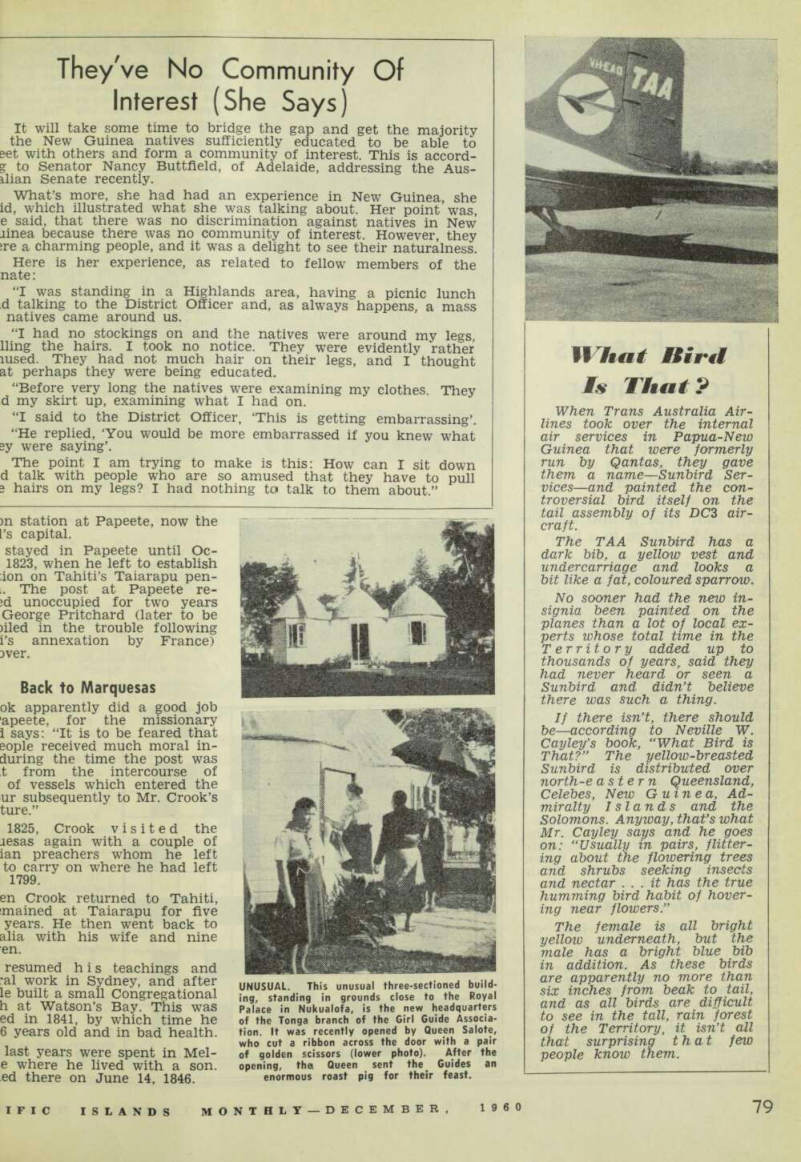
UNUSUAL. This unusual three-sectioned build ing, standing in grounds close to the Royal Palace in Nukualofa, is the new headquarters of the Tonga branch of the Girl Guide Associa tion. It was recently opened by Queen Salote, who cut a ribbon across the door with a pair of golden scissors (lower photo). After the opening, the Queen sent Guides an enormous roast pig for their feast.