Sydneysider
pp. 67-70 · Read in the full issue
Goes Walkabout Mother Is Still A Boy’s Best Friend
Rabaul, New Guinea.
If you are a native in New Guinea these days the possibilities are endless —you might even wake up one morning and find yourself a doctor, a bishop or a member of the Legislative Council.
If you are European and don’t like your own future, you can get out. If you are Chinese you can become naturalised and do the same thing.
But if you are of mixed blood and some of it’ native, you are stuck with it, and the indications are you’ll be left to rot where you are.
LIKE a lot of other people who have been in and out of the Territory for years and think they know something about it, I haven’t concerned myself greatly with this minority group which gener ally, and in the face of official discouragement, wants to be known as Euronesian.
But the other day, when seeking other informa tion here, I was told that the Department of Native Affairs now had a Welfare Officer—a Mr. T. Daw— and that I might find it worth while to see him and find out something about his job.
I did, and it was. Mr. Daw is an Englishman and if you were inclined to look at iti in that light, you could consider him a bird of ill omen. For, since the war Mr. Daw has been in India, Burma and Malaya and to each of them came independence, and his job folded up and he left. , Now he’s in New Guinea where there is also much talk of independence—someday. Unlike some Tern torians who still say they can’t see it happening here, he reckons that he sees exactly the same pattern being repeated in NG as he saw in the other three countries. , ..
The next phase, he thinks, will be when the natives start writing on walls— “Australians—Go Home”.
Trouble Fixing
That’s as maybe. In the meantime, Mr. Daw’s job is that of trouble fixer. It seems that anyone, of any race, can take their problems to him. The mixed race people have problems oftenest and occupy a fair chunk of his time. . , For some reason that I don’t know, the local mixed-race people of Rabaul are known as the Kambiu community; the road that leads from Rabaul proper down to their part of the town is called Kambiu Avenue; and their club is the Kambiu Club.
It’s probably a Malay word, but its significance escapes me. , . , , The place where the Kambiu people live is called Malaytown. Had I ever been to Malaytown? No I hadn’t so we got into Mr. Daw’s car in order to catch up with this part of my education. (Over)
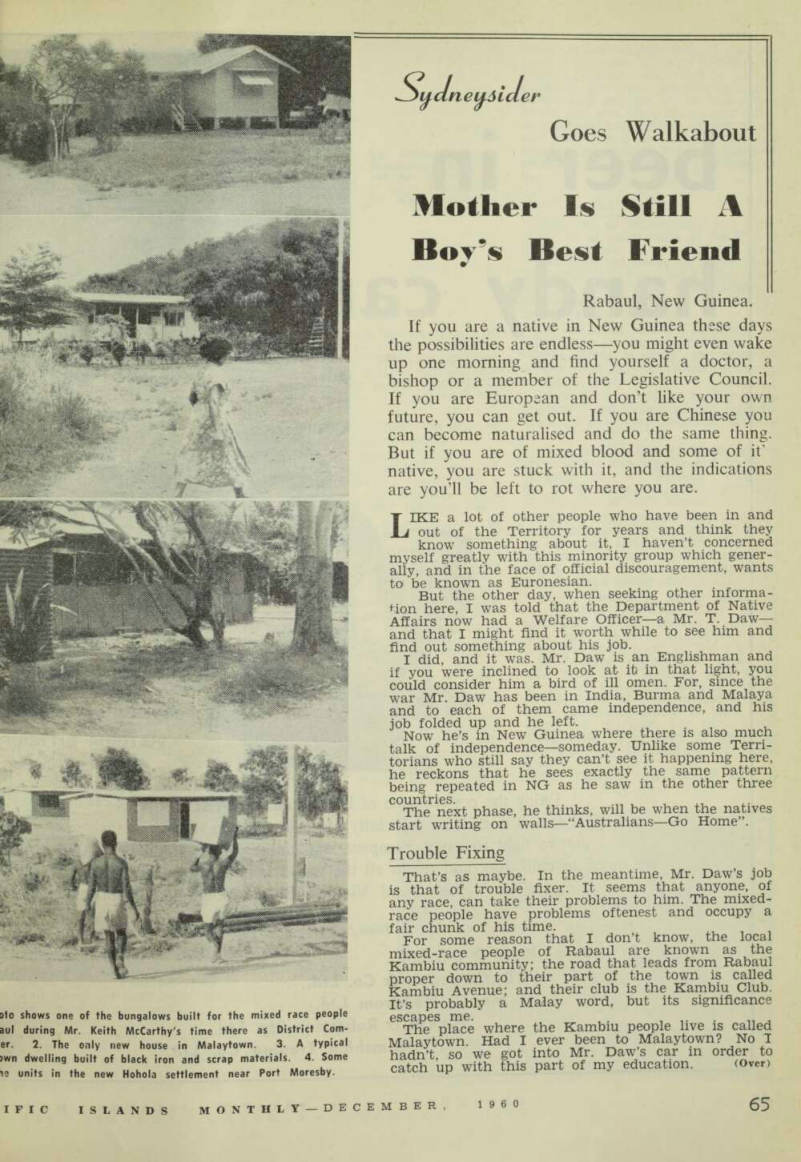
oTo shows one of the bungalows built for the mixed race people aul during Mr. Keith McCarthy's time there as District Com er. 2. The only new house in Malaytown. 3. A typical own dwelling built of black iron and scrap materials. 4. Some 10 units in the new Hohola settlement near Port Moresby.
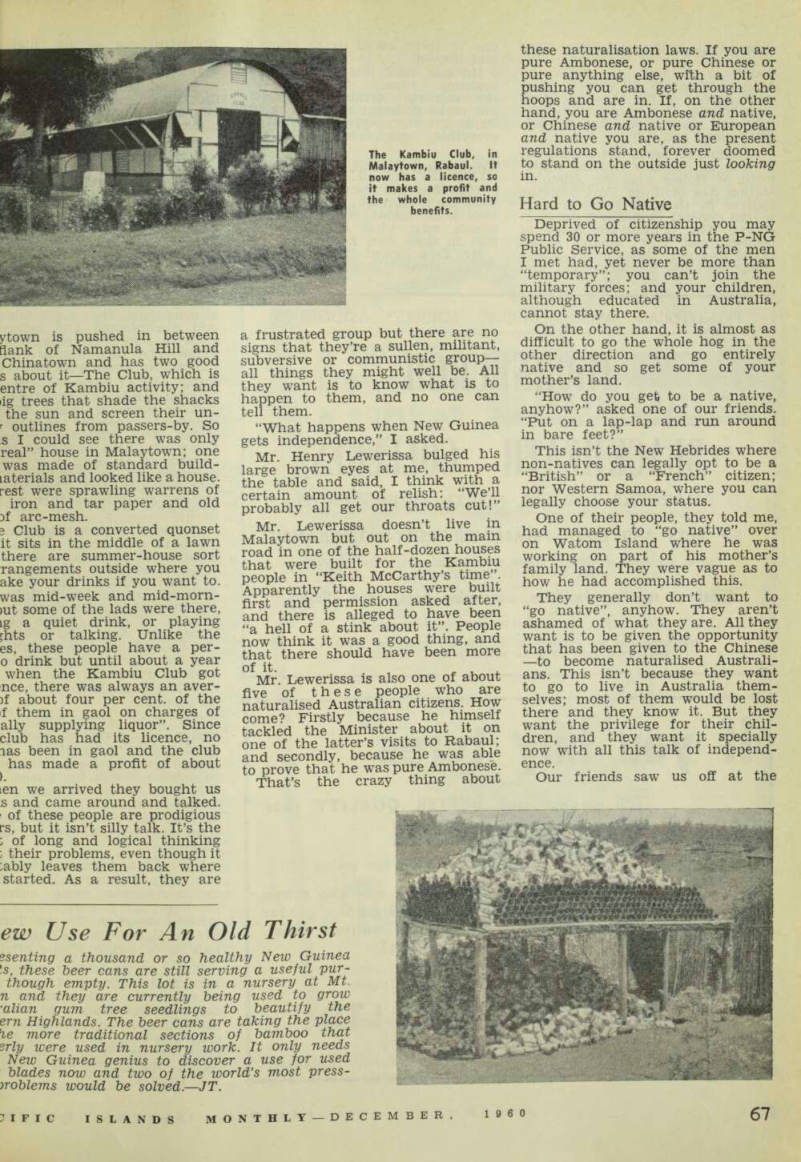
ytown is pushed in between dank of Namanula Hill and Chinatown and has two good s about it —The Club, which is entre of Kambiu activity; and dg trees that shade the shacks the sun and screen their un r outlines from passers-by. So s I could see there was only real” house in Malaytown; one was made of standard build laterials and looked like a house, rest were sprawling warrens of iron and tar paper and old 3f arc-mesh. 3 Club is a converted quonset it sits in the middle of a lawn there are summer-house sort rangements outside where you ake your drinks if you want to. was mid-week and mid-morn >ut some of the lads were there, ig a quiet drink, or playing ;hts or talking. Unlike the es, these people have a per o drink but until about a year when the Kambiu Club got nee, there was always an aver )f about four per cent, of the f them in gaol on charges of ally supplying liquor”. Since club has had its licence, no las been in gaol and the club has made a profit of about I. ten we arrived they bought us s and came around and talked, of these people are prodigious rs, but it isn’t silly talk. It’s the : of long and logical thinking ; their problems, even though it :ably leaves them back where started. As a result, they are
a frustrated group but there are no signs that they’re a sullen, militant, subversive or communistic group— all things they might well be. All they want is to know what is to happen to them, and no one can tell them.
“What happens when New Guinea gets independence,” I asked.
Mr. Henry Lewerissa bulged his large brown eyes at me, thumped the table and said, I think with a certain amount of relish: “We’ll probably all get our throats cut!”
Mr. Lewerissa doesn’t live in Malaytown but out on the main road in one of the half-dozen houses that were built for the Kambiu people in “Keith McCarthy’s time”.
Apparently the houses were built first and permission asked after, and there is alleged to have been “a hell of a stink about it”. People now think it was a good thing, and that there should have been more of it. .
Mr. Lewerissa is also one of about five of these people who are naturalised Australian citizens. How come? Firstly because he himself tackled the Minister about it on one of the latter’s visits to Rabaul; and secondly, because he was able to prove that he was pure Ambonese.
That’s the crazy thing about
these naturalisation laws. If you are pure Ambonese, or pure Chinese or pure anything else, with a bit of pushing you can get through the hoops and are in. If, on the other hand, you are Ambonese and native, or Chinese and native or European and native you are, as the present regulations stand, forever doomed to stand on the outside just looking in.
Hard to Go Native
Deprived of citizenship you may spend 30 or more years in the P-NG Public Service, as some of the men I met had, yet never be more than “temporary”; you can’t join the military forces; and your children, although educated in Australia, cannot stay there.
On the other hand, it is almost as difficult to go the whole hog in the other direction and go entirely native and so get some of your mother’s land.
“How do you get) to be a native, anyhow?” asked one of our friends, “Put on a lap-lap and run around in bare feet?”
This isn’t the New Hebrides where non-natives can legally opt to be a “British” or a “French” citizen; nor Western Samoa, where you can legally choose your status.
One of their people, they told me, had managed to “go native” over on Watom Island where he was working on part of his mother’s family land. They were vague as to how he had accomplished this.
They generally don’t want to “go native”, anyhow. They aren’t ashamed of what they are. All they want is to be given the opportunity that has been given to the Chinese —to become naturalised Australi ans. This isn’t because they want to go to live in Australia them selves; most of them would be lost there and they know it. But they want the privilege for their chil dren, and they want it specially now with all this talk of independ ence.
Our friends saw us off at the
The Kambiu Club, in
Malaytown, Rabaul. It
now has a licence, so it makes a profit and the whole community benefits.
door of the club, with instructions to go and look at the houses. We wandered off under the trees and Mary, a tiny, elderly woman asked us in to one of the rambling black iron houses. It was a place of dim ness and many rooms but scrupul ously clean and tidy.
A couple of weeks ago I went out to look at the new housing settle ment of Holola that the Adminis tration has built for Port Moresby natives in that Never-Never area in the general direction of the race course. The houses are made of cement and cost around about £l,OOO to build. Tenants pay some thing like 35/- per week rent and
one of them asked us to come in and inspect.
He said he’d just moved in, so probably wasn’t organised but the domestic arrangements were not much different to those in any Papuan house, anywhere; that is, everything took place at floor level.
Round and Round the Circle
That was the essential difference with these Kambiu people. There were beds, tables, chairs and in a simple way, what Europeans ex pect in their own households.
Mr. Daw looked into a bedroom.
“Who sleeps here?” he asked.
Apparently a young man £ woman—we’ll call them KathL and Harry—did.
“No, no, Mary,” he said, “It wc do. If this goes on, the next th you know Kathleen will be hav a piccaninny.”
Mary was equally emphatic; th was nothing of the sort going : she said. It was all respectable, on the up and up!
Mr. Daw remained unconvin and was still muttering as wandered over to another hoi “Only a few of these people legally married,” he said, “but tl produce numerous progeny. *3 girls go away to Australia to sch —usually at Administration expe —then they come back to these s of conditions. They are disillusioi and discontented and before ; know it, they’re sleeping with sc fellow—and then they’re pregm And so the cycle goes on.”
We stood inside a glo o ] labyrinthian building that was so sort of rooming house. Mr. E sounded as gloomy as the pi looked. “We had trouble with fellow who lives in there,” he Si nodding to an open door. “He i supposed to be guardian of nine-year-old niece. Then we foi she had gonorrhoea—then we foi he had.”
We went back outside into sunshine and things seemed bet immediately. Mr. Daw thinks tl the root of these people’s trout is bad housing and he’s r optimistic on that front. Rabaul 1 a Council of Social Services—a co bination of public bodies like I Cross and Apex and others—£ the Council has sub-committees deal with pressing problems. 1 sub-committee on housing rij now has Malaytown at the top its agenda.
But apart from housing th people also want to know wh they are going politically. In i last 15 years Australia has to swallow North Europeans, Po!
White Russians, Italians, Malt( Lebanese and half a dozen otl varieties of people with no nr than the normal amount of : digestion.
It’s hard to see then why it gf her such spasms to think of ( tending the same citizensl privileges to a comparatively f mixed-race people in the Territ( whose biggest sin is having h parents of mixed ethnic origin.
It is a pretty devious bureaucra mind that can say that a man whc parents were natives of an isla: north of New Guinea is worthy Australian citizenship: while anotli man who looks, thinks and acts t same as the first, is not—simj because bis mother was a native New Guinea!