Beware The Killer
pp. 39-41 · Read in the full issue

Shell-Fish!
Theophile Gnai, a New Caledonia farmer’s labourer, died irly in November, two hours after a shell-fish of the “cones” mily, Conus geographus, stung him in the palm of the left md. Theophile worked at Pouebo, on the north-east coast of e island.
was out fishing with his em iloyer’s son in a motor-boat md came up from a deep dive he reef (looking for trochus ) to tell his companion that a -fish had stung him. He had shell-fish in his possession. was taken ashore to the olic Mission dispensary, where rsing sister gave what help she . But he died 15 minutes later, -ly two hours after he was e nearest doctor was on the ■ side of the island, but on al all he could do was pro ce death. e news of Theophile’s death id considerable consternation ig Europeans and natives. Few em knew that such a danger hell-fish existed in New Cale m waters. wever, New Caledonia doesn’t the killer shell-fish on its own from it.
Very Toxic
D. F. McMichael, Curator of iscs in the Australian Museum ley) said in December that the ■fish probably existed right ghout the South Pacific area, ill as in the Indian Ocean, as r est as Madagascar. leir poison is exceedingly toxic nothing has been done about □ping an anti d o t e,” Dr. ichael said. said that Dr. Weiner, of the nonwealth Serum Laboratories, lad conducted research into the
effects of funnel web spider bites, had made the discovery about the effect of a “cones” sting during an investigation in the Great Barrier Reef.
Dr. McMichael added that a per son who handled the shell-fish care lessly was likely to suffer the sting, A paralysis, or even death, followed tne stm £- PlM’s Noumea correspondent, Fred Dunn, in reporting Theophile’s
death, sent in the following notes on the “cones”, supplied by the Fisheries Department of the South Pacific Commission at Noumea: The cone shell family is widely distributed and its species vary in size from one inch to seven inches.
Some of these shells are brilliantly coloured and many amateur col lectors prize them as much as the better known cowrie shells.
Kills in a Few Hours A number of the species of cones are known to be deadly and the bite of others can cause grave danger.
Well authenticated cases of death by stinging have been traced to five
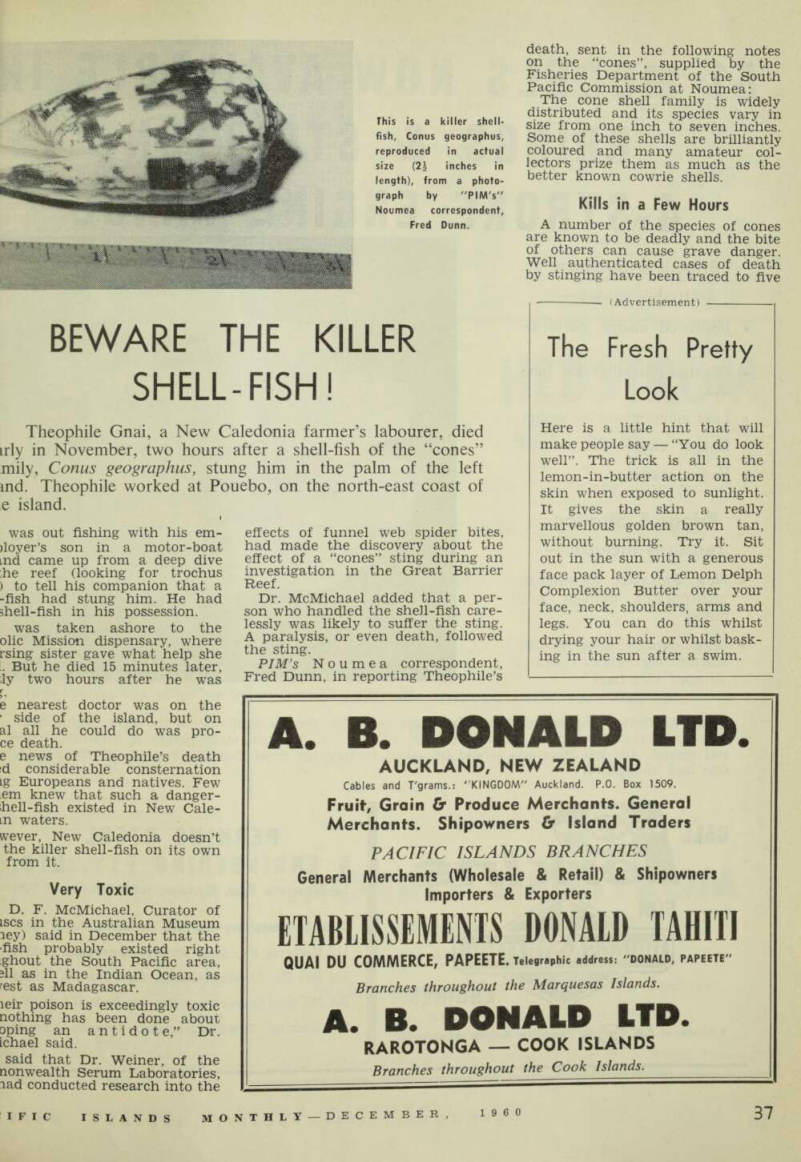
This is a killer shell fish, Conus geographus, reproduced in actual size (2½ inches in length), from a photo graph by "PIM's"
Noumea correspondent, Fred Dunn.
cent species of the conus. They Conus geographus; Conus tex- Conus tulipa; Conus marmoreus Conus aulicus. ises of death have been reported i the Loyalty Islands, Fiji, in and even Queensland. The h of a native in the Yate dis of New Caledonia about two s ago is thought to be due to a is sting. The poison is extremely lent and kills the strongest man few hours, lese conus, as in other snail-like spiral-shell creatures, have a ue, the “radula” which is pped with teeth used by the lal for mincing whatever food ss to it. In the venomous cones narginal teeth of the radula are >w fangs connected with poison in the animal’s head. These s serve to kill small fish and r sea creatures upon which the s feeds, the SPC report adds, flowing this report, the wonder t is that there are not more lents connected with these shell Thousands are gathered yearly eef hunters without accident, ry probably this is because the -fish is picked up and thrown a bag instead of being con tly held in the hands. These -fish make delicious eating but certain that many New Cale ans will look closely now at ; they pick up on the reef.