Crash’ Plan Gets
pp. 29-31 · Read in the full issue


A Slight Wobble
By a Staff Writer
e man in charge of Papua-New Guinea’s “crash” programme for training teachers re Territory — Mr. N. V. Salt—resigned on nber 1. This appeared to be the first creak e “crash” plan and the shock waves were I the way to Australia. (His resignation was quently withdrawn.)
)ER the crash scheme, Aus alia is recruiting young men Australia who are below the y acceptable educational level lachers, and giving them an training course in the Terri asting six months. They then native pupils of primary ird. first 60 chosen arrived at lalaguna Technical Training e, Rabaul, where they will get
their training, in early November.
Mr. Salt resigned with telegrams to the Minister for Territories and to the Assistant Administrator of P-NG. He is alleged to have accused the P-NG Department of Educa tion of “gross incompetence” and to have said that for a long time he had been dissatisfied with the education policy in P-NG.
But apparently the straw that finally broke Mr. Salt’s back and precipitated his resignation was when the P-NG Director of Educa tion, Mr. G. T. Roscoe, proposed to transfer one of Mr. Salt’s native teachers from Rabaul. This man apparently was a key figure in in structing the first crashees how to teach natives, and Mr. Roscoe, according to Mr. Salt, made the move without consulting Mr. Salt.
All this appeared in Australia under large headlines.
When a PIM reporter in late Oc tober was shown over Malaguna, where the crashees are being trained, Mr. Salt gave no indication of the feelings he is now alleged to have.
He was, in fact, one of the few people in the Territory who seemed to believe in the new programme for getting European teachers quickly, and was enthusiastically making preparations for their re ception, then a couple of days off, and their training programme.
Enthusiastic
Until a few weeks before, Mr. Salt had been at the education centre at Sogeri, near Port Moresby. Like everything else about the “scheme” he had got his orders suddenly and proceeded to Rabaul immediately.
Whatever else has caused the rift in the lute, it wasn’t lack of will ingness and enthusiasm on Mr.
Salt’s part.
The Malaguna Technical Train ing Centre in Rabaul is where the Fourth South Pacific Conference was held in 1959. The accommoda tion that was built for delegates on that occasion, and was subsequently used by the students, was again be ing rearranged to take the first trainees. (Over)
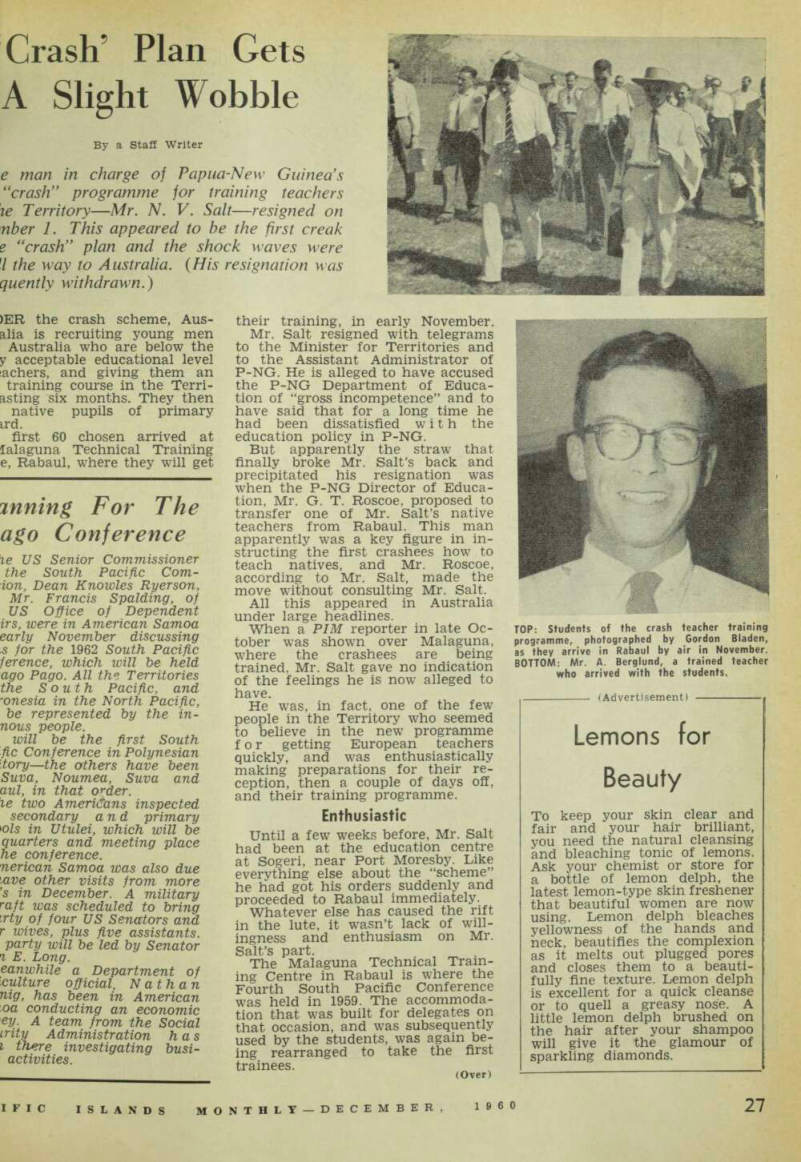
TOP: Students of the crash teacher training programme, photographed by Gordon Bladen, as they arrive in Rabaul by air in November.
BOTTOM: Mr. A. Berglund, a trained teacher who arrived with the students.
Like all “schemes” in the Ten tory, the crash training plan h been getting the full treatment! ridicule. With many Territorial even when a proposition is goc they don’t like it—and even t] most ardent Territories Departure or Administration well-wisher cou see a few flaws in this one.
The crash scheme was pulled o of the hat a few months ago whi suddenly there was talk of sel goverment for P-NG, and the di covery was made that the nativ “weren’t educated”—something th the PIM and other authorities ha been pointing out for 30 years.
Plenty of Recruits The basic idea is to give t] crashees an intensive course teaching method, etc., at MalaguE then—complete with pre-fabricat house—send them off to the remot areas of P-NG.
The minimum educational r quirement for the recruits was Intermediate Certificate, ai although it is exceedingly diffici to recruit anyone with acadeni or technical training for the Ten tory these days, for some reasol unknown, no less than 300 Au tralians were carried away with tl idea of going to darkest New Guim and teaching native children to res and write.
It can be assumed that only missionary zeal inspired them I apply and all that can be hoped i that it will sustain those chose through the shocks and set-bad that will almost certainly be the lot in the years ahead.
Out of the 300, 60 were chosen f| the first course. The average age i these is somewhere in the 30’sj which means that a proportion a: very much older. The average cai didate, therefore, is at least 16 yea: away from the Intermediate Cei tificate standard, which in itself I at the bottom of the academ! ladder.
This is the first criticism Terr torians have of the scheme. Wh; they ask, would anyone who wand a career in teaching wait all the! years for the “3all”? What ha\ they been doing In the years sind they left school? And they dedud from this that amongst those 3C there must be a high proportion d misfits and —as the picturesque Aus tralian term has it —no-hopers. j Is this then the sort of person wh is likely to adjust to life in th most primitive and isolated parts fl the Territory where there is like! to be no other European withi] miles? Territorians don’t think sc To make the task more difficul for them, they must teach ii English—not in the vernacular o in Pidgin. Most youngsters on out stations on the New Guinea sid speak Pidgin, but move a few mil 3 back from the station and thej know only their mother tongue, I won’t be impossible to teach then straight English right from th(
-off, but it isn’t going to be is usually assumed that if you 0 teach a foreign language it if you know something of the age of the fellow you are go d teach.
Some Resentment jre is also a certain amount of bment in the Public Service over these sudden recruits — from within the Education De ;me n t and elsewhere. The tor of Education dismisses the tment of other teachers as ’ or “jealousy”. That’s as e—but most of the other PS tment is based on the matter using. le single Administration officers itstations live in native-type ng for years waiting for a t house. Why then, they ask, 1 these newcomers be equipped a good house from the outset? iy aren’t impressed by the is reason—that if something done to cushion the shock of ild New Guinea bush for these ;eachers NG won’t have them ong.
Assistant District Officer said PIM reporter recently: “I’m g a couple of these blokes in ea but I’m going to insist that houses are built on the station. 0 one they’ll get fed up within months and leave. I can use houses for someone else if e on the station, but if they 'Uck away in the bush some they’ll be a dead loss.” There’s in what the ADO said, but 1 his new teachers are able to ute to their schools by heli ’ each day, that doesn’t seem a solution either, spite of Mr. Salt’s initial es and the dire forebodings my Territorians, the scheme r et produce enough permanent, ;eachers to have made it worth Nonetheless, it is permissible mder if it weren’t just the on of impulse and whether atives might not have filled ill better.
Some of the Missions are against schem e and Fr. J. Dwyer, MLC, pointed out at the October Legis lative Council meeting that if the same amount of money had been given to the Missions as increased subsidy for native teacher-training, permanent results might have been a lot better, Vu - r ® Say that lt>s a P ity the authorities hadn’t wakened up about six years ago and sent a couple of hundred of the brightest native youngsters to Australia for gaining,, and that if they had U f ldn ’ t have been forced into tbe £ e last-minute panic moves that, best > have only a 50-50 chance of achieving anything.
NO
Mangos
Those who bet that the road widening of Rabaul's famous Mango Avenue would not be com pleted by Christmas, looked like losing out in late Novem ber when this photograph was taken. The long job had almost ended and store owners, anyhow, were grateful.
Missing from the new Mango Avenue the beautiful mango trees.
Photo: M. R. Hayes