Commentary
pp. 25-26 · Read in the full issue
sbury Despatch and
Indian Lands
)ER questioning by Pressmen
. Suva on October 26, Colonies nder-Secretary Julian Amery omething like this:
; have two obligations—that
the Deed of Cession and that Lord Salisbury’s despatch. It to be clear, in keeping with obligations, that the rights of communities (Fijian and
i) must be respected.”
t was an obscure allusion to
hing equally obscure—namely,
espective land rights of the s and the Indians. m the Fiji-Indians, in No
;r, began to quote this freely,
at ion to current events in Fiji, ught more information from urns Report. These two para
s have a bearing:
Some Indian witnesses have stated, hers have implied, that Indians in ; discriminated against and unfairly In all cases reference is made ispatch dated March 24, 1875, from rquess of Salisbury, then Secretary te for India, to the Government a, dealing with the terms on which indenture labourers should be ed in British colonies.
Salisbury considered that "the I laws and their administration’’ ensure that the Indians "will be respects free men, with privileges It inferior to those of any other f Her Majesty’s subjects resident colonies’’. is been suggested that the recog by Her Majesty’s Government of ownership of land (other than 1 land) is in conflict with Lord ry’s suggestion, and that this tion goes beyond the terms of the f Cession, by which it is agreed re Government is bound, argued that in view of the changed itances, the Government could and repudiate the later promises made Fijian people about their land, it the land should be fairly divided all the inhabitants of the Colony. iVe do not agree with this argu- The promises and assurances given Fijians about their land cannot our be repudiated and the Fijian in effect “freehold”, in regard to the Fijian people are entitled to h protection as any owner of land freehold title. quoted words of Salisbury o particular reference to Fiji, asked a Fiji correspondent to ain the character and signific of any documents which the nment may have on file in n reference to the Salisbury tch. He replied: tave spent a couple of very in ing hours in the archives,
ng the Salisbury Despatch
elated documents.
“It is quite astonishing. A myth is being created before our eyes— the myth that the Salisbury De spatch is a sort of Magna Charta of Indian rights and claims in Fiji, comparable to the Deed of Cession.
“Salisbury sent this despatch to the Government of India on March 24, 1875. He was concerned about abuses that had crept into the in denture system, and he suggested that the Government of India should accept more responsibility for emigrants from India to various countries, and went on to suggest ways in which this might be done.
“Towards the end, almost as an aside, he said that if the immigrants fulfilled all their indenture period, he had no doubt that they would be given full citizenship rights, and colonial legislation should be directed to this end.
“The Government of India waited three years before replying; and then, at the end of a long despatch, it said: Tt will be seen from the foregoing remarks that we do not think it possible to carry into effect in any material degree the sug gestions which have been made in
your Lordship’s despatch for the further encouragement of immigra tion . . . In other words, they turned the thing down.
“The Salisbury Despatch is being quoted here in Fiji in speeches and in newspapers—especially by the Patel section —as if it were a magic word: but it is quite clear that very few of those who are using it, or of those to whom it is becoming a talisman, have ever read the full document.
“There are one or two passages in other documents —correspondence between the Governments of India and Fiji, in the early indenture days, for instance, and in the report of the 1910 committee on emigration to the Colonies —that might give sounder claims against any discrim ination; but these are not being quoted. ‘Salisbury’ is the magic word.
“I am astonished that Amery should have quoted it, while he was here, as the parallel of the Deed of Cession, by which the British Government is bound.
“In any case, Indians here suffer no political or economic disability; and Burns dealt effectively with the attempt to use Salisbury to chal lenge the system of Fijian land ownership.”
The important point is that the Salisbury Despatch of 1875 was dealing with Indian emigration generally, and not with Indian immigration in Fiji.
The system of taking indentured Indian labour to Fiji was not in troduced until 1877, and there were only 2.300 Indian labourers in Fiji in 1883 —mostly on a 10-years con tract, which provided for repatria tion.
The Future Shape
Of Fiji's Government
IN an article on page 15, the publisher of this journal, Mr.
R. W. Robson, who has been visiting Fiji and writing about Fiji for 30 years, is outspoken on the subject of the Fiji Government’s handling of the Burns Report, and of the politico-economic situation generally in the Colony.
Criticism of present conditions in Fiji should not be interpreted as lack of confidence in the long-term future of Fiji. , , Provided that the four chief com munities in Fiji—namely, (a) Fijians, (b) Europeans and part- Europeans, (c) Indians and (d) Chinese —can get ttpgether in an approach to their joint problems, there is no reason at all why the British Colony should not become a happy and secure home for a small, united nation, and why it should not provide overseas investors with a safe field of enterprise.
The difficulty lies in the present form of government.
The troubles created by the rapid increase of population, and the fumbling official approach to the
problem of feeding and comfortably housing many more people, can be solved now only by authoritative persons on the spot, who have strength, knowledge based on long experience of Fiji, clarity of vision, and ruthlessness.
Instead, we have British Colonial Office rule, exercised through a corps of high officials, of whom some command confidence, and some definitely do not. The events of the past twelve months show that the system will not solve Fiji’s chief problems.
Hitherto, the majority of wise men have perceptibly dodged away from the constitutional issue, and from the suggestion that Fiji should have self-government. They have very good reasons, based on past history and present sociological conditions.
The time has come to weigh one set of difficulties against the other.
If the British Colonial Office oligarchy cannot make the very early readjustments in Fiji’s admin istration, land use and develop mental machinery which now are vital to Fiji’s future—and the events of the last two decades indicate the inability of the Colonial Office to do this—then the citizens of Fiji should demand a large measure of self-government, either in close association with the British Colonial Office (if that is practicable) or alone.
The C.O. will reply—if that haughty institution ever deigns to notice criticism—that already Fiji has much self-governing authority in its Legislative Council.
In theory, that may be so. In actual fact, the administration is completely dominated by the Colonial Office. The history of the past year would have been very dif ferent if persons with real know ledge and understanding of Fiji, and the ability to implement their decisions, had been in charge.
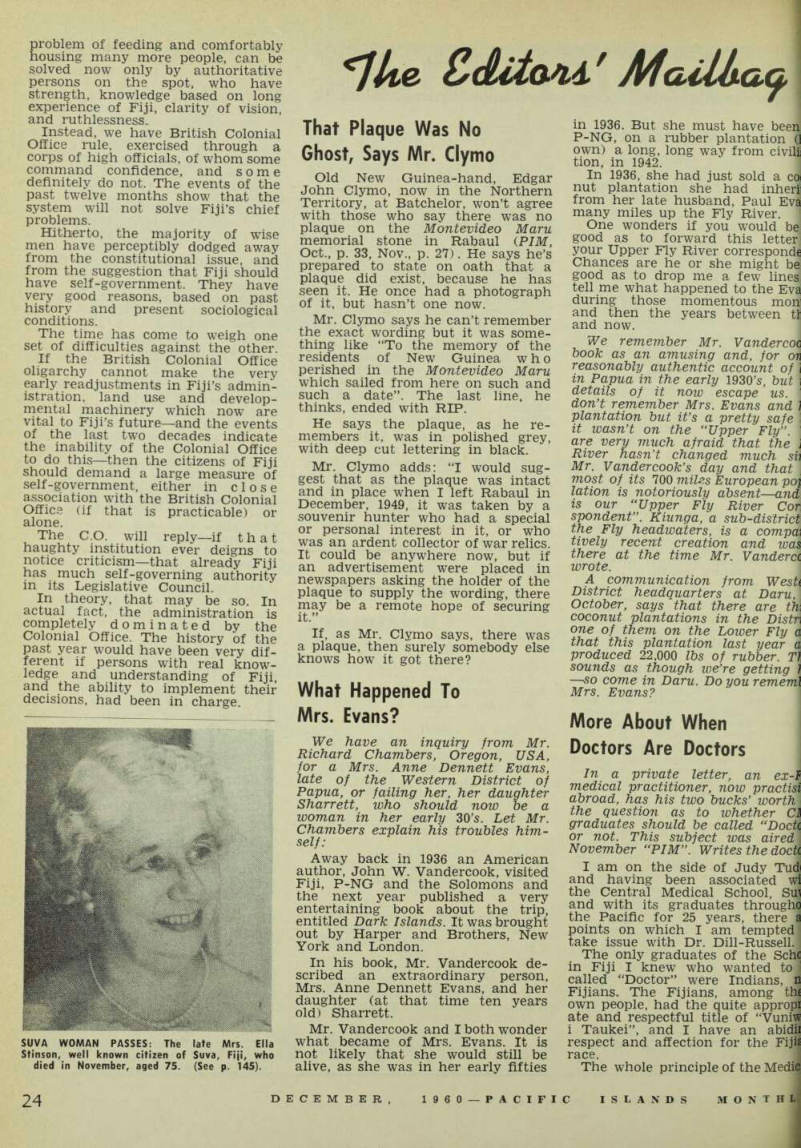
SUVA WOMAN PASSES: The late Mrs. Ella Stinson, well known citizen of Suva, Fiji, who died in November, aged 75. (See p. 145).