Are Their Big Worry!
pp. 21-148 · Read in the full issue
Immature Native Politicians Are Their Big Worry!
A conference of native members of Papua-New Guinea Local jrnment Councils, held at Rabaul in late November, brought
unexpected reactions.
C conference, arranged by the Territory Administration, was tie second of its kind, in which e councillors were brought to r to discuss their problems, first was held at Madang last vever, it wasn’t the worthy n for the conference which :ht the reactions —but the Ad tration’s decision to close the ng to the Press, and to issue official handouts. • did a statement by a senior nistration officer in Port >by, commenting on the ban, matters when he explained the ban had been decided se it was thought possible immature, emotional native nans could make unthinking nents. me native leaders, when given :hance to speak their minds, make statements which they do not mean,” said the officer, e ban on the conference brought reactions from the Territory questions in the Federal Par nt and even articles and ials in Australian newspapers.
I
Gus Smales' Report
m Raba u 1, PlM’s corre ent, Gus Smales, sent this re i responsible body decides to to the Press a meeting of public interest, I’m not one lose people who necessarily 3 on to a horse of outraged y. i talks might be unprivileged therefore legally dangerous. ,ps by their very nature they elicate. Perhaps the Press has d the matter beforehand and refore no longer welcome, letimes I disagree with the i, but I can always see it as as it is there. pite this, I believe that the nistration made a grave mis in closing to the Press this ic combined native Local Gov mt council conference at iadir. i reason was obscure, the re i was unfortunate, and the ge was considerable, sre is no point in recapitulat bime-honoured arguments of my conference should be open )sed to Press and public. the facts which led to a
tangle of false assumptions, in correct reports and damaging re actions are well worth considera tion.
"Unsettling"
The most unsettling incident was the question-and-answer spot in the Federal Parliament between Mr.
Clyde Cameron and the Minister for Territories, Mr. Hasluck.
Mr. Cameron suggested the Gov ernment had closed the conference because of a fear that the native councillors were going to “stand up and say what they really thought about the Government”.
This was unkind and unjustified.
From his own experience of putting curly questions to natives, Mr.
Cameron should realise that the native in conference always has a smooth answer, and is unlikely to be vocal in criticising the Govern ment under such conditions.
In answering Mr. Cameron, Mr.
Hasluck revealed an equal ignor ance in the matter. He said he was not aware the conference was
closed, and suggested the natives m i g ht have wanted it that way. ith inde ii ca te tact and incorrect pidgin English> Mr. Hasluck then quoted an un-named native who Ruggedly likened the brain of a newspaperman to that of a dog. z b £ i( T ve that the Local Govern ment house in Papua-New Guinea is a very clean one x have the highest praise for the system itself,
(Continued on p. 145)
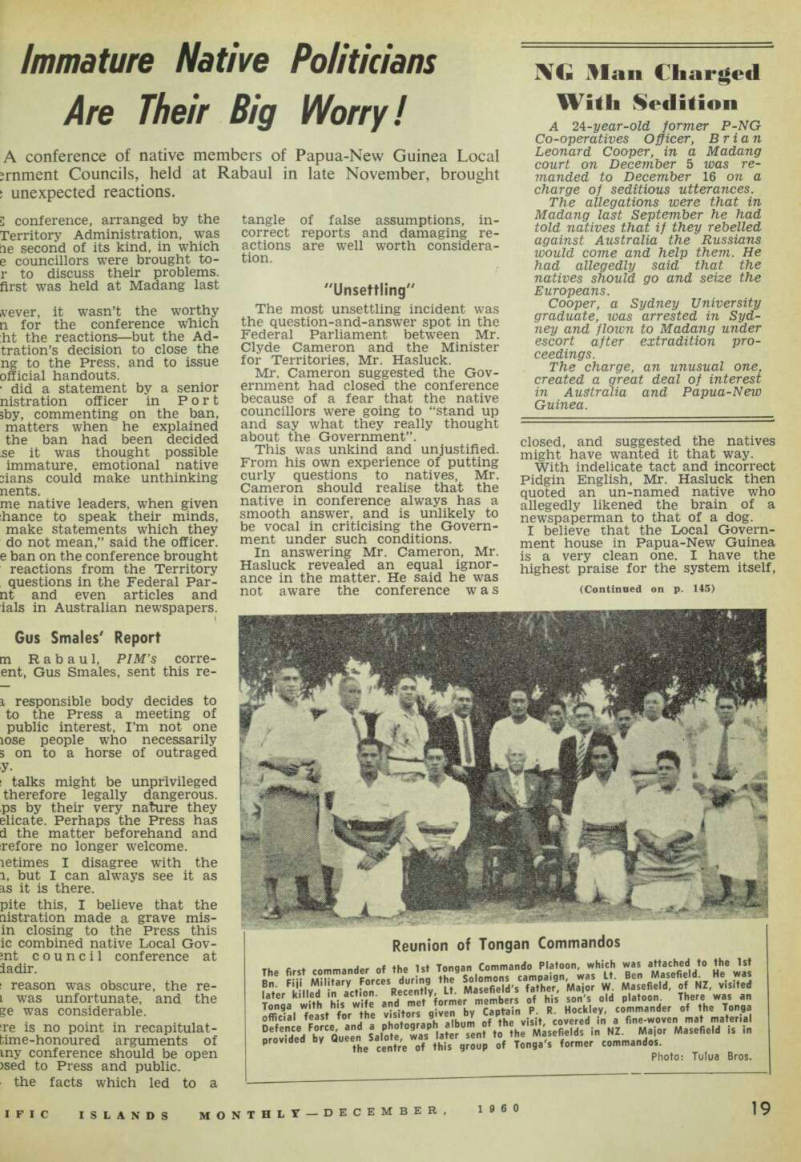
Reunion of Tongan Commandos The first commander of the lst Tongan Commando Platoon, which was attached to the lst Bn. Fiji Military Forces during the Solomons campaign, was Lt. Ben Masefield. He was Ilater killed in action. Recently, Lt. Masefield's father, Masefield, of NZ, visited Tonga with his wife and met former former memvers of his son's old platoon. He was official feast for the visitors given by Captain P. R. Hockley, commander of the Tonga Defence Force, and a photograph album of the visit, covered in a fine-woven mat material provided by Queen Salote, was later sent to the Masefields in NZ. Major Masefield is in the centre of this group of Tonga's former commandos.
Photo: Tulua Bros
for the government officers who are developing it and for the native councillors who are making it.
For that reason alone, I cannot understand the attitude of an Ad ministration which provides a set of circumstances which gives Mr.
Cameron the opportunities to make an impolitic attack, and Mr.
Hasluck the opportunities to make an equally impolitic answer.
I know well the courtesy with which native councillors (in New Britain, anyway) have welcomed journalists to their meetings. I know just as well that it was the Admin istration which closed the Vuna dadir conference, and announced this fact from Port Moresby a week earlier.
Three hours before the confer ence started I made two final at tempts to see if the Press could gain admittance at least to the official opening session. (Over)
But the ban continued. Thus the reports of the conference in the newspapers were late and sketchy. (The usually-careful Australian Broadcasting Commission news service, tired of waiting for something to happen, announced “The Administrator has opened the talks . . .
And he did, too—four hours after the radio broadcast!) The public reaction was bad. It all could have been avoided. Austraha has nothing to hide in the way that Papua-New Guinea people are being educated in Local Governm * jx, , . „ And through it all like a backbone will run a story of great achievement and political moment.
Problems of language and the need for a more extensive training of Local Government councillors were two of the most important points which finally emerged from the conference, The total number of delegates attending was 72, and their dis cussions lasted for two weeks—in eluding the time spent on tours of the Gazelle Peninsula, Two Administration headquarters officers who attended the confer ence- were the Director of Native Affairs, Mr. J. K. McCarthy—who had just assumed office after being acting director—and the Executive Officer for Local Government, Mr.
H. Plant
Although the talks were clos to the Press, invitations were se out to chosen members of the pub to attend some of the sessions.!
From the outset, the languai problem emerged as one which t natives of P-NG will need to ov( come before they can become truly unified nation. The offic languages adopted for the tal were Motu and Pidgin English, t a fairly large proportion of Er lish was also used.
Some delegates were fluent J neither of the official languag and this created special difficult!
Mr. Plant said later that t language problem tended to d appear as the talks progressed, j
"Surprised"
It was quite obvious, too, tt the councillors were surprised 3 how similar were their muti problems in Local Government a ministration.
On the need for more extensi training of native councillors, t conference came up with two val able recommendations.
One was a straight-out recoi mendation to the P-NG Admin tration that greater attention shoi be given to the direct training councillors. Speakers said that eve council needed stepped-up instn: tion in the mechanics of coun operation, the duties of councillo the responsibilities of councillo and in social and economic facto Administration officers we pleased with the tenor of the su gestion on the grounds that proved the average native council! is becoming increasingly aware the role he can play, and is anxio to learn the game properly.
At the same time it was point out that a considerable amount field instruction is already given councillors in each area, and th special schools for limited numbe have been held at Vunadadir.
The second recommendation ( training which came out of t conference was a suggestion th groups of councillors should vii Australia regularly in an endeavo to absorb the Australian scene ai apply it where possible to P-N communities.
A motion from the conference r commended that each council shou consider setting aside five per cei of its revenue for a travel stu( fund to finance the Australian toil] The number of councils which w adopt this suggestion has yet to revealed, but if all councils to( part, more than £6,000 a year woq be available for the travel fund. 1 The combined conferences w now be held each year, and the 19i meeting has been set down for Po Moresby, probably next November.* By that time the total number j councils in the Territory is expect] to be nearly 50, against 40 at pr< sent (representatives of 39 of th& attended this conference).